
PMS Providers in Delhi NCR: The Full List and What to Check
PMS providers serving Delhi NCR, listed unranked, plus the six checks and the five-minute test that separate a real SEBI-registered PMS from a pitch.

Ckredence Wealth |September 7, 2026

PMS providers serving Delhi NCR fall into four structural types: bank and AMC-affiliated wealth arms, independent boutique houses, digital-first platforms, and regional full-service firms that serve the region remotely.
The type matters more than the name on the website. None of them are restricted by geography.
So the useful list is not "who has a Delhi office." It is "who actually holds a SEBI Portfolio Manager registration, and what does that registration oblige them to do."
That distinction gets lost fast here, because "PMS provider" is not itself a licence.
The licence is a SEBI Portfolio Manager registration. It carries a statutory minimum investment of ₹50 lakh, a mandatory Disclosure Document, and a public complaint record on SEBI's SCORES portal.
A provider can advertise heavily in Delhi and still be unregistered, unregulated, or something else entirely dressed up as a PMS.
This page lists the firms, without ranking them, and gives you the checks that separate a real PMS provider from a well-marketed one.
| TL; DR"PMS provider" describes a service, not a licence. The licence is a SEBI Portfolio Manager registration, and it is checkable in about two minutesPMS carries a statutory minimum investment of ₹50 lakh, set by SEBI, not negotiable by any individual firmIndia had 515 registered portfolio managers as of 31 May 2026, more than double the 226 registered in 2020, so a longer list is not automatically a better oneRanking tables built on recent returns are the weakest available filter, because the strategy on top changes almost every quarterA provider's location changes almost nothing about custody, regulatory protection or reporting, all of which are centralised and apply nationallySEBI published a consultation paper in July 2026 that may change the entry threshold, so confirm current rules before committing capitalEvery registration claim below, and on any firm's own website, is verifiable on the SEBI register in about two minutes |
Ask for a structured review of your existing portfolio
What Should You Check Before Shortlisting Any PMS Provider in Delhi NCR?
Run these six checks before you look at the list below, and run them in this order.
The sequence matters. The early checks are cheap and disqualifying. Running them out of order wastes the time you should be spending on the ones that need real effort.
| # | Check | What you are looking for | Where it lives |
| 1 | SEBI Portfolio Manager registration number | The number, given without hesitation, then verified by you | SEBI register |
| 2 | The Disclosure Document | Fee schedule, conflicts of interest, litigation history, performance methodology | Provided by every registered portfolio manager |
| 3 | SCORES complaint record | A pattern of unresolved complaints outweighs any performance claim | SEBI's public grievance portal |
| 4 | Full fee structure | Fixed fee, profit share, hurdle rate and exit load schedule, all four | Disclosure Document |
| 5 | Who actually manages the portfolio | Whether that is the same person you are speaking to | Ask directly |
| 6 | A redacted sample client report | Real reporting, before you commit | Ask before signing |
An intermediary that hesitates on check one has already answered your question.
Thin reporting at the sample stage does not improve later.
| 💡 For investors comparing more than three firmsScore every firm on the same six checks in one spreadsheet before you take a single meeting. Meetings are built to persuade, and a criteria sheet made in advance is the only reliable defence against a good pitch. |
Our detailed walkthrough of choosing a portfolio management service expands each of these six checks into the specific questions to ask.
Our guide on how HNIs should evaluate PMS providers covers the fuller evaluation framework this list feeds into.
Which SEBI-Registered PMS Providers Serve Delhi NCR Investors?
The firms below serve Delhi NCR investors, either through a local presence or remotely, since a PMS registration is not geography-restricted.
They are listed alphabetically and are not ranked. No evaluation, scoring or recommendation is offered or implied.
Positioning is as each firm describes its PMS offering publicly as of September 2026. Registration status, minimums and fee structures change. Treat every row as a starting point for your own verification, not a settled fact.
| Firm | Structural type | How it positions its PMS offering publicly | What to verify yourself |
| Aequitas Investment Consultancy | Independent boutique | Concentrated equity PMS strategies for HNIs | PMS registration number, minimum, current fee structure |
| ASK Investment Managers | Independent, PMS-led | Quality-investing PMS across multiple strategies | PMS registration, minimum, whether advisory or discretionary |
| Ckredence Wealth Management | Regional full-service, Surat headquartered | Discretionary PMS across four approaches, plus RIA under the same roof | PMS INP000007164, RIA INA000020846, minimum, fee model |
| Marcellus Investment Managers | Independent boutique | Long-hold, quality-focused concentrated PMS | PMS registration, minimum, strategy-specific fee structure |
| Motilal Oswal PMS | AMC-affiliated | Multiple PMS strategies under an established AMC | PMS registration, minimum, product-shelf breadth |
| Unifi Capital | Independent boutique | Multi-strategy PMS with a long operating history | PMS registration, minimum, current strategy lineup |
| White Oak Capital Management | Independent, AMC and PMS | PMS alongside a mutual fund business | PMS registration, minimum, whether the AMC and PMS teams overlap |
Where Ckredence Sits on This List
Ckredence appears here on the same terms as every other entry, with the same verification column and no ranking.
It is headquartered in Surat and does not maintain an office in Delhi NCR. This page is not going to suggest otherwise.
What it does hold, less commonly than the list above makes it look, is both a Portfolio Manager and an Investment Adviser registration under one roof. That matters for the fee-comparison section below.
Where Ckredence has a genuine, checkable local advantage is not Delhi at all. Our page on PMS in Surat sets out what three decades of a single-city relationship actually looks like, which is a different claim from anything on this list.
Why This List Is Deliberately Short
Aggregator and comparison platforms publish far longer lists.
A longer list is not automatically a more useful one, because it usually mixes registered portfolio managers with distributors, digital platforms and firms that only curate access to other people's PMS strategies.
If you want the complete population, the SEBI register of portfolio managers is the only authoritative source. It will not sort by marketing spend.
How Was This List Compiled?
Stating the method matters more than the list itself, because it lets you rebuild the list yourself with different criteria.
| Element | Method used |
| Inclusion | Firms that hold, or publicly and consistently describe holding, a SEBI Portfolio Manager registration, and that appear in the first two pages of Google results for PMS-provider queries scoped to Delhi, Delhi NCR and India in September 2026 |
| Exclusion | Comparison and aggregator platforms that curate access to PMS strategies without being portfolio managers themselves, even where they rank prominently, because including them would blur the one distinction this page exists to make |
| Ordering | Alphabetical. No ranking, scoring or weighting was applied to any firm |
| Attributes | Taken from each firm's own public description of its PMS offering |
| Deliberately excluded | Assets under management, client counts and specific minimums, because self-reported figures are inconsistently defined across firms and go stale within months |
| Status | Not a recommendation. Appearance is not an endorsement, and absence is not a criticism |
If your own criteria differ from the ones above, and they reasonably might, our note on assessing financial advisory services in India sets out alternative filters worth applying before you shortlist.
What Type of PMS Provider Are You Actually Comparing?
Rather than compare firms directly, work out which structural type each one belongs to.
The type predicts how you will actually be served far more reliably than the brand name does.
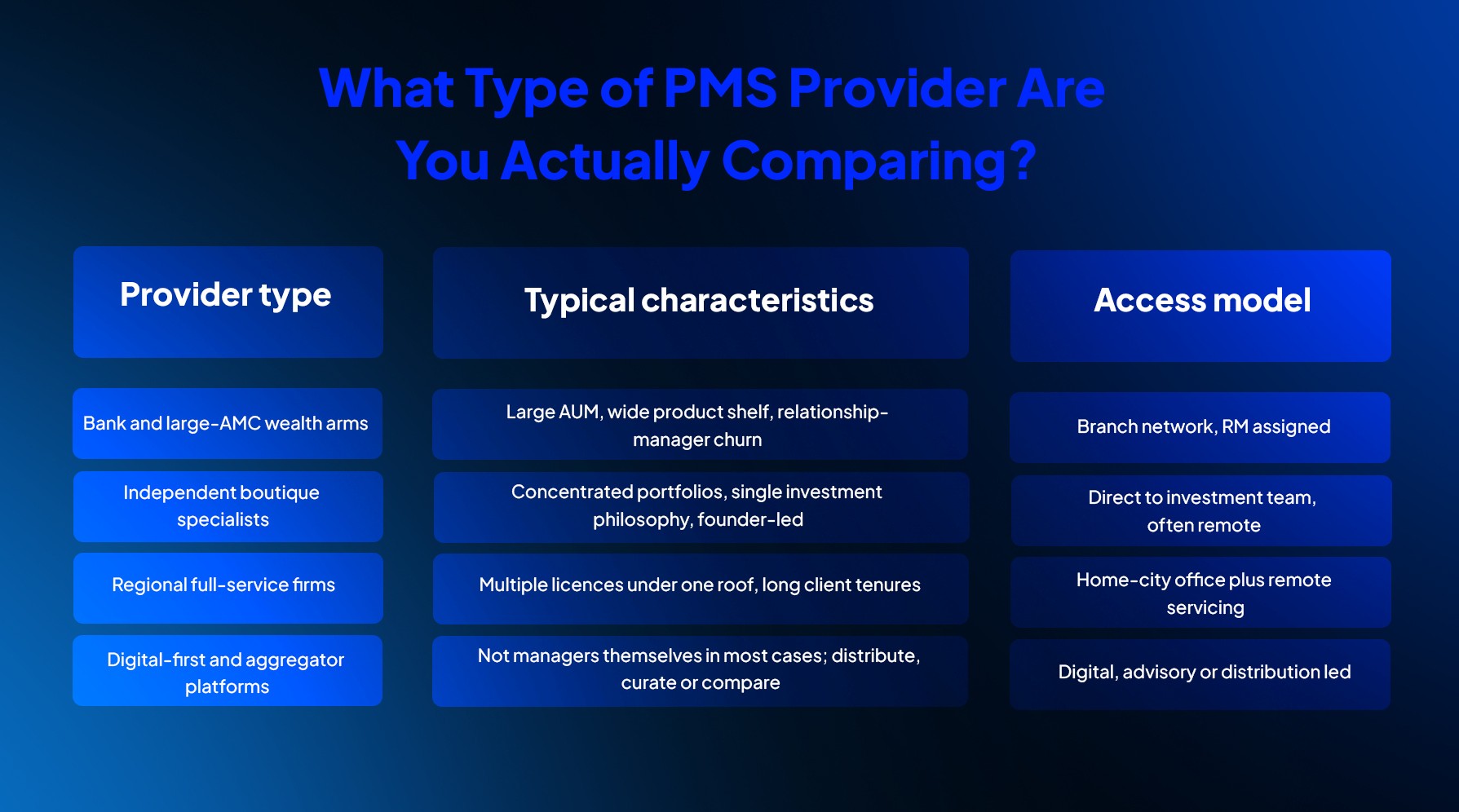
Where a firm sits in this table also shapes the range of products it can offer alongside PMS. Our overview of investment planning services for HNIs in India covers how PMS typically fits alongside advisory and tax planning at each provider type.
The ₹43 Lakh Crore Number You Should Correct Before Any Meeting
One number is worth correcting before you read any firm's marketing.
The PMS industry is routinely described as a ₹43 lakh crore market, and total AUM did reach ₹43.3 lakh crore in June 2026.
But according to Business Today's analysis of APMI data (as of 30 June 2026), ₹31.04 lakh crore of that, close to 85%, belongs to the EPFO and other provident funds rather than to individual investors.
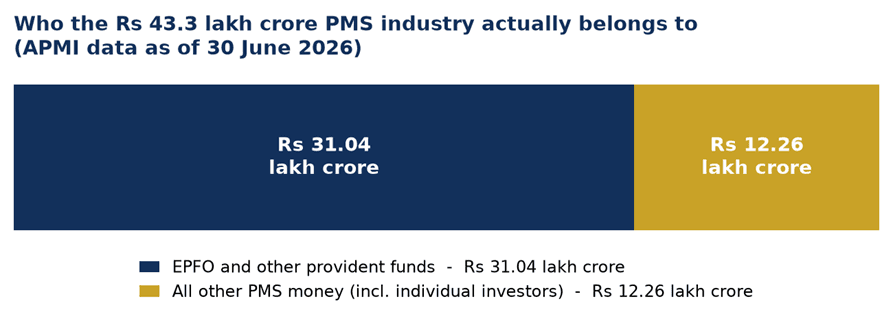
A firm's share of "the ₹43 lakh crore industry" therefore tells you almost nothing about its experience with private clients.
Ask instead how many individual discretionary clients a firm actually manages.
Can You Test a PMS Provider in Five Minutes?
Here is a diagnostic you can run on any name from the list above, or on any provider not listed here, in a single phone call.
Six questions. Four have answers you can independently verify afterwards, which is the point.
The two you cannot verify are the ones worth listening to most carefully.
| # | Ask this | What a good answer looks like | Verifiable? |
| 1 | What is your SEBI portfolio manager registration number? | Given immediately, without checking | Yes, on the SEBI register |
| 2 | How many complaints have you had on SCORES, and what happened to them? | A specific number, including zero, with context | Yes, on SCORES |
| 3 | What is your fixed fee, your profit share, your hurdle rate and your exit load? | All four figures, unprompted | Yes, in the Disclosure Document |
| 4 | Who manages the portfolio, and what did they do before this? | A named person with a traceable record | Yes, publicly |
| 5 | Will I get a consolidated statement my CA can file directly from? | A clear yes, with a sample offered | On receipt of the sample |
| 6 | What kind of investor should not choose you? | A real answer, not a deflection | No, but the hesitation tells you a lot |
Question six is the one that separates providers.
A firm that cannot describe who it is wrong for either has not thought about it or would rather not say. Both are informative.
If a provider fails question one or two, the remaining four do not matter.
See how Ckredence's four PMS approaches differ from one another
What Will a PMS Provider in Delhi NCR Actually Charge You on a ₹1 Crore Portfolio?
PMS fees generally combine three things: a fixed annual fee on assets under management, a performance-linked profit share above a hurdle rate, and an exit load that tapers over the first few years.
Comparing providers on the fixed fee alone is the most common costing error. The profit share often has the larger effect, and most investors never work the second number through to an actual rupee figure.
Ckredence's Published Structure
| Fee component | Ckredence's published terms |
| Fixed annual fee | 2.25% of assets under management |
| Profit share | 25% of gains above the hurdle |
| Hurdle rate | 7% |
| Exit load, year 1 | 2% |
| Exit load, year 2 | 1% |
| Exit load, year 3 onward | Nil |
The Same Structure Worked Through on ₹1 Crore
| Line | Working | Amount |
| Fixed fee | 2.25% of ₹1 crore, payable regardless of what the portfolio does | ₹2.25 lakh |
| Gross gain, hypothetical | 12% | ₹12 lakh |
| Excess over the 7% hurdle | 12% minus 7% | ₹5 lakh |
| Profit share | 25% of the ₹5 lakh excess | ₹1.25 lakh |
| Total fees for the year | Fixed plus profit share | ₹3.5 lakh, or 3.5% of the portfolio |
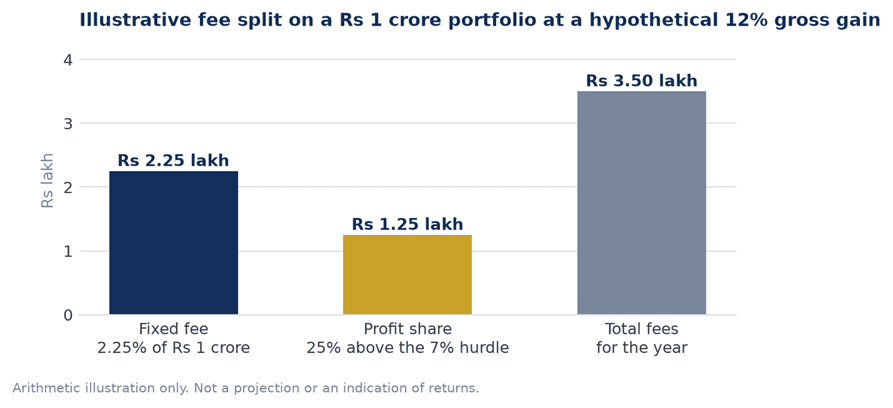
The 12% figure above is arithmetic to illustrate how the hurdle mechanism works. It is not a projection, an expectation, or an indication of what any portfolio will earn.
Past performance is not indicative of future results and there is no assurance of returns.
| ⚠️ Risk to understandAsk every firm on your shortlist to run this same arithmetic on your actual intended corpus, at the same hypothetical gain level, and to include the exit load if you left in year one. A structure that looks cheaper on the headline fixed fee alone frequently is not once the profit share is included. |
Our full breakdown of PMS charges and fee structures covers GST treatment and the less obvious cost lines.
₹50 Lakh Isn't Just a Number. Is SEBI About to Change the PMS Entry Threshold?
₹50 lakh is a statutory floor set by SEBI. It applies to every registered portfolio manager in India, and it is not something any individual firm on the list above can waive or discount.
Any offer to manage a discretionary PMS below that threshold should be treated as a serious warning sign, regardless of which firm makes it.
What SEBI Has Proposed
This threshold may not be permanent.
SEBI published a consultation paper on 23 July 2026 proposing a broad overhaul of the Portfolio Managers Regulations.
| Proposal | What it would change |
| An "MF-PMS" category | A reduced entry threshold below the current ₹50 lakh floor |
| Wider investment universe | Access to foreign and to-be-listed securities |
| Revised compliance timelines | Changed reporting and compliance obligations |
| Status as of writing | Comment window closed 13 August 2026; final position not settled |
The Population of Licensed Firms Has Doubled
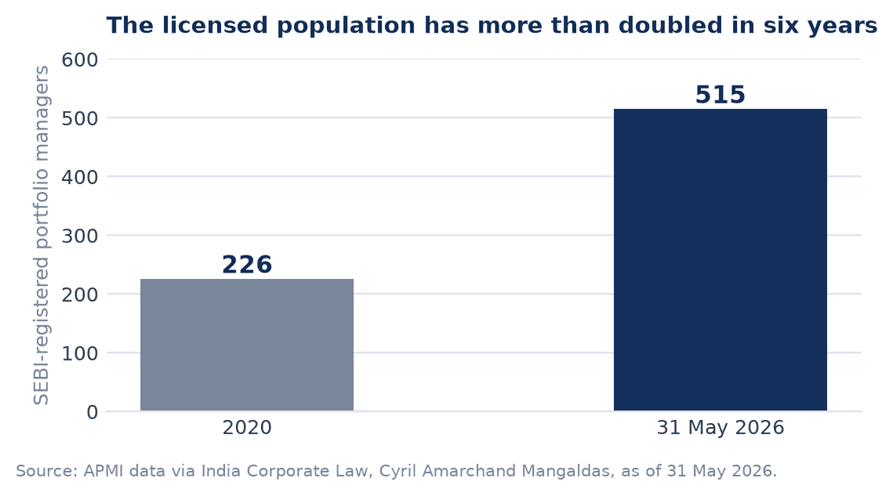
| 📊 515 registered portfolio managers in IndiaUp from 226 in 2020, alongside industry AUM of ₹42.61 lakh crore and 2.19 lakh total clients. The population of licensed firms has more than doubled in six years, which is exactly why the list above stays short and criteria-first rather than trying to be exhaustive.*Source: India Corporate Law, Cyril Amarchand Mangaldas, as of 31 May 2026* |
If you are weighing the ₹50 lakh commitment against advisory alternatives, our note on the PMS minimum investment threshold sets out who the threshold suits and who it does not.
Why Is "Which PMS Has Given the Highest Return?" the Wrong Question?
This is the most-asked question in this category right now, and it deserves a straight answer rather than a dodge.
Highest-return tables are real. They are also close to useless as a selection tool, for a structural reason.
The strategy at the top of a one-year table is usually the one whose style was most in favour that year. That is frequently the same strategy sitting at the bottom when the cycle turns.
Selecting a provider on it means systematically buying whatever just performed, and paying full fees to do it.
The Answerable Version of the Question
Which firm's strategy, concentration and holding period actually match your own risk tolerance and time horizon?
A concentrated portfolio of 25 stocks and a diversified portfolio of 50 are different products with different drawdown profiles. Neither is objectively better.
The Measurement Trap Underneath It
Returns quoted to you may be time-weighted or money-weighted, and the two answer different questions about the same portfolio.
Our explainer on TWRR versus XIRR covers why the same numbers can be presented two ways, both technically accurate.
Past performance is not indicative of future results. For a fuller framework on reading performance data critically rather than as a ranking, see our discussion of how to assess PMS returns.
Which Investors Should Not Choose a PMS in Delhi NCR?
A PMS is the wrong instrument for a meaningful number of the people who search for one here.
Saying so plainly is more useful than another paragraph of benefits.
| If this describes you | Why PMS is the wrong fit | Better direction |
| You are below the ₹50 lakh threshold | The question is closed by regulation, regardless of which firm you approach | Advisory or mutual funds |
| You would need the capital within two to three years | Exit loads, plus the holding period a concentrated equity strategy requires | Shorter-horizon instruments |
| You check portfolio values weekly | Concentrated portfolios deviate from the index in both directions, and the experience is uncomfortable if you are watching daily | Diversified, lower-tracking-error options |
| You mainly want tax-efficient diversification | Mutual funds often deliver this at materially lower cost | Mutual funds |
| You want to retain stock-level decisions | That points to a non-discretionary structure or advisory | Discretionary versus non-discretionary PMS |
| You cannot get a straight answer to question six of the five-minute test | If a firm will not say who it is wrong for, assume it thinks it is right for everyone | A different firm |
For several of these, a SEBI-registered investment adviser at a lower entry threshold is the better fit. It is a legitimate destination rather than a consolation.
Conclusion
The list of PMS providers serving Delhi NCR is short, public and easy to assemble. It is also the least useful part of the decision.
Every firm on it holds a version of the same licence and can present a similar pitch.
What actually separates them, and what will matter to you over the life of the mandate, is whether the registration checks out, who is paid for what, who actually manages your money, and whether the reporting is real from the first sample onward.
Those checks take less time than a single meeting and are verifiable on public registers before you take one.
Do that work first, and the list above becomes far easier to act on.
FAQs
Which company is best for PMS?
There is no single best PMS provider, because the right choice depends on your risk tolerance, time horizon and the concentration level you can hold through a full market cycle. A strategy that suits a 45-year-old business owner with a fifteen-year horizon may be unsuitable for someone retiring in three years. Screen on SEBI registration, complaint record, fee transparency and reporting quality first, then match the strategy's style to your own situation.
What are the top 5 PMS services in India?
No credible, non-promotional ranking of the top 5 exists, because PMS firms differ on strategy, concentration and client focus rather than on one comparable scale. Media and platform-published "top 5" lists typically sort by assets under management, which measures size rather than suitability for you specifically. A more useful approach is to shortlist firms that hold verifiable SEBI Portfolio Manager registration and then compare them on fee structure, complaint record and strategy fit.
How much fees do PMS charge?
PMS fees typically combine a fixed annual fee on assets under management with a performance-linked profit share above a hurdle rate, plus an exit load that reduces over the first two to three years. Fixed fees commonly fall in the 1% to 2.5% range and profit shares around 10% to 25% above a stated hurdle. Always compare the full structure rather than the headline fixed fee, because the profit share often has the larger effect on total cost.
Is PMS investment better than mutual funds?
Neither is better in the abstract, as they are different instruments. PMS offers direct ownership of securities in your own demat account, portfolio customisation and greater concentration, at a ₹50 lakh minimum and higher cost. Mutual funds offer lower minimums, lower costs, greater diversification and simpler taxation. PMS suits investors who want customisation and can hold a concentrated portfolio through volatility.