11min Read

11min Read

Best PMS in India: How HNIs Should Evaluate PMS Providers

Best PMS in India: How HNIs Should Evaluate PMS Providers

Best PMS in India: How HNIs Should Evaluate PMS Providers

Most HNIs choose PMS by recent returns and regret it later. Compare the best PMS in India by risk, fees, drawdown, and fund manager process before deciding.

Most HNIs choose PMS by recent returns and regret it later. Compare the best PMS in India by risk, fees, drawdown, and fund manager process before deciding.

Most HNIs choose PMS by recent returns and regret it later. Compare the best PMS in India by risk, fees, drawdown, and fund manager process before deciding.

Ckredence Wealth

Ckredence Wealth

|

Checklist for evaluating the best PMS in India, including investment objectives, risk assessment, portfolio management strategy, fund manager process, and fee structure review.

India's PMS sector now serves over 2.1 lakh investor accounts as of June 2026, per APMI data, reflecting strong and sustained HNI demand for professionally managed custom portfolios. Yet the comparison process has become more layered. Investors now evaluate fund manager quality, drawdown history, fee structure, and long-term suitability before selecting a provider.

SEBI requires a minimum investment of INR 50 lakh in securities from any PMS client, keeping this service firmly within the HNI segment. That threshold also raises the cost of a poor selection decision. This guide helps HNIs, business owners, CXOs, and family offices compare PMS providers with structure, without being misled by short-term performance rankings.

TL;DR

  • PMS selection should begin with investor goals and risk profile, not return rankings.

  • A strong PMS review examines manager process, drawdown history, and portfolio concentration.

  • Small and mid-cap PMS strategies require patience during significant market corrections.

  • PMS fees and tax on portfolio churn can significantly reduce the investor's actual return.

  • Direct security ownership in PMS gives holding-level visibility that pooled funds cannot.

  • Ckredence Wealth evaluates PMS options through goals, risk profile, and long-term suitability.

What Makes a Provider the Best PMS in India?

The best PMS in India should have a clear investment process, experienced portfolio managers, transparent reporting, and risk control across market cycles. Returns matter, but they should not be viewed without context.

A PMS provider manages concentrated wealth. The investor must understand how the manager buys, holds, exits, and reviews portfolio positions.

The Core Evaluation Lens

A good PMS review usually checks:

  • Investment philosophy: Is the manager value-led, growth-led, quality-led, or thematic?

  • Portfolio construction: Does the portfolio hold too many overlapping ideas?

  • Risk handling: How does the manager act during weak markets?

  • Reporting quality: Are holdings, changes, and rationale clearly shared?

  • Investor fit: Does the strategy match the investor's life stage and goals?

This is where many investors make the first mistake. They rank PMS providers by return first and suitability later. Our SEBI-registered PMS guide covers the verification steps and what regulatory registration means before you shortlist any provider.

Why "Best" Changes by Investor

The best PMS for a young founder may not suit a retired doctor. The founder may accept higher equity swings, while the doctor may prefer capital preservation and regular reviews. PMS selection should start with the investor profile, not the provider name.

Which Providers Are Often Listed Among the Best PMS in India?

Several PMS providers are often named in online rankings and AI Overview results. These lists usually include names such as Aequitas, Dezerv, Marcellus, Motilal Oswal, ASK Investment Managers, ICICI Prudential PMS, Green Lantern, Wallfort, Sundaram Alternates, and Stallion Asset.

These names appear because different platforms rank PMS providers using return history, AUM, category strength, fund manager profile, and consistency.

Ranking Lists Are a Starting Point

A PMS ranking can help you shortlist names. It cannot decide suitability. Use ranking pages to ask better questions about each provider. Our guide on active and passive portfolio management explains how different investment philosophies affect portfolio behaviour across market cycles.

Ranking Signal

What It Tells You

What You Still Need To Check

Return history

Past performance pattern

Risk taken to earn it

AUM

Investor trust and scale

Capacity to manage the same style

Category

Market-cap and style exposure

Fit with your portfolio

Fund manager

Decision-maker behind strategy

Process across cycles

Risk metrics

Downside behaviour

Your own comfort with volatility

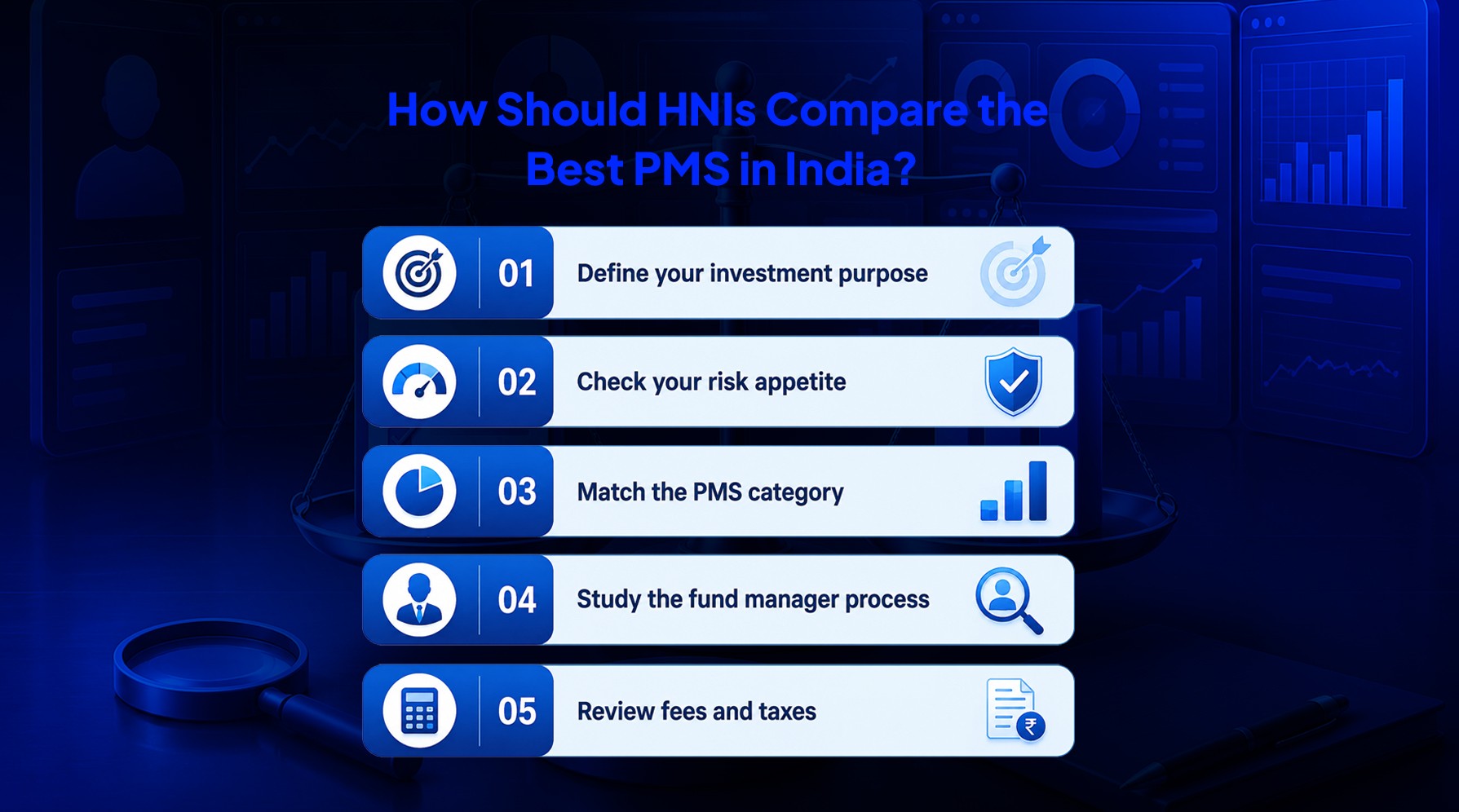
How Should HNIs Compare the Best PMS in India?

HNIs should compare the best PMS in India through a risk-first checklist. This keeps the decision grounded when return tables look attractive.
Best PMS in India 2026 guide for HNIs showing portfolio growth, wealth management planning, investment analysis, and portfolio manager selection framework.

The first question should be simple. Can you stay invested in this strategy when markets fall?

PMS Comparison Checklist

  1. Define your investment purpose: Decide whether the PMS money is for wealth creation, retirement, legacy, or surplus capital growth.

  2. Check your risk appetite: A concentrated equity PMS needs patience and emotional comfort during corrections.

  3. Match the PMS category: Large-cap, multi-cap, small-cap, thematic, and value PMS strategies behave differently.

  4. Study the fund manager process: Ask how stocks enter the portfolio and why they exit.

  5. Review fees and taxes: Check how the fee model affects your final return.

  6. Compare reporting quality: Strong reporting helps investors understand decisions, not just performance.

๐Ÿ’ก Most investors shortlist PMS providers by performance and only check risk and fees after. That sequence increases the chance of choosing a strategy that looks good on paper but becomes difficult to hold during weak markets. Compare PMS options through a structured goal-based review with Ckredence Wealth before making a capital commitment.

๐Ÿ“Š India's PMS sector serves over 2.1 lakh investor accounts as of June 2026, per APMI: This reflects growing HNI demand for professionally managed custom portfolios beyond traditional mutual fund structures.
Source: ANI, APMI Leadership Conclave, June 2026

What Types of PMS Are Available in India?

The best PMS in India can fall under different service types. SEBI classifies PMS into discretionary, non-discretionary, and advisory models based on investor control and manager involvement. Our guide to types of portfolio management services explains how each model works and which structure suits different investor profiles.

The right type depends on how much control the investor wants. Some investors prefer full manager-led execution, while others want recommendations before every decision.

Discretionary PMS

In discretionary PMS, the portfolio manager makes investment decisions on behalf of the investor. This suits investors who want professional management with limited day-to-day involvement.

Many busy business owners and senior professionals prefer this model. It reduces the need to approve every buy and sell decision.

Non-Discretionary PMS

In non-discretionary PMS, the manager gives recommendations, but the investor approves decisions. This suits investors who want expert input while keeping final control.

It works best when the investor has time and financial knowledge. Without timely action, execution can suffer.

Advisory PMS

In advisory PMS, the manager gives advice and the investor executes trades independently. This suits experienced investors who want guidance but prefer direct action.

This model gives control but also places more responsibility on the investor. It is not ideal for someone who wants full delegation.

๐Ÿ“‹ Not sure which PMS type matches your level of involvement and financial goals? Our advisors review discretionary, non-discretionary, and advisory structures based on your specific situation. Start a consultation with Ckredence Wealth to find the right PMS model before committing capital.

How Is the Best PMS in India Different From Mutual Funds and AIFs?

The best PMS in India differs from mutual funds and AIFs mainly in ownership, customization, access, and reporting. PMS gives direct ownership of securities in the investor's account, while mutual funds and AIFs work through pooled structures.

This ownership difference changes how investors review holdings and tax outcomes. Our comparison of wealth management and portfolio management covers how the two disciplines work together for HNIs with complex financial needs beyond investments alone.

Factor

PMS

Mutual Funds

AIFs

Ownership

Direct securities

Fund units

Fund units

Custom fit

Higher

Lower

Moderate

Investor access

Larger-ticket investors

Broad investor base

Larger-ticket investors

Reporting

Holding-level visibility

Scheme factsheet level

Depends on structure

Control

Higher visibility

Lower visibility

Varies by fund

Which One Fits Better?

PMS may suit investors who want custom equity exposure and deeper portfolio visibility. Mutual funds may suit investors who want simplicity, SIP-based investing, and broad diversification. AIFs may suit investors seeking alternate strategies and different structures.

"Know what you own, and know why you own it." Peter Lynch, Former Portfolio Manager, Fidelity Magellan Fund
Source: One Up on Wall Street, Peter Lynch, 1989

What Fees and Taxes Should Investors Check Before Choosing the Best PMS in India?

Investors choosing the best PMS in India should check fees and taxes before finalizing the provider. A high-return strategy can look less attractive after costs and tax treatment.

PMS taxation follows the investor's direct ownership of securities. The timing of trades, holding period, and portfolio churn can affect the final investor-level outcome. Our resource on equity and debt investment options explains how holding periods affect tax outcomes across different investment types.

PMS Fee Models

Common PMS fee models include:

  • Fixed management fee

  • Performance-linked fee

  • Hybrid fee

  • Exit-related charges

  • Brokerage, custody, and operational charges

A low fee is not always better. The better question is whether the fee matches the manager's process, reporting quality, and portfolio fit.

Tax Review Before Investing

Investors should ask how often the portfolio churns. Frequent buying and selling can significantly change tax outcomes.

This is why post-tax review matters. A PMS should be compared by what the investor keeps, not only what the strategy reports.

๐Ÿ“Š India's PMS industry oversees assets of โ‚น42 lakh crore as of June 2026, per APMI: This scale reflects the growing role of PMS in HNI and UHNI wealth portfolios across India.
Source: ANI, APMI Leadership Conclave, June 2026

๐Ÿ“Š PMS fee structures and portfolio churn can significantly change the actual return after taxes. Talk to our advisory team at Ckredence Wealth to compare fee models based on your capital size and investment horizon.

What Mistakes Should Investors Avoid While Selecting the Best PMS in India?

The biggest mistake is selecting the best PMS in India only by recent performance. One good phase does not prove that the strategy can hold up across different markets.

PMS is a long-term wealth decision. It needs patience, review, and a clear understanding of portfolio behaviour.

Common Mistakes and Better Checks

Mistake

Better Check

Choosing recent top performers

Study consistency across market cycles

Ignoring concentration

Check stock and sector exposure

Skipping drawdown review

Ask how the PMS behaved during corrections

Comparing wrong benchmarks

Match benchmark with PMS category

Ignoring tax

Review portfolio churn and holding period

Not checking suitability

Match PMS with goals and risk comfort

"Risk comes from not knowing what you're doing." Warren Buffett, Chairman and CEO, Berkshire Hathaway
Source: Omaha World-Herald, January 1994, via Quote Investigator

Why Behaviour Matters

Even a good PMS can disappoint if the investor exits at the wrong time. Investor behaviour can damage outcomes more than a weak quarter. That is why PMS selection should include a review process that helps investors stay committed through market corrections.

Why Should You Choose Ckredence Wealth for the Best PMS in India?

Choosing a PMS provider is one of the most significant wealth decisions an HNI makes. Most investors reach the selection stage with a shortlist but without a structured framework for comparing risk, fees, reporting quality, and long-term fit across providers.

Ckredence Wealth helps investors evaluate PMS through risk profile, goals, portfolio fit, and long-term suitability. The focus is not only on finding a high-return PMS, but on building a portfolio the investor can hold with confidence across all market conditions.

Ckredence Wealth Management Pvt. Ltd. offers PMS, mutual funds, and equity investment services, with branches in Surat, Mumbai, and Vadodara.

How Ckredence Wealth Reviews PMS Fit

  • Goal-based PMS selection: We match the PMS strategy to the investor's specific financial goals and time horizon.

  • Risk-adjusted portfolio review: We assess how the strategy behaves across market cycles, not only in strong phases.

  • Portfolio concentration checks: We flag strategies with excessive sector or stock overlap relative to the investor's overall portfolio.

  • Fee structure clarity: We break down how management fees and performance-linked charges affect actual post-tax returns.

  • Regular reporting and review: We provide holding-level transparency, not just headline performance numbers.

  • Relationship-led investor support: We are accessible at key decision points through advisor calls, WhatsApp, and in-person consultations.

Indian HNIs often need human validation before making large investment decisions. Our All Weather PMS strategy is designed for investors who want consistent capital preservation across different market conditions.

๐Ÿค Choosing the right PMS means matching a strategy to goals you can hold through all market phases. Begin your PMS review with Ckredence Wealth and get a structured plan before committing your capital.

Conclusion

The best PMS in India cannot be chosen from a return table alone. A good PMS decision requires fund manager quality, portfolio discipline, tax awareness, fee clarity, and clear investor suitability.

Before investing, focus on strategy fit, risk comfort, portfolio visibility, and cost and tax impact. For HNIs, PMS works best as part of a larger wealth plan, chosen for how it performs across market cycles and not only for recent returns. The right PMS is the one you can hold with confidence when markets test your patience.

FAQs

01.

What does SEBI registration mean for a PMS investor?

SEBI registration means the portfolio manager has met regulatory capital, disclosure, and compliance standards. It does not guarantee returns, but it ensures a legal framework for investor protection. Verifying SEBI registration is a basic step before shortlisting any PMS provider.

02.

How is PMS different from mutual funds and RIA advisory?

PMS gives direct ownership of securities in the investor's demat account. Mutual funds provide pooled fund units with shared portfolio exposure. RIA advisory offers personalised guidance without direct portfolio management by the advisor.

03.

Who should invest in PMS in India?

PMS suits investors with a minimum of INR 50 lakh in investable capital. It also requires patience during market corrections and comfort with concentrated equity exposure. Business owners, CXOs, and professionals with long investment horizons are typical PMS investors.

04.

How does Ckredence Wealth help evaluate PMS options?

Ckredence Wealth reviews your goals, risk profile, and investment horizon before recommending a PMS strategy. We assess fee structure, portfolio concentration, and reporting quality across shortlisted providers. Our engagement starts with a consultation and continues through regular portfolio reviews.

India's PMS sector now serves over 2.1 lakh investor accounts as of June 2026, per APMI data, reflecting strong and sustained HNI demand for professionally managed custom portfolios. Yet the comparison process has become more layered. Investors now evaluate fund manager quality, drawdown history, fee structure, and long-term suitability before selecting a provider.

SEBI requires a minimum investment of INR 50 lakh in securities from any PMS client, keeping this service firmly within the HNI segment. That threshold also raises the cost of a poor selection decision. This guide helps HNIs, business owners, CXOs, and family offices compare PMS providers with structure, without being misled by short-term performance rankings.

TL;DR

  • PMS selection should begin with investor goals and risk profile, not return rankings.

  • A strong PMS review examines manager process, drawdown history, and portfolio concentration.

  • Small and mid-cap PMS strategies require patience during significant market corrections.

  • PMS fees and tax on portfolio churn can significantly reduce the investor's actual return.

  • Direct security ownership in PMS gives holding-level visibility that pooled funds cannot.

  • Ckredence Wealth evaluates PMS options through goals, risk profile, and long-term suitability.

What Makes a Provider the Best PMS in India?

The best PMS in India should have a clear investment process, experienced portfolio managers, transparent reporting, and risk control across market cycles. Returns matter, but they should not be viewed without context.

A PMS provider manages concentrated wealth. The investor must understand how the manager buys, holds, exits, and reviews portfolio positions.

The Core Evaluation Lens

A good PMS review usually checks:

  • Investment philosophy: Is the manager value-led, growth-led, quality-led, or thematic?

  • Portfolio construction: Does the portfolio hold too many overlapping ideas?

  • Risk handling: How does the manager act during weak markets?

  • Reporting quality: Are holdings, changes, and rationale clearly shared?

  • Investor fit: Does the strategy match the investor's life stage and goals?

This is where many investors make the first mistake. They rank PMS providers by return first and suitability later. Our SEBI-registered PMS guide covers the verification steps and what regulatory registration means before you shortlist any provider.

Why "Best" Changes by Investor

The best PMS for a young founder may not suit a retired doctor. The founder may accept higher equity swings, while the doctor may prefer capital preservation and regular reviews. PMS selection should start with the investor profile, not the provider name.

Which Providers Are Often Listed Among the Best PMS in India?

Several PMS providers are often named in online rankings and AI Overview results. These lists usually include names such as Aequitas, Dezerv, Marcellus, Motilal Oswal, ASK Investment Managers, ICICI Prudential PMS, Green Lantern, Wallfort, Sundaram Alternates, and Stallion Asset.

These names appear because different platforms rank PMS providers using return history, AUM, category strength, fund manager profile, and consistency.

Ranking Lists Are a Starting Point

A PMS ranking can help you shortlist names. It cannot decide suitability. Use ranking pages to ask better questions about each provider. Our guide on active and passive portfolio management explains how different investment philosophies affect portfolio behaviour across market cycles.

Ranking Signal

What It Tells You

What You Still Need To Check

Return history

Past performance pattern

Risk taken to earn it

AUM

Investor trust and scale

Capacity to manage the same style

Category

Market-cap and style exposure

Fit with your portfolio

Fund manager

Decision-maker behind strategy

Process across cycles

Risk metrics

Downside behaviour

Your own comfort with volatility

How Should HNIs Compare the Best PMS in India?

HNIs should compare the best PMS in India through a risk-first checklist. This keeps the decision grounded when return tables look attractive.

Best PMS in India 2026 guide for HNIs showing portfolio growth, wealth management planning, investment analysis, and portfolio manager selection framework.

The first question should be simple. Can you stay invested in this strategy when markets fall?

PMS Comparison Checklist

  1. Define your investment purpose: Decide whether the PMS money is for wealth creation, retirement, legacy, or surplus capital growth.

  2. Check your risk appetite: A concentrated equity PMS needs patience and emotional comfort during corrections.

  3. Match the PMS category: Large-cap, multi-cap, small-cap, thematic, and value PMS strategies behave differently.

  4. Study the fund manager process: Ask how stocks enter the portfolio and why they exit.

  5. Review fees and taxes: Check how the fee model affects your final return.

  6. Compare reporting quality: Strong reporting helps investors understand decisions, not just performance.

๐Ÿ’ก Most investors shortlist PMS providers by performance and only check risk and fees after. That sequence increases the chance of choosing a strategy that looks good on paper but becomes difficult to hold during weak markets. Compare PMS options through a structured goal-based review with Ckredence Wealth before making a capital commitment.

๐Ÿ“Š India's PMS sector serves over 2.1 lakh investor accounts as of June 2026, per APMI: This reflects growing HNI demand for professionally managed custom portfolios beyond traditional mutual fund structures.
Source: ANI, APMI Leadership Conclave, June 2026

What Types of PMS Are Available in India?

The best PMS in India can fall under different service types. SEBI classifies PMS into discretionary, non-discretionary, and advisory models based on investor control and manager involvement. Our guide to types of portfolio management services explains how each model works and which structure suits different investor profiles.

The right type depends on how much control the investor wants. Some investors prefer full manager-led execution, while others want recommendations before every decision.

Discretionary PMS

In discretionary PMS, the portfolio manager makes investment decisions on behalf of the investor. This suits investors who want professional management with limited day-to-day involvement.

Many busy business owners and senior professionals prefer this model. It reduces the need to approve every buy and sell decision.

Non-Discretionary PMS

In non-discretionary PMS, the manager gives recommendations, but the investor approves decisions. This suits investors who want expert input while keeping final control.

It works best when the investor has time and financial knowledge. Without timely action, execution can suffer.

Advisory PMS

In advisory PMS, the manager gives advice and the investor executes trades independently. This suits experienced investors who want guidance but prefer direct action.

This model gives control but also places more responsibility on the investor. It is not ideal for someone who wants full delegation.

๐Ÿ“‹ Not sure which PMS type matches your level of involvement and financial goals? Our advisors review discretionary, non-discretionary, and advisory structures based on your specific situation. Start a consultation with Ckredence Wealth to find the right PMS model before committing capital.

How Is the Best PMS in India Different From Mutual Funds and AIFs?

The best PMS in India differs from mutual funds and AIFs mainly in ownership, customization, access, and reporting. PMS gives direct ownership of securities in the investor's account, while mutual funds and AIFs work through pooled structures.

This ownership difference changes how investors review holdings and tax outcomes. Our comparison of wealth management and portfolio management covers how the two disciplines work together for HNIs with complex financial needs beyond investments alone.

Factor

PMS

Mutual Funds

AIFs

Ownership

Direct securities

Fund units

Fund units

Custom fit

Higher

Lower

Moderate

Investor access

Larger-ticket investors

Broad investor base

Larger-ticket investors

Reporting

Holding-level visibility

Scheme factsheet level

Depends on structure

Control

Higher visibility

Lower visibility

Varies by fund

Which One Fits Better?

PMS may suit investors who want custom equity exposure and deeper portfolio visibility. Mutual funds may suit investors who want simplicity, SIP-based investing, and broad diversification. AIFs may suit investors seeking alternate strategies and different structures.

"Know what you own, and know why you own it." Peter Lynch, Former Portfolio Manager, Fidelity Magellan Fund
Source: One Up on Wall Street, Peter Lynch, 1989

What Fees and Taxes Should Investors Check Before Choosing the Best PMS in India?

Investors choosing the best PMS in India should check fees and taxes before finalizing the provider. A high-return strategy can look less attractive after costs and tax treatment.

PMS taxation follows the investor's direct ownership of securities. The timing of trades, holding period, and portfolio churn can affect the final investor-level outcome. Our resource on equity and debt investment options explains how holding periods affect tax outcomes across different investment types.

PMS Fee Models

Common PMS fee models include:

  • Fixed management fee

  • Performance-linked fee

  • Hybrid fee

  • Exit-related charges

  • Brokerage, custody, and operational charges

A low fee is not always better. The better question is whether the fee matches the manager's process, reporting quality, and portfolio fit.

Tax Review Before Investing

Investors should ask how often the portfolio churns. Frequent buying and selling can significantly change tax outcomes.

This is why post-tax review matters. A PMS should be compared by what the investor keeps, not only what the strategy reports.

๐Ÿ“Š India's PMS industry oversees assets of โ‚น42 lakh crore as of June 2026, per APMI: This scale reflects the growing role of PMS in HNI and UHNI wealth portfolios across India.
Source: ANI, APMI Leadership Conclave, June 2026

๐Ÿ“Š PMS fee structures and portfolio churn can significantly change the actual return after taxes. Talk to our advisory team at Ckredence Wealth to compare fee models based on your capital size and investment horizon.

What Mistakes Should Investors Avoid While Selecting the Best PMS in India?

The biggest mistake is selecting the best PMS in India only by recent performance. One good phase does not prove that the strategy can hold up across different markets.

PMS is a long-term wealth decision. It needs patience, review, and a clear understanding of portfolio behaviour.

Common Mistakes and Better Checks

Mistake

Better Check

Choosing recent top performers

Study consistency across market cycles

Ignoring concentration

Check stock and sector exposure

Skipping drawdown review

Ask how the PMS behaved during corrections

Comparing wrong benchmarks

Match benchmark with PMS category

Ignoring tax

Review portfolio churn and holding period

Not checking suitability

Match PMS with goals and risk comfort

"Risk comes from not knowing what you're doing." Warren Buffett, Chairman and CEO, Berkshire Hathaway
Source: Omaha World-Herald, January 1994, via Quote Investigator

Why Behaviour Matters

Even a good PMS can disappoint if the investor exits at the wrong time. Investor behaviour can damage outcomes more than a weak quarter. That is why PMS selection should include a review process that helps investors stay committed through market corrections.

Why Should You Choose Ckredence Wealth for the Best PMS in India?

Choosing a PMS provider is one of the most significant wealth decisions an HNI makes. Most investors reach the selection stage with a shortlist but without a structured framework for comparing risk, fees, reporting quality, and long-term fit across providers.

Ckredence Wealth helps investors evaluate PMS through risk profile, goals, portfolio fit, and long-term suitability. The focus is not only on finding a high-return PMS, but on building a portfolio the investor can hold with confidence across all market conditions.

Ckredence Wealth Management Pvt. Ltd. offers PMS, mutual funds, and equity investment services, with branches in Surat, Mumbai, and Vadodara.

How Ckredence Wealth Reviews PMS Fit

  • Goal-based PMS selection: We match the PMS strategy to the investor's specific financial goals and time horizon.

  • Risk-adjusted portfolio review: We assess how the strategy behaves across market cycles, not only in strong phases.

  • Portfolio concentration checks: We flag strategies with excessive sector or stock overlap relative to the investor's overall portfolio.

  • Fee structure clarity: We break down how management fees and performance-linked charges affect actual post-tax returns.

  • Regular reporting and review: We provide holding-level transparency, not just headline performance numbers.

  • Relationship-led investor support: We are accessible at key decision points through advisor calls, WhatsApp, and in-person consultations.

Indian HNIs often need human validation before making large investment decisions. Our All Weather PMS strategy is designed for investors who want consistent capital preservation across different market conditions.

๐Ÿค Choosing the right PMS means matching a strategy to goals you can hold through all market phases. Begin your PMS review with Ckredence Wealth and get a structured plan before committing your capital.

Conclusion

The best PMS in India cannot be chosen from a return table alone. A good PMS decision requires fund manager quality, portfolio discipline, tax awareness, fee clarity, and clear investor suitability.

Before investing, focus on strategy fit, risk comfort, portfolio visibility, and cost and tax impact. For HNIs, PMS works best as part of a larger wealth plan, chosen for how it performs across market cycles and not only for recent returns. The right PMS is the one you can hold with confidence when markets test your patience.

FAQs

01.

What does SEBI registration mean for a PMS investor?

SEBI registration means the portfolio manager has met regulatory capital, disclosure, and compliance standards. It does not guarantee returns, but it ensures a legal framework for investor protection. Verifying SEBI registration is a basic step before shortlisting any PMS provider.

02.

How is PMS different from mutual funds and RIA advisory?

PMS gives direct ownership of securities in the investor's demat account. Mutual funds provide pooled fund units with shared portfolio exposure. RIA advisory offers personalised guidance without direct portfolio management by the advisor.

03.

Who should invest in PMS in India?

PMS suits investors with a minimum of INR 50 lakh in investable capital. It also requires patience during market corrections and comfort with concentrated equity exposure. Business owners, CXOs, and professionals with long investment horizons are typical PMS investors.

04.

How does Ckredence Wealth help evaluate PMS options?

Ckredence Wealth reviews your goals, risk profile, and investment horizon before recommending a PMS strategy. We assess fee structure, portfolio concentration, and reporting quality across shortlisted providers. Our engagement starts with a consultation and continues through regular portfolio reviews.