5 min
5 min
SEBI Registered PMS: What It Means, Why It Matters, and How to Choose Right
Know what SEBI registered PMS means, key regulations, verification steps & how to pick the right portfolio manager for your goals.

Ckredence
Ckredence
|
May 6, 2026
May 6, 2026

India's Portfolio Management Services industry crossed Rs. 38.65 lakh crore in total AUM as of May 2025, yet a critical question still trips up most HNI investors: is the firm you are trusting with your wealth actually SEBI registered?
The number of SEBI-registered portfolio managers grew from 361 in FY21 to 493 by mid-2025, and discretionary PMS clients have grown at 13% annually. But not every firm offering portfolio management carries the credentials the law requires.
Ask yourself:
How do you know whether the PMS firm managing your Rs. 50 lakh or more is genuinely authorized by SEBI?
What legal protections do you actually lose if you invest with an unregistered provider?
When two PMS firms promise similar returns, what separates the compliant, trustworthy one from the rest?
These are not hypothetical concerns. SEBI itself has flagged that exaggerated performance claims by a few registered Portfolio Managers undermine trust in the entire industry. The regulation exists for a reason: to protect your capital, guarantee transparency, and hold fund managers accountable.
This blog breaks down exactly what SEBI registered PMS means, what rules govern it, how to verify a provider, and what you should look for before committing your wealth.
Key Takeaways
Any firm offering PMS in India must hold a SEBI INP-series registration. Verify this before you engage.
SEBI authorizes three PMS types: Discretionary, Non-Discretionary, and Advisory, each with a different level of client control.
Client assets must be held with an independent custodian, kept separate from the firm's own funds.
SEBI bans guaranteed returns and upfront commissions in PMS. Any provider offering either is a red flag.
From January 2025, PMS distributors must be registered with APMI. Unregistered distributors are operating outside the law.
What Is a SEBI Registered PMS?
A SEBI registered PMS refers to a Portfolio Management Service licensed by the Securities and Exchange Board of India under the SEBI (Portfolio Managers) Regulations, 2020. It is a professional investment service where a qualified fund manager takes charge of your equity, debt, and other securities portfolio. Only corporate entities, companies, or LLPs with SEBI registration can legally offer these services in India.
The distinction between a registered and an unregistered provider is not just legal: it is the difference between a managed, audited, and accountable investment structure and one with no regulatory oversight over fees, performance claims, or fund safety. Every registered PMS carries a unique INP-series registration number that you can verify publicly.
Rs. 38.65 Lakh Crore Total PMS Industry AUM as of May 2025 | Source: APMI via Outlook Money |
SEBI's registration framework also mandates minimum qualifications for the fund's Principal Officer, a dedicated Compliance Officer, and specific infrastructure requirements before a license is granted. This baseline filter is what separates the PMS you can trust from the ones you should avoid.
Key Features of SEBI Registered PMS
Minimum Investment Threshold
SEBI mandates that no PMS provider can accept less than Rs. 50 lakhs per client. This rule was raised from Rs. 25 lakhs in January 2020 specifically to ensure only financially capable investors participate, given the risk profile of PMS products.
Partial withdrawals are also restricted. Your portfolio value cannot fall below Rs. 50 lakhs after a partial withdrawal. This rule protects the overall investment structure and the manager's ability to maintain portfolio quality.
Custodian Safety
Client assets in a SEBI registered PMS are always held by an independent custodian, not the portfolio manager. Your securities are never mixed with the fund manager's own assets. This structural separation is one of the strongest investor protections in the entire framework.
Mandatory Disclosure
Before signing any agreement, you must receive a Disclosure Document that covers fees, investment strategy, performance track record, and associated risks. This document is not optional. SEBI requires it as a condition of doing business.
No Guaranteed Returns
A SEBI registered PMS is legally prohibited from offering indicative or guaranteed returns. If any provider promises a fixed return, they are either misrepresenting their SEBI status or violating regulation. Both are reasons to walk away immediately.
“APMI and the industry must curb misleading claims being made by a few registered Portfolio Managers. Such exaggerated performance claims undermine trust and could stall growth of this industry.” Tuhin Kanta Pandey, Chairman, SEBI | APMI Annual Conclave 2025 |
The next critical question most investors have is: which type of SEBI registered PMS is actually right for them? The answer depends entirely on how much control you want to retain over your investment decisions.
Types of SEBI Registered PMS: Discretionary, Non-Discretionary, and Advisory
SEBI categorizes PMS into three distinct types based on decision-making control. Each type has different regulatory requirements and suits a different investor profile.
Type | Decision Maker | Best For | Manager Authority |
Discretionary PMS | Portfolio Manager | Investors who want full professional management | Complete autonomy |
Non-Discretionary PMS | Client approves each trade | Investors who want expert input but retain control |
|
Advisory PMS | Client executes trades | Experienced investors wanting guidance, not management | Advice only |
Discretionary PMS
Discretionary PMS gives the fund manager full authority to buy, sell, and manage your portfolio without needing your approval on each transaction. It accounts for 92% of total PMS assets in India as of February 2026, making it the dominant model by a wide margin.
Performance under discretionary PMS is measured using the Time-Weighted Rate of Return (TWRR) method for the preceding three years or the period of operation, whichever is shorter. This standardized calculation method, mandated by SEBI, makes comparing managers genuinely meaningful.
Non-Discretionary PMS
In non-discretionary PMS, the portfolio manager recommends investments, but you must approve every transaction before it executes. This model works well for investors with domain knowledge who want professional analysis without ceding full control.
One key regulatory point: non-discretionary PMS allows investment in unlisted securities up to 25% of client AUM, including units of AIFs, REITs, InvITs, and unlisted debt instruments. This flexibility does not exist for discretionary PMS under current SEBI rules.
Advisory PMS
In the advisory model, the portfolio manager only advises. You, the investor, execute every trade independently. This carries the highest level of personal control and the highest responsibility for execution quality.
What none of the top-ranking blogs explain clearly is the fee implication difference between the three types. Advisory PMS typically carries a lower management fee since the manager bears no execution risk. However, your transaction costs depend entirely on the broker you use, which can erode returns if not managed carefully.
How to Verify a SEBI Registered PMS in 3 Steps
Verification takes less than five minutes. Yet, most investors skip it entirely. Every genuine PMS provider will welcome this check. Any resistance to it is itself a warning sign.
01 | Check the SEBI Official Portal Visit https://www.sebi.gov.in and go to the Registered Intermediaries section. Search for the firm's name under Portfolio Managers. The page displays the registration number, date of registration, and current status. |
02 | Verify the INP Registration Number Every SEBI-authorized PMS carries a registration number in the format INP000XXXXX. Confirm that the number the firm shows you matches the one on the SEBI website. Mismatches, expired registrations, or missing numbers are immediate disqualifiers. |
03 | Cross-Check on the APMI Member Portal The Association of Portfolio Managers in India (APMI) maintains an updated list of member firms and, as of January 2025, all PMS distributors must also be APMI registered. Use the APMI portal to verify both the manager and the distributor introducing you to the product. |
Ckredence Wealth's SEBI registration number is INP000007164, verifiable on both the SEBI Intermediaries page and the APMI database. A 37-year legacy paired with regulatory compliance is not a coincidence: it is the result of consistently operating within a framework built to protect investors.
Key SEBI Regulations Every PMS Investor Must Know
SEBI's regulatory framework for PMS is governed by the SEBI (Portfolio Managers) Regulations, 2020. These rules were substantially updated to increase transparency, reduce conflicts of interest, and protect HNI investors. Understanding them gives you the tools to evaluate any provider properly.
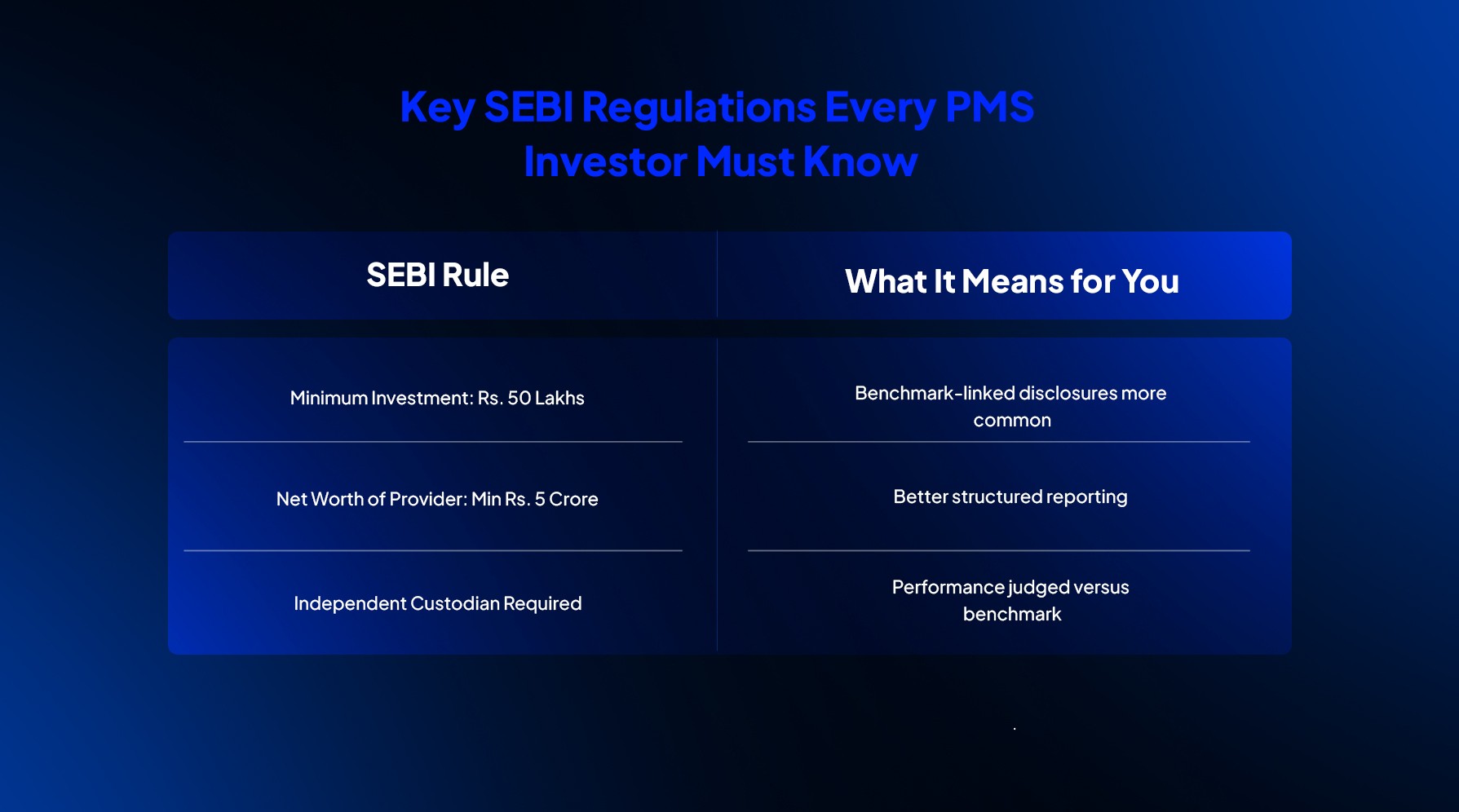
One regulation that most blogs leave out: SEBI caps the charges a PMS firm can route through its own associates or subsidiary brokers at 20% of AUM by value per associate in a given financial year.
This rule directly addresses the conflict of interest where a PMS firm profits by routing client trades through a related brokerage. A SEBI registered PMS that follows this rule is working in your interest, not its own.
According to Rashim Bagga, Principal Officer at APMI, the PMS industry's 15x AUM growth over 15 years reflects both India's economic strength and the product's rising appeal among affluent families. |
Knowing the regulations is one thing. Knowing the fee structures those regulations permit is what determines your actual returns. The next section covers exactly what you can expect to pay and what a compliant fee structure looks like.
SEBI PMS Fee Structure: What Is Permitted and What to Watch For
SEBI permits three types of fee structures for registered PMS providers. All three must be clearly documented in your client agreement along with illustrations. You must never sign an agreement where the fee structure is described vaguely.
Fee Type | Description | Risk to Client |
Fixed Management Fee | A flat annual percentage of AUM, charged regardless of returns | You pay even if performance is poor |
Performance Fee (with Hurdle) | Fee is charged only above a minimum return threshold (hurdle rate) | Lower cost during underperformance |
Combination Fee | Both a base management fee and a performance fee above a hurdle rate | Balance of fixed accountability and performance incentive |
The High Watermark Principle
Performance fees in SEBI registered PMS use the High Watermark Principle. This means the fund manager can only charge a performance fee on returns that exceed the highest NAV previously achieved. If your portfolio has not recovered past its previous peak, no performance fee is payable.
This is a meaningful investor protection. It prevents managers from charging performance fees in years when they are simply recovering from prior losses.
What to Watch For
No upfront fees: SEBI prohibits any upfront commission, directly or indirectly.
Exit fees: SEBI allows exit fees for early withdrawal, but caps them. Check the specific limits in your agreement.
Associate brokerage caps: Ensure total brokerage routed through firm associates does not exceed 20% of annual AUM value.
Ckredence Wealth operates with transparent, fixed fee structures across its four PMS strategies: All Weather, Diversified, Business Cycle, and ICE Growth. Fees are documented upfront, compliant with SEBI regulations, and aligned to client outcomes. There are no hidden charges and no inflated brokerage arrangements.
How to Choose the Right SEBI Registered PMS Provider
SEBI registration is the baseline. Every provider on the list meets the minimum requirement. What separates genuinely strong providers from the rest comes down to five factors that most HNI investors underweight when making their decision.
1. Track Record Across Market Cycles
A PMS provider's performance in a bull market is easy to achieve. What matters is performance through a full business cycle, including drawdowns, corrections, and recoveries. Ask specifically for TWRR-based performance data across a minimum of three complete years.
2. Investment Philosophy Clarity
Your fund manager must be able to articulate their investment strategy clearly and consistently. If the explanation changes depending on market conditions, that is not adaptive thinking: it is the absence of a defined framework.
3. Portfolio Concentration vs. Diversification
SEBI registered PMS portfolios are typically more concentrated than mutual funds. A portfolio of 15 to 25 high-conviction stocks is normal. Understand whether the concentration matches your risk tolerance and whether the diversification across sectors is intentional or incidental.
4. Conflict of Interest Disclosures
Ask every provider: Do you use related-party brokers for my trades? What percentage of my annual transaction value goes through associates? A provider operating within SEBI's 20% associate brokerage cap will answer this without hesitation. One that deflects the question probably should not be managing your wealth.
5. Accessibility and Reporting Quality
How often does your portfolio manager communicate? Is the reporting monthly or quarterly? Does it include absolute returns, benchmark comparison, and individual stock attribution? The quality of reporting is a direct indicator of how seriously the firm takes client accountability.
For a deeper comparison of how PMS compares to mutual funds and AIFs as investment vehicles, read: PMS vs Mutual Funds vs AIF in India. For investors evaluating different types, discretionary vs non-discretionary PMS is also a useful read before finalizing your choice.
Why Should You Choose Ckredence Wealth for Your PMS?
Finding a SEBI registered PMS is straightforward. Finding one with a 37-year operating history, verified SEBI registration (INP000007164), Rs. 805+ crore under active management, and 376+ clients is a different matter entirely.
What You Need SEBI-regulated portfolio management Proven track record across cycles Multiple investment strategies Transparent fee structure Dedicated relationship management | What Ckredence Delivers SEBI Reg. No. INP000007164, since 1987 37 years of wealth management across market cycles All Weather, Diversified, Business Cycle, ICE Growth Fixed fee model, no hidden charges Dedicated relationship managers, regular reviews |
Ckredence Wealth manages wealth for HNIs and UHNIs across Gujarat and Maharashtra with offices in Surat, Mumbai, and Vadodara. Our four PMS strategies cover all investor risk profiles, from capital preservation to growth-oriented equity exposure. Whether you are a first-time PMS investor or transitioning from mutual funds, we build portfolios aligned to your financial goals, not market trends.
Ready to invest with a SEBI registered PMS you can verify? Schedule a Consultation with Ckredence Wealth today.
Conclusion
SEBI registration is not a marketing credential: it is a legal requirement that protects your investment at every level, from custody of assets to fee transparency and performance reporting. With 493 registered PMS firms in India today, the choice is not between registered and unregistered. The choice is between firms that treat compliance as a floor and those that treat it as a competitive advantage.
Before committing to any PMS, verify the INP registration number, review the Disclosure Document, and confirm custodian independence. For investors who want a provider that has met every one of these standards for nearly four decades, Ckredence Wealth is worth a conversation.
FAQs
01.
What is the minimum investment required for a SEBI registered PMS?
The minimum investment for a SEBI registered PMS is Rs. 50 lakhs per client, as mandated by SEBI under the Portfolio Managers Regulations, 2020. Partial withdrawals cannot reduce your portfolio value below this threshold. APMI has recently requested SEBI to lower this limit, so regulatory changes may follow.
02.
How can I verify if a PMS provider is SEBI registered?
Visit the SEBI Intermediaries portal and search under Registered Portfolio Managers. Every genuine provider carries an INP-series registration number. You can also cross-check on the APMI member portal for additional verification.
03.
What is the difference between discretionary and non-discretionary PMS?
In discretionary PMS, the fund manager takes all investment decisions on your behalf without needing your approval for each trade. In non-discretionary PMS, the manager recommends trades but you must approve every transaction before execution. See our detailed guide: Discretionary vs Non-Discretionary PMS.
04.
Can a SEBI registered PMS guarantee returns?
No. SEBI explicitly prohibits registered portfolio managers from offering indicative or guaranteed returns to clients. Any PMS provider that promises a fixed return is either misrepresenting their SEBI status or in direct violation of regulation. This is a clear red flag for investors.
India's Portfolio Management Services industry crossed Rs. 38.65 lakh crore in total AUM as of May 2025, yet a critical question still trips up most HNI investors: is the firm you are trusting with your wealth actually SEBI registered?
The number of SEBI-registered portfolio managers grew from 361 in FY21 to 493 by mid-2025, and discretionary PMS clients have grown at 13% annually. But not every firm offering portfolio management carries the credentials the law requires.
Ask yourself:
How do you know whether the PMS firm managing your Rs. 50 lakh or more is genuinely authorized by SEBI?
What legal protections do you actually lose if you invest with an unregistered provider?
When two PMS firms promise similar returns, what separates the compliant, trustworthy one from the rest?
These are not hypothetical concerns. SEBI itself has flagged that exaggerated performance claims by a few registered Portfolio Managers undermine trust in the entire industry. The regulation exists for a reason: to protect your capital, guarantee transparency, and hold fund managers accountable.
This blog breaks down exactly what SEBI registered PMS means, what rules govern it, how to verify a provider, and what you should look for before committing your wealth.
Key Takeaways
Any firm offering PMS in India must hold a SEBI INP-series registration. Verify this before you engage.
SEBI authorizes three PMS types: Discretionary, Non-Discretionary, and Advisory, each with a different level of client control.
Client assets must be held with an independent custodian, kept separate from the firm's own funds.
SEBI bans guaranteed returns and upfront commissions in PMS. Any provider offering either is a red flag.
From January 2025, PMS distributors must be registered with APMI. Unregistered distributors are operating outside the law.
What Is a SEBI Registered PMS?
A SEBI registered PMS refers to a Portfolio Management Service licensed by the Securities and Exchange Board of India under the SEBI (Portfolio Managers) Regulations, 2020. It is a professional investment service where a qualified fund manager takes charge of your equity, debt, and other securities portfolio. Only corporate entities, companies, or LLPs with SEBI registration can legally offer these services in India.
The distinction between a registered and an unregistered provider is not just legal: it is the difference between a managed, audited, and accountable investment structure and one with no regulatory oversight over fees, performance claims, or fund safety. Every registered PMS carries a unique INP-series registration number that you can verify publicly.
Rs. 38.65 Lakh Crore Total PMS Industry AUM as of May 2025 | Source: APMI via Outlook Money |
SEBI's registration framework also mandates minimum qualifications for the fund's Principal Officer, a dedicated Compliance Officer, and specific infrastructure requirements before a license is granted. This baseline filter is what separates the PMS you can trust from the ones you should avoid.
Key Features of SEBI Registered PMS
Minimum Investment Threshold
SEBI mandates that no PMS provider can accept less than Rs. 50 lakhs per client. This rule was raised from Rs. 25 lakhs in January 2020 specifically to ensure only financially capable investors participate, given the risk profile of PMS products.
Partial withdrawals are also restricted. Your portfolio value cannot fall below Rs. 50 lakhs after a partial withdrawal. This rule protects the overall investment structure and the manager's ability to maintain portfolio quality.
Custodian Safety
Client assets in a SEBI registered PMS are always held by an independent custodian, not the portfolio manager. Your securities are never mixed with the fund manager's own assets. This structural separation is one of the strongest investor protections in the entire framework.
Mandatory Disclosure
Before signing any agreement, you must receive a Disclosure Document that covers fees, investment strategy, performance track record, and associated risks. This document is not optional. SEBI requires it as a condition of doing business.
No Guaranteed Returns
A SEBI registered PMS is legally prohibited from offering indicative or guaranteed returns. If any provider promises a fixed return, they are either misrepresenting their SEBI status or violating regulation. Both are reasons to walk away immediately.
“APMI and the industry must curb misleading claims being made by a few registered Portfolio Managers. Such exaggerated performance claims undermine trust and could stall growth of this industry.” Tuhin Kanta Pandey, Chairman, SEBI | APMI Annual Conclave 2025 |
The next critical question most investors have is: which type of SEBI registered PMS is actually right for them? The answer depends entirely on how much control you want to retain over your investment decisions.
Types of SEBI Registered PMS: Discretionary, Non-Discretionary, and Advisory
SEBI categorizes PMS into three distinct types based on decision-making control. Each type has different regulatory requirements and suits a different investor profile.
Type | Decision Maker | Best For | Manager Authority |
Discretionary PMS | Portfolio Manager | Investors who want full professional management | Complete autonomy |
Non-Discretionary PMS | Client approves each trade | Investors who want expert input but retain control |
|
Advisory PMS | Client executes trades | Experienced investors wanting guidance, not management | Advice only |
Discretionary PMS
Discretionary PMS gives the fund manager full authority to buy, sell, and manage your portfolio without needing your approval on each transaction. It accounts for 92% of total PMS assets in India as of February 2026, making it the dominant model by a wide margin.
Performance under discretionary PMS is measured using the Time-Weighted Rate of Return (TWRR) method for the preceding three years or the period of operation, whichever is shorter. This standardized calculation method, mandated by SEBI, makes comparing managers genuinely meaningful.
Non-Discretionary PMS
In non-discretionary PMS, the portfolio manager recommends investments, but you must approve every transaction before it executes. This model works well for investors with domain knowledge who want professional analysis without ceding full control.
One key regulatory point: non-discretionary PMS allows investment in unlisted securities up to 25% of client AUM, including units of AIFs, REITs, InvITs, and unlisted debt instruments. This flexibility does not exist for discretionary PMS under current SEBI rules.
Advisory PMS
In the advisory model, the portfolio manager only advises. You, the investor, execute every trade independently. This carries the highest level of personal control and the highest responsibility for execution quality.
What none of the top-ranking blogs explain clearly is the fee implication difference between the three types. Advisory PMS typically carries a lower management fee since the manager bears no execution risk. However, your transaction costs depend entirely on the broker you use, which can erode returns if not managed carefully.
How to Verify a SEBI Registered PMS in 3 Steps
Verification takes less than five minutes. Yet, most investors skip it entirely. Every genuine PMS provider will welcome this check. Any resistance to it is itself a warning sign.
01 | Check the SEBI Official Portal Visit https://www.sebi.gov.in and go to the Registered Intermediaries section. Search for the firm's name under Portfolio Managers. The page displays the registration number, date of registration, and current status. |
02 | Verify the INP Registration Number Every SEBI-authorized PMS carries a registration number in the format INP000XXXXX. Confirm that the number the firm shows you matches the one on the SEBI website. Mismatches, expired registrations, or missing numbers are immediate disqualifiers. |
03 | Cross-Check on the APMI Member Portal The Association of Portfolio Managers in India (APMI) maintains an updated list of member firms and, as of January 2025, all PMS distributors must also be APMI registered. Use the APMI portal to verify both the manager and the distributor introducing you to the product. |
Ckredence Wealth's SEBI registration number is INP000007164, verifiable on both the SEBI Intermediaries page and the APMI database. A 37-year legacy paired with regulatory compliance is not a coincidence: it is the result of consistently operating within a framework built to protect investors.
Key SEBI Regulations Every PMS Investor Must Know
SEBI's regulatory framework for PMS is governed by the SEBI (Portfolio Managers) Regulations, 2020. These rules were substantially updated to increase transparency, reduce conflicts of interest, and protect HNI investors. Understanding them gives you the tools to evaluate any provider properly.

One regulation that most blogs leave out: SEBI caps the charges a PMS firm can route through its own associates or subsidiary brokers at 20% of AUM by value per associate in a given financial year.
This rule directly addresses the conflict of interest where a PMS firm profits by routing client trades through a related brokerage. A SEBI registered PMS that follows this rule is working in your interest, not its own.
According to Rashim Bagga, Principal Officer at APMI, the PMS industry's 15x AUM growth over 15 years reflects both India's economic strength and the product's rising appeal among affluent families. |
Knowing the regulations is one thing. Knowing the fee structures those regulations permit is what determines your actual returns. The next section covers exactly what you can expect to pay and what a compliant fee structure looks like.
SEBI PMS Fee Structure: What Is Permitted and What to Watch For
SEBI permits three types of fee structures for registered PMS providers. All three must be clearly documented in your client agreement along with illustrations. You must never sign an agreement where the fee structure is described vaguely.
Fee Type | Description | Risk to Client |
Fixed Management Fee | A flat annual percentage of AUM, charged regardless of returns | You pay even if performance is poor |
Performance Fee (with Hurdle) | Fee is charged only above a minimum return threshold (hurdle rate) | Lower cost during underperformance |
Combination Fee | Both a base management fee and a performance fee above a hurdle rate | Balance of fixed accountability and performance incentive |
The High Watermark Principle
Performance fees in SEBI registered PMS use the High Watermark Principle. This means the fund manager can only charge a performance fee on returns that exceed the highest NAV previously achieved. If your portfolio has not recovered past its previous peak, no performance fee is payable.
This is a meaningful investor protection. It prevents managers from charging performance fees in years when they are simply recovering from prior losses.
What to Watch For
No upfront fees: SEBI prohibits any upfront commission, directly or indirectly.
Exit fees: SEBI allows exit fees for early withdrawal, but caps them. Check the specific limits in your agreement.
Associate brokerage caps: Ensure total brokerage routed through firm associates does not exceed 20% of annual AUM value.
Ckredence Wealth operates with transparent, fixed fee structures across its four PMS strategies: All Weather, Diversified, Business Cycle, and ICE Growth. Fees are documented upfront, compliant with SEBI regulations, and aligned to client outcomes. There are no hidden charges and no inflated brokerage arrangements.
How to Choose the Right SEBI Registered PMS Provider
SEBI registration is the baseline. Every provider on the list meets the minimum requirement. What separates genuinely strong providers from the rest comes down to five factors that most HNI investors underweight when making their decision.
1. Track Record Across Market Cycles
A PMS provider's performance in a bull market is easy to achieve. What matters is performance through a full business cycle, including drawdowns, corrections, and recoveries. Ask specifically for TWRR-based performance data across a minimum of three complete years.
2. Investment Philosophy Clarity
Your fund manager must be able to articulate their investment strategy clearly and consistently. If the explanation changes depending on market conditions, that is not adaptive thinking: it is the absence of a defined framework.
3. Portfolio Concentration vs. Diversification
SEBI registered PMS portfolios are typically more concentrated than mutual funds. A portfolio of 15 to 25 high-conviction stocks is normal. Understand whether the concentration matches your risk tolerance and whether the diversification across sectors is intentional or incidental.
4. Conflict of Interest Disclosures
Ask every provider: Do you use related-party brokers for my trades? What percentage of my annual transaction value goes through associates? A provider operating within SEBI's 20% associate brokerage cap will answer this without hesitation. One that deflects the question probably should not be managing your wealth.
5. Accessibility and Reporting Quality
How often does your portfolio manager communicate? Is the reporting monthly or quarterly? Does it include absolute returns, benchmark comparison, and individual stock attribution? The quality of reporting is a direct indicator of how seriously the firm takes client accountability.
For a deeper comparison of how PMS compares to mutual funds and AIFs as investment vehicles, read: PMS vs Mutual Funds vs AIF in India. For investors evaluating different types, discretionary vs non-discretionary PMS is also a useful read before finalizing your choice.
Why Should You Choose Ckredence Wealth for Your PMS?
Finding a SEBI registered PMS is straightforward. Finding one with a 37-year operating history, verified SEBI registration (INP000007164), Rs. 805+ crore under active management, and 376+ clients is a different matter entirely.
What You Need SEBI-regulated portfolio management Proven track record across cycles Multiple investment strategies Transparent fee structure Dedicated relationship management | What Ckredence Delivers SEBI Reg. No. INP000007164, since 1987 37 years of wealth management across market cycles All Weather, Diversified, Business Cycle, ICE Growth Fixed fee model, no hidden charges Dedicated relationship managers, regular reviews |
Ckredence Wealth manages wealth for HNIs and UHNIs across Gujarat and Maharashtra with offices in Surat, Mumbai, and Vadodara. Our four PMS strategies cover all investor risk profiles, from capital preservation to growth-oriented equity exposure. Whether you are a first-time PMS investor or transitioning from mutual funds, we build portfolios aligned to your financial goals, not market trends.
Ready to invest with a SEBI registered PMS you can verify? Schedule a Consultation with Ckredence Wealth today.
Conclusion
SEBI registration is not a marketing credential: it is a legal requirement that protects your investment at every level, from custody of assets to fee transparency and performance reporting. With 493 registered PMS firms in India today, the choice is not between registered and unregistered. The choice is between firms that treat compliance as a floor and those that treat it as a competitive advantage.
Before committing to any PMS, verify the INP registration number, review the Disclosure Document, and confirm custodian independence. For investors who want a provider that has met every one of these standards for nearly four decades, Ckredence Wealth is worth a conversation.
FAQs
01.
What is the minimum investment required for a SEBI registered PMS?
The minimum investment for a SEBI registered PMS is Rs. 50 lakhs per client, as mandated by SEBI under the Portfolio Managers Regulations, 2020. Partial withdrawals cannot reduce your portfolio value below this threshold. APMI has recently requested SEBI to lower this limit, so regulatory changes may follow.
02.
How can I verify if a PMS provider is SEBI registered?
Visit the SEBI Intermediaries portal and search under Registered Portfolio Managers. Every genuine provider carries an INP-series registration number. You can also cross-check on the APMI member portal for additional verification.
03.
What is the difference between discretionary and non-discretionary PMS?
In discretionary PMS, the fund manager takes all investment decisions on your behalf without needing your approval for each trade. In non-discretionary PMS, the manager recommends trades but you must approve every transaction before execution. See our detailed guide: Discretionary vs Non-Discretionary PMS.
04.
Can a SEBI registered PMS guarantee returns?
No. SEBI explicitly prohibits registered portfolio managers from offering indicative or guaranteed returns to clients. Any PMS provider that promises a fixed return is either misrepresenting their SEBI status or in direct violation of regulation. This is a clear red flag for investors.