13min Read
13min Read
PMS in Surat: How to Choose a SEBI-Registered Portfolio Manager You Can Actually Meet
What SEBI registration, fees, and exit loads actually mean for PMS in Surat, and what to verify before choosing a portfolio manager.

Ckredence Wealth
Ckredence Wealth
|

Unlike the broader question of who to trust with your money, PMS in Surat comes with specific, checkable mechanics: a SEBI-mandated minimum investment, a defined fee structure, and an exit load window, and most local searches skip straight past them to "which firm is best."
India's PMS industry oversees assets of roughly Rs.42 lakh crore as of mid-2026, per APMI, and that scale means the fine print, not the pitch, is what actually determines your outcome.
If you have not yet decided PMS is the right category for you, our broader guide to wealth advisory in Surat covers PMS alongside RIA, mutual fund, and brokerage options. This guide assumes you are already looking specifically at PMS.
Before you choose a provider, ask yourself:
Do you know whether the fee structure being pitched to you is fixed, performance-linked, or a hybrid, and what that changes in a good year versus a flat one?
Have you checked the exit load window, or only the headline returns?
Do you actually want a discretionary manager making every call, or more involvement in the decisions?
This guide walks through what SEBI registration, fees, and exit terms actually mean for PMS in Surat, so the decision comes down to fit, not just a pitch.
TL;DR
PMS requires a SEBI-mandated minimum investment of Rs.50 lakh, the same threshold across India, Surat included.
Fee models are typically fixed (roughly 1.5% to 2.5% annually) or performance-linked (roughly 15% to 20% above a hurdle rate), and the two can produce very different costs in the same year.
Many PMS structures charge a 1% to 3% exit load if withdrawn within 12 to 36 months, a detail worth checking before, not after, you commit.
Discretionary PMS gives the manager full control; non-discretionary and advisory models keep more decisions with you.
SEBI registration should be verified directly on the regulator’s portal, not taken from a firm’s own marketing.
Track record across a full market cycle matters more than recent returns alone.
What SEBI Registration Actually Means for PMS in Surat
A SEBI-registered portfolio manager operates under specific rules that a mutual fund distributor or a general broker does not. Our guide to types of portfolio management services breaks down the discretionary, non-discretionary, and advisory models in depth, but the short version matters here too.
Discretionary PMS: the manager makes buy, hold, and sell decisions on your behalf, within the agreed strategy.
Non-discretionary PMS: the manager recommends, but every trade needs your approval first.
Every PMS in India, Surat included, carries a SEBI-mandated minimum investment of Rs.50 lakh, which keeps this firmly in HNI territory.
DISCRETIONARY OR NON-DISCRETIONARY IS YOUR FIRST DECISION |
Most people choose based on the pitch, not on how much control they actually want to keep. That choice should come first. |
How PMS Fees and Exit Loads Work
The same 15% gross return can leave you with meaningfully different net gains depending on the fee model. Our breakdown of PMS charges and fee structures covers this in full, but the core trade-off is worth seeing in numbers.
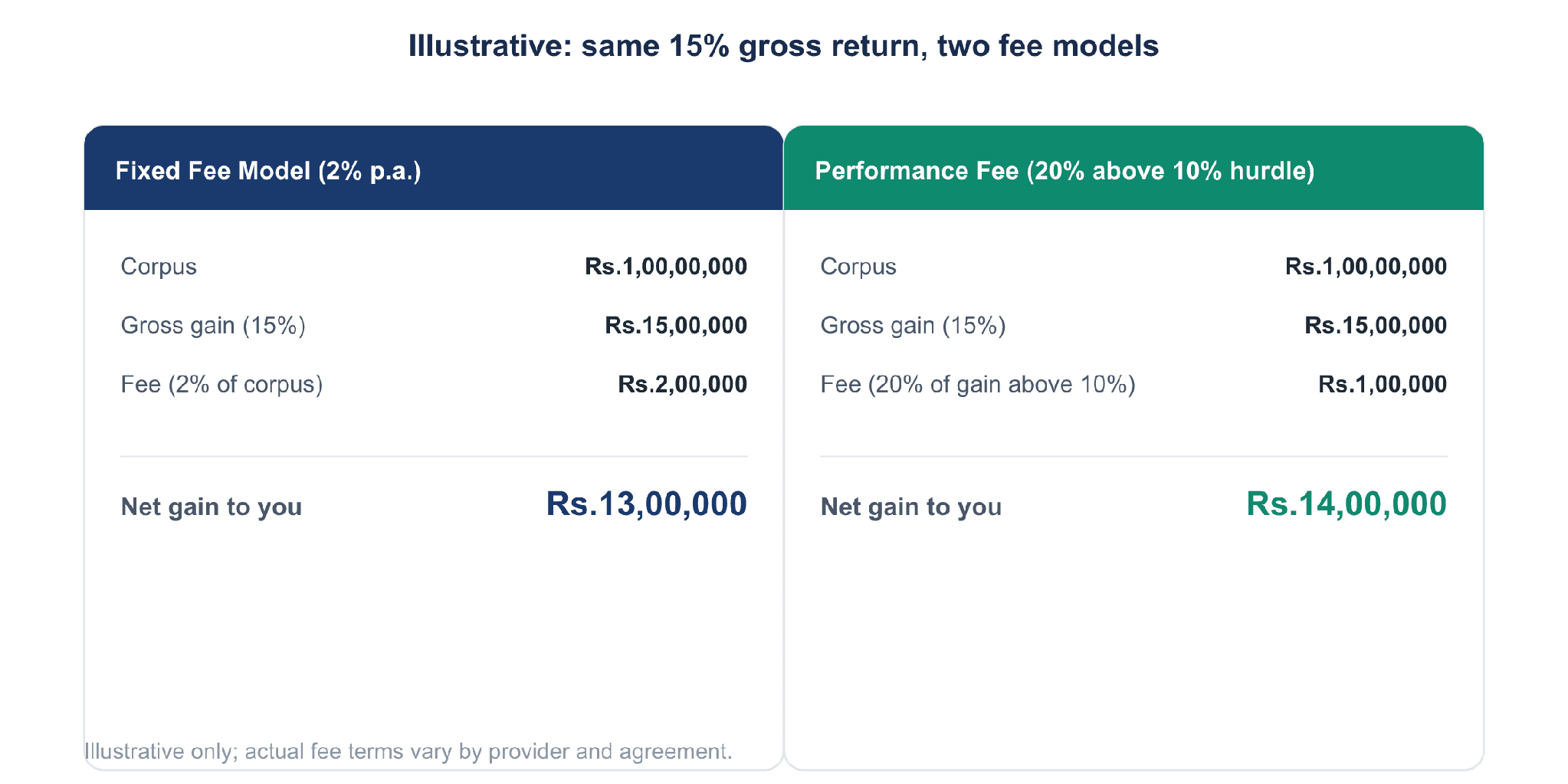
Illustrative comparison of fixed and performance-linked PMS fee models.
Exit loads are the other detail that rarely comes up until it is relevant. Many PMS structures charge 1% to 3% if you withdraw within 12 to 36 months, which matters if there is any chance you might need the capital back sooner than planned.
What to Verify Before Choosing a PMS Provider in Surat
A structured verification process beats a firm’s reputation alone. Our guide to evaluating the best PMS in India covers the full evaluation framework, including how to read a track record across market cycles rather than a single strong quarter.
What to Verify | Where to Check | Why It Matters |
SEBI registration number | SEBI's official intermediary portal | Confirms the firm is legally registered as a portfolio manager, not just self-described |
Discretionary vs non-discretionary | The client agreement itself | Decides who actually makes buy and sell decisions on your money |
Fee structure in writing | The disclosure document (Form C) | Fixed and performance fees create different incentives |
Exit load window | The client agreement | Many PMS structures charge 1% to 3% if withdrawn within 12 to 36 months |
Table: what to verify before choosing a PMS provider, and why each check matters.
Our SEBI-registered PMS guide walks through exactly how to confirm a registration number is active and current, a step worth doing before any conversation goes further.
Why Should You Choose Ckredence Wealth?
Ckredence Wealth is headquartered in Surat and is a SEBI registered portfolio manager (INP000007164), running four distinct PMS strategies for investors whose corpus has crossed the Rs.50 lakh threshold. Business owners are a large share of the clients we work with, and investment planning for HNI business owners is built around that, not a generic salaried-investor template.
Solutions That Matter:
Direct access to our PMS strategies, with fee structures explained upfront, not after you have signed.
Discretionary and non-discretionary options, matched to how much control you actually want to keep.
A Surat-based team that understands trade-linked, seasonal cash flow, not just salaried income patterns.
Ready to see whether PMS fits your situation? Schedule a Consultation!
Conclusion
PMS in Surat is not a single decision, it is several: whether you want discretionary or non-discretionary control, which fee model actually fits your expected returns, and what the exit terms commit you to. The Rs.50 lakh minimum is the same everywhere in India, but the fine print around fees and exit loads is where providers genuinely differ.
Verify the registration, read the fee structure in writing, and check the exit load before you look at anything else, including the pitch. A provider confident in their own numbers will not mind you asking.
FAQs
01.
What is the minimum investment for PMS in Surat?
Rs.50 lakh, the SEBI-mandated minimum that applies across India, not a Surat-specific figure.
02.
Is a fixed fee or performance-linked fee better for PMS?
Neither is universally better. A fixed fee is more predictable regardless of returns, while a performance-linked fee can cost less in a strong year and more closely aligns the manager’s incentive with your outcome, but costs more when returns are high.
03.
What happens if I need to withdraw from a PMS early?
Many PMS agreements include an exit load, often 1% to 3%, if you withdraw within 12 to 36 months, so it is worth checking this window before committing capital you might need back sooner.
04.
How do I verify a PMS provider is genuinely SEBI-registered?
Check the registration number directly on SEBI’s official intermediary portal, rather than relying on the number as displayed on the firm’s own website or brochure.
Unlike the broader question of who to trust with your money, PMS in Surat comes with specific, checkable mechanics: a SEBI-mandated minimum investment, a defined fee structure, and an exit load window, and most local searches skip straight past them to "which firm is best."
India's PMS industry oversees assets of roughly Rs.42 lakh crore as of mid-2026, per APMI, and that scale means the fine print, not the pitch, is what actually determines your outcome.
If you have not yet decided PMS is the right category for you, our broader guide to wealth advisory in Surat covers PMS alongside RIA, mutual fund, and brokerage options. This guide assumes you are already looking specifically at PMS.
Before you choose a provider, ask yourself:
Do you know whether the fee structure being pitched to you is fixed, performance-linked, or a hybrid, and what that changes in a good year versus a flat one?
Have you checked the exit load window, or only the headline returns?
Do you actually want a discretionary manager making every call, or more involvement in the decisions?
This guide walks through what SEBI registration, fees, and exit terms actually mean for PMS in Surat, so the decision comes down to fit, not just a pitch.
TL;DR
PMS requires a SEBI-mandated minimum investment of Rs.50 lakh, the same threshold across India, Surat included.
Fee models are typically fixed (roughly 1.5% to 2.5% annually) or performance-linked (roughly 15% to 20% above a hurdle rate), and the two can produce very different costs in the same year.
Many PMS structures charge a 1% to 3% exit load if withdrawn within 12 to 36 months, a detail worth checking before, not after, you commit.
Discretionary PMS gives the manager full control; non-discretionary and advisory models keep more decisions with you.
SEBI registration should be verified directly on the regulator’s portal, not taken from a firm’s own marketing.
Track record across a full market cycle matters more than recent returns alone.
What SEBI Registration Actually Means for PMS in Surat
A SEBI-registered portfolio manager operates under specific rules that a mutual fund distributor or a general broker does not. Our guide to types of portfolio management services breaks down the discretionary, non-discretionary, and advisory models in depth, but the short version matters here too.
Discretionary PMS: the manager makes buy, hold, and sell decisions on your behalf, within the agreed strategy.
Non-discretionary PMS: the manager recommends, but every trade needs your approval first.
Every PMS in India, Surat included, carries a SEBI-mandated minimum investment of Rs.50 lakh, which keeps this firmly in HNI territory.
DISCRETIONARY OR NON-DISCRETIONARY IS YOUR FIRST DECISION |
Most people choose based on the pitch, not on how much control they actually want to keep. That choice should come first. |
How PMS Fees and Exit Loads Work
The same 15% gross return can leave you with meaningfully different net gains depending on the fee model. Our breakdown of PMS charges and fee structures covers this in full, but the core trade-off is worth seeing in numbers.

Illustrative comparison of fixed and performance-linked PMS fee models.
Exit loads are the other detail that rarely comes up until it is relevant. Many PMS structures charge 1% to 3% if you withdraw within 12 to 36 months, which matters if there is any chance you might need the capital back sooner than planned.
What to Verify Before Choosing a PMS Provider in Surat
A structured verification process beats a firm’s reputation alone. Our guide to evaluating the best PMS in India covers the full evaluation framework, including how to read a track record across market cycles rather than a single strong quarter.
What to Verify | Where to Check | Why It Matters |
SEBI registration number | SEBI's official intermediary portal | Confirms the firm is legally registered as a portfolio manager, not just self-described |
Discretionary vs non-discretionary | The client agreement itself | Decides who actually makes buy and sell decisions on your money |
Fee structure in writing | The disclosure document (Form C) | Fixed and performance fees create different incentives |
Exit load window | The client agreement | Many PMS structures charge 1% to 3% if withdrawn within 12 to 36 months |
Table: what to verify before choosing a PMS provider, and why each check matters.
Our SEBI-registered PMS guide walks through exactly how to confirm a registration number is active and current, a step worth doing before any conversation goes further.
Why Should You Choose Ckredence Wealth?
Ckredence Wealth is headquartered in Surat and is a SEBI registered portfolio manager (INP000007164), running four distinct PMS strategies for investors whose corpus has crossed the Rs.50 lakh threshold. Business owners are a large share of the clients we work with, and investment planning for HNI business owners is built around that, not a generic salaried-investor template.
Solutions That Matter:
Direct access to our PMS strategies, with fee structures explained upfront, not after you have signed.
Discretionary and non-discretionary options, matched to how much control you actually want to keep.
A Surat-based team that understands trade-linked, seasonal cash flow, not just salaried income patterns.
Ready to see whether PMS fits your situation? Schedule a Consultation!
Conclusion
PMS in Surat is not a single decision, it is several: whether you want discretionary or non-discretionary control, which fee model actually fits your expected returns, and what the exit terms commit you to. The Rs.50 lakh minimum is the same everywhere in India, but the fine print around fees and exit loads is where providers genuinely differ.
Verify the registration, read the fee structure in writing, and check the exit load before you look at anything else, including the pitch. A provider confident in their own numbers will not mind you asking.
FAQs
01.
What is the minimum investment for PMS in Surat?
Rs.50 lakh, the SEBI-mandated minimum that applies across India, not a Surat-specific figure.
02.
Is a fixed fee or performance-linked fee better for PMS?
Neither is universally better. A fixed fee is more predictable regardless of returns, while a performance-linked fee can cost less in a strong year and more closely aligns the manager’s incentive with your outcome, but costs more when returns are high.
03.
What happens if I need to withdraw from a PMS early?
Many PMS agreements include an exit load, often 1% to 3%, if you withdraw within 12 to 36 months, so it is worth checking this window before committing capital you might need back sooner.
04.
How do I verify a PMS provider is genuinely SEBI-registered?
Check the registration number directly on SEBI’s official intermediary portal, rather than relying on the number as displayed on the firm’s own website or brochure.