
When to Change Your Financial Advisor in India
When should you change your financial advisor? Five warning signs, what switching really costs in India, and how to move without selling everything.

Ckredence Wealth |November 27, 2026

Change your financial advisor when you can no longer see how they are paid or when they go quiet in a falling market. Frequent product switches without a written reason are a third signal. One bad year of returns, on its own, is rarely the right trigger.
Most investors switch for the wrong reason and stay for the wrong reason. A Surat textile family may tolerate ten years of product churn because the relationship manager attends every wedding. The same family may then leave a careful adviser after a single weak year.
This guide sets out the signals that matter, what moving actually costs, and how to switch without selling your portfolio.
TL; DR
Weak returns in one year are the weakest reason to change a financial advisor.
Unclear pay, silence in a downturn and frequent product switches are stronger signals.
Distributors earned about ₹21,107 crore in mutual fund commission in FY25, so how your adviser is paid matters.
You can usually change who services your investments without selling them.
The Five Silences below are five things a good advisor tells you without being asked.
Check the next adviser's SEBI registration before you sign anything.
Share your current statements and we will tell you what we see, including whether you need to change anything.
How Do You Know When to Switch Financial Advisors?
You know it is time when trust in the process breaks, not when one year's numbers disappoint. Three signals carry the most weight. You cannot say how your adviser is paid, they did not call during the last fall, and your products keep changing.
The assumption is that you change advisers after poor returns. The reality is that returns over one or two years mostly reflect the market, while conflicts and neglect reflect the adviser.
A Rajkot engineering-goods owner whose portfolio fell with the index has learned little. One whose adviser sold him three insurance-linked plans in four years has learned a lot.
Our guide on whether you need a financial advisor at all covers the earlier question. This one assumes you have one and are unsure.
What Are the Red Flags in a Financial Advisor Relationship in India?
The warning signs below are checkable. Each one can be tested against a document, not just a feeling.
Red flag | Why it matters | How to check |
You cannot state their annual pay in rupees | Hidden pay hides conflicts | Ask for commission or fee disclosure in writing |
Frequent switches between funds or plans | Each new product can restart commission or exit costs | Count changes in your last three statements |
Silence during a market fall | The advice you pay for matters most then | Recall the last 10% fall: did they call? |
They call themselves an "advisor" without SEBI IA registration | Only SEBI-registered investment advisers may advise for a fee | Search the name on SEBI's intermediary register |
Advice covers one product line only | Nobody is looking at the whole picture | Ask who reviews your total portfolio |
The fourth flag is common. A mutual fund distributor is registered with AMFI and earns commission, while an investment adviser is registered with SEBI and charges a fee. Our page on what a SEBI-registered investment adviser does explains the difference.
Why Does It Matter How Your Financial Advisor Is Paid?
Because pay shapes advice. Commission rewards selling; fees reward advising, and most investors cannot tell which they are getting.
The sums are large. Business Standard reported that about 3,150 leading distributors earned ₹21,107 crore in mutual fund commission in FY25. Commission is not wrong in itself, but you should know what yours is.
📊 ₹21,107 crore in distributor commission, FY25 That is paid through regular-plan expense ratios, so investors bear it. Knowing your share in rupees is the first step to judging whether the service is worth it. *Source: Business Standard, FY25 data, published 31 August 2025* |
Disclosure is tightening. From 1 May 2026, distributors must show their registration details in client communication. The direct versus regular mutual fund gap shows what commission costs in practice.
The Five Silences: What a Good Advisor Tells You Unasked
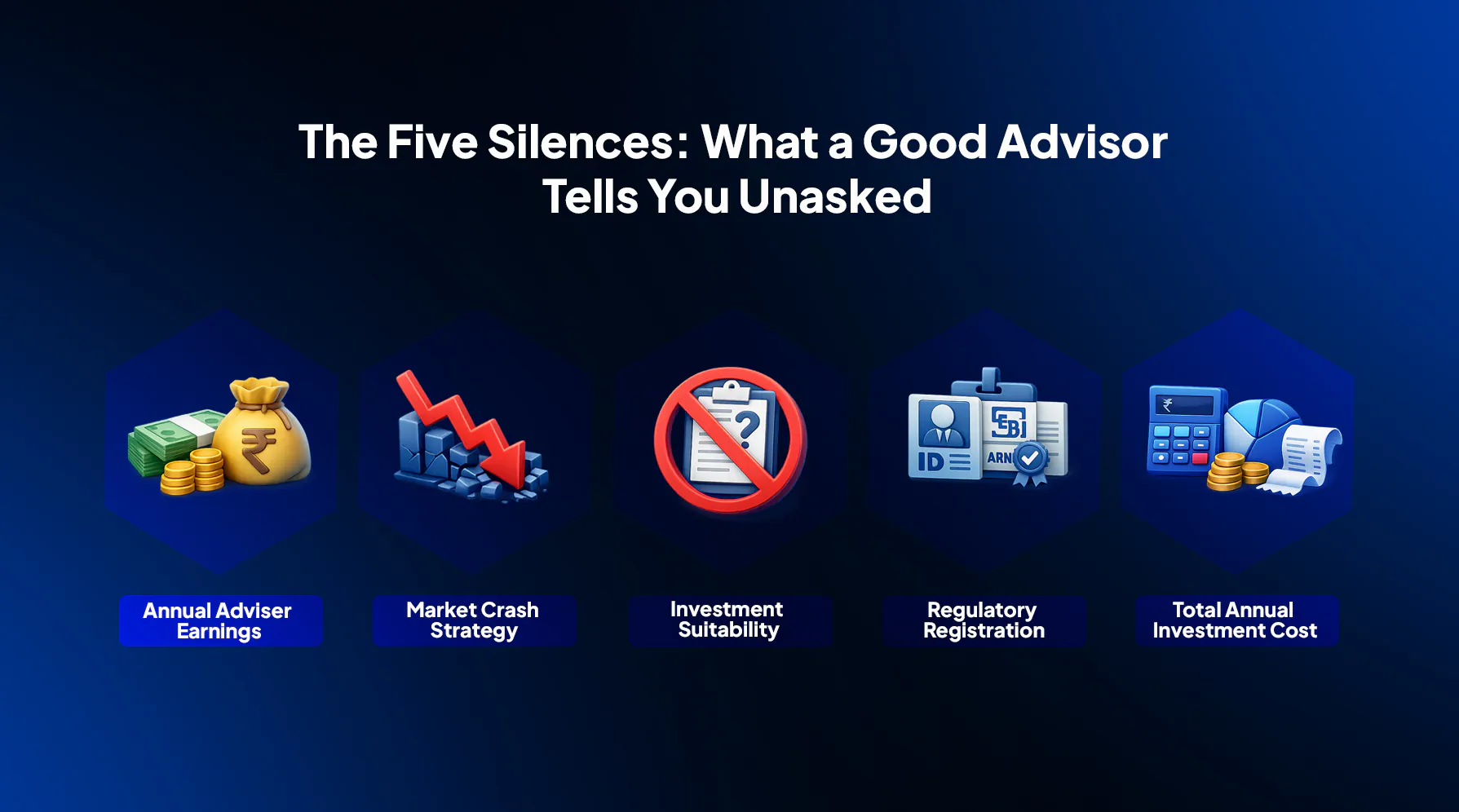
This is the test we suggest to any family reviewing an adviser, including us. A good adviser volunteers these five things before you have to ask.
What they earn from you, in rupees. Not a percentage buried in a factsheet, but an annual figure.
What they will do if markets fall 30%. Said in advance, not explained afterwards.
When not to buy what they sell. An adviser who never says "this is not for you" is selling.
Their registration and what it permits. SEBI IA, AMFI ARN, or both, and in which entity.
Your total annual cost across every product. Fund expenses, fees, insurance charges and exit loads together.
If two or more of these have never come up, the relationship has a gap. Our checklist for reviewing mutual fund advisory services adds questions for fund-only relationships. The pattern we see most in Gujarat business families is that points 1 and 5 are missing, while the service feels warm and personal.
Run the Five Silences on your own portfolio
Bring your statements and we will help you put a rupee figure on what you pay today, with no obligation to move.
How Do You Switch Financial Advisors Without Selling Everything?
In most cases you change who services your investments, not the investments themselves. Changing your adviser is not the same as selling your holdings.
Mutual funds in a regular plan: you can change the distributor code on existing units without selling them. Moving to a direct plan is a switch, which counts as a redemption for tax.
Shares in your demat account: they stay where they are. You simply stop acting on the old adviser's calls.
PMS: you end the agreement under its exit terms. Read how the PMS exit process works before you give notice.
Insurance-linked plans: surrender charges can be high in early years, so get the surrender value in writing first.
A Navsari doctor moving from a commission-based planner to a fee-only adviser can keep every fund. Only the servicing and the advice change.
What Does Changing Your Financial Advisor Cost?
The cost depends on what you sell, not on the change itself. Tax applies only if you redeem, and listed equity gains are taxed at 20% short-term and 12.5% long-term above ₹1.25 lakh a year. Exit loads also apply, and our PMS fee structure guide shows how they work in a PMS.
⚠️ Risk to understand Some new advisers recommend selling everything to "start clean". That can trigger tax and exit loads that take years of fee savings to recover. Ask for the cost of the move in rupees first. |
The channel is also shifting. Business Standard, citing Kotak Institutional Equities, reported that non-bank distributors took 75% of commission payouts in FY25, up from 65% in FY18.
Source: Business Standard, FY25 data, published 8 September 2025
Who Should Not Change Their Financial Advisor Yet?
Stay put for now if your only complaint is the last year's return. Patience with a sound process usually beats a rushed move.
Hold off as well if you are mid-way through a large tax event, such as a property sale or business exit. A change of hands then can cause errors. A family whose adviser passes the Five Silences has little to gain from switching, even if a rival pitch sounds better.
Before you choose a replacement, use our guide on how to choose a financial advisor in India. SEBI's chairman said in March 2026 that India has only about 1,000 registered investment advisers, so check registration carefully.
Source: Cafemutual, as of 16 March 2026
Data Sources & Methodology
Commission figures: Business Standard's reporting of AMFI data for FY25, and Kotak Institutional Equities.
Adviser count: the SEBI chairman's speech at ARIA Aspire on 16 March 2026, as reported by Cafemutual.
Tax rates: those applying to listed equity in FY 2026-27.
The Five Silences: Ckredence's own framework.
Ready to Review Your Financial Advisor?
Judge your adviser on pay, presence and product churn, not on last year's return. If the Five Silences show gaps, ask your current adviser to fill them before you move.
If you decide to work with a fee-only adviser, our SEBI-registered advisory team can explain how the arrangement works.
FAQs
How do I know when to switch financial advisors?
Switch when you cannot see how your adviser is paid, when they stayed silent through a market fall, or when your products keep changing without a written reason. One weak year of returns, alone, is not a strong signal.
When to dump your financial advisor?
Leave when trust in the process is gone: hidden pay, pressure to buy, or no review of your whole portfolio. Leave immediately if they are advising for a fee without SEBI investment adviser registration.
How often do people switch financial advisors?
Most investors switch rarely, and often for the wrong reason, such as one poor year. A yearly review of pay, communication and product changes is a better habit than waiting for frustration.
What is the 80/20 rule for financial advisors?
It usually refers to advisers earning most of their revenue from a small share of clients. For you, it is a reminder to ask how much attention your account actually receives.