
PMS Exit Process and Lock-In Period in India: The Real Rules
SEBI does not permit PMS lock-in periods. See the real exit process, the Rs 50 lakh partial withdrawal rule, exit loads and tax on exit.

Ckredence Wealth |September 27, 2026
PMS exit process and lock-in rules in India are widely misreported. Many comparisons online describe lock-in periods of one to five years depending on strategy or provider. SEBI does not permit a portfolio manager to impose a lock-in on a client's investment at all, in any strategy, at any provider.
What providers actually charge is an exit load, a fee for leaving early, not a legal restriction on access. A Surat promoter who assumed his PMS money was locked for three years, the way his father's insurance policies once were, is making a decision on a rule that does not exist. This guide covers what can actually stop or delay your exit.
TL; DR
- SEBI does not permit any portfolio manager to impose a lock-in period, in any strategy.
- What looks like a lock-in is an exit load, a fee schedule, not a legal restriction on your money.
- If your portfolio value has fallen below Rs. 50 lakh, you cannot make a partial withdrawal at all until it recovers.
- A change in control of your portfolio manager triggers a 30-calendar-day exit window with zero exit load.
- Tax applies on exit the same way it applies on any direct equity sale, not as a separate PMS tax.
- SEBI's Master Circular for Portfolio Managers (16 July 2025) governs most of these exit mechanics.
- Most "PMS lock-in" content online is describing the exit load schedule, not an actual restriction.
Get your exit flexibility questions answered before you commit capital.
| → Start a Structured Portfolio Review |
Does PMS Actually Have a Lock-In Period in India?
No. SEBI's Portfolio Managers FAQ states plainly that a portfolio manager cannot impose a lock-in on a client's investment. This is a specific, checkable regulatory fact, the same way you can verify any portfolio manager's SEBI registration yourself, not a matter of provider policy.
The assumption repeated across PMS comparison content is that equity strategies carry a three to five year lock-in, debt strategies six months to a year, and so on by provider. The reality is the opposite: nothing in SEBI's framework allows any of that. What those comparisons are actually describing, without naming it correctly, is each provider's exit load schedule.
What Happens If You Want to Exit Before the Portfolio Has Grown?
You can exit at any time. The only consequence is an exit load, a fee, not a denial of access. Exit loads are common in the first two years and typically taper: 2% in year one, 1% in year two, and nil after that.
This structure discourages very short holding periods without ever preventing them. For the fixed and performance-fee components that apply alongside any exit load, see our guide to PMS charges and fee structure.
Can You Make a Partial Withdrawal From Your PMS Account?
Usually yes, with one sharp exception. If market movement has taken your portfolio below the Rs. 50 lakh regulatory minimum, you cannot withdraw any amount until it recovers above that threshold, even if you originally invested far more.
SEBI does not require you to top up a portfolio that has fallen below Rs. 50 lakh. It simply freezes partial withdrawals until the value is back above the line. Our guide to the PMS minimum investment explains how that threshold is calculated and maintained.
Already Invested and Thinking About an Exit? Whether a full or partial exit makes sense depends on your current portfolio value against the Rs. 50 lakh floor.
| → Talk Through Your Exit Options |
What Is the Standard PMS Exit Process, Step by Step?
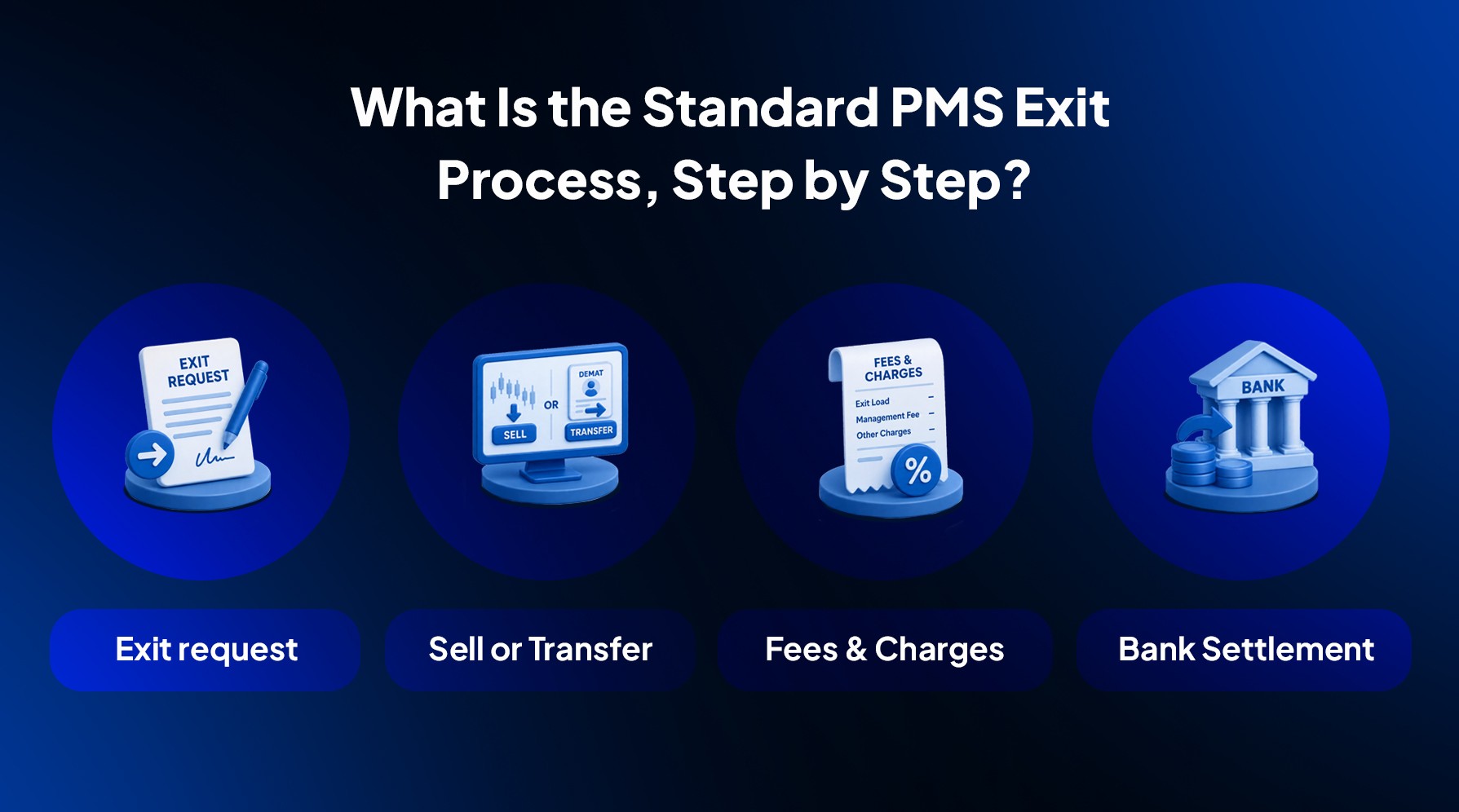
Exiting is closer to a stock sale than to redeeming a mutual fund. You instruct your portfolio manager, they liquidate or transfer the relevant holdings, and funds settle to your linked bank account.
- Submit a written exit or withdrawal request, full or partial, to your portfolio manager
- The manager liquidates the relevant securities or transfers them to your own demat, per your instruction, though exactly how that instruction works differs between discretionary and non-discretionary mandates
- Any applicable exit load and fees are deducted as per the Disclosure Document
- Net proceeds settle to your linked bank account, typically within a few business days of trade settlement
The pattern we see across Gujarat business families is that exits driven by a sudden need for liquidity move faster than exits driven by dissatisfaction, mainly because the first involves no second-guessing of the instruction.
Does Changing Your Portfolio Manager's Ownership Give You an Exit Option?
Yes. A change in control of your portfolio manager triggers a mandatory exit window of not less than 30 calendar days, with zero exit load. This is a specific investor protection, not a courtesy.
Portfolio managers must inform existing clients of a proposed change in control before it takes effect and offer this free exit window. What we see most often with investors is that they do not know this right exists until a firm actually changes hands, the same knowledge gap our guide on how to invest in portfolio management services addresses on the entry side.
What Are the Tax Implications When You Exit a PMS?
Exiting a PMS is taxed the same way selling direct equity is, because that is what it legally is. There is no separate "PMS tax." Short-term and long-term capital gains rules apply security by security, based on your own holding period for each one.
This is a meaningfully different mechanic from a mutual fund redemption, where you sell fund units rather than individual securities. Our guide to taxation on mutual funds and PMS covers the applicable rates and holding-period rules in full.
Who Should Think Twice Before Exiting a PMS Early?
Exiting is not always the right move just because it is available. Three situations are worth pausing on first.
- Your reason for exiting is a single weak quarter rather than a change in your own goals or risk comfort. Our guide to PMS returns in India covers why short periods mislead.
- Your portfolio sits close to the Rs. 50 lakh floor, where a partial exit could freeze future withdrawals entirely.
- You have not compared the exit load you will pay against simply waiting a few months for it to taper further.
There is no cost to a conversation before you instruct an exit. There is a real cost to an exit load paid on a decision you later reconsider.
| 📊 No Lock-In, By RegulationSEBI's own FAQ confirms portfolio managers cannot impose a lock-in on client investments, and can only charge a disclosed exit fee for early withdrawal.Source: SEBI, Portfolio Managers FAQ, as of 20 September 2024 |
According to Cafemutual's report on SEBI's investor-protection norms, a change in a portfolio manager's control requires a minimum 30-calendar-day free exit window for existing clients.
Source: Cafemutual, as of the SEBI circular on change in control
SEBI's Master Circular for Portfolio Managers, dated 16 July 2025, consolidates the current exit, disclosure, and reporting norms referenced throughout this guide.
Source: APMI, Master Circular for Portfolio Managers, as of 16 July 2025
Conclusion
PMS exit process and lock-in rules in India come down to one regulatory fact most comparisons get wrong. There is no lock-in, only a disclosed exit load, and a firm Rs. 50 lakh floor on partial withdrawals.
Understanding these mechanics before you invest, not after, is what actually determines how much flexibility you have. Our guide to PMS onboarding timing covers the other side of this same decision.
Not sure whether PMS's liquidity profile fits your situation? Talk it through with us first.
| → Review Your Mandate With Us |
FAQs
Is there a lock-in period in PMS?
No. SEBI does not permit a portfolio manager to impose a lock-in on a client's investment. Providers may charge a disclosed exit load for early withdrawal, which is a fee, not a restriction on access.
What is the minimum investment required to maintain a PMS account?
SEBI requires a minimum of Rs. 50 lakh at entry. If the portfolio later falls below this due to market movement, no top-up is required, but partial withdrawals are not permitted until it recovers.
Is PMS regulated by SEBI?
Yes. Every portfolio manager must be registered with SEBI, and exit mechanics, disclosure norms, and investor protections are governed by SEBI's Portfolio Managers Regulations and Master Circular.
How long does it take to receive funds after exiting a PMS?
Once an exit instruction is processed, proceeds typically settle within a few business days, similar to a standard stock sale settlement cycle, though this varies by portfolio manager and market conditions.