10 min

10 min

PMS Onboarding Process Timeline in India: What to Expect, Step by Step

PMS Onboarding Process Timeline in India: What to Expect, Step by Step

PMS Onboarding Process Timeline in India: What to Expect, Step by Step

What the PMS onboarding process actually looks like in India, stage by stage, and how long each step takes from KYC to fund deployment.

What the PMS onboarding process actually looks like in India, stage by stage, and how long each step takes from KYC to fund deployment.

What the PMS onboarding process actually looks like in India, stage by stage, and how long each step takes from KYC to fund deployment.

Ckredence Wealth

Ckredence Wealth

|

PMS Onboarding Process Timeline in India

If you are still deciding whether PMS is right for you, or which provider to choose, our existing guide on how to invest in portfolio management services covers that groundwork. This one assumes you have already decided, and answers a narrower, more practical question: once you commit, how long does it actually take before your money is invested?

The standard PMS onboarding process in India takes 5 to 10 business days from document submission to fund deployment, provided your KYC is already active and validated. That range is wide because each stage depends on how quickly documents come together, not just on the provider.

Before you start the process, ask yourself:

  • Is your KYC already validated on central registries, or will that need to happen first?

  • Are you a resident Indian or an NRI? The timeline differs meaningfully between the two.

  • Do you have your PAN, Aadhaar, and address proof ready, or will gathering documents be the actual bottleneck?

This guide breaks the onboarding process into its stages, with realistic durations for each.

TL;DR

  1. Standard PMS onboarding in India takes 5 to 10 business days, from document submission to fund deployment.

  2. The process runs through four stages: KYC, documentation and agreements, bank and demat account alignment, and fund transfer.

  3. Already-validated KYC significantly shortens the timeline; starting KYC from scratch adds days to the first stage.

  4. NRI onboarding typically takes longer due to FEMA, RBI, and Portfolio Investment Scheme approvals.

  5. The minimum regulatory investment of Rs.50 lakh, or existing securities, must be transferred before the manager begins deployment.

  6. Most delays come from incomplete documentation, not the provider’s internal process.

Stage-by-Stage Timeline

Stage

Duration

What Happens

Initial Setup & KYC

1 to 2 days

Risk profiling, suitability check, PAN, Aadhaar, and address verification

Documentation & Agreements

2 to 3 days

Review the Disclosure Document, sign the PMS agreement, submit FATCA declarations

Bank & Demat Alignment

2 to 4 days

Link or open a dedicated PMS bank account and custodian demat account

Fund Transfer & Deployment

1 to 2 days

Transfer the minimum investment; the manager begins deploying the strategy

Table: the four stages of PMS onboarding, with typical duration and what happens in each.

READY KYC IS THE BIGGEST TIME SAVER

If your KYC is already active and validated, you skip the slowest part of stage one entirely.

Schedule a Consultation

Documents You’ll Need Before You Start

Having these ready before you begin is the single biggest lever you have over your own timeline.

  • PAN card and Aadhaar, for identity verification and digital KYC.

  • Address proof that exactly matches the name and address on your PAN, a common mismatch point.

  • A recent passport-size photograph and signature specimen.

  • Bank account details and a cancelled cheque, for the account that will be linked to your PMS.

  • FATCA and CRS declarations, a compliance requirement that is easy to overlook until it holds up the agreement stage.

  • For NRIs specifically: passport, visa or OCI card, and overseas address proof, in addition to the standard documents.

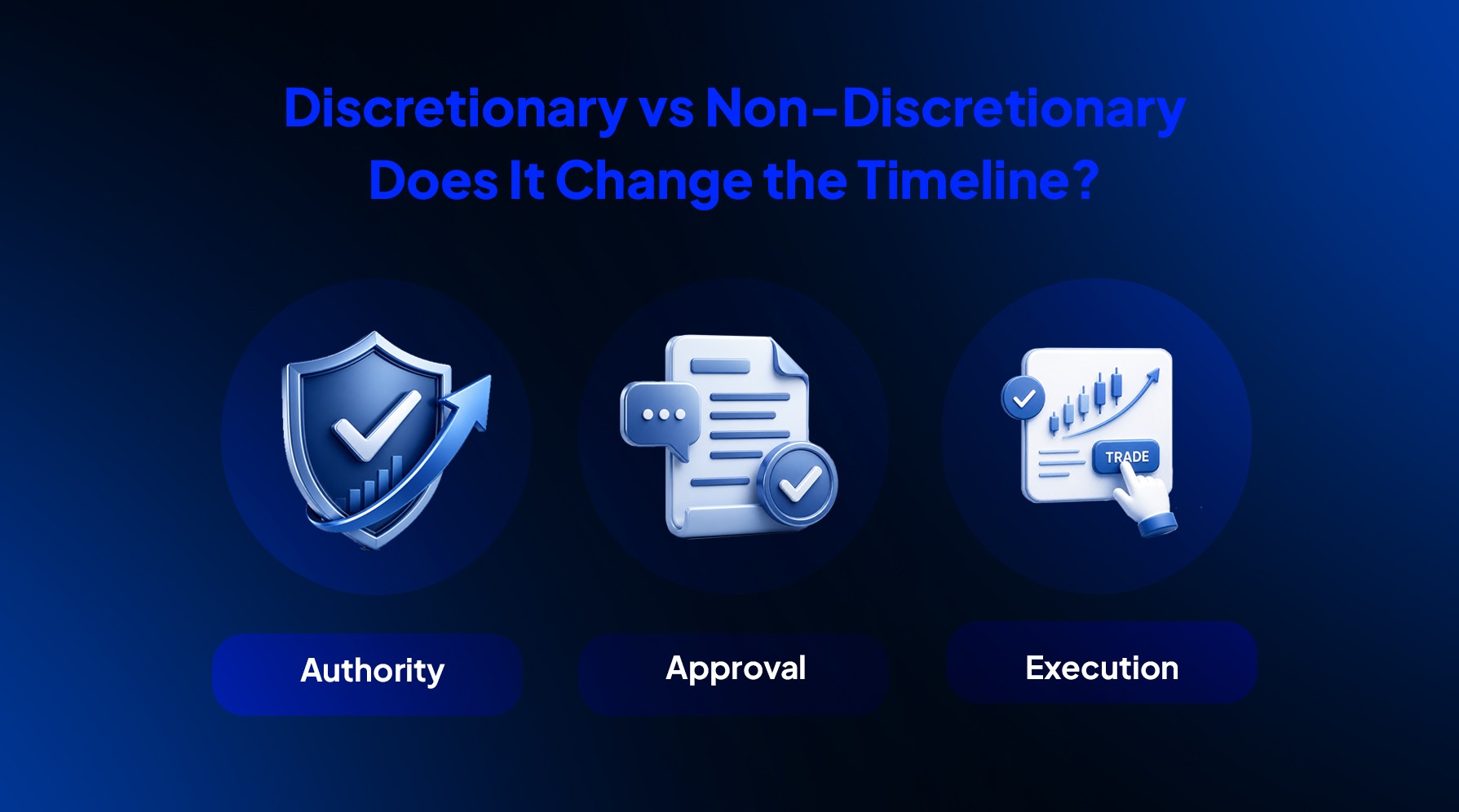
Discretionary vs Non-Discretionary: Does It Change the Timeline?

The PMS type you choose has a smaller effect on onboarding speed than most investors expect, but it is not zero.
Discretionary PMS vs Non Discretionary PMS
  • Discretionary PMS: generally the fastest to onboard, since the agreement grants the manager standing authority to trade, with no additional approval workflow to set up.

  • Non-discretionary PMS: onboarding itself takes about the same time, but the agreement includes an added layer defining how trade approvals will be communicated and confirmed, which can add a day to the documentation stage.

  • Advisory PMS: fastest of all to onboard, since the manager never takes custody of execution, though you take on the operational work of executing every trade yourself.

None of these differences are large enough to be the deciding factor between PMS types. Control preference should still drive that choice, not a day or two of onboarding time.

Why NRI Onboarding Takes Longer

For Non-Resident Indians, the bank and demat alignment stage can stretch well beyond the standard 2 to 4 days, since it also requires FEMA compliance, RBI approvals where applicable, and Portfolio Investment Scheme (PIS) account setup. Our PMS for NRI guide covers the additional requirements specific to NRI investors.

NRI ONBOARDING NEEDS A DIFFERENT TIMELINE ENTIRELY

Budget extra time for PIS and FEMA approvals if you are investing from outside India. Rushing this stage is where NRI onboarding usually stalls.

Schedule a Consultation

What Can Delay Your Onboarding

  • Incomplete or mismatched documents: address proof that does not match PAN records is a common, avoidable delay.

  • KYC not yet validated: starting from an inactive or unvalidated KYC status adds real time to stage one.

  • Missing FATCA declarations: a required document that is easy to overlook until it holds up the agreement stage.

  • Bank account mismatches: penny-drop verification fails when account details do not exactly match your KYC records.

What Happens After Day 9: Your First 30 Days

Fund deployment is not the finish line, it is the start of the part that actually matters.

  • Initial deployment: the manager rarely invests the full corpus on day one, positions are typically built over the first few weeks rather than all at once.

  • First portfolio report: most providers issue an initial holdings statement within the first month, your baseline for tracking performance going forward.

  • Relationship manager check-in: a call to confirm the strategy matches what was discussed, and to answer questions before the first full reporting cycle.

  • Ongoing reporting cadence: monthly or quarterly thereafter, depending on the provider, this is worth confirming during onboarding rather than assuming.

Why Should You Choose Ckredence Wealth?

We walk investors through each stage of this timeline directly, rather than leaving you to figure out what is next. Ckredence Wealth is a SEBI registered investment advisor (INA000020846) and portfolio manager (INP000007164), and our SEBI registration and onboarding documentation are available upfront, before you commit any capital.

Solutions That Matter:

  • A guided onboarding process through PMS, with document checklists provided in advance.

  • Support confirming your Rs.50 lakh minimum investment and eligibility before you begin the paperwork.

  • Dedicated support for NRI clients navigating FEMA and PIS requirements.

Ready to see your actual timeline? Schedule a Consultation!

Conclusion

The PMS onboarding process in India is not complicated, but it is sequential, KYC, documentation, account alignment, and fund transfer each depend on the one before it, and a delay in any stage pushes the whole timeline out. Five to ten business days is realistic when your paperwork is ready and your KYC is already validated.

The fastest path through onboarding is preparation, not urgency. Have your documents ready, confirm your KYC status before you start, and budget extra time if you are investing as an NRI. The process itself is straightforward once the inputs are.

FAQs

01 Number

How long does PMS onboarding take in India?

Typically 5 to 10 business days from document submission to fund deployment, assuming your KYC is already active and validated. Incomplete documentation or unvalidated KYC can extend this.

02 Number

Why is my PMS onboarding taking longer than expected?

The most common causes are mismatched documents, an inactive KYC status, missing FATCA declarations, or a bank account that fails penny-drop verification against your KYC records.

03 Number

Does NRI PMS onboarding take longer than for resident Indians?

Yes, usually. NRI onboarding involves additional FEMA compliance, potential RBI approvals, and Portfolio Investment Scheme account setup, which can extend the bank and demat alignment stage well beyond the standard timeline.

04 Number

Can I speed up the PMS onboarding process?

The most effective way is ensuring your KYC is already validated and your documents, PAN, Aadhaar, and address proof, are consistent and ready before you begin. Most delays come from document issues, not the provider’s internal processing time.


If you are still deciding whether PMS is right for you, or which provider to choose, our existing guide on how to invest in portfolio management services covers that groundwork. This one assumes you have already decided, and answers a narrower, more practical question: once you commit, how long does it actually take before your money is invested?

The standard PMS onboarding process in India takes 5 to 10 business days from document submission to fund deployment, provided your KYC is already active and validated. That range is wide because each stage depends on how quickly documents come together, not just on the provider.

Before you start the process, ask yourself:

  • Is your KYC already validated on central registries, or will that need to happen first?

  • Are you a resident Indian or an NRI? The timeline differs meaningfully between the two.

  • Do you have your PAN, Aadhaar, and address proof ready, or will gathering documents be the actual bottleneck?

This guide breaks the onboarding process into its stages, with realistic durations for each.

TL;DR

  1. Standard PMS onboarding in India takes 5 to 10 business days, from document submission to fund deployment.

  2. The process runs through four stages: KYC, documentation and agreements, bank and demat account alignment, and fund transfer.

  3. Already-validated KYC significantly shortens the timeline; starting KYC from scratch adds days to the first stage.

  4. NRI onboarding typically takes longer due to FEMA, RBI, and Portfolio Investment Scheme approvals.

  5. The minimum regulatory investment of Rs.50 lakh, or existing securities, must be transferred before the manager begins deployment.

  6. Most delays come from incomplete documentation, not the provider’s internal process.

Stage-by-Stage Timeline

Stage

Duration

What Happens

Initial Setup & KYC

1 to 2 days

Risk profiling, suitability check, PAN, Aadhaar, and address verification

Documentation & Agreements

2 to 3 days

Review the Disclosure Document, sign the PMS agreement, submit FATCA declarations

Bank & Demat Alignment

2 to 4 days

Link or open a dedicated PMS bank account and custodian demat account

Fund Transfer & Deployment

1 to 2 days

Transfer the minimum investment; the manager begins deploying the strategy

Table: the four stages of PMS onboarding, with typical duration and what happens in each.

READY KYC IS THE BIGGEST TIME SAVER

If your KYC is already active and validated, you skip the slowest part of stage one entirely.

Schedule a Consultation

Documents You’ll Need Before You Start

Having these ready before you begin is the single biggest lever you have over your own timeline.

  • PAN card and Aadhaar, for identity verification and digital KYC.

  • Address proof that exactly matches the name and address on your PAN, a common mismatch point.

  • A recent passport-size photograph and signature specimen.

  • Bank account details and a cancelled cheque, for the account that will be linked to your PMS.

  • FATCA and CRS declarations, a compliance requirement that is easy to overlook until it holds up the agreement stage.

  • For NRIs specifically: passport, visa or OCI card, and overseas address proof, in addition to the standard documents.

Discretionary vs Non-Discretionary: Does It Change the Timeline?

The PMS type you choose has a smaller effect on onboarding speed than most investors expect, but it is not zero.

Discretionary PMS vs Non Discretionary PMS
  • Discretionary PMS: generally the fastest to onboard, since the agreement grants the manager standing authority to trade, with no additional approval workflow to set up.

  • Non-discretionary PMS: onboarding itself takes about the same time, but the agreement includes an added layer defining how trade approvals will be communicated and confirmed, which can add a day to the documentation stage.

  • Advisory PMS: fastest of all to onboard, since the manager never takes custody of execution, though you take on the operational work of executing every trade yourself.

None of these differences are large enough to be the deciding factor between PMS types. Control preference should still drive that choice, not a day or two of onboarding time.

Why NRI Onboarding Takes Longer

For Non-Resident Indians, the bank and demat alignment stage can stretch well beyond the standard 2 to 4 days, since it also requires FEMA compliance, RBI approvals where applicable, and Portfolio Investment Scheme (PIS) account setup. Our PMS for NRI guide covers the additional requirements specific to NRI investors.

NRI ONBOARDING NEEDS A DIFFERENT TIMELINE ENTIRELY

Budget extra time for PIS and FEMA approvals if you are investing from outside India. Rushing this stage is where NRI onboarding usually stalls.

Schedule a Consultation

What Can Delay Your Onboarding

  • Incomplete or mismatched documents: address proof that does not match PAN records is a common, avoidable delay.

  • KYC not yet validated: starting from an inactive or unvalidated KYC status adds real time to stage one.

  • Missing FATCA declarations: a required document that is easy to overlook until it holds up the agreement stage.

  • Bank account mismatches: penny-drop verification fails when account details do not exactly match your KYC records.

What Happens After Day 9: Your First 30 Days

Fund deployment is not the finish line, it is the start of the part that actually matters.

  • Initial deployment: the manager rarely invests the full corpus on day one, positions are typically built over the first few weeks rather than all at once.

  • First portfolio report: most providers issue an initial holdings statement within the first month, your baseline for tracking performance going forward.

  • Relationship manager check-in: a call to confirm the strategy matches what was discussed, and to answer questions before the first full reporting cycle.

  • Ongoing reporting cadence: monthly or quarterly thereafter, depending on the provider, this is worth confirming during onboarding rather than assuming.

Why Should You Choose Ckredence Wealth?

We walk investors through each stage of this timeline directly, rather than leaving you to figure out what is next. Ckredence Wealth is a SEBI registered investment advisor (INA000020846) and portfolio manager (INP000007164), and our SEBI registration and onboarding documentation are available upfront, before you commit any capital.

Solutions That Matter:

  • A guided onboarding process through PMS, with document checklists provided in advance.

  • Support confirming your Rs.50 lakh minimum investment and eligibility before you begin the paperwork.

  • Dedicated support for NRI clients navigating FEMA and PIS requirements.

Ready to see your actual timeline? Schedule a Consultation!

Conclusion

The PMS onboarding process in India is not complicated, but it is sequential, KYC, documentation, account alignment, and fund transfer each depend on the one before it, and a delay in any stage pushes the whole timeline out. Five to ten business days is realistic when your paperwork is ready and your KYC is already validated.

The fastest path through onboarding is preparation, not urgency. Have your documents ready, confirm your KYC status before you start, and budget extra time if you are investing as an NRI. The process itself is straightforward once the inputs are.

FAQs

01 Number

How long does PMS onboarding take in India?

Typically 5 to 10 business days from document submission to fund deployment, assuming your KYC is already active and validated. Incomplete documentation or unvalidated KYC can extend this.

02 Number

Why is my PMS onboarding taking longer than expected?

The most common causes are mismatched documents, an inactive KYC status, missing FATCA declarations, or a bank account that fails penny-drop verification against your KYC records.

03 Number

Does NRI PMS onboarding take longer than for resident Indians?

Yes, usually. NRI onboarding involves additional FEMA compliance, potential RBI approvals, and Portfolio Investment Scheme account setup, which can extend the bank and demat alignment stage well beyond the standard timeline.

04 Number

Can I speed up the PMS onboarding process?

The most effective way is ensuring your KYC is already validated and your documents, PAN, Aadhaar, and address proof, are consistent and ready before you begin. Most delays come from document issues, not the provider’s internal processing time.