11 min Read

11 min Read

Direct Mutual Fund vs Regular Mutual Fund: Which Option Makes More Sense in 2026?

Direct Mutual Fund vs Regular Mutual Fund: Which Option Makes More Sense in 2026?

Direct Mutual Fund vs Regular Mutual Fund: Which Option Makes More Sense in 2026?

Lower fees in direct plans sound simple until behaviour decides the outcome. Compare direct mutual fund vs regular mutual fund to find which structure suits you.

Lower fees in direct plans sound simple until behaviour decides the outcome. Compare direct mutual fund vs regular mutual fund to find which structure suits you.

Lower fees in direct plans sound simple until behaviour decides the outcome. Compare direct mutual fund vs regular mutual fund to find which structure suits you.

Ckredence Wealth

Ckredence Wealth

|

May 26, 2026

May 26, 2026

Direct mutual fund vs regular mutual fund comparison showing investor choosing between lower-cost direct plans and advisor-supported regular plans for long-term wealth creation.

India's mutual fund industry crossed ₹81–82 lakh crore in total AUM by early 2026, according to AMFI data, with monthly SIP contributions reaching ₹31,002 crore in December 2025. 

Within that industry, the direct-versus-regular debate has grown sharper as digital platforms make self-directed investing more accessible. Individual investors' AUM in direct plans soared 43% in 2025, far outpacing the 11% growth recorded in regular plans, according to Business Standard citing AMFI data.

Yet the choice between direct and regular plans is rarely settled by expense ratios alone. Despite rapid growth in direct plan adoption, regular plans still command the larger share of total industry AUM, because many investors need advisory support, behavioural discipline, and allocation guidance more than they need a lower fee. 

Understanding the direct mutual fund vs regular mutual fund difference in terms of cost, structure, and investor suitability is what actually drives better long-term outcomes.

TL;DR

  • Direct and regular plans invest in the same mutual fund portfolio; the difference lies in cost and advisory structure.

  • Direct plans generally have lower expense ratios because no distributor commission is involved.

  • Regular plans include advisory or distributor commissions within the expense ratio.

  • Even small fee differences can create a meaningful impact on long-term compounding.

  • Direct plans are often preferred by investors comfortable managing their own portfolios.

  • Regular plans may benefit investors who value guidance, portfolio reviews, and behavioural support.

  • The best choice depends on investor suitability, discipline, and advisory needs - not just lower fees.

What Is the Difference Between Direct and Regular Mutual Funds?

The core difference between direct and regular mutual funds lies in how the investment is purchased and serviced. In direct mutual funds, investors buy units directly from the Asset Management Company (AMC) without involving intermediaries, which keeps annual costs lower.

In regular mutual funds, investments are routed through banks, distributors, financial advisors, or brokerage platforms. Since intermediary commissions are included within the expense ratio, regular plans usually have slightly higher annual costs. 

Over long investment periods, this cost difference can materially affect portfolio compounding and final wealth creation outcomes.

Direct Mutual Funds Explained Simply

Direct mutual funds are purchased directly through the AMC or authorised investment platforms without distributor involvement. Since no intermediary commission is included, the expense ratio remains lower. 

This generally allows investors to retain slightly higher long-term returns through better compounding efficiency.

Investors managing direct plan investments independently can explore how a registered investment advisory relationship provides fee-based allocation guidance without the distributor commission embedded in regular plan costs.

Regular Mutual Funds Explained Simply

Regular mutual funds are purchased through intermediaries who provide different levels of service depending on their role.

  • Distributors help investors purchase mutual funds and usually provide basic investment assistance and transaction support.

  • Banks offer mutual fund investment services alongside banking products, making investing convenient for existing customers.

  • Advisors help investors with fund selection, asset allocation, financial planning, and long-term portfolio guidance.

  • Brokerage platforms allow investors to buy, track, and manage mutual fund investments through online investment accounts and digital platforms.

The expense ratio includes distributor commissions and advisory compensation in all regular plan structures.

Why NAV Differs Between Both Plans

Direct plans usually maintain slightly higher NAVs over time because lower expenses reduce annual cost leakage from the portfolio. The underlying portfolio remains the same across both plans. The cost structure is what changes.

Why Many Investors Focus Only on Returns and Ignore Expense Ratio Impact

Many investors compare mutual funds only through recent returns while ignoring how annual cost differences compound over long periods. That can materially affect final wealth creation outcomes.

"Price is what you pay. Value is what you get." Warren Buffett, Chairman and CEO, Berkshire Hathaway
Source: Berkshire Hathaway Annual Letter to Shareholders, 2008

  • Small fee differences compound over time: Even a 0.5% to 1% annual expense-ratio difference may create a large long-term wealth gap over 10–20 years because of compounding impact on both returns and costs.

  • Higher commissions reduce long-term wealth creation: Regular plans include intermediary commissions that increase annual fund expenses and reduce long-term portfolio compounding efficiency.

  • Why regular plans continue growing: Many investors still prefer regular plans because advisory support helps with asset allocation, behavioural discipline, portfolio reviews, and long-term financial planning.

  • Cost versus advisory value: Lower cost alone does not guarantee better outcomes if investors struggle with panic selling, poor allocation decisions, or inconsistent investing behaviour during volatile market cycles.

📊 23% of regular plan SIP investors held their investments for over 5 years, compared to only 12.4% of direct plan investors: Advisor-supported investing through regular plans tends to produce meaningfully longer holding periods and more consistent investing behaviour.
Source: AMFI-CRISIL Factbook 2024, March 2025

📋 The compounding impact of fees is real, but so is the compounding cost of poor investor behaviour. Speak with our SEBI-registered advisors to understand whether a direct or regular structure, combined with fee-based advisory, produces better long-term outcomes for your specific portfolio.

Direct Mutual Fund vs Regular Mutual Fund - Core Differences

Direct and regular mutual funds differ mainly in purchase route, cost structure, advisory involvement, and investor responsibility.

Feature

Direct Plan

Regular Plan

Purchase Route

Directly through AMC or platform

Through advisor, bank, or distributor

Expense Ratio

Lower

Higher

NAV Difference

Slightly higher over time

Slightly lower due to commissions

Advisory Support

Self-managed

Advisor-assisted

Investor Involvement

Higher

Lower

Best Suited For

DIY investors

Investors seeking guidance

The fund itself remains identical in both structures. The difference lies in fees, support, and investor involvement in decision-making. 

Investors evaluating where mutual fund advisory fits inside a broader wealth allocation framework often find that the direct-versus-regular question is secondary to getting asset allocation right in the first place.

How Expense Ratios Impact Long-Term Compounding

Expense ratio plays a major role in long-term mutual fund investing because the deduction happens every year regardless of market conditions.
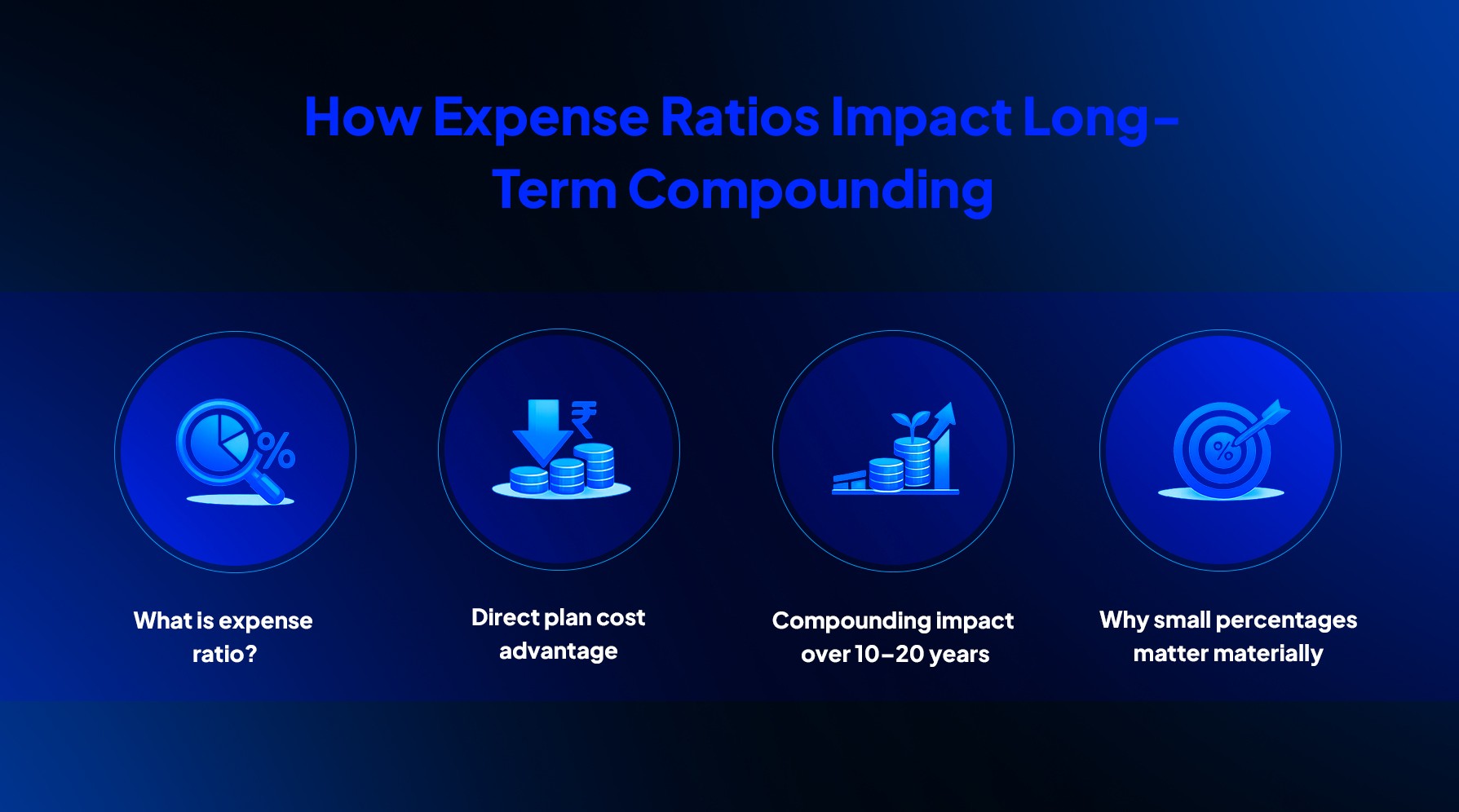
How expense ratios impact long-term compounding with direct plan cost advantage, lower fees, and mutual fund wealth growth illustration.

1. What is expense ratio? Expense ratio refers to the annual cost charged by the fund house for managing the scheme. This includes fund management costs, operational expenses, and distribution commissions depending on the plan type.

2. Direct plan cost advantage Direct plans usually carry lower expense ratios because no distributor commission is included within the structure. The expense ratio difference between direct and regular plans typically ranges from 0.5% to 1% annually, depending on fund category and AMC.

3. Compounding impact over 10–20 years A small annual fee difference may appear marginal initially but can create wealth gaps over long investment horizons, especially in SIP investing and retirement portfolios.

4. Why small percentages matter materially Compounding works on both returns and costs. Lower annual expenses help retain more invested capital within the portfolio over time, and that retained capital compounds alongside market returns.

📊 Direct plan share of total mutual fund industry AUM rose from 27.4% in March 2019 to 41.2% in March 2024: This steady growth reflects increasing investor awareness of expense ratio impact on long-term portfolio compounding. Source: AMFI-CRISIL Factbook 2024, reported March 2025 (Upstox)

Direct Mutual Fund vs Regular - Which Investors Usually Prefer Each?

Different mutual fund structures suit different investor personalities, financial-management styles, and involvement preferences.

Investor Type

Usually Prefers

Primary Reason

Self-Directed Investors

Direct Plans

Comfortable handling fund selection, asset allocation, portfolio reviews, and market behaviour independently

First-Time Investors

Regular Plans

Professional guidance helps reduce confusion and behavioural mistakes

Busy Professionals

Regular Plans

Advisor-supported investing offers convenience and portfolio discipline

HNIs Seeking Advisory Support

Regular Plans or Hybrid Approach

Often require allocation planning, taxation guidance, estate structuring, and behavioural discipline

DIY Investors with Market Knowledge

Direct Plans

Prefer lower expense ratios and greater control over investment decisions

Direct investing generally requires greater investor involvement and emotional discipline during volatile market periods. Regular plans may still benefit investors who value structured advisory support and long-term portfolio guidance.

Common Mistakes Investors Make While Choosing Direct or Regular Plans

Many mistakes happen when investors focus only on costs without evaluating suitability and behavioural discipline.

  • Selecting direct plans without allocation knowledge: Lower fees cannot compensate for poor asset-allocation decisions and emotional investing mistakes.

  • Choosing regular plans without understanding fees: Many investors remain unaware of how commissions affect long-term compounding over multi-decade horizons.

  • Focusing only on NAV differences: Higher NAV alone does not automatically make one plan universally superior across all investor types.

  • Ignoring behavioural discipline: Investor behaviour often affects returns more than small fee differences, particularly during market corrections.

  • Switching plans without tax evaluation: Moving from regular to direct plans may trigger capital gains taxation and exit-load implications depending on fund type and holding period.

🛡️ Switching from regular to direct plans without assessing tax impact first can cost more than the fees saved. Book an advisory consultation to evaluate the tax-efficient restructuring approach before making any changes to your mutual fund allocation.

Direct Mutual Fund vs Regular - Which Option Fits Different Investor Types?

Different mutual fund structures suit different investor profiles and financial behaviour. The right choice depends not only on cost, but also on investment knowledge, behavioural discipline, and the ability to manage portfolios during volatile market conditions.

1. Beginner Investors

Beginners often benefit from regular plans if professional guidance improves discipline, allocation behaviour, and long-term investing consistency. Advisory support may also help reduce emotional decisions during market corrections when self-directed investors are more likely to exit prematurely.

2. Experienced DIY Investors

Experienced investors comfortable managing portfolios independently usually prefer direct plans for lower expenses and greater investment control. These investors are generally confident handling fund selection, allocation decisions, and portfolio reviews without advisor involvement.

3. HNIs and Affluent Families

HNIs often evaluate both cost structure and advisory quality before selecting between direct and regular plans. Advisory requirements for HNIs typically go beyond fund selection and include asset allocation, taxation guidance, portfolio reviews, and long-term wealth planning. A SEBI-registered portfolio management framework often complements mutual fund allocation for HNIs with larger investable surpluses, providing customised structuring across both direct and regular instruments.

4. Retirement-Focused Investors

Retirement investors generally prioritise consistency, allocation discipline, and downside management over fee minimisation alone. Long-duration retirement portfolios benefit more from stable allocation and sustained investing behaviour than from marginal expense ratio advantages that require active self-management.

5. Long-Term SIP Investors

Long-term SIP investors may benefit materially from lower expense ratios if they can maintain disciplined investing behaviour independently across market cycles, including correction phases where behavioural discipline is most tested.

🎯 For most HNI investors, the direct-versus-regular decision is secondary to getting asset class allocation, tax structure, and rebalancing discipline right. Speak with our SEBI-registered advisors to evaluate which structure and advisory model produces the most efficient long-term outcome for your portfolio.

Conclusion

Direct mutual funds and regular mutual funds are not universally better or worse structures. The right choice depends on investor capability, behavioural discipline, advisory needs, and overall comfort with portfolio management decisions across different market cycles. Expense ratios matter and the compounding impact of even 0.5% annual cost differences is real over 15–20 year horizons. 

Investing success depends on more than expense ratios alone. Asset allocation quality, emotional discipline during volatile market cycles, consistency in investing behaviour, and long-term financial planning play a larger role in actual wealth creation outcomes than the plan structure selected.

FAQs

01.

What is the core difference between direct and regular mutual funds?

Direct mutual funds are purchased straight from the AMC without intermediary commissions, while regular plans are purchased through advisors, banks, or distributors who receive commission-based compensation included in the expense ratio. Both plans invest in the same underlying portfolio with the same fund manager. The difference lies in annual cost and the advisory support structure attached to each route.

02.

Do direct mutual funds always give better returns than regular plans?

Direct plans usually generate slightly higher long-term returns because lower expense ratios reduce annual cost deductions. The return difference may appear small over short periods, but compounding over 10–20 years can create a meaningful wealth gap. However, that advantage applies only if the investor maintains consistent, disciplined investing behaviour throughout the holding period.

03.

When does a regular mutual fund make more sense than a direct plan?

Regular plans tend to work better for investors who require guidance on fund selection, asset allocation, and portfolio reviews, and for those who benefit from advisor support in avoiding behavioural mistakes during corrections. AMFI-CRISIL data shows that regular plan investors hold their investments for longer periods on average, which suggests advisory support may improve long-term investing consistency for many investor profiles.

04.

Can investors switch from regular to direct mutual funds?

Yes, investors can switch from regular to direct plans, although capital gains taxation and exit-load implications should be evaluated carefully before making changes. Switching is treated as a redemption and fresh investment for tax purposes. A SEBI-registered advisor can help assess whether the long-term fee savings justify the tax cost of switching at a given point in the investment holding period.


India's mutual fund industry crossed ₹81–82 lakh crore in total AUM by early 2026, according to AMFI data, with monthly SIP contributions reaching ₹31,002 crore in December 2025. 

Within that industry, the direct-versus-regular debate has grown sharper as digital platforms make self-directed investing more accessible. Individual investors' AUM in direct plans soared 43% in 2025, far outpacing the 11% growth recorded in regular plans, according to Business Standard citing AMFI data.

Yet the choice between direct and regular plans is rarely settled by expense ratios alone. Despite rapid growth in direct plan adoption, regular plans still command the larger share of total industry AUM, because many investors need advisory support, behavioural discipline, and allocation guidance more than they need a lower fee. 

Understanding the direct mutual fund vs regular mutual fund difference in terms of cost, structure, and investor suitability is what actually drives better long-term outcomes.

TL;DR

  • Direct and regular plans invest in the same mutual fund portfolio; the difference lies in cost and advisory structure.

  • Direct plans generally have lower expense ratios because no distributor commission is involved.

  • Regular plans include advisory or distributor commissions within the expense ratio.

  • Even small fee differences can create a meaningful impact on long-term compounding.

  • Direct plans are often preferred by investors comfortable managing their own portfolios.

  • Regular plans may benefit investors who value guidance, portfolio reviews, and behavioural support.

  • The best choice depends on investor suitability, discipline, and advisory needs - not just lower fees.

What Is the Difference Between Direct and Regular Mutual Funds?

The core difference between direct and regular mutual funds lies in how the investment is purchased and serviced. In direct mutual funds, investors buy units directly from the Asset Management Company (AMC) without involving intermediaries, which keeps annual costs lower.

In regular mutual funds, investments are routed through banks, distributors, financial advisors, or brokerage platforms. Since intermediary commissions are included within the expense ratio, regular plans usually have slightly higher annual costs. 

Over long investment periods, this cost difference can materially affect portfolio compounding and final wealth creation outcomes.

Direct Mutual Funds Explained Simply

Direct mutual funds are purchased directly through the AMC or authorised investment platforms without distributor involvement. Since no intermediary commission is included, the expense ratio remains lower. 

This generally allows investors to retain slightly higher long-term returns through better compounding efficiency.

Investors managing direct plan investments independently can explore how a registered investment advisory relationship provides fee-based allocation guidance without the distributor commission embedded in regular plan costs.

Regular Mutual Funds Explained Simply

Regular mutual funds are purchased through intermediaries who provide different levels of service depending on their role.

  • Distributors help investors purchase mutual funds and usually provide basic investment assistance and transaction support.

  • Banks offer mutual fund investment services alongside banking products, making investing convenient for existing customers.

  • Advisors help investors with fund selection, asset allocation, financial planning, and long-term portfolio guidance.

  • Brokerage platforms allow investors to buy, track, and manage mutual fund investments through online investment accounts and digital platforms.

The expense ratio includes distributor commissions and advisory compensation in all regular plan structures.

Why NAV Differs Between Both Plans

Direct plans usually maintain slightly higher NAVs over time because lower expenses reduce annual cost leakage from the portfolio. The underlying portfolio remains the same across both plans. The cost structure is what changes.

Why Many Investors Focus Only on Returns and Ignore Expense Ratio Impact

Many investors compare mutual funds only through recent returns while ignoring how annual cost differences compound over long periods. That can materially affect final wealth creation outcomes.

"Price is what you pay. Value is what you get." Warren Buffett, Chairman and CEO, Berkshire Hathaway
Source: Berkshire Hathaway Annual Letter to Shareholders, 2008

  • Small fee differences compound over time: Even a 0.5% to 1% annual expense-ratio difference may create a large long-term wealth gap over 10–20 years because of compounding impact on both returns and costs.

  • Higher commissions reduce long-term wealth creation: Regular plans include intermediary commissions that increase annual fund expenses and reduce long-term portfolio compounding efficiency.

  • Why regular plans continue growing: Many investors still prefer regular plans because advisory support helps with asset allocation, behavioural discipline, portfolio reviews, and long-term financial planning.

  • Cost versus advisory value: Lower cost alone does not guarantee better outcomes if investors struggle with panic selling, poor allocation decisions, or inconsistent investing behaviour during volatile market cycles.

📊 23% of regular plan SIP investors held their investments for over 5 years, compared to only 12.4% of direct plan investors: Advisor-supported investing through regular plans tends to produce meaningfully longer holding periods and more consistent investing behaviour.
Source: AMFI-CRISIL Factbook 2024, March 2025

📋 The compounding impact of fees is real, but so is the compounding cost of poor investor behaviour. Speak with our SEBI-registered advisors to understand whether a direct or regular structure, combined with fee-based advisory, produces better long-term outcomes for your specific portfolio.

Direct Mutual Fund vs Regular Mutual Fund - Core Differences

Direct and regular mutual funds differ mainly in purchase route, cost structure, advisory involvement, and investor responsibility.

Feature

Direct Plan

Regular Plan

Purchase Route

Directly through AMC or platform

Through advisor, bank, or distributor

Expense Ratio

Lower

Higher

NAV Difference

Slightly higher over time

Slightly lower due to commissions

Advisory Support

Self-managed

Advisor-assisted

Investor Involvement

Higher

Lower

Best Suited For

DIY investors

Investors seeking guidance

The fund itself remains identical in both structures. The difference lies in fees, support, and investor involvement in decision-making. 

Investors evaluating where mutual fund advisory fits inside a broader wealth allocation framework often find that the direct-versus-regular question is secondary to getting asset allocation right in the first place.

How Expense Ratios Impact Long-Term Compounding

Expense ratio plays a major role in long-term mutual fund investing because the deduction happens every year regardless of market conditions.

How expense ratios impact long-term compounding with direct plan cost advantage, lower fees, and mutual fund wealth growth illustration.

1. What is expense ratio? Expense ratio refers to the annual cost charged by the fund house for managing the scheme. This includes fund management costs, operational expenses, and distribution commissions depending on the plan type.

2. Direct plan cost advantage Direct plans usually carry lower expense ratios because no distributor commission is included within the structure. The expense ratio difference between direct and regular plans typically ranges from 0.5% to 1% annually, depending on fund category and AMC.

3. Compounding impact over 10–20 years A small annual fee difference may appear marginal initially but can create wealth gaps over long investment horizons, especially in SIP investing and retirement portfolios.

4. Why small percentages matter materially Compounding works on both returns and costs. Lower annual expenses help retain more invested capital within the portfolio over time, and that retained capital compounds alongside market returns.

📊 Direct plan share of total mutual fund industry AUM rose from 27.4% in March 2019 to 41.2% in March 2024: This steady growth reflects increasing investor awareness of expense ratio impact on long-term portfolio compounding. Source: AMFI-CRISIL Factbook 2024, reported March 2025 (Upstox)

Direct Mutual Fund vs Regular - Which Investors Usually Prefer Each?

Different mutual fund structures suit different investor personalities, financial-management styles, and involvement preferences.

Investor Type

Usually Prefers

Primary Reason

Self-Directed Investors

Direct Plans

Comfortable handling fund selection, asset allocation, portfolio reviews, and market behaviour independently

First-Time Investors

Regular Plans

Professional guidance helps reduce confusion and behavioural mistakes

Busy Professionals

Regular Plans

Advisor-supported investing offers convenience and portfolio discipline

HNIs Seeking Advisory Support

Regular Plans or Hybrid Approach

Often require allocation planning, taxation guidance, estate structuring, and behavioural discipline

DIY Investors with Market Knowledge

Direct Plans

Prefer lower expense ratios and greater control over investment decisions

Direct investing generally requires greater investor involvement and emotional discipline during volatile market periods. Regular plans may still benefit investors who value structured advisory support and long-term portfolio guidance.

Common Mistakes Investors Make While Choosing Direct or Regular Plans

Many mistakes happen when investors focus only on costs without evaluating suitability and behavioural discipline.

  • Selecting direct plans without allocation knowledge: Lower fees cannot compensate for poor asset-allocation decisions and emotional investing mistakes.

  • Choosing regular plans without understanding fees: Many investors remain unaware of how commissions affect long-term compounding over multi-decade horizons.

  • Focusing only on NAV differences: Higher NAV alone does not automatically make one plan universally superior across all investor types.

  • Ignoring behavioural discipline: Investor behaviour often affects returns more than small fee differences, particularly during market corrections.

  • Switching plans without tax evaluation: Moving from regular to direct plans may trigger capital gains taxation and exit-load implications depending on fund type and holding period.

🛡️ Switching from regular to direct plans without assessing tax impact first can cost more than the fees saved. Book an advisory consultation to evaluate the tax-efficient restructuring approach before making any changes to your mutual fund allocation.

Direct Mutual Fund vs Regular - Which Option Fits Different Investor Types?

Different mutual fund structures suit different investor profiles and financial behaviour. The right choice depends not only on cost, but also on investment knowledge, behavioural discipline, and the ability to manage portfolios during volatile market conditions.

1. Beginner Investors

Beginners often benefit from regular plans if professional guidance improves discipline, allocation behaviour, and long-term investing consistency. Advisory support may also help reduce emotional decisions during market corrections when self-directed investors are more likely to exit prematurely.

2. Experienced DIY Investors

Experienced investors comfortable managing portfolios independently usually prefer direct plans for lower expenses and greater investment control. These investors are generally confident handling fund selection, allocation decisions, and portfolio reviews without advisor involvement.

3. HNIs and Affluent Families

HNIs often evaluate both cost structure and advisory quality before selecting between direct and regular plans. Advisory requirements for HNIs typically go beyond fund selection and include asset allocation, taxation guidance, portfolio reviews, and long-term wealth planning. A SEBI-registered portfolio management framework often complements mutual fund allocation for HNIs with larger investable surpluses, providing customised structuring across both direct and regular instruments.

4. Retirement-Focused Investors

Retirement investors generally prioritise consistency, allocation discipline, and downside management over fee minimisation alone. Long-duration retirement portfolios benefit more from stable allocation and sustained investing behaviour than from marginal expense ratio advantages that require active self-management.

5. Long-Term SIP Investors

Long-term SIP investors may benefit materially from lower expense ratios if they can maintain disciplined investing behaviour independently across market cycles, including correction phases where behavioural discipline is most tested.

🎯 For most HNI investors, the direct-versus-regular decision is secondary to getting asset class allocation, tax structure, and rebalancing discipline right. Speak with our SEBI-registered advisors to evaluate which structure and advisory model produces the most efficient long-term outcome for your portfolio.

Conclusion

Direct mutual funds and regular mutual funds are not universally better or worse structures. The right choice depends on investor capability, behavioural discipline, advisory needs, and overall comfort with portfolio management decisions across different market cycles. Expense ratios matter and the compounding impact of even 0.5% annual cost differences is real over 15–20 year horizons. 

Investing success depends on more than expense ratios alone. Asset allocation quality, emotional discipline during volatile market cycles, consistency in investing behaviour, and long-term financial planning play a larger role in actual wealth creation outcomes than the plan structure selected.

FAQs

01.

What is the core difference between direct and regular mutual funds?

Direct mutual funds are purchased straight from the AMC without intermediary commissions, while regular plans are purchased through advisors, banks, or distributors who receive commission-based compensation included in the expense ratio. Both plans invest in the same underlying portfolio with the same fund manager. The difference lies in annual cost and the advisory support structure attached to each route.

02.

Do direct mutual funds always give better returns than regular plans?

Direct plans usually generate slightly higher long-term returns because lower expense ratios reduce annual cost deductions. The return difference may appear small over short periods, but compounding over 10–20 years can create a meaningful wealth gap. However, that advantage applies only if the investor maintains consistent, disciplined investing behaviour throughout the holding period.

03.

When does a regular mutual fund make more sense than a direct plan?

Regular plans tend to work better for investors who require guidance on fund selection, asset allocation, and portfolio reviews, and for those who benefit from advisor support in avoiding behavioural mistakes during corrections. AMFI-CRISIL data shows that regular plan investors hold their investments for longer periods on average, which suggests advisory support may improve long-term investing consistency for many investor profiles.

04.

Can investors switch from regular to direct mutual funds?

Yes, investors can switch from regular to direct plans, although capital gains taxation and exit-load implications should be evaluated carefully before making changes. Switching is treated as a redemption and fresh investment for tax purposes. A SEBI-registered advisor can help assess whether the long-term fee savings justify the tax cost of switching at a given point in the investment holding period.