13min Read

13min Read

Financial Advisory Services India: Do You Really Need a Financial Advisor in 2026?

Financial Advisory Services India: Do You Really Need a Financial Advisor in 2026?

Financial Advisory Services India: Do You Really Need a Financial Advisor in 2026?

Most financial advice in India still runs on product commissions, not fiduciary duty. Learn the signs you need a SEBI-registered advisor in 2026.

Most financial advice in India still runs on product commissions, not fiduciary duty. Learn the signs you need a SEBI-registered advisor in 2026.

Most financial advice in India still runs on product commissions, not fiduciary duty. Learn the signs you need a SEBI-registered advisor in 2026.

Ckredence Wealth

Ckredence Wealth

|

Illustration showing the key services offered by financial advisors in India, including financial planning, investment advisory, asset allocation planning, retirement planning, tax planning, insurance planning, estate and succession planning, and wealth preservation strategies.

Financial decisions in India have stopped being simple. Rising incomes, more investment choices, and tax complexity now mean asset allocation, retirement planning, real estate exposure, and succession all compete for the same decision. India's ultra-high-net-worth population surged 63 percent between 2021 and 2026, making the country the sixth most UHNWI populous nation globally, according to Knight Frank's Wealth Report 2026.

A Deloitte India report estimates wealth management demand will nearly double from USD 1.1 trillion to USD 2.3 trillion between FY24 and FY29, yet much of that wealth still sits self-managed. For most investors, the real question is no longer which product to buy. It is whether their complete financial life is structured correctly, and whether the person advising them is actually accountable for that structure.

TL;DR

  • Financial advisory helps investors plan, invest, protect, and manage wealth systematically

  • Advisors support asset allocation, tax planning, retirement planning, and portfolio reviews

  • Fee-only advisors and commission-based distributors operate under very different incentives

  • SEBI registration should be verified before engaging any advisor

  • Good advisory avoids costly mistakes more than it chases returns

  • HNIs, NRIs, business owners, and multi-asset investors benefit most from structured advice

  • The right advisor should start with your goals, not with a product

What Are Financial Advisory Services and Why Do They Matter?

Financial advisory services help individuals, families, and businesses make structured decisions about money, investments, taxation, insurance, retirement, and wealth preservation. The objective is a roadmap that supports both short-term needs and long-term goals.

Financial Advisory Services Meaning Explained

Financial advisory includes professional guidance on managing income, savings, investments, insurance, tax planning, retirement goals, and wealth transfer. The advisor studies the investor's financial situation and builds a plan that fits their actual needs, not a generic template.

What Financial Advisors Actually Do?

Financial advisors help investors understand where they stand financially and how their money should be allocated. They may guide decisions on mutual funds, PMS, bonds, insurance, tax planning, retirement planning, and estate planning.

Financial Planning vs Investment Advice

Investment advice focuses narrowly on where to invest. Financial planning is broader. It connects investments to goals such as retirement, children's education, home buying, tax saving, and wealth transfer.

How Advisory Services Help Investors Make Better Decisions

Advisory services reduce random decision-making. Instead of investing based on market noise, investors get a structured framework that weighs risk, timeline, liquidity, and tax impact before a rupee moves.

Why Are More Indians Seeking Financial Advisory Services Today?

  • Rising incomes and more investment choices: Higher income levels have expanded access to mutual funds, stocks, PMS, AIFs, bonds, and global ETFs, making decisions more complex

  • Increasing complexity of personal finance: Planning now spans emergency funds, insurance, asset allocation, retirement, tax management, and wealth preservation

  • Tax planning becoming more important: High-income professionals, business owners, and NRIs increasingly need advice on capital gains, tax-efficient investing, and withdrawal strategies

  • Need for structured wealth creation: Many investors accumulate products over time without a unified strategy tying them together

  • Shift from product buying to financial planning: Investors are moving from product-centric recommendations toward goal-based, risk-managed frameworks

What Services Do Financial Advisors Typically Provide?

Financial advisors provide services that help investors manage money across different life stages and financial goals.

Financial Planning: Mapping income, expenses, assets, liabilities, and future requirements into a clear roadmap for stability and growth.

Financial Advisory Services India banner featuring a financial advisor discussing portfolio performance with a client using charts and investment reports, highlighting goal-based financial planning, wealth management, and investment advisory services in India.

Investment Advisory: Helping investors choose suitable products based on goals, risk profile, and time horizon. Deciding between actively managed equity and pooled fund structures often means choosing between our mutual fund offerings and a direct equity approach, depending on cost, control, and involvement.

Asset Allocation Planning: Deciding how much money goes into equity, debt, gold, real estate, cash, and global assets. This is one of the most consequential parts of financial planning.

Retirement Planning: Estimating how much an investor will need after retirement and how to build that corpus systematically.

Tax Planning: Reducing unnecessary tax leakage through proper investment structure, capital gains planning, and withdrawal sequencing.

Insurance Planning: Reviewing whether the investor holds adequate term and health cover for family security.

Estate and Succession Planning: Preparing families for wealth transfer through nomination, wills, trusts, and succession clarity.

Wealth Preservation Strategies: Protecting accumulated capital through diversification, risk management, liquidity planning, and tax efficiency.

Do You Really Need a Financial Advisor?

Not every investor needs one. Some investors manage finances independently if they understand asset allocation, taxation, insurance, and investment products well enough. Others are mixing up roles entirely, since a financial advisor and a portfolio manager serve genuinely different functions under different SEBI regulations.

1. Investors Who May Benefit From Professional Advice

High-income professionals, NRIs, business owners, HNIs, retirees, and investors with multiple assets often benefit because their finances span investments, real estate, insurance, business income, and global holdings.

2. Investors Who May Manage Finances Independently

Investors with simple goals, basic mutual fund portfolios, adequate insurance, and strong financial discipline may not need full-time advisory support.

3. DIY Investing vs Professional Guidance

DIY investing works well for disciplined investors. Professional guidance becomes useful once decisions involve taxation, retirement planning, estate planning, or multiple family goals at once.

4. The Role of Behavioural Coaching

A financial advisor also acts as a behavioural guide, helping investors avoid panic selling, overconfidence, return chasing, and poor diversification.

"Be fearful when others are greedy and greedy when others are fearful." Warren Buffett, Chairman and CEO, Berkshire Hathaway Source: Berkshire Hathaway Shareholder Letters

Advisory Type

Primary Role

Typical Services

How They Earn

Best Suited For

Financial Advisor

Financial planning and investment guidance based on goals and risk profile

Planning, asset allocation, retirement planning, risk management

Advisory fees (fee-only or fee-based)

Investors seeking structured, objective guidance

Wealth Manager

Comprehensive wealth management for affluent families and HNIs

Portfolio management, tax coordination, estate planning, alternatives

Advisory fees, AUM-based fees, or both

HNIs, UHNIs, multi-generational families

Mutual Fund Distributor

Helps investors purchase and manage mutual funds

Fund selection, transactions, SIP management

Commissions from AMCs

Investors focused mainly on mutual funds

Relationship Manager

Banking point of contact recommending financial products

Deposits, loans, insurance, mutual funds

Salary, incentives, product commissions

Banking customers seeking single-window access

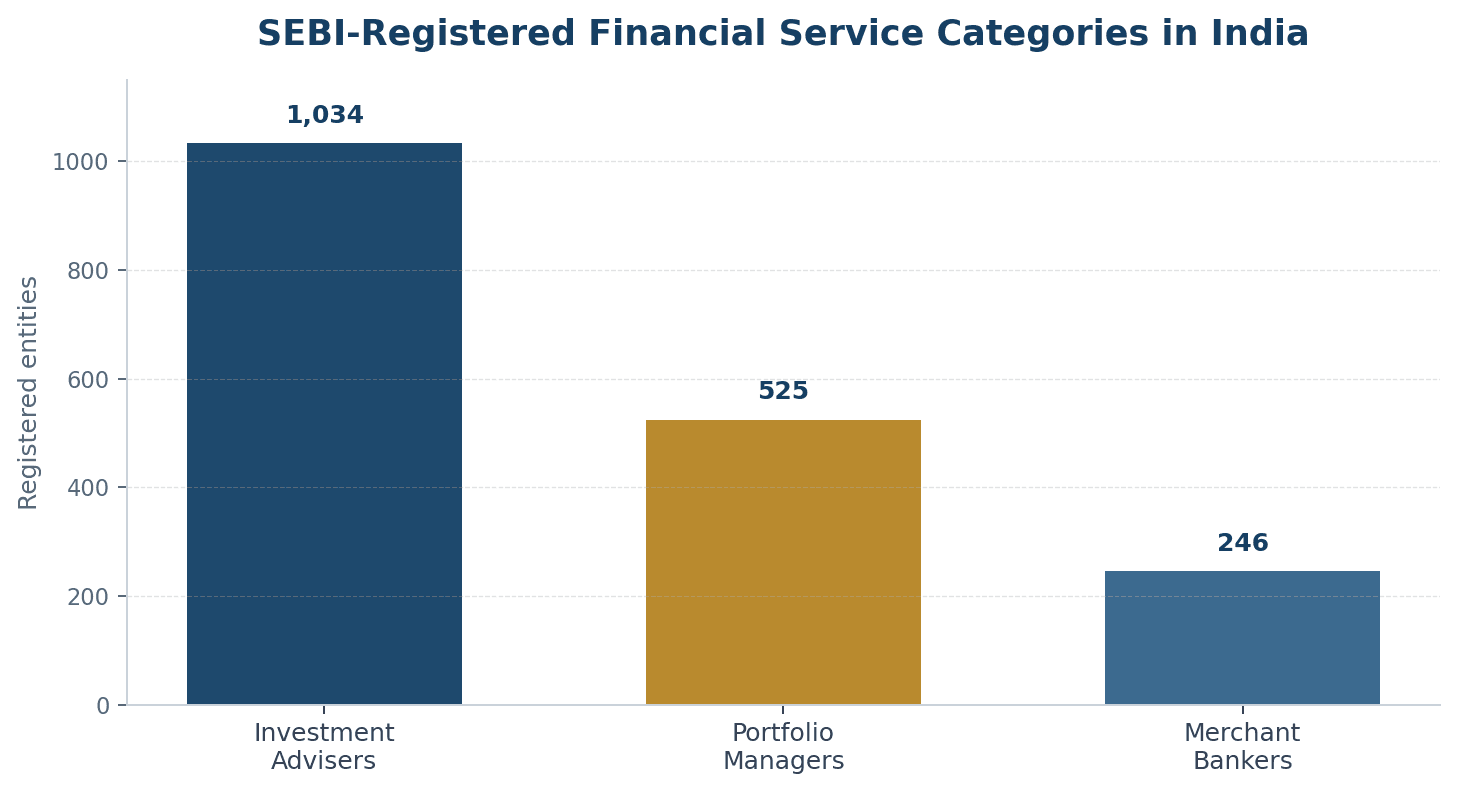
๐Ÿ“Š India had only 967 SEBI-registered investment advisers against 20 crore-plus investors as of August 2025: that works out to roughly one regulated fiduciary advisor for every two million investors. Source: Learnyst citing SEBI Official Site, September 2025

๐Ÿ“‹ Spreading wealth across mutual funds, PMS, and real estate without a coordinated plan creates blind spots. Schedule a consultation with Ckredence Wealth to map your complete financial picture in one place.

Fee-Only Advisors vs Commission-Based Advisors: Which Is Better?

The debate matters because compensation shapes incentives.

How Fee-Only Advisors Work

Fee-only advisors charge investors directly through a flat fee, hourly fee, retainer, or AUM-based fee. They earn nothing from product commissions, which is the structural distinction behind every genuine RIA advisory relationship in India.

How Commission-Based Advisors Earn

Commission-based distributors earn through product commissions. In mutual funds, this typically happens through regular plans where the commission sits inside the expense ratio.

Potential Conflicts of Interest

Commission-based advice can create conflicts when recommendations are influenced by payouts. This does not mean every distributor gives bad advice, but the incentive structure deserves scrutiny.

Transparency and Fiduciary Responsibility

Fee-only advice is generally more transparent because the investor knows exactly what they are paying. SEBI-registered investment advisers also operate under a defined fiduciary duty.

Which Model Suits Different Investors

Fee-only advice tends to suit investors who want independent planning. Commission-based models can suit investors who prefer transaction support without a separate advisory bill.

Fee Model

How It Works

Typical Cost Structure

Advantages

Considerations

Fixed-Fee Advisory

Predefined annual or project fee for planning and ongoing guidance

Fixed annual or one-time fee

Transparent, no link to product sales

Confirm exactly what is included

AUM Fee

A percentage of the portfolio value being managed or advised on

Percentage of AUM, scales with portfolio

Aligns advisor pay with portfolio growth

Fees can grow large on bigger portfolios

Commission-Based

Advisor earns commissions from mutual funds, insurance, or schemes

Embedded in product cost

No visible upfront fee

Conflict of interest risk

What You're Paying For

Covers planning, allocation, tax awareness, and behavioural coaching

Varies by advisor and scope

Supports a structured long-term strategy

Value depends on advisor quality

๐Ÿ’ฐ Not sure if your current advisor earns from your fees or from product commissions? Talk to a SEBI-registered advisor at Ckredence Wealth about a transparent, fee-based model.

How Do Financial Advisors Help With Tax Planning and Wealth Preservation?

  • Tax-Efficient Investing: Structuring investments to reduce unnecessary tax leakage and improve long-term compounding

  • Capital Gains Planning: Understanding short-term and long-term capital gains implications before making changes

  • Retirement Income Planning: Designing tax-aware withdrawal strategies that minimise the overall tax burden

  • Succession and Estate Planning: Assisting with nominations, wills, trusts, and ownership transfer for smoother transitions

  • Long-Term Wealth Transfer: Building structured frameworks for HNIs and family offices that reduce future disputes

๐Ÿ“Š Capital gains tax and succession gaps quietly erode wealth across generations. Schedule a tax-aware portfolio review with Ckredence Wealth before your next investment decision.

How Professional Wealth Managers Build Financial Plans

Professional wealth managers look at an investor's complete financial picture rather than isolated investments.

1. Goal-Based Planning

Every decision is linked to specific goals such as retirement, education, home purchase, or succession.

2. Risk Profiling

Risk profiling determines how much volatility an investor can tolerate, both financially and emotionally.

3. Asset Allocation Frameworks

Portfolios are allocated across equity, debt, gold, cash, real estate, and alternatives based on goals and horizon. Investors comparing the different types of portfolio management services available in India often find this is where a generic plan starts breaking down.

๐Ÿ“Š India's PMS industry crossed โ‚น35 lakh crore in AUM in early 2025, up from โ‚น32.1 lakh crore in January 2024: growing HNI wealth is creating demand for structured advisory at the same time regulated advisors remain scarce. Source: Storifynews citing SEBI Data, October 2025

4. Liquidity Management

Adequate liquidity covers emergencies and planned expenses without disrupting long-term investments.

5. Portfolio Review and Rebalancing

Regular reviews keep the intended asset allocation intact as market movements shift risk exposure.

6. Long-Term Wealth Creation Process

The focus stays on sustainable growth through diversification, discipline, and tax efficiency.

Why Ckredence Wealth Focuses on Goal-Based Financial Advisory

Most financial advisory in India still starts with a product recommendation. At Ckredence Wealth, we start with the investor's goals, risk capacity, and tax position, then build the portfolio around that.

  • Personalised Financial Planning: Every investor has different goals, income patterns, and risk tolerance, so our HNI investment planning approach reflects that individuality rather than one model applied to every client.

  • Risk-First Portfolio Construction: Risk is assessed before return expectations, which helps investors avoid unsuitable products and excessive concentration in any single asset.

  • Tax-Aware Investment Strategies: Tax planning is integrated into portfolio decisions so investors stay focused on what they actually keep after tax.

  • Long-Term Wealth Preservation: The objective is not only to grow wealth but to protect it across market cycles and life stages.

  • Periodic Portfolio Reviews: Regular reviews keep investors aligned with changing goals, market conditions, and family needs.

"The investor's chief problem, and even his worst enemy, is likely to be himself." Benjamin Graham, Author, The Intelligent Investor Source: The Intelligent Investor, Revised Edition, HarperCollins

Building a plan this way takes longer than recommending a product off a shelf. It is also the difference between a portfolio built around an investor's actual life and one that simply fits a brochure.

๐Ÿค Goal-based planning only works when it is built around your actual risk capacity and timeline. Schedule a consultation with Ckredence Wealth to start with a documented financial plan.

Conclusion

Financial advisory in India is shifting from product selling toward structured, goal-based planning. The right advisor builds a plan around your income, risk profile, and family responsibilities, not around what pays the highest commission. SEBI registration is the only verifiable signal of fiduciary accountability in this market. Checking it takes minutes and protects decades of wealth.

Not every investor needs full-time advisory support, but complexity usually changes that calculus. HNIs, NRIs, and business owners with multiple assets benefit most from coordinated, tax-aware planning. Ckredence Wealth structures advice around documented goals and risk capacity rather than product targets. Schedule a consultation with Ckredence Wealth to see how a SEBI-registered, goal-based plan fits your situation.

FAQs

01.

What does SEBI registration mean for a financial advisor in India?

SEBI registration means the advisor operates under fiduciary duty rules. They must act in your interest, not their own. Always verify the registration number on SEBI's official portal.

02.

What is the difference between a financial advisor and a wealth manager?

A financial advisor focuses on planning and investment guidance for individual goals. A wealth manager offers broader services like tax coordination and estate planning. Wealth managers typically serve HNIs and UHNIs with complex portfolios.

03.

Who actually needs a financial advisor in India?

HNIs, NRIs, business owners, and investors with multiple assets benefit most. Complex tax situations or scattered portfolios usually need coordinated advice. Simple, disciplined investors with basic goals can often manage independently.

04.

How does working with a SEBI-registered advisor typically begin?

Engagement usually starts with risk profiling and goal mapping. The advisor then designs an asset allocation aligned to your timeline. Reviews and rebalancing follow at regular intervals.


Financial decisions in India have stopped being simple. Rising incomes, more investment choices, and tax complexity now mean asset allocation, retirement planning, real estate exposure, and succession all compete for the same decision. India's ultra-high-net-worth population surged 63 percent between 2021 and 2026, making the country the sixth most UHNWI populous nation globally, according to Knight Frank's Wealth Report 2026.

A Deloitte India report estimates wealth management demand will nearly double from USD 1.1 trillion to USD 2.3 trillion between FY24 and FY29, yet much of that wealth still sits self-managed. For most investors, the real question is no longer which product to buy. It is whether their complete financial life is structured correctly, and whether the person advising them is actually accountable for that structure.

TL;DR

  • Financial advisory helps investors plan, invest, protect, and manage wealth systematically

  • Advisors support asset allocation, tax planning, retirement planning, and portfolio reviews

  • Fee-only advisors and commission-based distributors operate under very different incentives

  • SEBI registration should be verified before engaging any advisor

  • Good advisory avoids costly mistakes more than it chases returns

  • HNIs, NRIs, business owners, and multi-asset investors benefit most from structured advice

  • The right advisor should start with your goals, not with a product

What Are Financial Advisory Services and Why Do They Matter?

Financial advisory services help individuals, families, and businesses make structured decisions about money, investments, taxation, insurance, retirement, and wealth preservation. The objective is a roadmap that supports both short-term needs and long-term goals.

Financial Advisory Services Meaning Explained

Financial advisory includes professional guidance on managing income, savings, investments, insurance, tax planning, retirement goals, and wealth transfer. The advisor studies the investor's financial situation and builds a plan that fits their actual needs, not a generic template.

What Financial Advisors Actually Do?

Financial advisors help investors understand where they stand financially and how their money should be allocated. They may guide decisions on mutual funds, PMS, bonds, insurance, tax planning, retirement planning, and estate planning.

Financial Planning vs Investment Advice

Investment advice focuses narrowly on where to invest. Financial planning is broader. It connects investments to goals such as retirement, children's education, home buying, tax saving, and wealth transfer.

How Advisory Services Help Investors Make Better Decisions

Advisory services reduce random decision-making. Instead of investing based on market noise, investors get a structured framework that weighs risk, timeline, liquidity, and tax impact before a rupee moves.

Why Are More Indians Seeking Financial Advisory Services Today?

  • Rising incomes and more investment choices: Higher income levels have expanded access to mutual funds, stocks, PMS, AIFs, bonds, and global ETFs, making decisions more complex

  • Increasing complexity of personal finance: Planning now spans emergency funds, insurance, asset allocation, retirement, tax management, and wealth preservation

  • Tax planning becoming more important: High-income professionals, business owners, and NRIs increasingly need advice on capital gains, tax-efficient investing, and withdrawal strategies

  • Need for structured wealth creation: Many investors accumulate products over time without a unified strategy tying them together

  • Shift from product buying to financial planning: Investors are moving from product-centric recommendations toward goal-based, risk-managed frameworks

What Services Do Financial Advisors Typically Provide?

Financial advisors provide services that help investors manage money across different life stages and financial goals.

Financial Planning: Mapping income, expenses, assets, liabilities, and future requirements into a clear roadmap for stability and growth.

Financial Advisory Services India banner featuring a financial advisor discussing portfolio performance with a client using charts and investment reports, highlighting goal-based financial planning, wealth management, and investment advisory services in India.

Investment Advisory: Helping investors choose suitable products based on goals, risk profile, and time horizon. Deciding between actively managed equity and pooled fund structures often means choosing between our mutual fund offerings and a direct equity approach, depending on cost, control, and involvement.

Asset Allocation Planning: Deciding how much money goes into equity, debt, gold, real estate, cash, and global assets. This is one of the most consequential parts of financial planning.

Retirement Planning: Estimating how much an investor will need after retirement and how to build that corpus systematically.

Tax Planning: Reducing unnecessary tax leakage through proper investment structure, capital gains planning, and withdrawal sequencing.

Insurance Planning: Reviewing whether the investor holds adequate term and health cover for family security.

Estate and Succession Planning: Preparing families for wealth transfer through nomination, wills, trusts, and succession clarity.

Wealth Preservation Strategies: Protecting accumulated capital through diversification, risk management, liquidity planning, and tax efficiency.

Do You Really Need a Financial Advisor?

Not every investor needs one. Some investors manage finances independently if they understand asset allocation, taxation, insurance, and investment products well enough. Others are mixing up roles entirely, since a financial advisor and a portfolio manager serve genuinely different functions under different SEBI regulations.

1. Investors Who May Benefit From Professional Advice

High-income professionals, NRIs, business owners, HNIs, retirees, and investors with multiple assets often benefit because their finances span investments, real estate, insurance, business income, and global holdings.

2. Investors Who May Manage Finances Independently

Investors with simple goals, basic mutual fund portfolios, adequate insurance, and strong financial discipline may not need full-time advisory support.

3. DIY Investing vs Professional Guidance

DIY investing works well for disciplined investors. Professional guidance becomes useful once decisions involve taxation, retirement planning, estate planning, or multiple family goals at once.

4. The Role of Behavioural Coaching

A financial advisor also acts as a behavioural guide, helping investors avoid panic selling, overconfidence, return chasing, and poor diversification.

"Be fearful when others are greedy and greedy when others are fearful." Warren Buffett, Chairman and CEO, Berkshire Hathaway Source: Berkshire Hathaway Shareholder Letters

Advisory Type

Primary Role

Typical Services

How They Earn

Best Suited For

Financial Advisor

Financial planning and investment guidance based on goals and risk profile

Planning, asset allocation, retirement planning, risk management

Advisory fees (fee-only or fee-based)

Investors seeking structured, objective guidance

Wealth Manager

Comprehensive wealth management for affluent families and HNIs

Portfolio management, tax coordination, estate planning, alternatives

Advisory fees, AUM-based fees, or both

HNIs, UHNIs, multi-generational families

Mutual Fund Distributor

Helps investors purchase and manage mutual funds

Fund selection, transactions, SIP management

Commissions from AMCs

Investors focused mainly on mutual funds

Relationship Manager

Banking point of contact recommending financial products

Deposits, loans, insurance, mutual funds

Salary, incentives, product commissions

Banking customers seeking single-window access

๐Ÿ“Š India had only 967 SEBI-registered investment advisers against 20 crore-plus investors as of August 2025: that works out to roughly one regulated fiduciary advisor for every two million investors. Source: Learnyst citing SEBI Official Site, September 2025

๐Ÿ“‹ Spreading wealth across mutual funds, PMS, and real estate without a coordinated plan creates blind spots. Schedule a consultation with Ckredence Wealth to map your complete financial picture in one place.

Fee-Only Advisors vs Commission-Based Advisors: Which Is Better?

The debate matters because compensation shapes incentives.

How Fee-Only Advisors Work

Fee-only advisors charge investors directly through a flat fee, hourly fee, retainer, or AUM-based fee. They earn nothing from product commissions, which is the structural distinction behind every genuine RIA advisory relationship in India.

How Commission-Based Advisors Earn

Commission-based distributors earn through product commissions. In mutual funds, this typically happens through regular plans where the commission sits inside the expense ratio.

Potential Conflicts of Interest

Commission-based advice can create conflicts when recommendations are influenced by payouts. This does not mean every distributor gives bad advice, but the incentive structure deserves scrutiny.

Transparency and Fiduciary Responsibility

Fee-only advice is generally more transparent because the investor knows exactly what they are paying. SEBI-registered investment advisers also operate under a defined fiduciary duty.

Which Model Suits Different Investors

Fee-only advice tends to suit investors who want independent planning. Commission-based models can suit investors who prefer transaction support without a separate advisory bill.

Fee Model

How It Works

Typical Cost Structure

Advantages

Considerations

Fixed-Fee Advisory

Predefined annual or project fee for planning and ongoing guidance

Fixed annual or one-time fee

Transparent, no link to product sales

Confirm exactly what is included

AUM Fee

A percentage of the portfolio value being managed or advised on

Percentage of AUM, scales with portfolio

Aligns advisor pay with portfolio growth

Fees can grow large on bigger portfolios

Commission-Based

Advisor earns commissions from mutual funds, insurance, or schemes

Embedded in product cost

No visible upfront fee

Conflict of interest risk

What You're Paying For

Covers planning, allocation, tax awareness, and behavioural coaching

Varies by advisor and scope

Supports a structured long-term strategy

Value depends on advisor quality

๐Ÿ’ฐ Not sure if your current advisor earns from your fees or from product commissions? Talk to a SEBI-registered advisor at Ckredence Wealth about a transparent, fee-based model.

How Do Financial Advisors Help With Tax Planning and Wealth Preservation?

  • Tax-Efficient Investing: Structuring investments to reduce unnecessary tax leakage and improve long-term compounding

  • Capital Gains Planning: Understanding short-term and long-term capital gains implications before making changes

  • Retirement Income Planning: Designing tax-aware withdrawal strategies that minimise the overall tax burden

  • Succession and Estate Planning: Assisting with nominations, wills, trusts, and ownership transfer for smoother transitions

  • Long-Term Wealth Transfer: Building structured frameworks for HNIs and family offices that reduce future disputes

๐Ÿ“Š Capital gains tax and succession gaps quietly erode wealth across generations. Schedule a tax-aware portfolio review with Ckredence Wealth before your next investment decision.

How Professional Wealth Managers Build Financial Plans

Professional wealth managers look at an investor's complete financial picture rather than isolated investments.

1. Goal-Based Planning

Every decision is linked to specific goals such as retirement, education, home purchase, or succession.

2. Risk Profiling

Risk profiling determines how much volatility an investor can tolerate, both financially and emotionally.

3. Asset Allocation Frameworks

Portfolios are allocated across equity, debt, gold, cash, real estate, and alternatives based on goals and horizon. Investors comparing the different types of portfolio management services available in India often find this is where a generic plan starts breaking down.

๐Ÿ“Š India's PMS industry crossed โ‚น35 lakh crore in AUM in early 2025, up from โ‚น32.1 lakh crore in January 2024: growing HNI wealth is creating demand for structured advisory at the same time regulated advisors remain scarce. Source: Storifynews citing SEBI Data, October 2025

4. Liquidity Management

Adequate liquidity covers emergencies and planned expenses without disrupting long-term investments.

5. Portfolio Review and Rebalancing

Regular reviews keep the intended asset allocation intact as market movements shift risk exposure.

6. Long-Term Wealth Creation Process

The focus stays on sustainable growth through diversification, discipline, and tax efficiency.

Why Ckredence Wealth Focuses on Goal-Based Financial Advisory

Most financial advisory in India still starts with a product recommendation. At Ckredence Wealth, we start with the investor's goals, risk capacity, and tax position, then build the portfolio around that.

  • Personalised Financial Planning: Every investor has different goals, income patterns, and risk tolerance, so our HNI investment planning approach reflects that individuality rather than one model applied to every client.

  • Risk-First Portfolio Construction: Risk is assessed before return expectations, which helps investors avoid unsuitable products and excessive concentration in any single asset.

  • Tax-Aware Investment Strategies: Tax planning is integrated into portfolio decisions so investors stay focused on what they actually keep after tax.

  • Long-Term Wealth Preservation: The objective is not only to grow wealth but to protect it across market cycles and life stages.

  • Periodic Portfolio Reviews: Regular reviews keep investors aligned with changing goals, market conditions, and family needs.

"The investor's chief problem, and even his worst enemy, is likely to be himself." Benjamin Graham, Author, The Intelligent Investor Source: The Intelligent Investor, Revised Edition, HarperCollins

Building a plan this way takes longer than recommending a product off a shelf. It is also the difference between a portfolio built around an investor's actual life and one that simply fits a brochure.

๐Ÿค Goal-based planning only works when it is built around your actual risk capacity and timeline. Schedule a consultation with Ckredence Wealth to start with a documented financial plan.

Conclusion

Financial advisory in India is shifting from product selling toward structured, goal-based planning. The right advisor builds a plan around your income, risk profile, and family responsibilities, not around what pays the highest commission. SEBI registration is the only verifiable signal of fiduciary accountability in this market. Checking it takes minutes and protects decades of wealth.

Not every investor needs full-time advisory support, but complexity usually changes that calculus. HNIs, NRIs, and business owners with multiple assets benefit most from coordinated, tax-aware planning. Ckredence Wealth structures advice around documented goals and risk capacity rather than product targets. Schedule a consultation with Ckredence Wealth to see how a SEBI-registered, goal-based plan fits your situation.

FAQs

01.

What does SEBI registration mean for a financial advisor in India?

SEBI registration means the advisor operates under fiduciary duty rules. They must act in your interest, not their own. Always verify the registration number on SEBI's official portal.

02.

What is the difference between a financial advisor and a wealth manager?

A financial advisor focuses on planning and investment guidance for individual goals. A wealth manager offers broader services like tax coordination and estate planning. Wealth managers typically serve HNIs and UHNIs with complex portfolios.

03.

Who actually needs a financial advisor in India?

HNIs, NRIs, business owners, and investors with multiple assets benefit most. Complex tax situations or scattered portfolios usually need coordinated advice. Simple, disciplined investors with basic goals can often manage independently.

04.

How does working with a SEBI-registered advisor typically begin?

Engagement usually starts with risk profiling and goal mapping. The advisor then designs an asset allocation aligned to your timeline. Reviews and rebalancing follow at regular intervals.