11min Read

11min Read

Asset Allocation India: Building the Right Investment Mix

Asset Allocation India: Building the Right Investment Mix

Asset Allocation India: Building the Right Investment Mix

India's HNWI population grew 6% in 2024. Discover how disciplined asset allocation frameworks drive long-term wealth creation for HNI investors.

India's HNWI population grew 6% in 2024. Discover how disciplined asset allocation frameworks drive long-term wealth creation for HNI investors.

India's HNWI population grew 6% in 2024. Discover how disciplined asset allocation frameworks drive long-term wealth creation for HNI investors.

Ckredence Wealth

Ckredence Wealth

|

Asset allocation India guide showing equity, debt, gold, real estate, and wealth growth for balanced investment planning.

India's HNWI population reached 85,698 in 2024, marking a 6% year-on-year increase according to the Knight Frank Wealth Report 2025. Yet growing wealth does not automatically produce wealth preservation. The more persistent challenge is portfolios built around recent performance rather than a deliberate allocation framework.

According to the AMFI Annual Report Fiscal 2025, equity scheme folios grew 33.4% year-on-year and now represent nearly 70% of all mutual fund folios in India. The concentration reflects a broader pattern: investors are adding to equity when it performs and avoiding it when it corrects, rather than building a structure that holds across both conditions. 

Asset allocation is not about predicting which class will outperform next. It is about building a portfolio that functions across different market environments while remaining aligned with specific financial goals.

TL;DR

  • Portfolio allocation structure typically has more impact on outcomes than individual investment selection.

  • Each asset class, equity, debt, gold, and cash, serves a specific risk-management function.

  • Risk profile, not age alone, should drive allocation decisions across an investor's portfolio.

  • Equity-heavy portfolios often experience disproportionate drawdowns during sustained market corrections.

  • A goal-based framework connects every allocation decision to a defined financial objective and timeline.

  • Portfolios require review and rebalancing at least annually or after major life changes.

  • Professional allocation frameworks account for liquidity, tax efficiency, and downside risk together.

What Is Asset Allocation and Why Does It Matter?

Asset allocation is the process of dividing a portfolio across different asset classes to manage risk and return in relation to specific financial goals. 

It is not simply diversification. Diversification describes owning multiple investments. Asset allocation describes the deliberate decision about how much capital goes into each category and why.

Asset Allocation Meaning Explained Simply

Each asset class serves a specific function. Equities provide long-term growth potential. Debt provides stability and liquidity. Gold offers a hedge during periods of uncertainty. Cash allows investors to act when opportunities arise. 

A portfolio built without deliberate allocation across these functions does not have a strategy. It has a collection.

Why Allocation Drives Portfolio Outcomes

Many investors direct most of their attention toward identifying strong individual investments while leaving the overall portfolio structure to develop by default. Portfolio structure, specifically how capital is distributed across asset classes, typically determines long-term risk and return outcomes more than any single investment choice. Selecting a strong equity fund inside an unstructured portfolio does not resolve an allocation problem.

Why Many Indian Investors Focus Too Much on Returns and Ignore Asset Allocation

The most common portfolio construction error is not poor stock selection. It is building a portfolio around recent winners without considering whether the resulting allocation is appropriate for the investor's goals, timeline, or risk capacity.

  • Chasing recent performance: Investors typically move capital toward sectors, funds, or asset classes that have recently delivered strong returns, entering after much of the gain has already been realised.

  • Underestimating correction risk: Portfolios concentrated in equities may produce strong returns during bull markets. During corrections, however, they often experience sharper drawdowns that disrupt financial plans depending on capital availability at specific dates.

  • Ignoring the stabilising function of other assets: Debt, gold, and cash are not just conservative choices. They are structural components that give the equity allocation room to recover without forcing a sale at a loss.

  • Reacting to short-term sentiment: Investors who adjust allocation in response to market news frequently lock in underperformance that a held allocation would have recovered from.

"The stock market is a device for transferring money from the impatient to the patient." Warren Buffett, Chairman and CEO, Berkshire Hathaway
Source: Berkshire Hathaway Shareholder Letters

A structured allocation framework removes individual reactions from the equation. It defines in advance how the portfolio should behave under different market conditions.

Major Asset Classes Used in Asset Allocation in India

Indian investors typically structure portfolios using a combination of growth-oriented and stability-oriented asset classes. Each class responds differently to economic conditions.

1. Equity Investments

Our equity investment services reflect the role equities play as the primary growth engine of most long-term portfolios. Equities provide the return potential to outpace inflation over time but require the investor to tolerate short-term volatility.

2. Debt and Fixed-Income Investments

Debt investments, including bonds, debt mutual funds, EPF, and PPF, provide stability and predictable income. They also give investors the liquidity to rebalance or meet obligations without selling equity at a loss during market stress.

3. Gold and Precious Metals

Gold often performs differently from equities during periods of geopolitical stress or inflationary pressure. It provides diversification without adding the same correlation risk that comes from holding multiple equity positions.

4. Real Estate

Real estate can provide long-term capital appreciation and income. It requires larger capital commitments and offers lower liquidity than financial assets, which affects how it fits within an overall allocation framework.

5. Cash and Liquid Investments

Cash reserves and liquid funds do not generate strong returns. They provide flexibility. An investor with adequate cash allocation can invest during market declines instead of being forced to remain passive or liquidate other positions.

6. Global Investments

International equity exposure reduces dependence on India's economic and market cycles. It also provides currency diversification, which becomes more relevant as portfolios grow in scale and complexity.

📊 Equity scheme folios in India grew 33.4% in fiscal 2025 and now represent nearly 70% of all mutual fund folios: Rising equity concentration increases the cost of unmanaged market risk when corrections arrive.
Source: AMFI Annual Report, Fiscal 2025

📋 Most Indian portfolios are structured around equity alone, with no formal allocation to debt, gold, or liquidity. Our goal-based portfolio management approach helps HNIs build an allocation framework that holds across different market cycles.

How Different Asset Classes Work Together

Asset allocation works because different asset classes do not move in the same direction at the same time. When one declines, another may provide stability or counter-movement.

Concept

Explanation

Growth Assets vs Stability Assets

Equities are growth-focused assets. Debt and cash are stability-focused. Combining both creates a portfolio that can grow during favourable conditions and hold during adverse ones.

Why Correlation Matters

Assets with lower correlation reduce portfolio volatility because they respond differently to the same economic events. Holding many correlated assets does not produce this benefit.

Balancing Return and Downside Protection

A portfolio built only for strong markets will struggle during corrections. Structural balance means the portfolio remains functional across different environments.

The Role of Diversification

Diversification reduces the impact of any single investment, sector, or market event on overall portfolio performance. Owning many highly correlated assets, however, does not produce true diversification.

Popular Asset Allocation Strategies Used by Indian Investors

Different approaches to allocation serve different investor profiles, goals, and levels of active involvement.

  • Strategic Asset Allocation: Maintains a long-term target mix across asset classes and periodically rebalances to that predefined structure. Suited to investors with defined long-term goals and lower tolerance for active decision-making.

  • Tactical Asset Allocation: Allows measured adjustments based on valuations, interest rate outlook, or changing market conditions. Tactical shifts are bounded within defined ranges rather than unrestricted.

  • Dynamic Asset Allocation: Continuously adjusts exposure based on risk indicators and valuation levels. Our all-weather investment approach reflects this orientation, built to maintain portfolio stability across different market environments rather than concentrating in one favourable condition.

  • Core-Satellite Approach: Combines a diversified core portfolio with smaller tactical positions targeting specific themes or growth opportunities. The core provides stability while satellite positions offer upside without disproportionate risk.

  • Goal-Based Asset Allocation: Structures the entire allocation around specific financial objectives, including retirement, education, wealth transfer, or capital preservation, each with its own timeline and liquidity requirement.

Asset Allocation by Risk Profile

Risk profile determines the proportion of growth assets to stability assets that is appropriate for a given investor. Age is one input. Income stability, existing wealth, financial obligations, and goal timelines are equally relevant.

Risk Profile

Equity

Debt

Gold and Others

Conservative

20–40%

50–70%

10–20%

Moderate

50–70%

20–40%

10–15%

Aggressive

70–90%

5–20%

5–10%

These allocations are indicative. Actual allocation should reflect the investor's full financial picture, including liquidity needs, tax situation, and goal-specific timelines, rather than risk profile alone.

Asset Allocation by Age and Life Stage

Allocation priorities typically shift as financial responsibilities, goals, and time horizons change. Age provides a general frame. Actual allocation requires a more complete picture of the investor's circumstances.

1. Investors in Their 20s and 30s Longer investment horizons allow for higher equity exposure and a stronger orientation toward long-term wealth creation. Short-term market volatility is less consequential when the investment timeline extends across decades.

2. Investors in Their 40s Financial responsibilities typically increase during this decade. Many investors begin balancing growth with greater diversification. Goals such as education funding, home ownership, and retirement planning start requiring dedicated allocation.

3. Pre-Retirement Investors Protecting accumulated wealth becomes the primary concern as retirement approaches. Many investors gradually increase debt and liquid allocations to reduce risk without abandoning equity exposure entirely.

4. Retirees Retirement portfolios prioritise income generation, capital preservation, and liquidity management. The portfolio's function shifts from accumulation to distribution, with predictable cash flows becoming more important than growth potential.

5. Why Age Alone Is Not Enough Two investors of the same age with different income stability, existing assets, obligations, and family structures may require very different allocations. Treating age as the primary allocation variable oversimplifies a decision with material consequences for long-term financial security.

Equity, Debt, and Gold: What Indian Investors Commonly Allocate

No single allocation model works equally well for every investor or every market cycle. Common frameworks provide useful starting points.

Traditional 60-30-10 Approach Many investors use a structure combining approximately 60% equity, 30% debt, and 10% gold. This attempts to balance long-term growth with stability, allowing equities to drive returns while debt and gold reduce overall portfolio volatility.

70-15-15 Approach A higher-growth structure combining 70% equity, 15% debt, and 15% gold. This approach retains growth orientation while maintaining more meaningful exposure to defensive and diversifying assets than a pure-equity portfolio.

Multi-Asset Allocation Models Multi-asset portfolios combine equity, debt, gold, cash, and sometimes global investments within a single framework. Rather than optimising for one market environment, multi-asset allocation attempts to create a portfolio that adapts better across different economic conditions. For investors evaluating fund structures for multi-asset exposure, our direct vs regular mutual fund guide covers how plan type affects long-term net returns.

Why There Is No Perfect Allocation A successful asset allocation strategy is one the investor can maintain consistently across both bull and bear markets, not one that looks optimal on paper. Consistency of execution matters more than perfection of design.

Should Indian Investors Add Global Exposure to Asset Allocation?

Global diversification is becoming more relevant as Indian portfolios grow in scale and as financial goals increasingly extend across geographic boundaries.

  • Reducing single-country risk: International exposure reduces dependence on India's economic and market cycle. A global correction does not affect all geographies equally.

  • Currency diversification: Assets held in foreign currencies provide a natural hedge against rupee depreciation. This becomes relevant for investors with future international spending plans or offshore obligations.

  • Access to different industries and growth sectors: Several industries that represent a substantial share of global economic output, including semiconductors, biotechnology, and global technology platforms, have limited representation in Indian markets.

  • Appropriate proportion: Global allocation depends on financial goals, existing wealth, and risk tolerance. There is no universal percentage. Most structured frameworks include global exposure as a component rather than the foundation.

Common Asset Allocation Mistakes Investors Make

Most portfolio performance problems stem from allocation errors rather than poor investment selection within those allocations.

Mistake

Why It Carries Risk

100% Equity Portfolios

Concentration in equities creates high portfolio volatility. Drawdowns during corrections can be large enough to disrupt goals that depend on capital availability at specific dates.

Ignoring Debt Allocation

Debt is not only for conservative investors. It provides the liquidity and stability that allow the equity portion to remain invested rather than being sold during market stress.

Chasing Recent Winners

Recent performance does not predict future outcomes. It frequently leads to poorly timed allocation decisions that enter positions after peak gains and create pressure to exit at a loss.

Not Rebalancing Portfolios

Portfolios drift from their target allocation as markets move. Without rebalancing, risk exposure increases beyond what the investor intended, often without awareness.

Confusing Diversification With Over-Allocation

Holding many investments does not produce diversification if the underlying holdings are highly correlated. Adding ten equity funds does not reduce equity risk.

How Professional Wealth Managers Build Asset Allocation Frameworks

Professional portfolio construction begins with goals and risk capacity before any investment selection. Each allocation decision links to a defined objective rather than a market view.
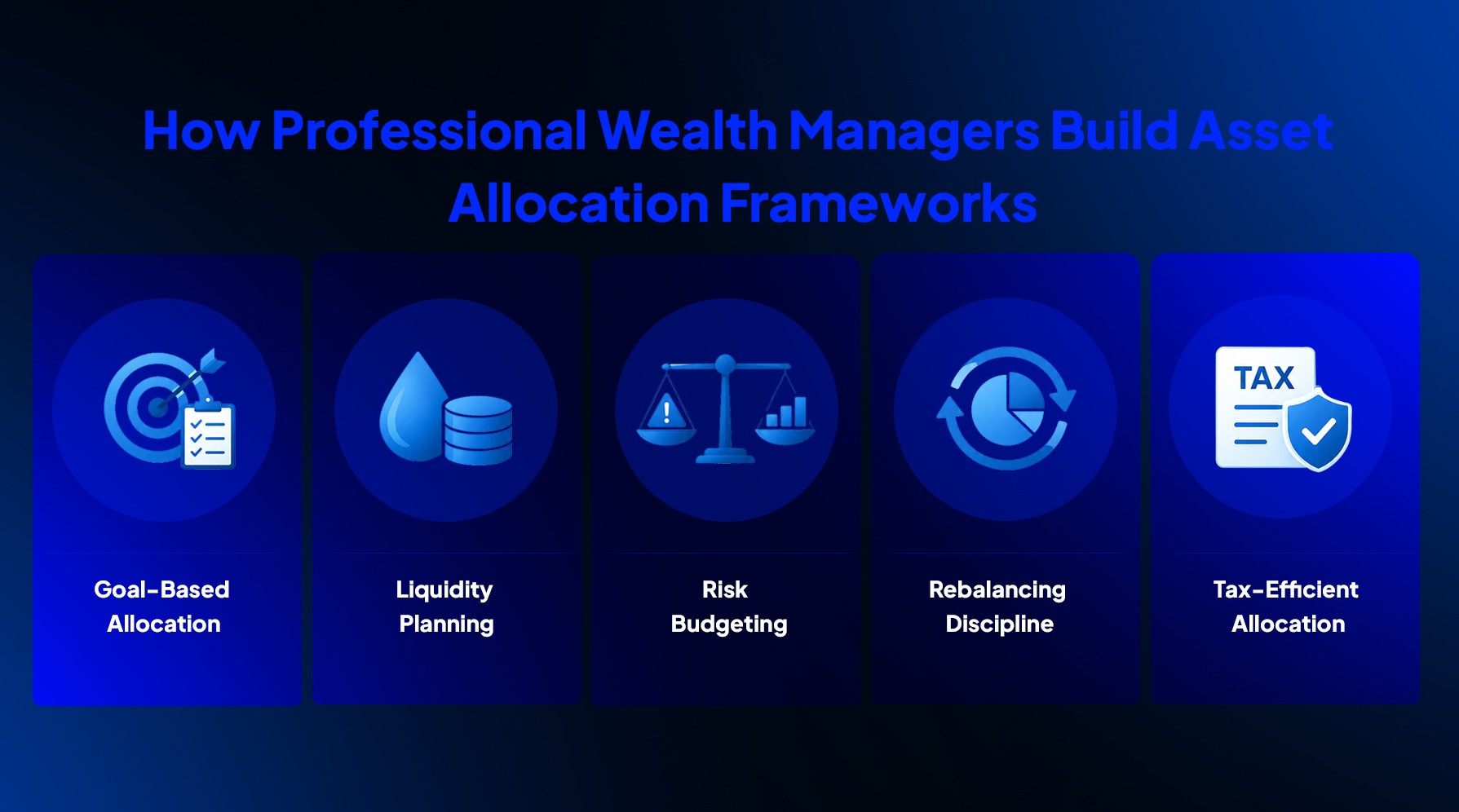
Professional wealth management asset allocation framework showing goal-based planning, liquidity, risk, rebalancing, and tax efficiency.

Goal-Based Allocation: Every asset class allocation connects to a specific financial goal and timeline. Retirement capital is allocated differently from a fund earmarked for a child's education in five years.

  • Liquidity Planning: Adequate liquidity allows investors to manage emergencies, planned expenses, and investment opportunities without disrupting long-term positions.

  • Risk Budgeting: Risk is distributed intentionally across asset classes. No single allocation carries a disproportionate share of total portfolio risk.

  • Rebalancing Discipline: Periodic reviews maintain the intended allocation despite market drift. Rebalancing is a systematic process, not a reaction to short-term performance.

  • Tax-Efficient Allocation: Asset placement decisions account for long-term tax treatment. Gains harvesting, tax-loss offsets, and investment structure choices all affect net-of-tax returns.

Working with a SEBI-registered investment advisor means that allocation recommendations are structured around the investor's interest, rather than shaped by product distribution arrangements.

"The investor's chief problem, and even his worst enemy, is likely to be himself." Benjamin Graham, Author, The Intelligent Investor Source: The Intelligent Investor, Revised Edition, HarperCollins

📊 India's HNWI population reached 85,698 in 2024, a 6% year-on-year increase: Growing wealth concentrations make structured, professional asset allocation more consequential, not less, as portfolio complexity grows with portfolio size.
Source: Knight Frank Wealth Report 2025

🎯 Asset allocation without a goal-linked risk framework produces a portfolio that looks balanced but behaves unpredictably. Our SEBI-registered advisory team builds structured allocation frameworks around your specific goals, liquidity requirements, and tax profile.

Why Ckredence Wealth Uses Goal-Based Asset Allocation

At Ckredence Wealth, portfolio construction begins with financial objectives, not with product selection. Every allocation decision links to a client's goals, timeline, and risk capacity.

Our approach to asset allocation includes:

  • Goal-based portfolio construction: Each client's portfolio is built around defined financial objectives with timelines attached, not around broad market views or return targets alone.

  • Multi-asset class diversification: Portfolios incorporate equity, debt, gold, and cash allocations structured to reduce concentration risk and improve resilience across different market cycles.

  • Risk-first investment framework: Risk capacity is assessed before any allocation recommendation. The portfolio is designed to remain within the investor's defined risk tolerance across changing market conditions.

  • Periodic portfolio reviews and rebalancing: Allocations are reviewed regularly and adjusted to maintain alignment with the investor's goals as markets and life stages evolve.

  • Long-term wealth preservation focus: Capital protection and compounding efficiency are built into the allocation framework from the outset.

Our Portfolio Management Services are SEBI-registered and designed for HNIs and UHNIs who require a structured, goal-oriented approach to long-term wealth management. All indicative portfolio data is provided for reference and subject to market conditions and individual investor circumstances.

📊 Asset allocation should evolve as financial goals and life stages change, not remain static. Schedule a portfolio review with Ckredence Wealth to assess your current allocation and identify structural gaps.

Conclusion

Asset allocation is not a one-time decision. It is the structural foundation on which every other investment choice rests. Getting the allocation right, and keeping it aligned with evolving goals through disciplined rebalancing, typically contributes more to long-term portfolio outcomes than identifying individual winning investments.

For HNIs and UHNIs reviewing their portfolios, the more productive question is not which asset class will perform next. It is whether the current allocation is structured to serve specific financial goals across both favourable and adverse market conditions. If that structure is unclear, it is worth examining before the next market cycle makes the consequences visible.

FAQs

01.

What does SEBI registration mean for the quality of asset allocation advice?

SEBI registration means the advisor is legally bound to act in the client's interest. Advice is not influenced by commissions or distribution arrangements. Allocation decisions reflect the investor's individual goals, risk capacity, and financial situation.

02.

How does PMS differ from mutual funds for asset allocation purposes?

A Portfolio Management Service creates a tailored portfolio for each individual client. Mutual funds pool capital across many investors and apply a common strategy. PMS allows more precise alignment with individual goals, timelines, and tax situations. This level of precision is not achievable within a standard mutual fund structure.

03.

Who benefits most from a structured goal-based asset allocation framework?

Investors with multiple financial goals, varying timelines, and meaningful investable capital benefit most. HNIs managing wealth across equity, debt, real estate, and alternatives need a framework. Individual product selection without allocation discipline is insufficient at this scale.

04.

How does Ckredence Wealth approach asset allocation for HNI clients?

Ckredence Wealth builds portfolios around client-specific goals and risk capacity. Each allocation decision connects to a defined financial objective with a timeline. Portfolios are reviewed periodically and rebalanced to maintain alignment across changing market conditions. All allocation frameworks are structured under SEBI-registered advisory oversight.


India's HNWI population reached 85,698 in 2024, marking a 6% year-on-year increase according to the Knight Frank Wealth Report 2025. Yet growing wealth does not automatically produce wealth preservation. The more persistent challenge is portfolios built around recent performance rather than a deliberate allocation framework.

According to the AMFI Annual Report Fiscal 2025, equity scheme folios grew 33.4% year-on-year and now represent nearly 70% of all mutual fund folios in India. The concentration reflects a broader pattern: investors are adding to equity when it performs and avoiding it when it corrects, rather than building a structure that holds across both conditions. 

Asset allocation is not about predicting which class will outperform next. It is about building a portfolio that functions across different market environments while remaining aligned with specific financial goals.

TL;DR

  • Portfolio allocation structure typically has more impact on outcomes than individual investment selection.

  • Each asset class, equity, debt, gold, and cash, serves a specific risk-management function.

  • Risk profile, not age alone, should drive allocation decisions across an investor's portfolio.

  • Equity-heavy portfolios often experience disproportionate drawdowns during sustained market corrections.

  • A goal-based framework connects every allocation decision to a defined financial objective and timeline.

  • Portfolios require review and rebalancing at least annually or after major life changes.

  • Professional allocation frameworks account for liquidity, tax efficiency, and downside risk together.

What Is Asset Allocation and Why Does It Matter?

Asset allocation is the process of dividing a portfolio across different asset classes to manage risk and return in relation to specific financial goals. 

It is not simply diversification. Diversification describes owning multiple investments. Asset allocation describes the deliberate decision about how much capital goes into each category and why.

Asset Allocation Meaning Explained Simply

Each asset class serves a specific function. Equities provide long-term growth potential. Debt provides stability and liquidity. Gold offers a hedge during periods of uncertainty. Cash allows investors to act when opportunities arise. 

A portfolio built without deliberate allocation across these functions does not have a strategy. It has a collection.

Why Allocation Drives Portfolio Outcomes

Many investors direct most of their attention toward identifying strong individual investments while leaving the overall portfolio structure to develop by default. Portfolio structure, specifically how capital is distributed across asset classes, typically determines long-term risk and return outcomes more than any single investment choice. Selecting a strong equity fund inside an unstructured portfolio does not resolve an allocation problem.

Why Many Indian Investors Focus Too Much on Returns and Ignore Asset Allocation

The most common portfolio construction error is not poor stock selection. It is building a portfolio around recent winners without considering whether the resulting allocation is appropriate for the investor's goals, timeline, or risk capacity.

  • Chasing recent performance: Investors typically move capital toward sectors, funds, or asset classes that have recently delivered strong returns, entering after much of the gain has already been realised.

  • Underestimating correction risk: Portfolios concentrated in equities may produce strong returns during bull markets. During corrections, however, they often experience sharper drawdowns that disrupt financial plans depending on capital availability at specific dates.

  • Ignoring the stabilising function of other assets: Debt, gold, and cash are not just conservative choices. They are structural components that give the equity allocation room to recover without forcing a sale at a loss.

  • Reacting to short-term sentiment: Investors who adjust allocation in response to market news frequently lock in underperformance that a held allocation would have recovered from.

"The stock market is a device for transferring money from the impatient to the patient." Warren Buffett, Chairman and CEO, Berkshire Hathaway
Source: Berkshire Hathaway Shareholder Letters

A structured allocation framework removes individual reactions from the equation. It defines in advance how the portfolio should behave under different market conditions.

Major Asset Classes Used in Asset Allocation in India

Indian investors typically structure portfolios using a combination of growth-oriented and stability-oriented asset classes. Each class responds differently to economic conditions.

1. Equity Investments

Our equity investment services reflect the role equities play as the primary growth engine of most long-term portfolios. Equities provide the return potential to outpace inflation over time but require the investor to tolerate short-term volatility.

2. Debt and Fixed-Income Investments

Debt investments, including bonds, debt mutual funds, EPF, and PPF, provide stability and predictable income. They also give investors the liquidity to rebalance or meet obligations without selling equity at a loss during market stress.

3. Gold and Precious Metals

Gold often performs differently from equities during periods of geopolitical stress or inflationary pressure. It provides diversification without adding the same correlation risk that comes from holding multiple equity positions.

4. Real Estate

Real estate can provide long-term capital appreciation and income. It requires larger capital commitments and offers lower liquidity than financial assets, which affects how it fits within an overall allocation framework.

5. Cash and Liquid Investments

Cash reserves and liquid funds do not generate strong returns. They provide flexibility. An investor with adequate cash allocation can invest during market declines instead of being forced to remain passive or liquidate other positions.

6. Global Investments

International equity exposure reduces dependence on India's economic and market cycles. It also provides currency diversification, which becomes more relevant as portfolios grow in scale and complexity.

📊 Equity scheme folios in India grew 33.4% in fiscal 2025 and now represent nearly 70% of all mutual fund folios: Rising equity concentration increases the cost of unmanaged market risk when corrections arrive.
Source: AMFI Annual Report, Fiscal 2025

📋 Most Indian portfolios are structured around equity alone, with no formal allocation to debt, gold, or liquidity. Our goal-based portfolio management approach helps HNIs build an allocation framework that holds across different market cycles.

How Different Asset Classes Work Together

Asset allocation works because different asset classes do not move in the same direction at the same time. When one declines, another may provide stability or counter-movement.

Concept

Explanation

Growth Assets vs Stability Assets

Equities are growth-focused assets. Debt and cash are stability-focused. Combining both creates a portfolio that can grow during favourable conditions and hold during adverse ones.

Why Correlation Matters

Assets with lower correlation reduce portfolio volatility because they respond differently to the same economic events. Holding many correlated assets does not produce this benefit.

Balancing Return and Downside Protection

A portfolio built only for strong markets will struggle during corrections. Structural balance means the portfolio remains functional across different environments.

The Role of Diversification

Diversification reduces the impact of any single investment, sector, or market event on overall portfolio performance. Owning many highly correlated assets, however, does not produce true diversification.

Popular Asset Allocation Strategies Used by Indian Investors

Different approaches to allocation serve different investor profiles, goals, and levels of active involvement.

  • Strategic Asset Allocation: Maintains a long-term target mix across asset classes and periodically rebalances to that predefined structure. Suited to investors with defined long-term goals and lower tolerance for active decision-making.

  • Tactical Asset Allocation: Allows measured adjustments based on valuations, interest rate outlook, or changing market conditions. Tactical shifts are bounded within defined ranges rather than unrestricted.

  • Dynamic Asset Allocation: Continuously adjusts exposure based on risk indicators and valuation levels. Our all-weather investment approach reflects this orientation, built to maintain portfolio stability across different market environments rather than concentrating in one favourable condition.

  • Core-Satellite Approach: Combines a diversified core portfolio with smaller tactical positions targeting specific themes or growth opportunities. The core provides stability while satellite positions offer upside without disproportionate risk.

  • Goal-Based Asset Allocation: Structures the entire allocation around specific financial objectives, including retirement, education, wealth transfer, or capital preservation, each with its own timeline and liquidity requirement.

Asset Allocation by Risk Profile

Risk profile determines the proportion of growth assets to stability assets that is appropriate for a given investor. Age is one input. Income stability, existing wealth, financial obligations, and goal timelines are equally relevant.

Risk Profile

Equity

Debt

Gold and Others

Conservative

20–40%

50–70%

10–20%

Moderate

50–70%

20–40%

10–15%

Aggressive

70–90%

5–20%

5–10%

These allocations are indicative. Actual allocation should reflect the investor's full financial picture, including liquidity needs, tax situation, and goal-specific timelines, rather than risk profile alone.

Asset Allocation by Age and Life Stage

Allocation priorities typically shift as financial responsibilities, goals, and time horizons change. Age provides a general frame. Actual allocation requires a more complete picture of the investor's circumstances.

1. Investors in Their 20s and 30s Longer investment horizons allow for higher equity exposure and a stronger orientation toward long-term wealth creation. Short-term market volatility is less consequential when the investment timeline extends across decades.

2. Investors in Their 40s Financial responsibilities typically increase during this decade. Many investors begin balancing growth with greater diversification. Goals such as education funding, home ownership, and retirement planning start requiring dedicated allocation.

3. Pre-Retirement Investors Protecting accumulated wealth becomes the primary concern as retirement approaches. Many investors gradually increase debt and liquid allocations to reduce risk without abandoning equity exposure entirely.

4. Retirees Retirement portfolios prioritise income generation, capital preservation, and liquidity management. The portfolio's function shifts from accumulation to distribution, with predictable cash flows becoming more important than growth potential.

5. Why Age Alone Is Not Enough Two investors of the same age with different income stability, existing assets, obligations, and family structures may require very different allocations. Treating age as the primary allocation variable oversimplifies a decision with material consequences for long-term financial security.

Equity, Debt, and Gold: What Indian Investors Commonly Allocate

No single allocation model works equally well for every investor or every market cycle. Common frameworks provide useful starting points.

Traditional 60-30-10 Approach Many investors use a structure combining approximately 60% equity, 30% debt, and 10% gold. This attempts to balance long-term growth with stability, allowing equities to drive returns while debt and gold reduce overall portfolio volatility.

70-15-15 Approach A higher-growth structure combining 70% equity, 15% debt, and 15% gold. This approach retains growth orientation while maintaining more meaningful exposure to defensive and diversifying assets than a pure-equity portfolio.

Multi-Asset Allocation Models Multi-asset portfolios combine equity, debt, gold, cash, and sometimes global investments within a single framework. Rather than optimising for one market environment, multi-asset allocation attempts to create a portfolio that adapts better across different economic conditions. For investors evaluating fund structures for multi-asset exposure, our direct vs regular mutual fund guide covers how plan type affects long-term net returns.

Why There Is No Perfect Allocation A successful asset allocation strategy is one the investor can maintain consistently across both bull and bear markets, not one that looks optimal on paper. Consistency of execution matters more than perfection of design.

Should Indian Investors Add Global Exposure to Asset Allocation?

Global diversification is becoming more relevant as Indian portfolios grow in scale and as financial goals increasingly extend across geographic boundaries.

  • Reducing single-country risk: International exposure reduces dependence on India's economic and market cycle. A global correction does not affect all geographies equally.

  • Currency diversification: Assets held in foreign currencies provide a natural hedge against rupee depreciation. This becomes relevant for investors with future international spending plans or offshore obligations.

  • Access to different industries and growth sectors: Several industries that represent a substantial share of global economic output, including semiconductors, biotechnology, and global technology platforms, have limited representation in Indian markets.

  • Appropriate proportion: Global allocation depends on financial goals, existing wealth, and risk tolerance. There is no universal percentage. Most structured frameworks include global exposure as a component rather than the foundation.

Common Asset Allocation Mistakes Investors Make

Most portfolio performance problems stem from allocation errors rather than poor investment selection within those allocations.

Mistake

Why It Carries Risk

100% Equity Portfolios

Concentration in equities creates high portfolio volatility. Drawdowns during corrections can be large enough to disrupt goals that depend on capital availability at specific dates.

Ignoring Debt Allocation

Debt is not only for conservative investors. It provides the liquidity and stability that allow the equity portion to remain invested rather than being sold during market stress.

Chasing Recent Winners

Recent performance does not predict future outcomes. It frequently leads to poorly timed allocation decisions that enter positions after peak gains and create pressure to exit at a loss.

Not Rebalancing Portfolios

Portfolios drift from their target allocation as markets move. Without rebalancing, risk exposure increases beyond what the investor intended, often without awareness.

Confusing Diversification With Over-Allocation

Holding many investments does not produce diversification if the underlying holdings are highly correlated. Adding ten equity funds does not reduce equity risk.

How Professional Wealth Managers Build Asset Allocation Frameworks

Professional portfolio construction begins with goals and risk capacity before any investment selection. Each allocation decision links to a defined objective rather than a market view.

Professional wealth management asset allocation framework showing goal-based planning, liquidity, risk, rebalancing, and tax efficiency.

Goal-Based Allocation: Every asset class allocation connects to a specific financial goal and timeline. Retirement capital is allocated differently from a fund earmarked for a child's education in five years.

  • Liquidity Planning: Adequate liquidity allows investors to manage emergencies, planned expenses, and investment opportunities without disrupting long-term positions.

  • Risk Budgeting: Risk is distributed intentionally across asset classes. No single allocation carries a disproportionate share of total portfolio risk.

  • Rebalancing Discipline: Periodic reviews maintain the intended allocation despite market drift. Rebalancing is a systematic process, not a reaction to short-term performance.

  • Tax-Efficient Allocation: Asset placement decisions account for long-term tax treatment. Gains harvesting, tax-loss offsets, and investment structure choices all affect net-of-tax returns.

Working with a SEBI-registered investment advisor means that allocation recommendations are structured around the investor's interest, rather than shaped by product distribution arrangements.

"The investor's chief problem, and even his worst enemy, is likely to be himself." Benjamin Graham, Author, The Intelligent Investor Source: The Intelligent Investor, Revised Edition, HarperCollins

📊 India's HNWI population reached 85,698 in 2024, a 6% year-on-year increase: Growing wealth concentrations make structured, professional asset allocation more consequential, not less, as portfolio complexity grows with portfolio size.
Source: Knight Frank Wealth Report 2025

🎯 Asset allocation without a goal-linked risk framework produces a portfolio that looks balanced but behaves unpredictably. Our SEBI-registered advisory team builds structured allocation frameworks around your specific goals, liquidity requirements, and tax profile.

Why Ckredence Wealth Uses Goal-Based Asset Allocation

At Ckredence Wealth, portfolio construction begins with financial objectives, not with product selection. Every allocation decision links to a client's goals, timeline, and risk capacity.

Our approach to asset allocation includes:

  • Goal-based portfolio construction: Each client's portfolio is built around defined financial objectives with timelines attached, not around broad market views or return targets alone.

  • Multi-asset class diversification: Portfolios incorporate equity, debt, gold, and cash allocations structured to reduce concentration risk and improve resilience across different market cycles.

  • Risk-first investment framework: Risk capacity is assessed before any allocation recommendation. The portfolio is designed to remain within the investor's defined risk tolerance across changing market conditions.

  • Periodic portfolio reviews and rebalancing: Allocations are reviewed regularly and adjusted to maintain alignment with the investor's goals as markets and life stages evolve.

  • Long-term wealth preservation focus: Capital protection and compounding efficiency are built into the allocation framework from the outset.

Our Portfolio Management Services are SEBI-registered and designed for HNIs and UHNIs who require a structured, goal-oriented approach to long-term wealth management. All indicative portfolio data is provided for reference and subject to market conditions and individual investor circumstances.

📊 Asset allocation should evolve as financial goals and life stages change, not remain static. Schedule a portfolio review with Ckredence Wealth to assess your current allocation and identify structural gaps.

Conclusion

Asset allocation is not a one-time decision. It is the structural foundation on which every other investment choice rests. Getting the allocation right, and keeping it aligned with evolving goals through disciplined rebalancing, typically contributes more to long-term portfolio outcomes than identifying individual winning investments.

For HNIs and UHNIs reviewing their portfolios, the more productive question is not which asset class will perform next. It is whether the current allocation is structured to serve specific financial goals across both favourable and adverse market conditions. If that structure is unclear, it is worth examining before the next market cycle makes the consequences visible.

FAQs

01.

What does SEBI registration mean for the quality of asset allocation advice?

SEBI registration means the advisor is legally bound to act in the client's interest. Advice is not influenced by commissions or distribution arrangements. Allocation decisions reflect the investor's individual goals, risk capacity, and financial situation.

02.

How does PMS differ from mutual funds for asset allocation purposes?

A Portfolio Management Service creates a tailored portfolio for each individual client. Mutual funds pool capital across many investors and apply a common strategy. PMS allows more precise alignment with individual goals, timelines, and tax situations. This level of precision is not achievable within a standard mutual fund structure.

03.

Who benefits most from a structured goal-based asset allocation framework?

Investors with multiple financial goals, varying timelines, and meaningful investable capital benefit most. HNIs managing wealth across equity, debt, real estate, and alternatives need a framework. Individual product selection without allocation discipline is insufficient at this scale.

04.

How does Ckredence Wealth approach asset allocation for HNI clients?

Ckredence Wealth builds portfolios around client-specific goals and risk capacity. Each allocation decision connects to a defined financial objective with a timeline. Portfolios are reviewed periodically and rebalanced to maintain alignment across changing market conditions. All allocation frameworks are structured under SEBI-registered advisory oversight.