12min Read

12min Read

Value Investing vs Momentum Investing: Which Strategy Should Indian HNIs Actually Use?

Value Investing vs Momentum Investing: Which Strategy Should Indian HNIs Actually Use?

Value Investing vs Momentum Investing: Which Strategy Should Indian HNIs Actually Use?

Value and momentum are opposite investment strategies. Learn the key differences, when each works, the real risks, and how HNIs in India can apply both

Value and momentum are opposite investment strategies. Learn the key differences, when each works, the real risks, and how HNIs in India can apply both

Value and momentum are opposite investment strategies. Learn the key differences, when each works, the real risks, and how HNIs in India can apply both

Ckredence Wealth

Ckredence Wealth

|

Value investing vs momentum investing guide for Indian HNIs comparing growth trends and intrinsic value strategies.

According to MSCI's foundational research on factor investing covering 25 years of global equity data momentum and value strategies, when combined in a single portfolio, historically produced stronger risk-adjusted returns than either factor in isolation. (MSCI, Foundations of Factor Investing). Yet most Indian investors and financial advisors still treat this as a binary choice: pick one and stay with it. That framing costs investors alpha every market cycle.

  • You shifted portfolio weight to momentum plays during the 2021 to 2024 Indian bull run. Now that markets are choppy, are those positions recovering or compounding the problem?

  • Your current advisor recommends "buy quality and hold." But at what price point is quality also a value opportunity, and how do you know when momentum has already left that stock?

  • If your portfolio has not beaten the Nifty 500 on a rolling 3-year basis, is the strategy working, or just surviving?

Value investing and momentum investing are not competing philosophies. They respond to different market conditions and, when managed with cycle awareness, they work together. This blog covers the mechanics of each, the conditions where each performs, the failure modes both carry, and how experienced portfolio managers in India use both to build resilient HNI portfolios.

TL;DR

  • Value investing focuses on buying stocks trading below their intrinsic worth; momentum investing follows stocks already rising in price

  • Value historically outperforms in market recoveries and downturns; momentum outperforms in sustained bull markets

  • Both strategies carry specific failure risks: value traps for value investing, and sudden sharp reversals for momentum investing

  • Academic research from MSCI confirms value and momentum factors have historically shown negative correlation, meaning combining both in a portfolio reduces overall volatility

  • The key metric for value is the P/E and P/B ratio; for momentum, it is the trailing 12-month price return excluding the most recent month

  • Professional portfolio management built around business cycles rotates between these two factors based on market phase, not investor preference

  • An HNI choosing between the two strategies without a cycle framework is making a timing decision without the data to support it

Value Investing vs Momentum Investing: The Core Difference

Value and momentum investing are built on opposite market beliefs. Value investing holds that markets frequently misprice fundamentally sound companies, and that patient investors who buy below intrinsic value will earn returns when the market corrects that gap. Momentum investing holds that stocks already rising in price continue rising, and that following recent winners produces returns before the trend ends.

These beliefs are not just different. They produce entirely different stock selection criteria, holding periods, and risk profiles.

Feature

Value Investing

Momentum Investing

Core Belief

Markets misprice strong companies

Recent winners keep winning

Key Metrics

P/E ratio, P/B ratio, dividend yield

12-month trailing price return (ex-last month)

Time Horizon

Long-term: months to years

Short-to-medium-term: weeks to months

Best Market Phase

Recoveries, downturns, post-correction

Strong, sustained bull markets

Primary Risk

Value trap: stock stays cheap permanently

Sudden reversal: trend breaks sharply

Analysis Type

Fundamental (earnings, cash flow, balance sheet)

Technical (price trend, relative strength)

For an HNI building a concentrated portfolio not a broadly diversified mutual fund — this distinction carries real weight. A value-only approach in a momentum-driven market means watching correctly identified stocks go nowhere for 18 to 24 months while the broader market runs. A momentum-only approach in a correction means watching positions fall 30% to 40% with no fundamental reason to hold them. The table above outlines the mechanics. The practical implication is this: neither strategy is complete on its own.

Investors exploring the full range of portfolio management strategies available to HNIs will find the contrast between factor-based and cycle-aware approaches especially relevant here.

Why Most Indian HNIs End Up on the Wrong Side of This Debate

The standard advice across most wealth management conversations is straightforward: pick an investment style that matches your risk profile and stay consistent. This advice sounds disciplined. In practice, it locks investors into one factor at exactly the wrong time.

The Indian market between 2021 and 2024 rewarded momentum strategies decisively. That same market in 2025, marked by FII outflows exceeding ₹94,000 crore in a single month, valuation compression across mid-caps, and sharp sector rotations, punished investors who had not already shifted toward value. Staying "consistent" in that environment was not discipline. It was rigidity.

Here is the piece of research that most financial advisors never share with their HNI clients:

"Momentum and Value investing have historically exhibited negative correlation meaning when one underperforms, the other outperforms. Portfolios combining both factors historically showed lower volatility and stronger long-term risk-adjusted returns than either factor alone." - MSCI, Foundations of Factor Investing

The implication matters. An HNI managing a concentrated portfolio through a single investment style is not just taking on style risk. They are absorbing avoidable cycle risk.

Across multiple Indian market cycles the post-2008 recovery, the 2014 to 2017 value run, the 2020 COVID correction, and the 2021 to 2024 momentum phase the investors who preserved and grew wealth were not necessarily the ones who picked the right style. They were the ones who had a process for rotating when the evidence called for it.

The discipline is not in picking one strategy. It is in knowing when each strategy's conditions are in place, and having a framework to act on that knowledge without emotion.

Benjamin Graham, who built the foundation of value investing, put it plainly:

"Price is what you pay. Value is what you get." - Benjamin Graham, The Intelligent Investor The corollary holds equally for momentum: you are not buying the business, you are buying the trend. Both are legitimate decisions. Knowing which one applies today is the actual skill.

Key Metrics Each Strategy Uses to Spot Opportunities

Both strategies rely on specific, measurable signals. Understanding these metrics separates factor-based investing from guesswork.

1. Value Investing Metrics

Value investors screen for stocks where the current price has fallen below estimated intrinsic worth. The primary filters are:

  • Price-to-Earnings (P/E) ratio: A P/E significantly below the sector average or historical mean signals potential undervaluation

  • Price-to-Book (P/B) ratio: A P/B below 1.0 suggests the stock is trading below its net asset value

  • Dividend yield: Consistently high yield relative to sector peers can confirm undervaluation, not just distress

What Intrinsic Value Actually Measures

Intrinsic value is the estimated worth of a business based on future cash flows discounted to the present. It is calculated through discounted cash flow analysis, earnings multiples, or asset-based valuation. A value investor acts when market price falls well below this estimate the gap between price and value is the margin of safety.

2. Momentum Investing Metrics

Momentum investors measure price behavior, not business fundamentals. The standard metric is the 12-month trailing return, excluding the most recent month a measure validated across global equity markets in academic factor research by Fama and French (1993) and Carhart (1997).

Why the Last Month Is Excluded in Factor Investing

The most recent month is removed to reduce short-term mean reversion effects. Stocks that have risen sharply in the last 30 days often correct briefly before continuing a trend. Removing that month improves the signal quality of momentum screens considerably. This is the kind of methodological detail that separates a structured momentum strategy from simply chasing last month's best performers a mistake many retail investors make.

The connection between systematic metric-based stock selection and active portfolio management is where the real discipline of both strategies lives.

When Value Wins and When Momentum Takes Over

Both strategies have documented market conditions where they consistently outperform. Understanding these phases is what allows a portfolio manager to rotate between them rather than commit to just one.
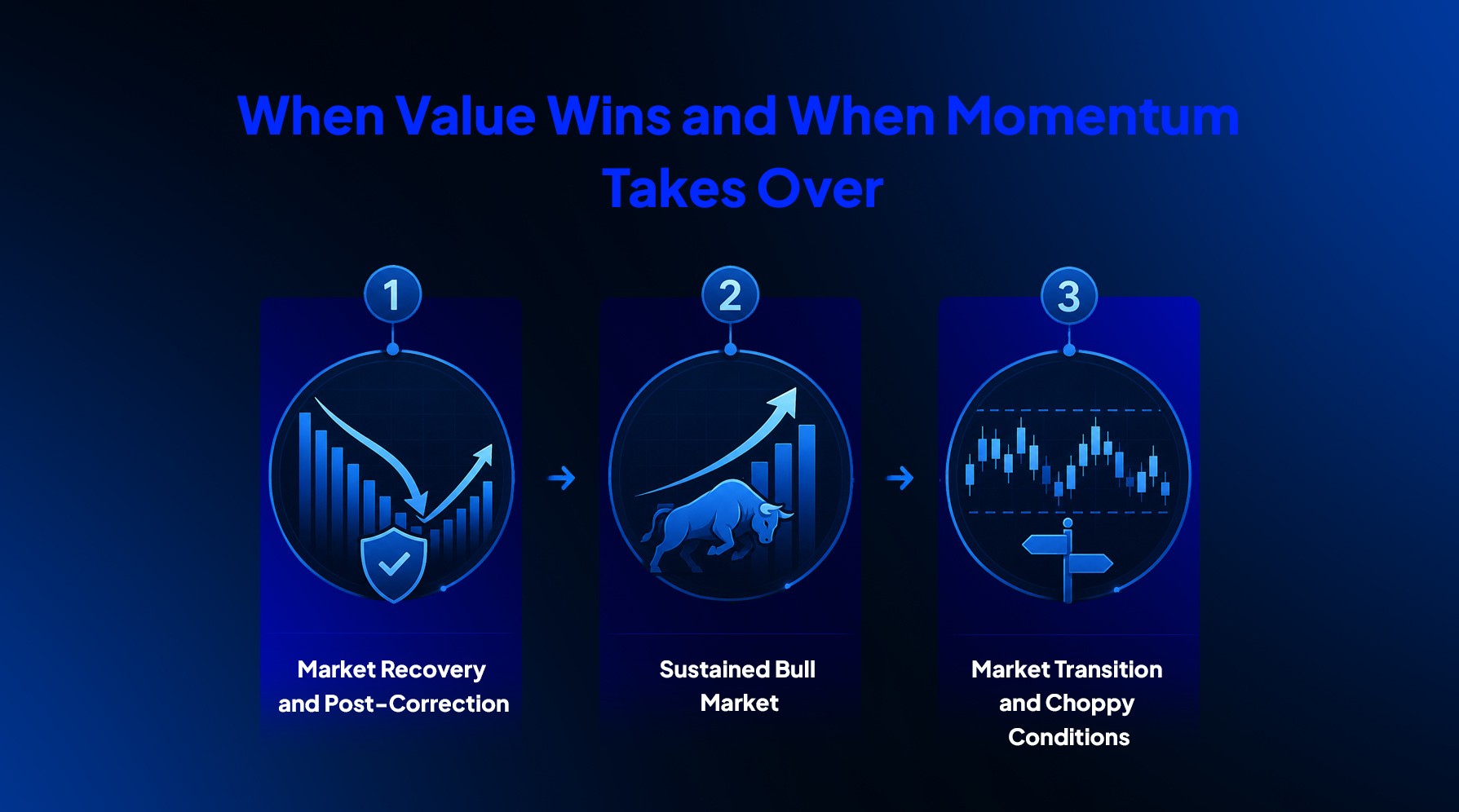
Value investing and momentum investing performance across market recovery, bull markets, and volatile conditions.

Phase 1: Market Recovery and Post-Correction

Value investing historically delivers its strongest performance in the 12 to 18 months following a broad market correction. Fundamentally sound stocks that fell during a sell-off begin recovering as earnings normalize and sentiment stabilizes.

This pattern was visible in India after the COVID correction of March 2020 and again during the 2022 correction period following global macro uncertainty. Investors in value-screened positions at those points saw meaningful recovery as the market repriced with fresh earnings data. The key is entering before sentiment recovers which requires conviction in the fundamentals, not in the prevailing market mood.

Phase 2: Sustained Bull Market

Momentum strategies outperform in extended bull runs where market sentiment drives prices above pure fundamentals. During the Nifty 50's extended run from 2021 through early 2024, momentum factors outperformed value screens across most sectors.

In a rising market, stocks already rising attract more capital, and the trend feeds itself until it does not. The investors who benefited most were not necessarily those who had done the best fundamental analysis. They were the ones who identified which sectors and stocks were already moving and positioned early in the trend.

Phase 3: Market Transition and Choppy Conditions

This phase is where both strategies underperform individually. A market moving from a bull run into a correction, or from recovery into a new cycle, sends mixed signals to both value and momentum screens. Value positions have not yet recovered. Momentum positions may have already reversed.

As of 2026, several Indian mid-cap and small-cap segments sit in exactly this phase sectors that ran hard on momentum through 2024 are now correcting, while value opportunities are forming but have not yet triggered a recovery catalyst. Portfolio managers using a business cycle investing framework identify this transitional phase early and position defensively before either single-factor strategy falters.

The Risks That Come With Each Strategy

No investment strategy delivers returns without specific failure modes. Both value and momentum investing carry risks that can absorb gains quickly if not actively managed.

The Value Trap

A value trap is a stock that appears cheap by every standard metric but does not recover. The business has deteriorated structurally, the sector has declined permanently, or management has destroyed capital systematically. The market is not mispricing it. It is correctly pricing in a real problem. Investors who held certain Indian public sector bank stocks or telecom names between 2015 and 2019 experienced this directly: cheap on paper, going cheaper in practice. The error in a value trap is not in the initial thesis. It is in failing to revisit the thesis when the evidence changes. A stock that is "cheap" for three consecutive years is not waiting to be discovered. It is telling you something about the underlying business that your initial screen did not capture.

The Momentum Reversal

Momentum strategies work until the trend breaks. A sudden shift in market sentiment, an earnings miss, a macro shock, or sector rotation can reverse a momentum trend sharply and fast. Stocks that were momentum leaders often become the hardest hit because they carry the most concentrated positions.

The October 2024 FII outflow of over ₹94,000 crore in a single month showed how quickly momentum can unwind across an entire market. Investors who had not already reduced momentum exposure in overextended positions absorbed outsized losses in a very short window.

Both risks share one answer: active monitoring and cycle awareness. A portfolio with no mechanism to identify when a value position has become a trap, or when momentum has reversed, will eventually absorb one of these losses without adequate preparation.

Investors looking at how all-weather investing approaches handle these cycle-specific risks will find the logic directly applicable to their current situation.

How to Use Both Strategies Without Choosing Wrong

The most relevant question for an Indian HNI is not "which strategy is better." It is "how do I build a portfolio that captures value when value conditions are in place and momentum when momentum is running, without the timing errors that cost returns?"

Here is how professional portfolio managers approach this:

Step 1: Establish the market phase first. Before selecting stocks, identify whether the market is in recovery, expansion, or correction. RBI rate trajectory, FII flow direction, earnings growth trend, and sector rotation patterns provide the framework. This step happens before stock selection, not after.

Step 2: Allocate by factor weight, not style label. A portfolio can hold both value-screened and momentum-screened positions simultaneously. The weight between the two shifts as the market cycle changes. This is not market timing. It is factor-aware allocation with a disciplined rebalancing trigger.

Step 3: Rebalance based on signals, not sentiment. When value positions recover, rotate partial gains toward momentum screens. When momentum leaders show reversal signals, reduce exposure and move back toward value. The trigger is the market signal not market news, not media narratives.

Step 4: Monitor for overlap. Some stocks qualify as both value and momentum candidates at specific cycle inflection points. Identifying this overlap reduces concentration risk and improves overall portfolio efficiency. These stocks often represent the highest-conviction entries in a multi-factor approach.

Step 5: Review the framework quarterly, not the positions weekly. The biggest error in managing a combined value-momentum portfolio is over-monitoring individual stock movements while under-reviewing the broader cycle position. Quarterly framework reviews covering macro signals, sector earnings, and factor performance are more useful than daily position tracking.

This level of ongoing analysis requires continuous monitoring, factor expertise, and cycle judgment. It is exactly what professional investment planning services for HNIs in India are designed to provide and what a self-managed or loosely advisory portfolio typically cannot sustain across changing market environments.

Why Should You Choose Ckredence Wealth?

Indian HNIs managing ₹50 lakh to ₹10 crore in investible surplus need a portfolio management partner who understands both strategies and knows when to apply which. Ckredence Wealth brings 37 years of active portfolio management across every major Indian market cycle.

What we bring to this specifically:

  • Business Cycle Investment Approach: Rotates between value and momentum factors systematically, based on macro and earnings signals — not advisor preference

  • All Weather Investment Approach: Holds positions designed to work across multiple market phases without single-factor concentration

  • SEBI-registered portfolio management: INP000007164, with full regulatory compliance and transparent fee structures aligned with client outcomes

  • ₹805.85 crore AUM across 376 active clients: Managed with consistent focus on risk-adjusted returns and capital preservation across changing market conditions

Our investment approaches are not built around a market view. They are built around a process that adapts to the market phase the evidence supports.

Ready to align your portfolio with where the market cycle actually is today? Schedule a Consultation.

Conclusion

Value investing and momentum investing are both credible strategies with decades of academic and market evidence behind them. The error is not in choosing one it is in holding one without a framework for when to shift. For HNIs in India, where market cycles are shaped by global FII flows, domestic policy changes, and sector-specific rotations, the ability to move between value and momentum exposure is a core portfolio management discipline, not an optional upgrade.

The question worth bringing to your next portfolio review is not "am I a value investor or a momentum investor?" It is: does my current portfolio reflect where the market cycle is today, and does the person managing it have a process for answering that question every quarter?

FAQs

01.

What is the main difference between value investing and momentum investing?

Value investing buys stocks priced below their intrinsic worth, using P/E and P/B ratios as primary filters. Momentum investing follows stocks with strong recent price performance using trailing return signals. Value investors bet on market mispricing correction. Momentum investors bet on trend continuation.

02.

Which investment strategy performs better in Indian markets?

Neither strategy consistently outperforms across all Indian market phases. Value historically outperforms after corrections and in recovery periods. Momentum historically outperforms in sustained bull markets. The most effective approach combines both based on the current market cycle.

03.

Can I combine value and momentum investing in one portfolio?

Yes, and academic research from MSCI supports this directly. Value and momentum strategies have historically shown negative correlation. Combining both reduces overall portfolio volatility while maintaining long-term return potential.

04.

What is a value trap, and how do I avoid it?

A value trap is a cheap-looking stock that never recovers because the underlying business is structurally declining. Avoiding value traps requires ongoing fundamental monitoring, not just an initial screen. Active PMS management addresses this through continuous analysis rather than a single buy-and-hold decision.

According to MSCI's foundational research on factor investing covering 25 years of global equity data momentum and value strategies, when combined in a single portfolio, historically produced stronger risk-adjusted returns than either factor in isolation. (MSCI, Foundations of Factor Investing). Yet most Indian investors and financial advisors still treat this as a binary choice: pick one and stay with it. That framing costs investors alpha every market cycle.

  • You shifted portfolio weight to momentum plays during the 2021 to 2024 Indian bull run. Now that markets are choppy, are those positions recovering or compounding the problem?

  • Your current advisor recommends "buy quality and hold." But at what price point is quality also a value opportunity, and how do you know when momentum has already left that stock?

  • If your portfolio has not beaten the Nifty 500 on a rolling 3-year basis, is the strategy working, or just surviving?

Value investing and momentum investing are not competing philosophies. They respond to different market conditions and, when managed with cycle awareness, they work together. This blog covers the mechanics of each, the conditions where each performs, the failure modes both carry, and how experienced portfolio managers in India use both to build resilient HNI portfolios.

TL;DR

  • Value investing focuses on buying stocks trading below their intrinsic worth; momentum investing follows stocks already rising in price

  • Value historically outperforms in market recoveries and downturns; momentum outperforms in sustained bull markets

  • Both strategies carry specific failure risks: value traps for value investing, and sudden sharp reversals for momentum investing

  • Academic research from MSCI confirms value and momentum factors have historically shown negative correlation, meaning combining both in a portfolio reduces overall volatility

  • The key metric for value is the P/E and P/B ratio; for momentum, it is the trailing 12-month price return excluding the most recent month

  • Professional portfolio management built around business cycles rotates between these two factors based on market phase, not investor preference

  • An HNI choosing between the two strategies without a cycle framework is making a timing decision without the data to support it

Value Investing vs Momentum Investing: The Core Difference

Value and momentum investing are built on opposite market beliefs. Value investing holds that markets frequently misprice fundamentally sound companies, and that patient investors who buy below intrinsic value will earn returns when the market corrects that gap. Momentum investing holds that stocks already rising in price continue rising, and that following recent winners produces returns before the trend ends.

These beliefs are not just different. They produce entirely different stock selection criteria, holding periods, and risk profiles.

Feature

Value Investing

Momentum Investing

Core Belief

Markets misprice strong companies

Recent winners keep winning

Key Metrics

P/E ratio, P/B ratio, dividend yield

12-month trailing price return (ex-last month)

Time Horizon

Long-term: months to years

Short-to-medium-term: weeks to months

Best Market Phase

Recoveries, downturns, post-correction

Strong, sustained bull markets

Primary Risk

Value trap: stock stays cheap permanently

Sudden reversal: trend breaks sharply

Analysis Type

Fundamental (earnings, cash flow, balance sheet)

Technical (price trend, relative strength)

For an HNI building a concentrated portfolio not a broadly diversified mutual fund — this distinction carries real weight. A value-only approach in a momentum-driven market means watching correctly identified stocks go nowhere for 18 to 24 months while the broader market runs. A momentum-only approach in a correction means watching positions fall 30% to 40% with no fundamental reason to hold them. The table above outlines the mechanics. The practical implication is this: neither strategy is complete on its own.

Investors exploring the full range of portfolio management strategies available to HNIs will find the contrast between factor-based and cycle-aware approaches especially relevant here.

Why Most Indian HNIs End Up on the Wrong Side of This Debate

The standard advice across most wealth management conversations is straightforward: pick an investment style that matches your risk profile and stay consistent. This advice sounds disciplined. In practice, it locks investors into one factor at exactly the wrong time.

The Indian market between 2021 and 2024 rewarded momentum strategies decisively. That same market in 2025, marked by FII outflows exceeding ₹94,000 crore in a single month, valuation compression across mid-caps, and sharp sector rotations, punished investors who had not already shifted toward value. Staying "consistent" in that environment was not discipline. It was rigidity.

Here is the piece of research that most financial advisors never share with their HNI clients:

"Momentum and Value investing have historically exhibited negative correlation meaning when one underperforms, the other outperforms. Portfolios combining both factors historically showed lower volatility and stronger long-term risk-adjusted returns than either factor alone." - MSCI, Foundations of Factor Investing

The implication matters. An HNI managing a concentrated portfolio through a single investment style is not just taking on style risk. They are absorbing avoidable cycle risk.

Across multiple Indian market cycles the post-2008 recovery, the 2014 to 2017 value run, the 2020 COVID correction, and the 2021 to 2024 momentum phase the investors who preserved and grew wealth were not necessarily the ones who picked the right style. They were the ones who had a process for rotating when the evidence called for it.

The discipline is not in picking one strategy. It is in knowing when each strategy's conditions are in place, and having a framework to act on that knowledge without emotion.

Benjamin Graham, who built the foundation of value investing, put it plainly:

"Price is what you pay. Value is what you get." - Benjamin Graham, The Intelligent Investor The corollary holds equally for momentum: you are not buying the business, you are buying the trend. Both are legitimate decisions. Knowing which one applies today is the actual skill.

Key Metrics Each Strategy Uses to Spot Opportunities

Both strategies rely on specific, measurable signals. Understanding these metrics separates factor-based investing from guesswork.

1. Value Investing Metrics

Value investors screen for stocks where the current price has fallen below estimated intrinsic worth. The primary filters are:

  • Price-to-Earnings (P/E) ratio: A P/E significantly below the sector average or historical mean signals potential undervaluation

  • Price-to-Book (P/B) ratio: A P/B below 1.0 suggests the stock is trading below its net asset value

  • Dividend yield: Consistently high yield relative to sector peers can confirm undervaluation, not just distress

What Intrinsic Value Actually Measures

Intrinsic value is the estimated worth of a business based on future cash flows discounted to the present. It is calculated through discounted cash flow analysis, earnings multiples, or asset-based valuation. A value investor acts when market price falls well below this estimate the gap between price and value is the margin of safety.

2. Momentum Investing Metrics

Momentum investors measure price behavior, not business fundamentals. The standard metric is the 12-month trailing return, excluding the most recent month a measure validated across global equity markets in academic factor research by Fama and French (1993) and Carhart (1997).

Why the Last Month Is Excluded in Factor Investing

The most recent month is removed to reduce short-term mean reversion effects. Stocks that have risen sharply in the last 30 days often correct briefly before continuing a trend. Removing that month improves the signal quality of momentum screens considerably. This is the kind of methodological detail that separates a structured momentum strategy from simply chasing last month's best performers a mistake many retail investors make.

The connection between systematic metric-based stock selection and active portfolio management is where the real discipline of both strategies lives.

When Value Wins and When Momentum Takes Over

Both strategies have documented market conditions where they consistently outperform. Understanding these phases is what allows a portfolio manager to rotate between them rather than commit to just one.

Value investing and momentum investing performance across market recovery, bull markets, and volatile conditions.

Phase 1: Market Recovery and Post-Correction

Value investing historically delivers its strongest performance in the 12 to 18 months following a broad market correction. Fundamentally sound stocks that fell during a sell-off begin recovering as earnings normalize and sentiment stabilizes.

This pattern was visible in India after the COVID correction of March 2020 and again during the 2022 correction period following global macro uncertainty. Investors in value-screened positions at those points saw meaningful recovery as the market repriced with fresh earnings data. The key is entering before sentiment recovers which requires conviction in the fundamentals, not in the prevailing market mood.

Phase 2: Sustained Bull Market

Momentum strategies outperform in extended bull runs where market sentiment drives prices above pure fundamentals. During the Nifty 50's extended run from 2021 through early 2024, momentum factors outperformed value screens across most sectors.

In a rising market, stocks already rising attract more capital, and the trend feeds itself until it does not. The investors who benefited most were not necessarily those who had done the best fundamental analysis. They were the ones who identified which sectors and stocks were already moving and positioned early in the trend.

Phase 3: Market Transition and Choppy Conditions

This phase is where both strategies underperform individually. A market moving from a bull run into a correction, or from recovery into a new cycle, sends mixed signals to both value and momentum screens. Value positions have not yet recovered. Momentum positions may have already reversed.

As of 2026, several Indian mid-cap and small-cap segments sit in exactly this phase sectors that ran hard on momentum through 2024 are now correcting, while value opportunities are forming but have not yet triggered a recovery catalyst. Portfolio managers using a business cycle investing framework identify this transitional phase early and position defensively before either single-factor strategy falters.

The Risks That Come With Each Strategy

No investment strategy delivers returns without specific failure modes. Both value and momentum investing carry risks that can absorb gains quickly if not actively managed.

The Value Trap

A value trap is a stock that appears cheap by every standard metric but does not recover. The business has deteriorated structurally, the sector has declined permanently, or management has destroyed capital systematically. The market is not mispricing it. It is correctly pricing in a real problem. Investors who held certain Indian public sector bank stocks or telecom names between 2015 and 2019 experienced this directly: cheap on paper, going cheaper in practice. The error in a value trap is not in the initial thesis. It is in failing to revisit the thesis when the evidence changes. A stock that is "cheap" for three consecutive years is not waiting to be discovered. It is telling you something about the underlying business that your initial screen did not capture.

The Momentum Reversal

Momentum strategies work until the trend breaks. A sudden shift in market sentiment, an earnings miss, a macro shock, or sector rotation can reverse a momentum trend sharply and fast. Stocks that were momentum leaders often become the hardest hit because they carry the most concentrated positions.

The October 2024 FII outflow of over ₹94,000 crore in a single month showed how quickly momentum can unwind across an entire market. Investors who had not already reduced momentum exposure in overextended positions absorbed outsized losses in a very short window.

Both risks share one answer: active monitoring and cycle awareness. A portfolio with no mechanism to identify when a value position has become a trap, or when momentum has reversed, will eventually absorb one of these losses without adequate preparation.

Investors looking at how all-weather investing approaches handle these cycle-specific risks will find the logic directly applicable to their current situation.

How to Use Both Strategies Without Choosing Wrong

The most relevant question for an Indian HNI is not "which strategy is better." It is "how do I build a portfolio that captures value when value conditions are in place and momentum when momentum is running, without the timing errors that cost returns?"

Here is how professional portfolio managers approach this:

Step 1: Establish the market phase first. Before selecting stocks, identify whether the market is in recovery, expansion, or correction. RBI rate trajectory, FII flow direction, earnings growth trend, and sector rotation patterns provide the framework. This step happens before stock selection, not after.

Step 2: Allocate by factor weight, not style label. A portfolio can hold both value-screened and momentum-screened positions simultaneously. The weight between the two shifts as the market cycle changes. This is not market timing. It is factor-aware allocation with a disciplined rebalancing trigger.

Step 3: Rebalance based on signals, not sentiment. When value positions recover, rotate partial gains toward momentum screens. When momentum leaders show reversal signals, reduce exposure and move back toward value. The trigger is the market signal not market news, not media narratives.

Step 4: Monitor for overlap. Some stocks qualify as both value and momentum candidates at specific cycle inflection points. Identifying this overlap reduces concentration risk and improves overall portfolio efficiency. These stocks often represent the highest-conviction entries in a multi-factor approach.

Step 5: Review the framework quarterly, not the positions weekly. The biggest error in managing a combined value-momentum portfolio is over-monitoring individual stock movements while under-reviewing the broader cycle position. Quarterly framework reviews covering macro signals, sector earnings, and factor performance are more useful than daily position tracking.

This level of ongoing analysis requires continuous monitoring, factor expertise, and cycle judgment. It is exactly what professional investment planning services for HNIs in India are designed to provide and what a self-managed or loosely advisory portfolio typically cannot sustain across changing market environments.

Why Should You Choose Ckredence Wealth?

Indian HNIs managing ₹50 lakh to ₹10 crore in investible surplus need a portfolio management partner who understands both strategies and knows when to apply which. Ckredence Wealth brings 37 years of active portfolio management across every major Indian market cycle.

What we bring to this specifically:

  • Business Cycle Investment Approach: Rotates between value and momentum factors systematically, based on macro and earnings signals — not advisor preference

  • All Weather Investment Approach: Holds positions designed to work across multiple market phases without single-factor concentration

  • SEBI-registered portfolio management: INP000007164, with full regulatory compliance and transparent fee structures aligned with client outcomes

  • ₹805.85 crore AUM across 376 active clients: Managed with consistent focus on risk-adjusted returns and capital preservation across changing market conditions

Our investment approaches are not built around a market view. They are built around a process that adapts to the market phase the evidence supports.

Ready to align your portfolio with where the market cycle actually is today? Schedule a Consultation.

Conclusion

Value investing and momentum investing are both credible strategies with decades of academic and market evidence behind them. The error is not in choosing one it is in holding one without a framework for when to shift. For HNIs in India, where market cycles are shaped by global FII flows, domestic policy changes, and sector-specific rotations, the ability to move between value and momentum exposure is a core portfolio management discipline, not an optional upgrade.

The question worth bringing to your next portfolio review is not "am I a value investor or a momentum investor?" It is: does my current portfolio reflect where the market cycle is today, and does the person managing it have a process for answering that question every quarter?

FAQs

01.

What is the main difference between value investing and momentum investing?

Value investing buys stocks priced below their intrinsic worth, using P/E and P/B ratios as primary filters. Momentum investing follows stocks with strong recent price performance using trailing return signals. Value investors bet on market mispricing correction. Momentum investors bet on trend continuation.

02.

Which investment strategy performs better in Indian markets?

Neither strategy consistently outperforms across all Indian market phases. Value historically outperforms after corrections and in recovery periods. Momentum historically outperforms in sustained bull markets. The most effective approach combines both based on the current market cycle.

03.

Can I combine value and momentum investing in one portfolio?

Yes, and academic research from MSCI supports this directly. Value and momentum strategies have historically shown negative correlation. Combining both reduces overall portfolio volatility while maintaining long-term return potential.

04.

What is a value trap, and how do I avoid it?

A value trap is a cheap-looking stock that never recovers because the underlying business is structurally declining. Avoiding value traps requires ongoing fundamental monitoring, not just an initial screen. Active PMS management addresses this through continuous analysis rather than a single buy-and-hold decision.