6 min

6 min

Business Cycle Investing: What It Is and How It Works in Indian Equity Markets

Business Cycle Investing: What It Is and How It Works in Indian Equity Markets

Business Cycle Investing: What It Is and How It Works in Indian Equity Markets

Business cycle investing adjusts portfolio allocations across sectors to align with economic phases. Learn how it works in Indian equity markets and how Ckredence Wealth's Business Cycle strategy applies it.

Business cycle investing adjusts portfolio allocations across sectors to align with economic phases. Learn how it works in Indian equity markets and how Ckredence Wealth's Business Cycle strategy applies it.

Business cycle investing adjusts portfolio allocations across sectors to align with economic phases. Learn how it works in Indian equity markets and how Ckredence Wealth's Business Cycle strategy applies it.

Ckredence

Ckredence

|

April 20, 2026

April 20, 2026

Business cycle investing strategy India showing sector rotation, key indicators and economic phases overview

Introduction

Business cycle investing is a dynamic strategy that adjusts portfolio allocations across sectors to align with the economy's four phases: expansion, peak, contraction, and trough. By identifying these shifts, investors aim to capitalise on growth during expansions and mitigate risks through defensive positioning during downturns.

According to Multibagg.ai citing market analysis, Nifty 50 earnings growth slowed to a high-single-digit rate in FY26 but this earnings downgrade cycle appears to have reached a trough, with corporate earnings poised to re-accelerate into double-digit growth in 2026. 

For India, 2026 will be the year of resilience in domestic demand, decisive reforms in fiscal and monetary policies, and recalibrations in trade policies, according to Deloitte India's Economic Outlook January 2026, creating a clear framework for cycle-aware investors to position portfolios ahead of each shift.

  • Do you know which sectors in India outperform during each phase of the business cycle, and how to position your portfolio accordingly?

  • Are you clear on how to read leading economic indicators like GDP growth, RBI policy, and Nifty earnings trends to identify which cycle phase India is currently in?

  • Do you know how Ckredence Wealth's Business Cycle PMS strategy actively rotates across sectors to capture each phase of India's economic cycle?

This blog explains business cycle investing from the ground up, maps each phase to India-specific sectors, and shows how a professionally managed Business Cycle strategy works in practice.

Key Takeaways

  • Business cycle investing rotates portfolio allocations across sectors based on the current economic phase: expansion, peak, contraction, or trough

  • Cyclicals lead in early expansion, defensives in late cycle and contraction, and recovery plays emerge at the trough

  • Key indicators include GDP growth, RBI repo rate direction, inflation trajectory, and Nifty earnings revision trends

  • India is transitioning from a late-cycle slowdown into early recovery, with consumer discretionary and financials expected to lead in 2026

  • Ckredence Wealth's Business Cycle PMS actively manages sector rotation to capture each phase of India's economic cycle

What Is Business Cycle Investing?

Business cycle investing is an active strategy that rotates portfolio holdings across sectors to align with the economy's expansion, peak, contraction, and trough phases. 

Rather than buying and holding a fixed portfolio, investors shift capital into sectors likely to outperform in the current economic environment and reduce exposure to those likely to underperform.

Different sectors respond differently to economic conditions. Banking and consumer discretionary thrive when credit is easy and incomes are rising. Healthcare and utilities hold steady when growth slows. 

Energy and materials benefit from inflation and late-cycle demand. Understanding where the economy is in its cycle allows investors to position ahead of these shifts rather than react after them.

This is not a passive strategy. It requires continuous monitoring of GDP trends, RBI policy signals, earnings revisions, and sectoral data. At Ckredence Wealth, our Business Cycle PMS strategy is built around exactly this methodology, actively rotating across Indian equity sectors based on rigorous cycle analysis.

Key Phases and Investment Strategy

The economy generally moves through four main phases. Each phase has a distinct economic environment and a corresponding set of sectors that historically outperform.

1. Expansion (Early Cycle): Economic activity accelerates. Credit is easy, interest rates are low or falling, and business investment picks up. In India, this phase favours banking and financial services, consumer discretionary, industrials, and automobiles. 

Domestic demand recovery leads earnings upgrades in these sectors, creating significant alpha opportunities for active managers. 

For investors looking to capture this phase through a directly owned equity portfolio, our guide on how to invest in portfolio management services walks through every step of the onboarding process.

2. Peak (Late Cycle): Growth continues but slows. Inflation rises, interest rates move higher, and capacity becomes tight. This phase favours energy, materials, and select FMCG stocks. 

Investment moves away from rate-sensitive sectors like real estate and NBFCs toward those that benefit from high commodity prices and pricing power. 

Understanding how active portfolio managers navigate this shift is covered in our guide on active vs passive portfolio management.

3. Contraction (Recession): Economic activity falls. Consumer spending declines, unemployment rises, and corporate earnings get cut. 

In this phase, investors prioritise cash, short-duration debt, and defensive equity sectors like healthcare, utilities, and consumer staples. These sectors deliver stable earnings regardless of GDP growth. 

For a detailed breakdown of how defensive allocation works within a structured portfolio, read our guide on portfolio management strategies.

4. Trough (Recovery): The economy bottoms out. Policy becomes accommodative, interest rates fall, and early green shoots appear in credit and consumption data. 

This is the highest-alpha phase for informed investors, as undervalued cyclicals begin to recover sharply before the broader market recognises the turn. 

Our Business Cycle PMS strategy is specifically built to identify and capture this transition ahead of the broader market.

Key Aspects of Business Cycle Investing
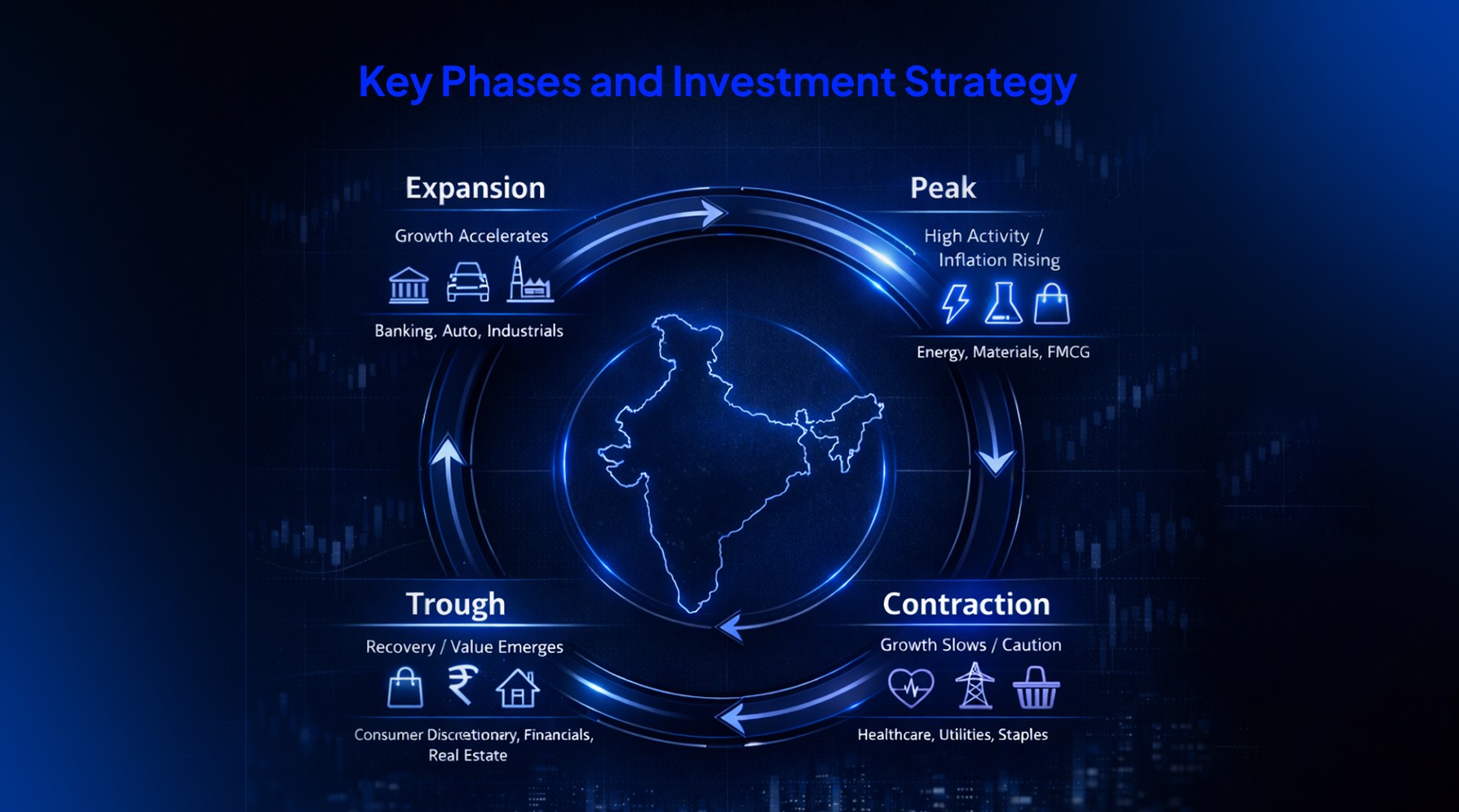
Business cycle phases in India with sector rotation mapping expansion peak contraction trough sectors

Understanding the phases is just the beginning. Executing a business cycle strategy requires mastery of four interconnected elements.

Aspect

What It Means

India-Specific Context

Phases of the Cycle

The economy rarely announces its phase. Investors must infer it from leading, coincident, and lagging indicators

RBI monetary policy stance, IIP data, GST collections, and corporate earnings guidance are the most reliable cycle signals in India

Sector Rotation

Rather than picking individual stocks, this strategy focuses on shifting capital into sectors likely to perform best in the current phase

Sector rotation in India is particularly pronounced as the economy is still developing, making each phase more distinct and each shift more powerful than in mature markets

Key Indicators

GDP growth rate, RBI repo rate direction, CPI inflation, credit growth, PMI data, earnings revision trends, and Nifty forward P/E

India's repo rate at 5.25% and moderating inflation signal an accommodative backdrop that historically marks the transition into early expansion

Risks and Challenges

Correctly timing market cycles is difficult. Premature repositioning can result in underperformance and high transaction costs

Professional active management through a dedicated Business Cycle PMS strategy offers a meaningful advantage over self-directed cycle investing

Sector Rotation Strategy in Indian Equity Markets

India's equity market offers a particularly compelling environment for business cycle investing because the economy's domestic demand-driven nature creates more pronounced sectoral divergence across cycle phases than export-driven economies.

Here is how each cycle phase maps to Nifty sectors in the Indian context:

Business Cycle Phase

Economic Signal

Outperforming Indian Sectors

Underperforming Sectors

Early Expansion

Rate cuts, GDP recovery, credit growth

Banking, Auto, Consumer Discretionary, Industrials

Defensive FMCG, Utilities

Mid Cycle

Stable growth, neutral rates, earnings upgrade

IT, Healthcare, Financials, Infrastructure

Energy, Commodities

Late Cycle

High inflation, rate hikes, slowing GDP

Energy, Metals, Commodities, FMCG

Banking, Real Estate, NBFCs

Contraction

Rate cuts begin, earnings downgrades

Healthcare, Utilities, Consumer Staples, Cash

Auto, Industrials, Capital Goods

For investors who want to understand how sector allocation interacts with portfolio construction in a professional PMS context, our guide on types of portfolio management services in India provides a detailed framework.

Where Is India in the Business Cycle Right Now? (2026)

Identifying the current cycle position is the most important and the most contested question in business cycle investing. Based on available macroeconomic data as of April 2026, India appears to be transitioning from a late-cycle earnings slowdown into an early expansion or recovery phase.

The domestic economic cycle is stabilising and demand is recovering, with corporate earnings poised to re-accelerate into double-digit growth in 2026, and sectors tied to domestic consumption such as consumer discretionary expected to lead this recovery, according to Multibagg.ai

The key signals pointing to early recovery in India in 2026 are as follows:

  • RBI Rate-Cutting Cycle: Cumulative repo rate cuts to 5.25% with surplus system liquidity signal the beginning of an accommodative monetary phase, which historically precedes early expansion in India's economic cycle

  • Consumer Discretionary Recovery: GST rationalisation and income tax relief under Budget 2026 are directly driving consumption recovery in discretionary categories, the first sector to re-rate in an early expansion

  • Nifty 50 Earnings Re-acceleration: Corporate earnings are expected to re-accelerate into double-digit growth in FY27, up from the high-single-digit trough of FY26, with earnings revision cycles turning positive

  • Government Capital Expenditure: Public capex at 3.4% of GDP in H1 FY26 continues to support infrastructure, industrials, and capital goods, providing a demand floor during the recovery transition

  • Trade Deal Tailwinds: New trade agreements with the US and EU are reducing export uncertainty for IT and pharma, adding external demand support alongside the domestic recovery

This combination of signals suggests that banking, consumer discretionary, industrials, and select capital goods stocks are entering their outperformance window in India's current cycle. 

Our All Weather and Business Cycle investment approaches are positioned to capture this rotation systematically.

Advantages and Disadvantages of Business Cycle Investing

Like any active investment strategy, business cycle investing has clear benefits and genuine risks that investors must understand before committing capital.

Advantages:

  • Potentially higher returns by capturing sectoral upside in each phase before the broader market reprices

  • Better risk management during downturns through defensive positioning in healthcare, utilities, and consumer staples before contractions deepen

  • A structured framework for investment decision-making that is anchored in macroeconomic fundamentals rather than short-term price movements

  • Diversification across the cycle through rotation, rather than concentrated bets on a single sector or theme

Disadvantages:

  • Market timing is risky and economic turning points are notoriously hard to predict with precision

  • High transaction costs from frequent rebalancing can erode returns if not managed carefully within a low-cost structure

  • Potential to miss out on sharp market rallies if positioned defensively just before an unexpected recovery

  • Requires continuous, expert-level monitoring of economic data, earnings revisions, and policy signals — making it unsuitable for passive or self-directed investors without significant research infrastructure

The most effective way to access business cycle investing without taking on the timing risk yourself is through a professionally managed strategy with a dedicated research framework. 

Why Should You Choose Ckredence Wealth for Business Cycle Investing?

Ckredence Wealth's Business Cycle strategy is one of four active PMS strategies we manage for HNI investors across India. It is built on the principle that the Indian economy's distinct domestic demand-driven growth model creates clear, identifiable cycle phases that reward active sector rotation with superior long-term returns.

What Makes Our Approach Different:

  • Our Business Cycle PMS is anchored in proprietary macro research covering RBI policy signals, sectoral earnings revision trends, PMI data, credit growth, and GDP cycle positioning

  • We rotate across Nifty sectors systematically as the cycle evolves, rather than making ad-hoc calls based on short-term market movements

  • Every holding in the portfolio is directly owned in the investor's Demat account with complete transparency, unlike mutual funds where holdings are pooled

  • Our research team continuously monitors India's economic indicators to identify cycle transitions ahead of the broader market, giving our portfolio an early-mover advantage in each rotation

Track Record and Credibility:

  • ₹805+ Crores in AUM managed across 376+ active clients with 37 years of wealth management experience

  • SEBI-registered Portfolio Manager with four active strategies designed for different market environments

  • Offices in Surat, Mumbai, and Vadodara with dedicated relationship managers and quarterly portfolio reviews

To understand how PMS compares to mutual funds for cycle-aware investing, read our detailed guide on portfolio management services vs mutual funds.

Ready to invest with India's business cycle rather than against it? Schedule a consultation with our team.

Conclusion

Business cycle investing is one of the most intellectually rigorous and potentially rewarding active strategies available to equity investors in India. By aligning portfolio sector exposure with the current phase of India's economic cycle, disciplined investors can systematically capture outperformance across expansion, peak, contraction, and recovery phases rather than relying on luck or market timing alone.

India's current macro environment, with easing monetary policy, recovering corporate earnings, and domestic consumption re-acceleration, presents a compelling setup for the early-expansion positioning that business cycle investing rewards most. The investors who benefit most from this environment will not be those who react to it after it is obvious. They will be the ones already positioned with a professional, cycle-aware portfolio manager before the earnings re-acceleration becomes the consensus.

Investments are subject to market risks. Please read all scheme-related documents carefully before investing. Past performance is not indicative of future returns.

FAQs

01.

What is business cycle investing and how does it work in India?

Business cycle investing is an active strategy that rotates portfolio allocations across sectors to align with the four economic phases: expansion, peak, contraction, and trough. In India, each phase is driven by specific macro signals like RBI policy, GDP growth, and corporate earnings trends. Sectors like banking and consumer discretionary lead in expansion, while healthcare and utilities outperform during contraction.

02.

Which sectors perform best in each phase of India's business cycle?

In early expansion, banking, auto, and consumer discretionary typically outperform. In mid-cycle, IT and healthcare lead. In late cycle, energy, metals, and FMCG take over. During contraction, defensive sectors like utilities, healthcare, and consumer staples provide relative safety.

03.

What are the risks of business cycle investing?

The primary risks include difficulty in timing cycle transitions accurately, high rebalancing costs if managed inefficiently, and the possibility of missing sharp rallies if positioned defensively too early. These risks are best managed through a professionally run strategy with dedicated macro research infrastructure rather than a self-directed approach.

04.

How is Ckredence Wealth's Business Cycle strategy different from a business cycle mutual fund?

Unlike business cycle mutual funds, our Business Cycle PMS holds securities directly in the investor's Demat account with full transparency on every holding and transaction. The portfolio is fully customised to the investor's risk profile and is managed with a high-conviction, concentrated approach rather than broad diversification. Minimum investment is ₹50 lakhs.


Introduction

Business cycle investing is a dynamic strategy that adjusts portfolio allocations across sectors to align with the economy's four phases: expansion, peak, contraction, and trough. By identifying these shifts, investors aim to capitalise on growth during expansions and mitigate risks through defensive positioning during downturns.

According to Multibagg.ai citing market analysis, Nifty 50 earnings growth slowed to a high-single-digit rate in FY26 but this earnings downgrade cycle appears to have reached a trough, with corporate earnings poised to re-accelerate into double-digit growth in 2026. 

For India, 2026 will be the year of resilience in domestic demand, decisive reforms in fiscal and monetary policies, and recalibrations in trade policies, according to Deloitte India's Economic Outlook January 2026, creating a clear framework for cycle-aware investors to position portfolios ahead of each shift.

  • Do you know which sectors in India outperform during each phase of the business cycle, and how to position your portfolio accordingly?

  • Are you clear on how to read leading economic indicators like GDP growth, RBI policy, and Nifty earnings trends to identify which cycle phase India is currently in?

  • Do you know how Ckredence Wealth's Business Cycle PMS strategy actively rotates across sectors to capture each phase of India's economic cycle?

This blog explains business cycle investing from the ground up, maps each phase to India-specific sectors, and shows how a professionally managed Business Cycle strategy works in practice.

Key Takeaways

  • Business cycle investing rotates portfolio allocations across sectors based on the current economic phase: expansion, peak, contraction, or trough

  • Cyclicals lead in early expansion, defensives in late cycle and contraction, and recovery plays emerge at the trough

  • Key indicators include GDP growth, RBI repo rate direction, inflation trajectory, and Nifty earnings revision trends

  • India is transitioning from a late-cycle slowdown into early recovery, with consumer discretionary and financials expected to lead in 2026

  • Ckredence Wealth's Business Cycle PMS actively manages sector rotation to capture each phase of India's economic cycle

What Is Business Cycle Investing?

Business cycle investing is an active strategy that rotates portfolio holdings across sectors to align with the economy's expansion, peak, contraction, and trough phases. 

Rather than buying and holding a fixed portfolio, investors shift capital into sectors likely to outperform in the current economic environment and reduce exposure to those likely to underperform.

Different sectors respond differently to economic conditions. Banking and consumer discretionary thrive when credit is easy and incomes are rising. Healthcare and utilities hold steady when growth slows. 

Energy and materials benefit from inflation and late-cycle demand. Understanding where the economy is in its cycle allows investors to position ahead of these shifts rather than react after them.

This is not a passive strategy. It requires continuous monitoring of GDP trends, RBI policy signals, earnings revisions, and sectoral data. At Ckredence Wealth, our Business Cycle PMS strategy is built around exactly this methodology, actively rotating across Indian equity sectors based on rigorous cycle analysis.

Key Phases and Investment Strategy

The economy generally moves through four main phases. Each phase has a distinct economic environment and a corresponding set of sectors that historically outperform.

1. Expansion (Early Cycle): Economic activity accelerates. Credit is easy, interest rates are low or falling, and business investment picks up. In India, this phase favours banking and financial services, consumer discretionary, industrials, and automobiles. 

Domestic demand recovery leads earnings upgrades in these sectors, creating significant alpha opportunities for active managers. 

For investors looking to capture this phase through a directly owned equity portfolio, our guide on how to invest in portfolio management services walks through every step of the onboarding process.

2. Peak (Late Cycle): Growth continues but slows. Inflation rises, interest rates move higher, and capacity becomes tight. This phase favours energy, materials, and select FMCG stocks. 

Investment moves away from rate-sensitive sectors like real estate and NBFCs toward those that benefit from high commodity prices and pricing power. 

Understanding how active portfolio managers navigate this shift is covered in our guide on active vs passive portfolio management.

3. Contraction (Recession): Economic activity falls. Consumer spending declines, unemployment rises, and corporate earnings get cut. 

In this phase, investors prioritise cash, short-duration debt, and defensive equity sectors like healthcare, utilities, and consumer staples. These sectors deliver stable earnings regardless of GDP growth. 

For a detailed breakdown of how defensive allocation works within a structured portfolio, read our guide on portfolio management strategies.

4. Trough (Recovery): The economy bottoms out. Policy becomes accommodative, interest rates fall, and early green shoots appear in credit and consumption data. 

This is the highest-alpha phase for informed investors, as undervalued cyclicals begin to recover sharply before the broader market recognises the turn. 

Our Business Cycle PMS strategy is specifically built to identify and capture this transition ahead of the broader market.

Key Aspects of Business Cycle Investing

Business cycle phases in India with sector rotation mapping expansion peak contraction trough sectors

Understanding the phases is just the beginning. Executing a business cycle strategy requires mastery of four interconnected elements.

Aspect

What It Means

India-Specific Context

Phases of the Cycle

The economy rarely announces its phase. Investors must infer it from leading, coincident, and lagging indicators

RBI monetary policy stance, IIP data, GST collections, and corporate earnings guidance are the most reliable cycle signals in India

Sector Rotation

Rather than picking individual stocks, this strategy focuses on shifting capital into sectors likely to perform best in the current phase

Sector rotation in India is particularly pronounced as the economy is still developing, making each phase more distinct and each shift more powerful than in mature markets

Key Indicators

GDP growth rate, RBI repo rate direction, CPI inflation, credit growth, PMI data, earnings revision trends, and Nifty forward P/E

India's repo rate at 5.25% and moderating inflation signal an accommodative backdrop that historically marks the transition into early expansion

Risks and Challenges

Correctly timing market cycles is difficult. Premature repositioning can result in underperformance and high transaction costs

Professional active management through a dedicated Business Cycle PMS strategy offers a meaningful advantage over self-directed cycle investing

Sector Rotation Strategy in Indian Equity Markets

India's equity market offers a particularly compelling environment for business cycle investing because the economy's domestic demand-driven nature creates more pronounced sectoral divergence across cycle phases than export-driven economies.

Here is how each cycle phase maps to Nifty sectors in the Indian context:

Business Cycle Phase

Economic Signal

Outperforming Indian Sectors

Underperforming Sectors

Early Expansion

Rate cuts, GDP recovery, credit growth

Banking, Auto, Consumer Discretionary, Industrials

Defensive FMCG, Utilities

Mid Cycle

Stable growth, neutral rates, earnings upgrade

IT, Healthcare, Financials, Infrastructure

Energy, Commodities

Late Cycle

High inflation, rate hikes, slowing GDP

Energy, Metals, Commodities, FMCG

Banking, Real Estate, NBFCs

Contraction

Rate cuts begin, earnings downgrades

Healthcare, Utilities, Consumer Staples, Cash

Auto, Industrials, Capital Goods

For investors who want to understand how sector allocation interacts with portfolio construction in a professional PMS context, our guide on types of portfolio management services in India provides a detailed framework.

Where Is India in the Business Cycle Right Now? (2026)

Identifying the current cycle position is the most important and the most contested question in business cycle investing. Based on available macroeconomic data as of April 2026, India appears to be transitioning from a late-cycle earnings slowdown into an early expansion or recovery phase.

The domestic economic cycle is stabilising and demand is recovering, with corporate earnings poised to re-accelerate into double-digit growth in 2026, and sectors tied to domestic consumption such as consumer discretionary expected to lead this recovery, according to Multibagg.ai

The key signals pointing to early recovery in India in 2026 are as follows:

  • RBI Rate-Cutting Cycle: Cumulative repo rate cuts to 5.25% with surplus system liquidity signal the beginning of an accommodative monetary phase, which historically precedes early expansion in India's economic cycle

  • Consumer Discretionary Recovery: GST rationalisation and income tax relief under Budget 2026 are directly driving consumption recovery in discretionary categories, the first sector to re-rate in an early expansion

  • Nifty 50 Earnings Re-acceleration: Corporate earnings are expected to re-accelerate into double-digit growth in FY27, up from the high-single-digit trough of FY26, with earnings revision cycles turning positive

  • Government Capital Expenditure: Public capex at 3.4% of GDP in H1 FY26 continues to support infrastructure, industrials, and capital goods, providing a demand floor during the recovery transition

  • Trade Deal Tailwinds: New trade agreements with the US and EU are reducing export uncertainty for IT and pharma, adding external demand support alongside the domestic recovery

This combination of signals suggests that banking, consumer discretionary, industrials, and select capital goods stocks are entering their outperformance window in India's current cycle. 

Our All Weather and Business Cycle investment approaches are positioned to capture this rotation systematically.

Advantages and Disadvantages of Business Cycle Investing

Like any active investment strategy, business cycle investing has clear benefits and genuine risks that investors must understand before committing capital.

Advantages:

  • Potentially higher returns by capturing sectoral upside in each phase before the broader market reprices

  • Better risk management during downturns through defensive positioning in healthcare, utilities, and consumer staples before contractions deepen

  • A structured framework for investment decision-making that is anchored in macroeconomic fundamentals rather than short-term price movements

  • Diversification across the cycle through rotation, rather than concentrated bets on a single sector or theme

Disadvantages:

  • Market timing is risky and economic turning points are notoriously hard to predict with precision

  • High transaction costs from frequent rebalancing can erode returns if not managed carefully within a low-cost structure

  • Potential to miss out on sharp market rallies if positioned defensively just before an unexpected recovery

  • Requires continuous, expert-level monitoring of economic data, earnings revisions, and policy signals — making it unsuitable for passive or self-directed investors without significant research infrastructure

The most effective way to access business cycle investing without taking on the timing risk yourself is through a professionally managed strategy with a dedicated research framework. 

Why Should You Choose Ckredence Wealth for Business Cycle Investing?

Ckredence Wealth's Business Cycle strategy is one of four active PMS strategies we manage for HNI investors across India. It is built on the principle that the Indian economy's distinct domestic demand-driven growth model creates clear, identifiable cycle phases that reward active sector rotation with superior long-term returns.

What Makes Our Approach Different:

  • Our Business Cycle PMS is anchored in proprietary macro research covering RBI policy signals, sectoral earnings revision trends, PMI data, credit growth, and GDP cycle positioning

  • We rotate across Nifty sectors systematically as the cycle evolves, rather than making ad-hoc calls based on short-term market movements

  • Every holding in the portfolio is directly owned in the investor's Demat account with complete transparency, unlike mutual funds where holdings are pooled

  • Our research team continuously monitors India's economic indicators to identify cycle transitions ahead of the broader market, giving our portfolio an early-mover advantage in each rotation

Track Record and Credibility:

  • ₹805+ Crores in AUM managed across 376+ active clients with 37 years of wealth management experience

  • SEBI-registered Portfolio Manager with four active strategies designed for different market environments

  • Offices in Surat, Mumbai, and Vadodara with dedicated relationship managers and quarterly portfolio reviews

To understand how PMS compares to mutual funds for cycle-aware investing, read our detailed guide on portfolio management services vs mutual funds.

Ready to invest with India's business cycle rather than against it? Schedule a consultation with our team.

Conclusion

Business cycle investing is one of the most intellectually rigorous and potentially rewarding active strategies available to equity investors in India. By aligning portfolio sector exposure with the current phase of India's economic cycle, disciplined investors can systematically capture outperformance across expansion, peak, contraction, and recovery phases rather than relying on luck or market timing alone.

India's current macro environment, with easing monetary policy, recovering corporate earnings, and domestic consumption re-acceleration, presents a compelling setup for the early-expansion positioning that business cycle investing rewards most. The investors who benefit most from this environment will not be those who react to it after it is obvious. They will be the ones already positioned with a professional, cycle-aware portfolio manager before the earnings re-acceleration becomes the consensus.

Investments are subject to market risks. Please read all scheme-related documents carefully before investing. Past performance is not indicative of future returns.

FAQs

01.

What is business cycle investing and how does it work in India?

Business cycle investing is an active strategy that rotates portfolio allocations across sectors to align with the four economic phases: expansion, peak, contraction, and trough. In India, each phase is driven by specific macro signals like RBI policy, GDP growth, and corporate earnings trends. Sectors like banking and consumer discretionary lead in expansion, while healthcare and utilities outperform during contraction.

02.

Which sectors perform best in each phase of India's business cycle?

In early expansion, banking, auto, and consumer discretionary typically outperform. In mid-cycle, IT and healthcare lead. In late cycle, energy, metals, and FMCG take over. During contraction, defensive sectors like utilities, healthcare, and consumer staples provide relative safety.

03.

What are the risks of business cycle investing?

The primary risks include difficulty in timing cycle transitions accurately, high rebalancing costs if managed inefficiently, and the possibility of missing sharp rallies if positioned defensively too early. These risks are best managed through a professionally run strategy with dedicated macro research infrastructure rather than a self-directed approach.

04.

How is Ckredence Wealth's Business Cycle strategy different from a business cycle mutual fund?

Unlike business cycle mutual funds, our Business Cycle PMS holds securities directly in the investor's Demat account with full transparency on every holding and transaction. The portfolio is fully customised to the investor's risk profile and is managed with a high-conviction, concentrated approach rather than broad diversification. Minimum investment is ₹50 lakhs.