10min Read

10min Read

Financial Advisor in Surat: A Guide to Planning Beyond Just Investing

Financial Advisor in Surat: A Guide to Planning Beyond Just Investing

Financial Advisor in Surat: A Guide to Planning Beyond Just Investing

Meta Desc What a financial advisor in Surat should actually cover, insurance, tax, retirement, and emergency planning, before investing enters the picture.

Meta Desc What a financial advisor in Surat should actually cover, insurance, tax, retirement, and emergency planning, before investing enters the picture.

Meta Desc What a financial advisor in Surat should actually cover, insurance, tax, retirement, and emergency planning, before investing enters the picture.

Ckredence Wealth

Ckredence Wealth

|

Ckredence Wealth banner for financial advisor in Surat showing an advisor discussing investment planning with a couple, with financial goal icons representing insurance, family, education, home, savings, and wealth growth.

"Financial advisor" gets used as a catch-all in Surat, covering everything from a Certified Financial Planner doing holistic life planning to an insurance agent selling a single policy to a wealth advisor managing a PMS portfolio. Most people searching for one actually want the first kind, someone to look at the whole picture, not just where to invest.

That whole-picture view is missing more often than not. The average Indian holds life cover of just 3.1 times their annual income, against an industry-recommended benchmark of 10 times, which means most financial plans have a hole in them long before investing ever comes up.

If you already know you want investment or PMS-specific guidance, our guides to wealth advisory in Surat, PMS in Surat, and mutual fund advisory in Surat cover that ground directly. This one is about the layer that usually needs to come first.

Before you choose an advisor, ask yourself:

  • Has anyone reviewed your insurance cover against your actual income, or did you buy what was pitched to you?

  • Do you have an emergency fund separate from your investments, or would a bad month force you to sell something?

  • Is the person you are about to hire qualified to plan holistically, or only to sell one category of product?

This guide covers what a financial advisor in Surat should actually help you build, in the right order.

TL;DR

  • "Financial advisor" spans several distinct roles in Surat: CFPs doing holistic planning, insurance agents, tax consultants, and investment-focused wealth advisors.

  • A financial plan is built bottom-up: emergency fund, then insurance, then tax-efficient saving, then retirement, then wealth growth.

  • Most Indians are underinsured relative to income, which is usually the first gap worth closing, before investment strategy.

  • CFPs are typically fee-based and cover your whole financial life; insurance agents are commission-based and cover one product category.

  • If planning is already done and you are ready to invest, that is where a wealth advisor or PMS provider becomes the right next step, not the first one.

  • Ask how an advisor is paid before asking what they recommend, it usually explains the recommendation.

What "Financial Advisor" Actually Covers in Surat

The term hides at least four distinct roles, each qualified for a different part of the picture.
V2: Points in Image format 

  • CFP-led holistic planners: cover budgeting, insurance, tax, and retirement planning as one connected plan.

  • Investment-focused wealth advisors: RIAs and PMS providers, covered in depth in our wealth advisory in Surat guide.

  • Insurance agents and distributors: commission-based, qualified to sell policies, not to plan holistically.

  • Tax consultants and CAs: focused on filing and compliance, not on building a forward-looking financial plan.

Financial Planning Mistakes That Show Up Most in Surat

A few patterns repeat often enough among Surat's trading and business families that they're worth naming directly:

  • Treating a ULIP as both insurance and investment. It usually does neither well, the cover is thin relative to the premium, and the investment return lags a plain mutual fund after charges.

  • Nominee details left outdated for years, sometimes still naming a parent after marriage or a child's birth, which creates real complications for the family when it matters most.

  • Family wealth concentrated in one person's name for convenience, without the succession documentation to back it up, a common gap in family-run businesses specifically.

  • Understating income for insurance underwriting to keep premiums low, which can reduce or void a claim exactly when the cover was needed.

How Often Should You Review Your Financial Plan?

A plan set once and never revisited drifts out of date faster than most people expect:

  • Annual review, at minimum, to check insurance adequacy, tax planning, and whether investments still match your goals.

  • Trigger-based reviews matter more than the calendar: a new dependent, a business liquidity event, a loan taken or cleared, or a significant income change should each prompt a review on their own.

  • For business owners specifically, a strong or weak trading season is also worth a check-in, since it changes both your investable surplus and your risk capacity for that year.

What to Bring to Your First Meeting With a Financial Advisor

A more useful first conversation starts with a few documents in hand, not just a goal in mind:

  • A rough breakdown of monthly expenses, including business-linked expenses if income and spending overlap.

  • Existing insurance policies, life and health, with premium and cover amounts.

  • A summary of current investments, FDs, mutual funds, PPF, or anything else already in place.

  • Outstanding loans or debts, with interest rates, since this often changes the entire priority order of the plan.

  • Family and dependent details, since cover and planning decisions are sized around them, not around you alone.

The Core Areas a Good Financial Plan Should Cover

These build on each other, and skipping a lower layer to chase a higher one is the most common planning mistake.
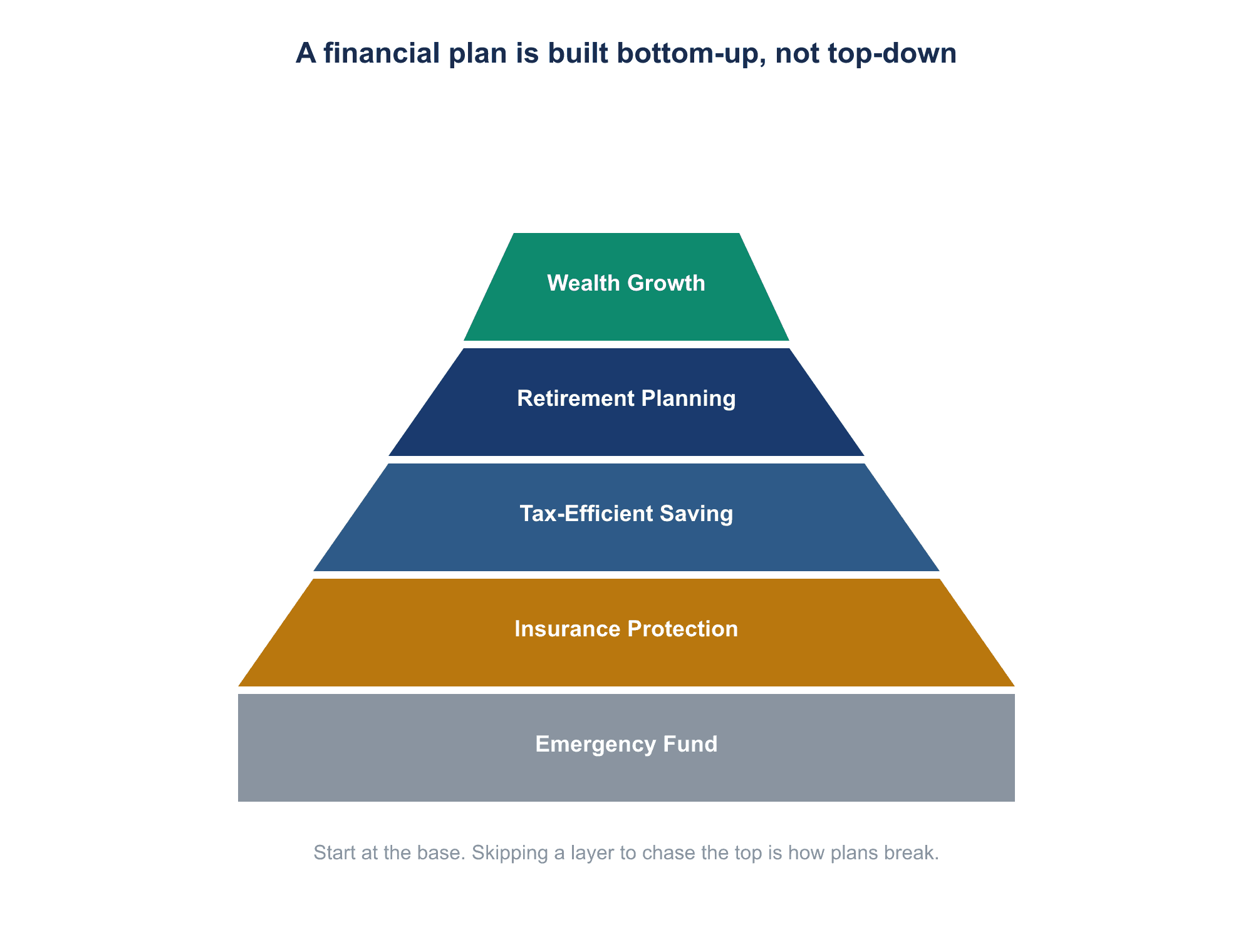
Financial planning pyramid: emergency fund, insurance, tax, retirement, wealth growth

A financial plan is built bottom-up, starting with the emergency fund.

  • Emergency fund: 3 to 6 months of expenses, kept liquid, before anything else is prioritized.

  • Insurance protection: term life and health cover sized to your actual income and dependents, not a tax-saving ULIP bought for the deduction.

  • Tax-efficient saving: using available deductions properly, our guide on the best investments after Section 80C covers what comes after the usual limits are used up.

  • Retirement planning: a defined target and timeline, covered in our retirement investment plan guide.

  • Wealth growth: investing surplus capital once the layers below are in place, not before.

SKIPPING A LAYER IS HOW PLANS BREAK

Investing before insurance and an emergency fund are in place is the most common ordering mistake we see.

Schedule a Consultation

CFP vs Insurance Agent vs Investment Advisor: Who Does What


CFP / Planner

Insurance Agent

Investment Advisor (RIA)

Scope

Whole financial life

Insurance products only

Investments only

Paid by

Fee, mostly

Commission

Fee, mostly

Good first stop if

You have not planned holistically

You need cover, nothing else

Planning is done, ready to invest

Table: how the three most common "financial advisor" roles in Surat actually differ.

Once the planning layers are in place, the investing conversation becomes much simpler, and that is where a SEBI-registered RIA or a PMS provider takes over from a general planner.

Why Should You Choose Ckredence Wealth?

Ckredence Wealth’s core strength is the investing and retirement-planning layers of this pyramid, not insurance sales or tax filing, and we say that directly rather than pretending to be a one-stop shop for everything. For business owners, that pairs with our financial advisory services and investment planning for HNI clients.

Solutions That Matter:

  • Fee-only RIA advisory once your insurance and emergency fund layers are already in place.

  • Retirement and goal-based planning, built around your actual timeline.

  • Referrals rather than false promises when a need falls outside our expertise, insurance and tax filing included.

Ready to see where you actually stand on the pyramid? Schedule a Consultation!

Conclusion

A financial advisor in Surat should help you build a plan in order: emergency fund, insurance, tax efficiency, retirement, and only then investing. Most searches for "financial advisor" skip straight to the last layer, which is exactly backwards, and exactly why the earlier layers so often go missing.

Match the advisor to the role you actually need. A CFP for holistic planning, an insurance specialist for cover, a tax consultant for filing, and an investment advisor once the rest is already handled. One person rarely does all four well.

FAQs

01.

What is the difference between a financial advisor and a wealth advisor?

A financial advisor typically covers your whole financial life, budgeting, insurance, tax, and retirement. A wealth advisor is usually investment-focused, managing a portfolio once the broader plan is already in place.

02.

Should I get insurance or start investing first?

Insurance and an emergency fund typically come first. Investing before adequate cover is in place leaves a bigger gap than most people realize, especially given how underinsured the average household is relative to income.

03.

Is a Certified Financial Planner the same as a SEBI-registered investment advisor?

No. A CFP is a professional certification covering holistic financial planning, while a SEBI-registered RIA is a specific regulatory registration for investment advice. Some professionals hold both.

04.

How do I know if my insurance cover is enough?

A common starting benchmark is life cover of about 10 times your annual income, though your actual need depends on debts, dependents, and existing assets, not a single fixed multiple.

"Financial advisor" gets used as a catch-all in Surat, covering everything from a Certified Financial Planner doing holistic life planning to an insurance agent selling a single policy to a wealth advisor managing a PMS portfolio. Most people searching for one actually want the first kind, someone to look at the whole picture, not just where to invest.

That whole-picture view is missing more often than not. The average Indian holds life cover of just 3.1 times their annual income, against an industry-recommended benchmark of 10 times, which means most financial plans have a hole in them long before investing ever comes up.

If you already know you want investment or PMS-specific guidance, our guides to wealth advisory in Surat, PMS in Surat, and mutual fund advisory in Surat cover that ground directly. This one is about the layer that usually needs to come first.

Before you choose an advisor, ask yourself:

  • Has anyone reviewed your insurance cover against your actual income, or did you buy what was pitched to you?

  • Do you have an emergency fund separate from your investments, or would a bad month force you to sell something?

  • Is the person you are about to hire qualified to plan holistically, or only to sell one category of product?

This guide covers what a financial advisor in Surat should actually help you build, in the right order.

TL;DR

  • "Financial advisor" spans several distinct roles in Surat: CFPs doing holistic planning, insurance agents, tax consultants, and investment-focused wealth advisors.

  • A financial plan is built bottom-up: emergency fund, then insurance, then tax-efficient saving, then retirement, then wealth growth.

  • Most Indians are underinsured relative to income, which is usually the first gap worth closing, before investment strategy.

  • CFPs are typically fee-based and cover your whole financial life; insurance agents are commission-based and cover one product category.

  • If planning is already done and you are ready to invest, that is where a wealth advisor or PMS provider becomes the right next step, not the first one.

  • Ask how an advisor is paid before asking what they recommend, it usually explains the recommendation.

What "Financial Advisor" Actually Covers in Surat

The term hides at least four distinct roles, each qualified for a different part of the picture.
V2: Points in Image format 

  • CFP-led holistic planners: cover budgeting, insurance, tax, and retirement planning as one connected plan.

  • Investment-focused wealth advisors: RIAs and PMS providers, covered in depth in our wealth advisory in Surat guide.

  • Insurance agents and distributors: commission-based, qualified to sell policies, not to plan holistically.

  • Tax consultants and CAs: focused on filing and compliance, not on building a forward-looking financial plan.

Financial Planning Mistakes That Show Up Most in Surat

A few patterns repeat often enough among Surat's trading and business families that they're worth naming directly:

  • Treating a ULIP as both insurance and investment. It usually does neither well, the cover is thin relative to the premium, and the investment return lags a plain mutual fund after charges.

  • Nominee details left outdated for years, sometimes still naming a parent after marriage or a child's birth, which creates real complications for the family when it matters most.

  • Family wealth concentrated in one person's name for convenience, without the succession documentation to back it up, a common gap in family-run businesses specifically.

  • Understating income for insurance underwriting to keep premiums low, which can reduce or void a claim exactly when the cover was needed.

How Often Should You Review Your Financial Plan?

A plan set once and never revisited drifts out of date faster than most people expect:

  • Annual review, at minimum, to check insurance adequacy, tax planning, and whether investments still match your goals.

  • Trigger-based reviews matter more than the calendar: a new dependent, a business liquidity event, a loan taken or cleared, or a significant income change should each prompt a review on their own.

  • For business owners specifically, a strong or weak trading season is also worth a check-in, since it changes both your investable surplus and your risk capacity for that year.

What to Bring to Your First Meeting With a Financial Advisor

A more useful first conversation starts with a few documents in hand, not just a goal in mind:

  • A rough breakdown of monthly expenses, including business-linked expenses if income and spending overlap.

  • Existing insurance policies, life and health, with premium and cover amounts.

  • A summary of current investments, FDs, mutual funds, PPF, or anything else already in place.

  • Outstanding loans or debts, with interest rates, since this often changes the entire priority order of the plan.

  • Family and dependent details, since cover and planning decisions are sized around them, not around you alone.

The Core Areas a Good Financial Plan Should Cover

These build on each other, and skipping a lower layer to chase a higher one is the most common planning mistake.

Financial planning pyramid: emergency fund, insurance, tax, retirement, wealth growth

A financial plan is built bottom-up, starting with the emergency fund.

  • Emergency fund: 3 to 6 months of expenses, kept liquid, before anything else is prioritized.

  • Insurance protection: term life and health cover sized to your actual income and dependents, not a tax-saving ULIP bought for the deduction.

  • Tax-efficient saving: using available deductions properly, our guide on the best investments after Section 80C covers what comes after the usual limits are used up.

  • Retirement planning: a defined target and timeline, covered in our retirement investment plan guide.

  • Wealth growth: investing surplus capital once the layers below are in place, not before.

SKIPPING A LAYER IS HOW PLANS BREAK

Investing before insurance and an emergency fund are in place is the most common ordering mistake we see.

Schedule a Consultation

CFP vs Insurance Agent vs Investment Advisor: Who Does What


CFP / Planner

Insurance Agent

Investment Advisor (RIA)

Scope

Whole financial life

Insurance products only

Investments only

Paid by

Fee, mostly

Commission

Fee, mostly

Good first stop if

You have not planned holistically

You need cover, nothing else

Planning is done, ready to invest

Table: how the three most common "financial advisor" roles in Surat actually differ.

Once the planning layers are in place, the investing conversation becomes much simpler, and that is where a SEBI-registered RIA or a PMS provider takes over from a general planner.

Why Should You Choose Ckredence Wealth?

Ckredence Wealth’s core strength is the investing and retirement-planning layers of this pyramid, not insurance sales or tax filing, and we say that directly rather than pretending to be a one-stop shop for everything. For business owners, that pairs with our financial advisory services and investment planning for HNI clients.

Solutions That Matter:

  • Fee-only RIA advisory once your insurance and emergency fund layers are already in place.

  • Retirement and goal-based planning, built around your actual timeline.

  • Referrals rather than false promises when a need falls outside our expertise, insurance and tax filing included.

Ready to see where you actually stand on the pyramid? Schedule a Consultation!

Conclusion

A financial advisor in Surat should help you build a plan in order: emergency fund, insurance, tax efficiency, retirement, and only then investing. Most searches for "financial advisor" skip straight to the last layer, which is exactly backwards, and exactly why the earlier layers so often go missing.

Match the advisor to the role you actually need. A CFP for holistic planning, an insurance specialist for cover, a tax consultant for filing, and an investment advisor once the rest is already handled. One person rarely does all four well.

FAQs

01.

What is the difference between a financial advisor and a wealth advisor?

A financial advisor typically covers your whole financial life, budgeting, insurance, tax, and retirement. A wealth advisor is usually investment-focused, managing a portfolio once the broader plan is already in place.

02.

Should I get insurance or start investing first?

Insurance and an emergency fund typically come first. Investing before adequate cover is in place leaves a bigger gap than most people realize, especially given how underinsured the average household is relative to income.

03.

Is a Certified Financial Planner the same as a SEBI-registered investment advisor?

No. A CFP is a professional certification covering holistic financial planning, while a SEBI-registered RIA is a specific regulatory registration for investment advice. Some professionals hold both.

04.

How do I know if my insurance cover is enough?

A common starting benchmark is life cover of about 10 times your annual income, though your actual need depends on debts, dependents, and existing assets, not a single fixed multiple.