
Wealth Advisory in Surat: A Local Guide to Choosing the Right Advisor
A local guide to wealth advisory in Surat: the categories of advisors, what to verify, and why Surat business owners need a different playbook.

Ckredence Wealth |August 9, 2026

Surat processes over 90% of the world’s polished diamonds and is one of India’s largest textile manufacturing hubs, generating enormous personal wealth for its trading and manufacturing families, often in cash-flow patterns that look nothing like a salaried investor’s.
Yet wealth advisory in Surat means navigating a mix of SEBI-registered investment advisors, portfolio managers, mutual fund distributors, and full-service brokerages, categories that are regulated very differently, and most local searches do not distinguish between them.
Before you choose, ask yourself:
- Do you know whether the "advisor" you are evaluating is SEBI-registered as an RIA, or is actually a commission-earning distributor?
- Does their fee model create an incentive to sell you a product, or purely to advise you?
- Have they worked with businesses like yours, textile, diamond trade, or another family-run enterprise, where income is irregular and cash-heavy?
This guide lays out exactly what to check before choosing wealth advisory in Surat, and where a Surat-headquartered firm fits into that picture.
TL;DR
- Wealth advisory in Surat spans several regulated categories, SEBI RIAs, PMS providers, mutual fund distributors, and brokerages, each with different obligations to you.
- Fee-only, SEBI-registered advisors must act in your interest; commission-based distributors don't have to.
- Surat's trading and manufacturing families need advisors comfortable with irregular, cash-heavy income, not a generic salaried playbook.
- Verify SEBI registration directly before engaging anyone, regardless of how established they appear locally.
- PMS requires a minimum ticket size of Rs.50 lakh, the same threshold as anywhere else in India.
- A firm with genuine roots in Surat tends to understand the city's trade-linked cash flow better than a purely remote advisor.
- Watch for common mistakes specific to trading families: over-concentration in the business, gold, or property, and blurred personal versus business finances.
The Categories of Wealth Advisory in Surat
Before comparing firms, it helps to know which regulatory category you are actually talking to.
- SEBI-Registered Investment Advisors (RIA): fee-only, with a fiduciary duty to act in your interest, no product commissions.
- Portfolio Management Services (PMS) providers: direct, personalized management of securities in your own name, for a minimum ticket of Rs.50 lakh.
- Mutual Fund Distributors: commission-based, lower entry point, suited to simpler, product-led needs.
- Full-Service Brokerages: trading, advisory, and distribution bundled together, with the underlying model varying firm to firm.
What to Check Before Choosing?
A structured check matters more than a firm’s reputation alone. Our guide to SEBI-registered PMS providers covers the verification steps in more depth, but the essentials are the same across categories.
- Verify SEBI registration directly on SEBI’s own portal, not just on the firm’s website.
- Ask for the fee model in writing: flat fee, AUM-based, or commission, and what it changes about their incentives.
- Check specialization fit: has the firm worked with HNI business owners with irregular income, not just salaried clients on a fixed SIP?
- Look at tenure and continuity, not just recent performance claims.
| A CHECKLIST BEATS A REPUTATION |
| Ask every Surat advisor the same four questions before you decide. The answers matter more than how established they appear. |
| Schedule a Consultation |
Comparing the Categories
A side-by-side view of what each category is actually obligated to do makes the choice clearer.
| Criterion | MF Distributor | Brokerage | PMS | RIA |
| SEBI-Registered as Advisor | No | Varies | Yes | Yes |
| Fee-Only Model | No | No | Yes | Yes |
| Fiduciary Duty to You | No | No | Yes | Yes |
| Rs.50 Lakh+ Minimum Ticket | No | No | Yes | No |
Table: what each category of wealth advisory in Surat is actually regulated to do.
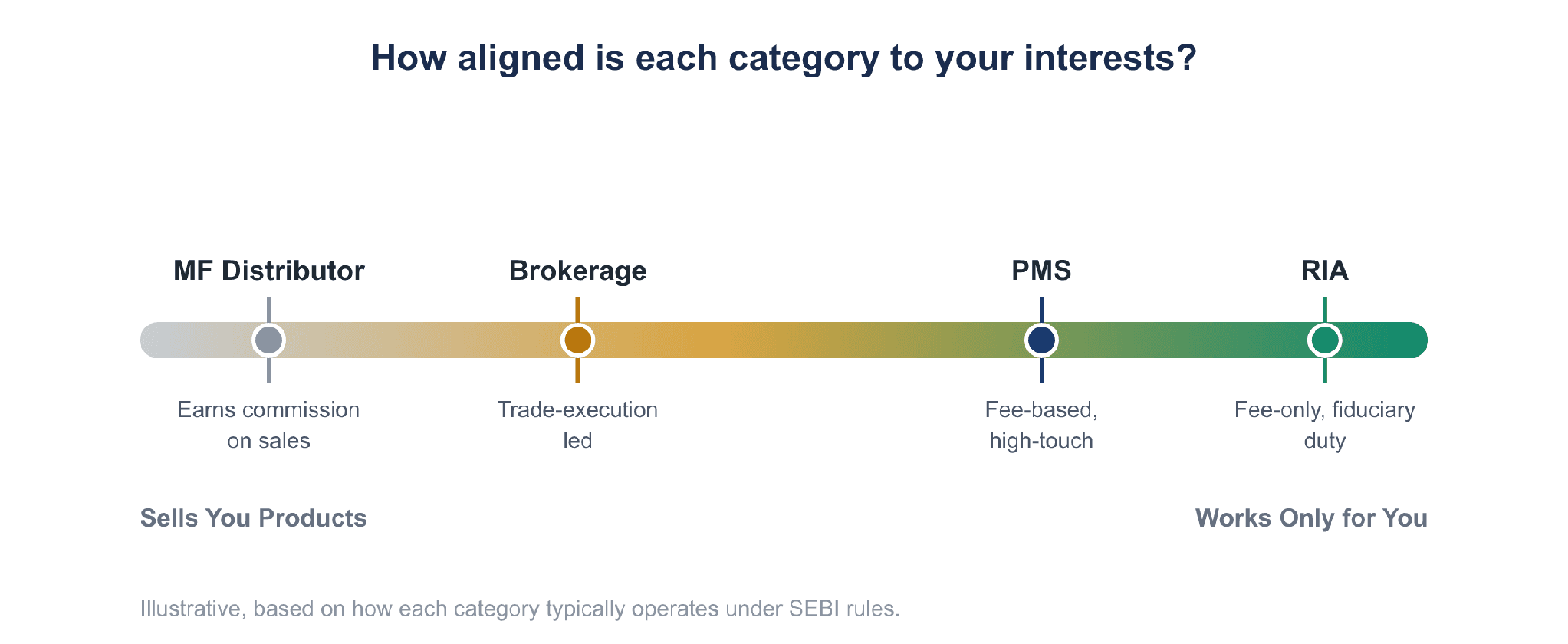
How aligned each category is to your interests, from product-led to fully fiduciary.
Why Surat’s Business Owners Need a Different Playbook?
A textile trader or diamond merchant’s income rarely arrives as a fixed monthly figure. It comes in seasonal, working-capital-linked waves, which makes a generic salaried-investor SIP plan a poor fit. An advisor who understands asset allocation against irregular cash flow, not just a steady paycheck, matters more here than in most other cities.
| A SURAT-ROOTED FIRM UNDERSTANDS SURAT’S CASH FLOW |
| Advisors built for salaried, big-city clients often default to a plan that does not fit a trading or manufacturing business. |
| Schedule a Consultation |
Timing Investments Around Surat’s Trade Cycles
A fixed monthly SIP assumes a fixed monthly income. For a textile trader or diamond exporter, that assumption rarely holds.
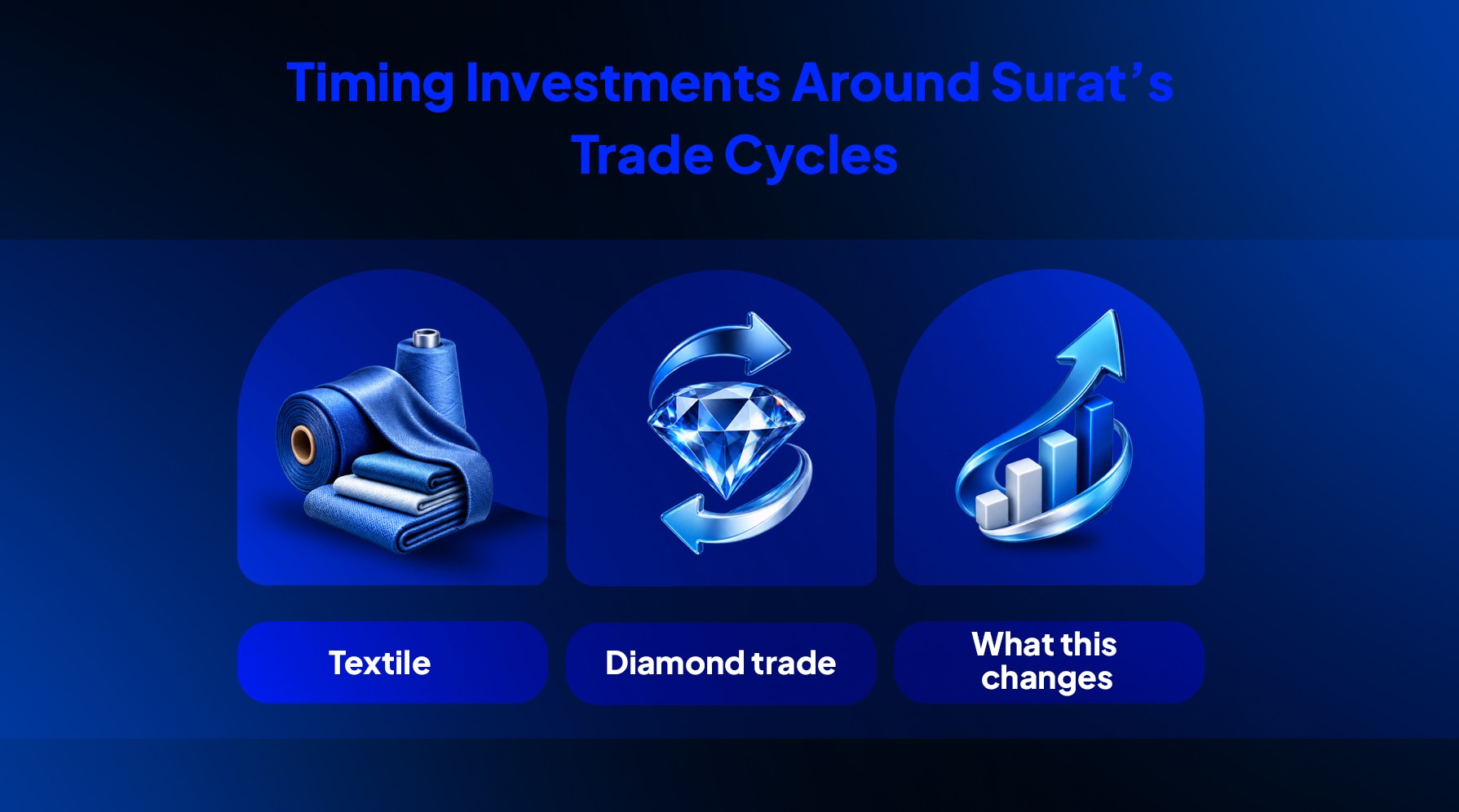
- Textile: demand and working capital needs typically build through the festive and wedding season, roughly August through November, with a slower stretch in the months after.
- Diamond trade: cutting and polishing volumes track global demand and festive or wedding jewelry cycles, which do not move in a straight line month to month.
- What this changes: a rigid monthly commitment often fits poorly. A surplus-linked approach, larger deployments through an STP when trade surplus peaks, lighter contributions in the off months, tends to match how the money actually arrives.
None of this shows up in a generic financial plan built around a salary slip, which is exactly why it needs to be discussed explicitly, not assumed away.
Common Wealth Mistakes in Surat’s Trading Families
A few patterns show up often enough in trading and manufacturing families that they are worth naming directly.
- Over-concentration: reinvesting nearly every surplus rupee back into inventory, the business itself, or physical assets like gold and property, leaving personal wealth with almost no diversification.
- Blurred personal and business finances: treating company working capital and personal savings as one pool, so a bad season in the business drags down both at once.
- Delayed succession planning: many family businesses postpone formal wealth transfer and estate planning across generations until it becomes urgent rather than optional.
None of these are unique to Surat, but they show up here with unusual consistency, which is exactly why a generic financial plan tends to miss them.
Why Should You Choose Ckredence Wealth?
Ckredence Wealth is headquartered in Surat, at the International Wealth Center on VIP Road, Vesu, with roots going back to 1987 as Chirag Investments before the firm restructured into its current form. Ckredence Wealth is a SEBI registered investment advisor (INA000020846) and portfolio manager (INP000007164).
Solutions That Matter:
- Fee-only RIA advisory, with the fiduciary duty that a commission-based distributor does not carry.
- Portfolio management through PMS, for Surat business owners whose corpus qualifies beyond a mutual fund.
- A local understanding of wealth management for trading and manufacturing families, not a generic salaried-investor template.
Ready to talk to a Surat-based team? Schedule a Consultation!
Conclusion
Wealth advisory in Surat is not one category, it is several, RIAs, PMS providers, mutual fund distributors, and brokerages, each with a different obligation to you. Verifying which one you are actually talking to, and what their fee model incentivizes, matters more than how established or well-known a firm appears locally.
Surat’s trading and manufacturing economy also means most local investors need an advisor comfortable with irregular, cash-heavy income, not a plan built for a fixed salary. A firm with genuine roots in the city, not just a branch office, tends to understand that difference faster.
FAQs
01.
What is the difference between an RIA and a mutual fund distributor in Surat?
An RIA is SEBI-registered, fee-only, and has a fiduciary duty to act in your interest. A mutual fund distributor earns commission on the products they sell and is not bound by the same fiduciary standard.
02.
How much money do I need for PMS in Surat?
PMS requires a SEBI-mandated minimum investment of Rs.50 lakh, regardless of where in India you are located.
03.
Do I need a local Surat advisor, or can I use a national firm remotely?
A national firm can serve you perfectly well operationally, but for business owners with irregular, trade-linked income, an advisor who understands Surat’s business rhythms specifically tends to build a more realistic plan.
04.
How do I verify a wealth advisor’s SEBI registration?
Check the registration number directly on SEBI’s official portal rather than relying on claims made on a firm’s own website or marketing material.