
Wealth Management for Women in India: How to Choose an Adviser
Wealth management for women in India explained: what it covers, how to pick a SEBI-registered adviser, and a five-minute check of the names on your accounts.

Ckredence Wealth |October 11, 2026

Wealth management for women in India is the same regulated service every investor gets: advice, portfolio construction and reporting from a SEBI-registered firm. What changes is rarely the product. It is whether the adviser explains the reasoning, shows the cost and looks at the whole household's money.
Consider a Surat professional with ₹1 crore in mutual funds she picked herself and nobody to test her plan against. Or a woman in Ahmedabad who has just inherited a portfolio she did not build. Both need the same first step: a clear picture of what exists, in whose name, and who can act on it.
TL; DR
1. Wealth management for women in India is the standard SEBI-regulated service. Process and cost transparency matter more than a "women's" label.
2. Women held ₹11.3 trillion in CAMS-serviced mutual funds in FY26 (CAMS, May 2026).
3. In Barclays Private Bank's August 2026 report, 85% of women named trust and transparency as the most important quality in an adviser.
4. Check SEBI registration, how the adviser is paid and what conflicts exist.
5. The Name-on-Record Check takes five minutes and shows who holds, who can act and who inherits.
6. PMS starts at ₹50 lakh under SEBI rules, so it suits some women investors and not others.
Already have an adviser? We will read your current plan and say plainly what we see.
| → Get a second opinion |
What Does Wealth Management for Women in India Include?
It covers financial planning, investment advice, portfolio management, tax-aware structuring and succession, delivered by a SEBI-registered adviser or portfolio manager. In practice it means one adviser looking at the whole household's money, not a single product.
Our guides to what wealth management is and to wealth management vs portfolio management set out the services.
📊 ₹11.3 trillion Women held this much in CAMS-serviced mutual funds in FY26, and about 2.2 million women investors were added during the year. *Source: Angel One, on the CAMS report "Going Beyond the Box 2026" - as of FY26 (published 19 May 2026)* |
Do Women Investors in India Need a Different Kind of Wealth Management?
The assumption is that women need simpler, gentler products. The reality is that women want the same strategies, explained more clearly.
According to Barclays Private Bank's report with Encubay (August 2026), 66% of surveyed women take part in investment decisions. Also, 84% favour balancing growth with capital preservation. The sample is affluent women leaders, so it describes that group only.
The 360 ONE Wealth Creators List 2026 counts 738 women holding 22.6% of listed wealth (July 2026). Much of it was built, not inherited.
How Should a Woman Choose a Financial or Investment Advisor in India?
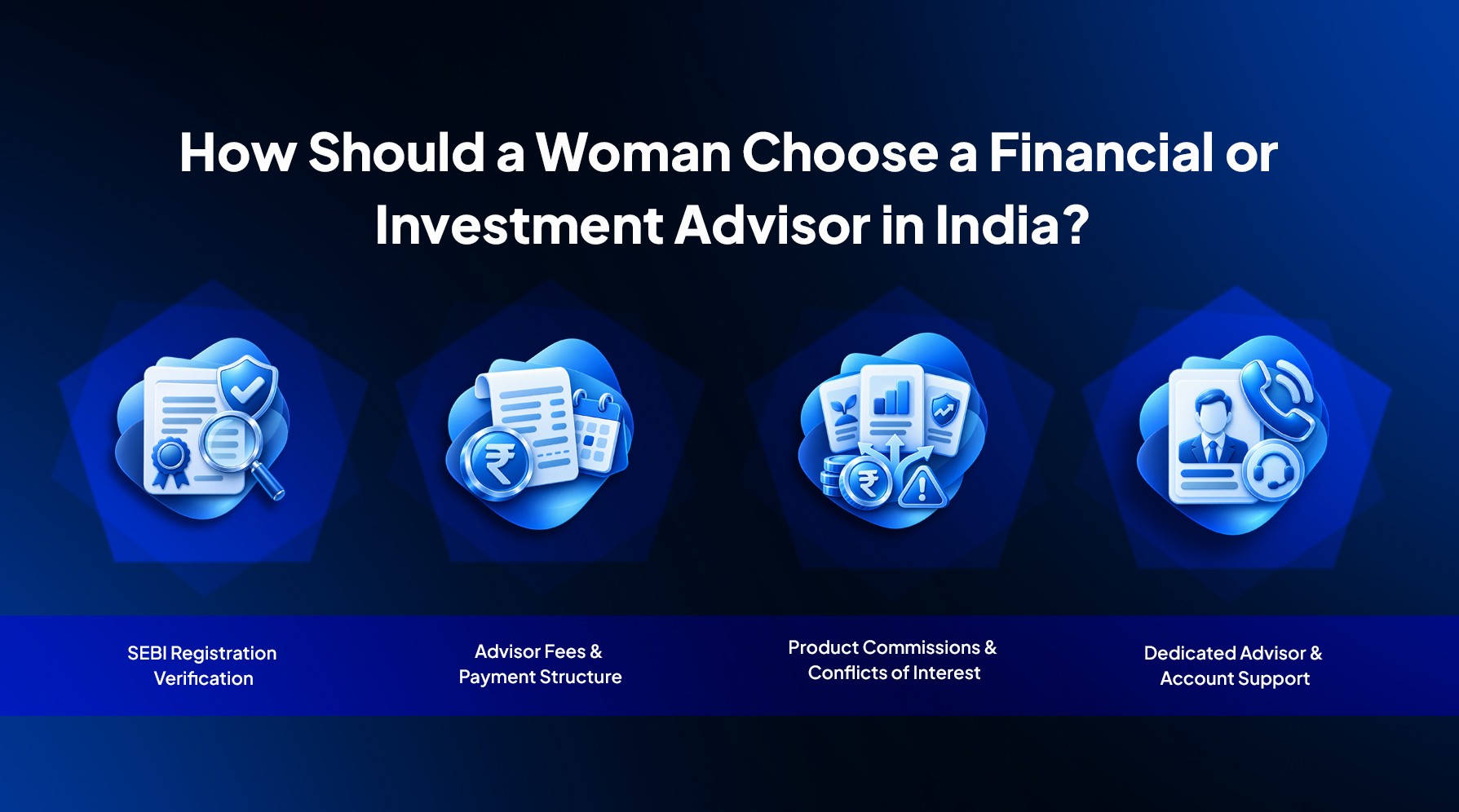
Check four things first: SEBI registration, how the adviser is paid, what conflicts exist, and who looks after your account. A SEBI-registered Investment Adviser is paid by the client and cannot earn commission on products it advises on.
Verify the registration number on SEBI's intermediary listing.
Ask how they are paid if you do nothing for a year. The answer should be a fee, not "it depends".
Ask which products they also sell, and whether any pay them a commission.
Ask who will answer your calls, by name and role.
Our guides to SEBI-registered RIAs and advisory fee models cover the differences. What we see across Gujarat families is that an account is opened by one person and understood by one person. An adviser who explains the plan to everyone it affects is worth more than a better brochure.
Ckredence does not run a separate women's desk or a women-only product. Every client is advised under the same fiduciary standard.
What Is the Five-Minute Name-on-Record Check for Women Investors?
A wealth plan is only as strong as the names, nominees and phone numbers on record. Run these checks on your own statements first. If you have just inherited, start with this plan for inherited money.
Check | Where to verify it | Why it matters |
Whose name is first holder on each demat, folio and bank account? | Latest statement | The first holder is who the platform deals with |
Is a nominee registered, and is it who you would choose today? | Demat and folio statements | SEBI now allows several nominees with set shares |
Which mobile and e-mail receive OTPs? | Contact details on the statement | If they belong to someone else, you cannot act alone |
Can you act alone, or only jointly? | Mode of holding on each account | Single, joint and anyone-or-survivor modes differ |
Is there one written list of every account? | Your own record | Unknown accounts are the ones that go unclaimed |
Every answer is checkable against a statement, which makes this a test rather than an opinion.
See what is on record in your name
Bring one statement and we will walk through the five checks with you.
When Does PMS Make Sense for Women Investors, and When Does It Not?
PMS suits women who hold ₹50 lakh or more, want a discretionary manager and can accept direct-equity risk. It does not suit those who may need the money at short notice.
It may fit a woman with a concentrated or inherited equity portfolio who wants one manager and one set of reports.
It may not fit someone below the minimum, or still deciding her overall mix. Portfolio planning for women HNIs starts with asset allocation.
The PMS minimum is set by SEBI at ₹50 lakh. SEBI's board approved a new portfolio manager framework on 24 September 2026, including a mutual-fund route with a ₹25 lakh ticket (Hubbis). Coverage differs on what it changes for conventional PMS, so check the notified rules.
Who Is Ckredence's Advice for Women Investors Not Right For?
Anyone seeking promised or targeted returns. No registered adviser can give them.
Anyone who wants a women-only team or product. We do not run one.
Anyone who needs a will, trust or dispute handled. Ckredence coordinates the portfolio side of succession. A lawyer drafts the documents.
⚠️ Risk to understand Past performance is not indicative of future results. Any pitch that promises a return should end the conversation. |
Conclusion
The next decision is not which product to buy. It is whether the person advising you will show their working. Run the Name-on-Record Check this week, and ask every adviser how they are paid.
Tell us what you hold and what you want it to do. We will say whether we are the right fit.
FAQs
What wealth management options are available specifically for affluent women?
There is no separate regulated category. Affluent women use the same services as any investor: advice from a SEBI-registered adviser, portfolio management, and financial and succession planning. Judge any women-focused programme on process, cost and transparency.
Can a woman open a PMS account on her own in India?
Yes. A resident woman can invest in her own name after completing KYC, provided she meets the SEBI minimum of ₹50 lakh. She does not need a joint holder, though she can add one.
How do I check whether an investment adviser is SEBI registered?
Search SEBI's list of registered investment advisers by name or registration number, and match it to what the adviser states in writing. A registered adviser quotes the number on every document. Treat a missing number as a reason to stop.
Can a woman invest in India without a joint account holder?
Yes. Demat accounts, fund folios and advisory agreements can all be held in a single name, with a nominee registered separately.