9 min read

9 min read

Retirement Corpus India: How Much Do HNIs Actually Need in 2026?

Retirement Corpus India: How Much Do HNIs Actually Need in 2026?

Retirement Corpus India: How Much Do HNIs Actually Need in 2026?

Standard calculators understate HNI retirement corpus needs by 30–40%. Here is how inflation, LTCG, and healthcare costs change the real number.

Standard calculators understate HNI retirement corpus needs by 30–40%. Here is how inflation, LTCG, and healthcare costs change the real number.

Standard calculators understate HNI retirement corpus needs by 30–40%. Here is how inflation, LTCG, and healthcare costs change the real number.

Ckredence

Ckredence

|

May 12, 2026

May 12, 2026

Retirement corpus planning for HNIs in India with inflation, withdrawal, and healthcare strategy framework

Most retirement corpus calculations in India are built for middle-income households with standard expense assumptions and a traditional retirement age of 60. That framework breaks immediately for business owners, CXOs, and affluent families. 

According to the Marcellus India Wealth Survey 2025, 4 in 10 HNIs reported serious difficulties meeting long-term financial goals including retirement, despite high income levels. The gap is not a savings problem. It is a planning structure problem.

For HNIs in India, retirement corpus planning must account for real lifestyle costs, premium healthcare, and a 25–35 year withdrawal horizon. India’s medical inflation is running at 14%, the highest in Asia, per the ACKO India Health Report 2024, far above what standard retirement calculators assume. 

Retirement planning for affluent investors is no longer about reaching a number. It is about building a portfolio structure capable of sustaining lifestyle, liquidity, healthcare, and financial independence across multiple decades without depending on active income.

Key Takeaways

  • The standard 25x retirement rule often understates what HNIs actually need.

  • Inflation, LTCG tax, and healthcare costs can raise corpus requirements by 30–40%.

  • Retirement corpus requirements differ sharply across cities and lifestyle categories.

  • HNIs need investment structures beyond SIPs and PPF for long-term planning.

  • Business owners must separate business wealth from personal retirement wealth.

  • The 10 years before retirement carry the highest portfolio transition risk.

  • Withdrawal strategy and tax planning matter as much as corpus size.

What Is a Retirement Corpus and How Much Do You Actually Need in India?

A retirement corpus is the total wealth required to support your lifestyle after active income stops. The most commonly used formula in India is the 25x rule, where investors target 25 times their annual expenses as a baseline. Our guide to financial independence for Indian HNIs covers how this calculation shifts when lifestyle costs and investment structures change.

For HNIs, the challenge begins when standard retirement examples stop making sense. Most calculators use ₹50,000 monthly expenses. That is not relevant for affluent households already spending ₹3–5 lakh monthly today.

How the 25x Rule Changes for HNIs

Monthly Expenses

Indicative Corpus Requirement

₹1 lakh

₹4–6 crore

₹2 lakh

₹8–10 crore

₹3 lakh

₹12–15 crore

₹5 lakh

₹18–25 crore

Indicative figures only. Actual requirements vary based on inflation, lifestyle, taxes, healthcare, and retirement age.

What Changes the Headline Number?

Three factors consistently increase the retirement corpus requirement for affluent investors:

  • Long-term inflation: Inflation gradually increases the cost of lifestyle expenses, healthcare, travel, and daily living.

    A corpus that looks sufficient today may feel inadequate after 15–20 years if inflation is not properly accounted for.

  • LTCG tax on withdrawals: Long-term capital gains tax reduces usable income generated from portfolio withdrawals.

    Over a long retirement horizon, this tax impact can meaningfully increase the corpus required to maintain the same lifestyle.

  • Rising healthcare costs: Healthcare inflation in India rises faster than general inflation, especially for premium private healthcare. Many affluent families need a separate healthcare reserve to avoid disturbing the main retirement corpus during medical emergencies.

Why the Standard Retirement Corpus Calculation Understates Your Actual Requirement by 30–40%

Most retirement calculators in India are built on assumptions borrowed from Western frameworks. They usually assume lower inflation, lower healthcare cost growth, and simpler withdrawal structures. That becomes a problem for Indian HNIs.

“Price is what you pay. Value is what you get.”

Warren Buffett, Chairman & CEO, Berkshire Hathaway

Source: Berkshire Hathaway Annual Shareholder Letters

Inflation Changes Everything

The traditional 4% withdrawal rule assumes inflation closer to 2–3%. In India, structural inflation often stays closer to 6–7%, while premium healthcare inflation rises much faster. A retirement corpus built on lower inflation assumptions may weaken earlier than expected.

📊 India’s medical inflation is running at 14%, the highest in Asia: Premium private healthcare costs compound at more than double the general inflation rate.

Source: ACKO India Health Report 2024, via Business Standard

LTCG Tax Reduces Usable Income

Most retirement calculations ignore the long-term capital gains tax impact on portfolio withdrawals. Over a 25–30 year retirement horizon, this creates a meaningful drag on effective income. The difference between gross returns and post-tax retirement income becomes large at higher corpus sizes.

Healthcare Costs Rise Faster Than General Inflation

Private healthcare costs for affluent families rise sharply over time. Long-term senior healthcare planning in India often requires a separate corpus layer rather than relying entirely on insurance.

Why the Gap Becomes Large for HNIs

A business owner with ₹3 lakh monthly expenses today may initially calculate a retirement corpus of ₹9 crore using the standard 25x framework. Once inflation adjustments, LTCG drag, and healthcare reserves are added, the real requirement may move toward ₹13–15 crore or more.

Indicative only. Actual retirement requirements vary based on health, lifestyle, and financial structure.

How to Calculate Your Retirement Corpus in India: A Step-by-Step Framework for HNIs
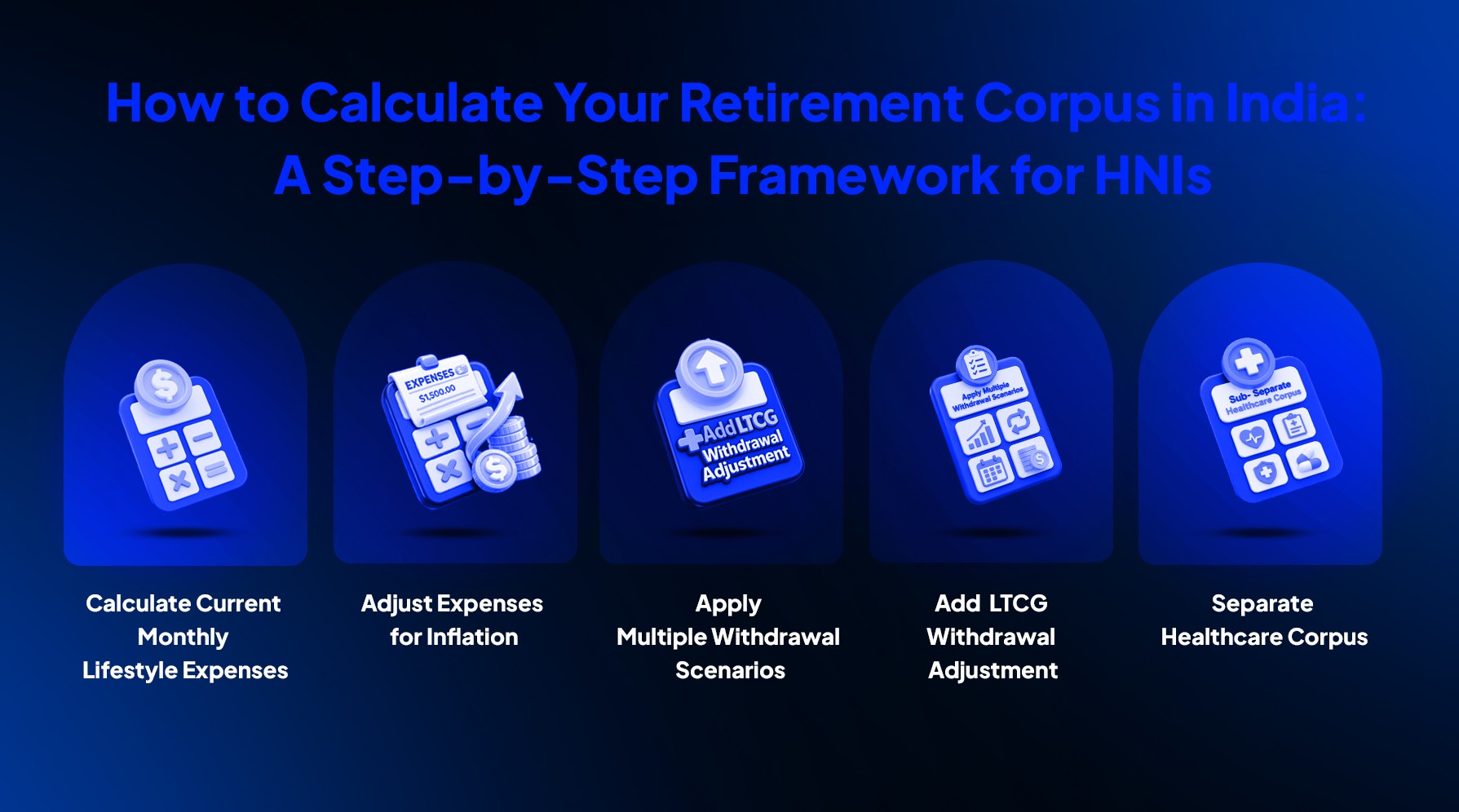
Retirement corpus calculation framework for HNIs covering inflation, LTCG, withdrawals, and healthcare

Retirement planning becomes more accurate when calculations move beyond simplified formulas. For HNIs, retirement is not just about replacing salary income. It is about sustaining lifestyle, liquidity, healthcare, travel, and long-term financial independence over multiple decades. Our comparison of PMS, mutual funds, and AIFs covers how the investment layer of this framework affects corpus growth and tax efficiency.

Step 1: Calculate Current Monthly Lifestyle Expenses

Start with real monthly spending rather than idealized estimates. Include housing, travel, healthcare, family support, education commitments, staff costs, insurance, and lifestyle expenses. Many affluent investors underestimate their actual monthly outflow because several expenses are irregular or business-linked.

Step 2: Adjust Expenses for Inflation

If retirement is still years away, current expenses must be inflation-adjusted. A lifestyle that costs ₹3 lakh monthly today will not cost the same after 8–10 years. At a 6% inflation assumption, ₹3 lakh today becomes approximately ₹4.7–4.8 lakh monthly at retirement. This is one of the biggest reasons standard calculators understate the required corpus for HNIs.

Step 3: Apply Multiple Withdrawal Scenarios

Different withdrawal frameworks create different retirement outcomes. Conservative withdrawal assumptions usually improve long-term sustainability.

Withdrawal Framework

Indicative Corpus

25x Rule

₹14–15 crore

30x Rule

₹17–18 crore

35x Rule

₹20 crore+

For affluent investors with long retirement horizons, relying only on the 25x framework may create future pressure if inflation and market volatility remain elevated.

Step 4: Add LTCG Withdrawal Adjustment

Long-term capital gains tax affects portfolio withdrawals across retirement years. Even if portfolio returns remain healthy, post-tax income may be lower than expected over time. Many HNIs maintain additional buffer capital to improve withdrawal sustainability and reduce pressure during volatile market periods.

Step 5: Separate Healthcare Corpus

Healthcare should not depend entirely on the investment corpus. Medical inflation in India rises faster than general inflation, especially for premium healthcare and long-term treatment requirements. Many affluent families maintain a separate healthcare reserve so emergency medical expenses do not disturb long-term retirement investments.

📋 The five-step calculation gives a direction. The exact number requires a SEBI-registered advisor who has structured this for HNIs in your income and lifestyle bracket.  Schedule a retirement corpus review with Ckredence Wealth.

How Much Retirement Corpus Is Enough in India: By Lifestyle, Age, and City

Retirement corpus requirements differ sharply depending on lifestyle, city, and retirement age. A corpus that feels sufficient for one family may fall short for another because spending patterns, healthcare expectations, and lifestyle choices differ across income groups. Our FIRE planning guide for HNIs covers how the financial independence number shifts further when retirement begins before 55.

Monthly Expenses

Retirement Age

Indicative Corpus Range

₹1 lakh

60

₹4–6 crore

₹2 lakh

58

₹8–12 crore

₹3 lakh

55

₹12–16 crore

₹4 lakh

55

₹16–22 crore

₹5 lakh

55

₹20–30 crore

Factor

Why It Changes the Retirement Corpus Requirement

Why City Matters

Retiring in Surat, Ahmedabad, Mumbai, or Pune creates different long-term cost structures. Housing, healthcare, and lifestyle inflation differ across cities.

Why Retirement Age Matters

Retiring at 55 instead of 60 adds five additional years of withdrawal pressure, increasing corpus requirements considerably.

All figures are indicative and vary based on individual financial circumstances.

📊 4 in 10 HNIs in India reported serious difficulties meeting long-term financial goals including retirement: Most cited poor investment structure rather than insufficient income as the core gap.

Source: Marcellus India Wealth Survey 2025, via Business Today, June 2025

🏙 A Mumbai lifestyle and a Surat lifestyle require different FIRE numbers, and most HNIs have never had that city-level calculation done.  Map your actual retirement corpus with Ckredence’s SEBI-registered advisors.

Building Your Retirement Corpus: Investment Instruments for HNIs in India Beyond SIPs and PPF

Retail retirement planning focuses on SIPs, NPS, and PPF. HNIs often require broader portfolio structures because retirement planning at larger corpus levels involves growth, income generation, diversification, and tax efficiency together. Our SEBI-registered PMS services are designed for HNIs seeking active portfolio management across these layers.

Portfolio Management Services (PMS)

  • Actively managed equity exposure for larger capital: PMS is designed for investors deploying higher capital who want professional portfolio management instead of self-directed investing.

  • Structured portfolio management for long-term wealth: Portfolios are actively reviewed based on market conditions, valuation opportunities, and risk levels.

  • Personalised strategies aligned to retirement timelines: PMS allows portfolio strategies to align more closely with an investor’s goals, risk profile, and retirement horizon.

National Pension System (NPS)

  • Tax-efficient retirement accumulation: NPS provides additional tax deductions and improves long-term retirement planning efficiency for high-income earners.

  • Useful during peak earning years: Many HNIs use NPS as part of their retirement allocation while optimising taxable income.

  • Structured long-term discipline: Since NPS is retirement-focused, it encourages long-term investing discipline and structured accumulation.

REITs and InvITs

  • Recurring income from commercial assets: These instruments generate income from rent-producing real estate or infrastructure cash flows.

  • Passive cash flow during retirement years: REITs and InvITs may help create regular income streams without direct property management responsibilities.

  • Diversification beyond traditional equity: They add an alternative income-generating layer to the overall retirement portfolio structure.

Structured Products

  • Downside protection near retirement: Structured products are often used when investors want lower volatility in the pre-retirement transition phase.

  • Capital protection in volatile markets: Some structures are designed to balance market participation with controlled downside risk.

Global Diversification

  • Reduces overdependence on Indian markets: Global investments help reduce concentration risk linked to one economy or market cycle.

  • Currency and geographic risk diversification: Dollar-denominated assets provide stability against long-term INR depreciation.

  • Access to global sectors: Investors gain participation in industries and companies not available in Indian markets alone.

Retirement Corpus Planning in India: A Year-by-Year Roadmap for Someone 10 Years from Retirement

The final decade before retirement is usually the most important phase in retirement planning. Decisions made during this period affect portfolio stability, withdrawal sustainability, taxation, and long-term lifestyle continuity after active income slows down.

“The individual investor should act consistently as an investor and not as a speculator.”

Benjamin Graham, Author, The Intelligent Investor

Source: The Intelligent Investor, Revised Edition, Harper Business

Years 1–5: Accumulation Phase

  1. Maximum long-term growth allocation: This phase focuses on building the corpus aggressively through growth-oriented investments while there is enough time to recover from market volatility.

  2. PMS deployment where appropriate: PMS strategies may help affluent investors create structured equity exposure with active portfolio management and long-term wealth accumulation.

  3. Tax-efficient accumulation: Investment structures during this phase should also focus on improving tax efficiency while increasing overall retirement capital.

Years 6–8: Pre-Retirement Transition

  1. Gradual equity-to-debt balancing: As retirement approaches, reducing excessive equity exposure helps protect accumulated wealth from major market corrections.

  2. LTCG harvesting strategy: Planned withdrawals and profit booking may help manage long-term capital gains tax exposure more efficiently before retirement begins.

  3. Income structure planning: Investors should start planning how retirement income will actually be generated through dividends, rentals, withdrawals, or other passive income sources.

Years 9–10: Decumulation Preparation

  1. Healthcare corpus ring-fencing: A separate healthcare reserve prevents medical costs from disturbing the main retirement investment portfolio.

  2. Emergency liquidity setup: Liquid funds and emergency reserves handle unexpected expenses without forcing long-term asset liquidation.

  3. Business wealth separation: Business owners should separate retirement wealth from business assets to reduce concentration and liquidity risk after retirement.

The decisions in Years 6–8, the pre-retirement transition phase, carry the highest consequence of any period in the corpus-building journey.

If you

are in the 10-year window before retirement and your allocation has not yet shifted, this is when professional advisory matters most.  Talk to a Ckredence wealth advisor about your pre-retirement transition plan.

Why Ckredence Wealth for Your Retirement Corpus Planning in Gujarat and Maharashtra

A retirement corpus of ₹16–20 crore does not manage itself. The decisions around allocation, tax planning, healthcare reserves, and withdrawal sustainability require ongoing oversight. Our SEBI-registered RIA services provide the full-spectrum advisory structure affluent investors need across every phase of retirement planning.

Why HNIs Choose Ckredence Wealth

  • SEBI Registered PMS (INP000007164): Full regulatory accountability with verified portfolio management credentials.

  • ₹805+ crore AUM: Active wealth under management across 376 HNI clients in Gujarat and Maharashtra.

  • 37-year wealth management legacy: Built across multiple market cycles, with proven structures for HNI retirement planning.

  • Four PMS strategies across risk profiles: Flexible allocation options matched to growth, income, and preservation requirements.

  • Offices in Surat, Mumbai, and Vadodara: Locally present advisors with direct understanding of Gujarat and Maharashtra lifestyle costs.

How Ckredence Helps

  • Retirement corpus structuring: Building a personalised corpus calculation based on lifestyle, city, and retirement timeline.

  • PMS allocation planning: Matching equity strategies to risk profile, tax position, and income replacement needs.

  • Tax-aware withdrawal strategy: Planning withdrawals to manage LTCG exposure and improve post-tax retirement income.

  • Business corpus separation: Structurally separating retirement wealth from business assets before retirement begins.

  • Long-term retirement portfolio oversight: Ongoing review and rebalancing as markets, tax rules, and lifestyle costs evolve over time.

Conclusion

Retirement corpus planning in India has changed for affluent investors. Inflation, taxation, healthcare costs, and longer retirement horizons have made standard calculator-based planning unreliable for HNIs. For business owners and senior professionals, retirement is no longer just about reaching a number. 

It is about creating a portfolio structure capable of sustaining lifestyle, liquidity, and financial independence over multiple decades. The gap between having wealth and having structured retirement wealth is where most HNIs are today. That gap is the first conversation to have.

FAQs

01.

How much retirement corpus do HNIs with ₹3 lakh monthly expenses need in India?

The corpus requirement typically ranges between ₹12 crore and ₹18 crore or more. Retiring earlier, planning for 35 years, or carrying premium healthcare adds to this figure. A Surat or Pune lifestyle requires a different number than Mumbai.

02.

Why does India’s inflation rate change the standard 25x retirement corpus calculation?

India’s structural inflation runs higher than Western assumptions embedded in the 25x formula. Premium healthcare and lifestyle costs inflate faster than general CPI. HNIs planning on 25x without inflation adjustments often find their corpus insufficient within 12–15 years.

03.

What investment instruments should HNIs use beyond SIPs and PPF?

PMS, REITs, AIFs, global ETFs, and structured products are commonly used for HNI retirement accumulation. Each serves a different layer: income generation, long-term growth, or downside protection. The right mix depends on timeline, risk profile, and tax position.

04.

When should an HNI consult a SEBI-registered advisor for retirement corpus planning?

Professional advisory becomes important once corpus size, business assets, or withdrawal complexity increases. It also becomes necessary when LTCG planning, succession, or pre-retirement transition decisions are approaching. Starting the conversation 10 years before retirement gives the most room to structure.

Most retirement corpus calculations in India are built for middle-income households with standard expense assumptions and a traditional retirement age of 60. That framework breaks immediately for business owners, CXOs, and affluent families. 

According to the Marcellus India Wealth Survey 2025, 4 in 10 HNIs reported serious difficulties meeting long-term financial goals including retirement, despite high income levels. The gap is not a savings problem. It is a planning structure problem.

For HNIs in India, retirement corpus planning must account for real lifestyle costs, premium healthcare, and a 25–35 year withdrawal horizon. India’s medical inflation is running at 14%, the highest in Asia, per the ACKO India Health Report 2024, far above what standard retirement calculators assume. 

Retirement planning for affluent investors is no longer about reaching a number. It is about building a portfolio structure capable of sustaining lifestyle, liquidity, healthcare, and financial independence across multiple decades without depending on active income.

Key Takeaways

  • The standard 25x retirement rule often understates what HNIs actually need.

  • Inflation, LTCG tax, and healthcare costs can raise corpus requirements by 30–40%.

  • Retirement corpus requirements differ sharply across cities and lifestyle categories.

  • HNIs need investment structures beyond SIPs and PPF for long-term planning.

  • Business owners must separate business wealth from personal retirement wealth.

  • The 10 years before retirement carry the highest portfolio transition risk.

  • Withdrawal strategy and tax planning matter as much as corpus size.

What Is a Retirement Corpus and How Much Do You Actually Need in India?

A retirement corpus is the total wealth required to support your lifestyle after active income stops. The most commonly used formula in India is the 25x rule, where investors target 25 times their annual expenses as a baseline. Our guide to financial independence for Indian HNIs covers how this calculation shifts when lifestyle costs and investment structures change.

For HNIs, the challenge begins when standard retirement examples stop making sense. Most calculators use ₹50,000 monthly expenses. That is not relevant for affluent households already spending ₹3–5 lakh monthly today.

How the 25x Rule Changes for HNIs

Monthly Expenses

Indicative Corpus Requirement

₹1 lakh

₹4–6 crore

₹2 lakh

₹8–10 crore

₹3 lakh

₹12–15 crore

₹5 lakh

₹18–25 crore

Indicative figures only. Actual requirements vary based on inflation, lifestyle, taxes, healthcare, and retirement age.

What Changes the Headline Number?

Three factors consistently increase the retirement corpus requirement for affluent investors:

  • Long-term inflation: Inflation gradually increases the cost of lifestyle expenses, healthcare, travel, and daily living.

    A corpus that looks sufficient today may feel inadequate after 15–20 years if inflation is not properly accounted for.

  • LTCG tax on withdrawals: Long-term capital gains tax reduces usable income generated from portfolio withdrawals.

    Over a long retirement horizon, this tax impact can meaningfully increase the corpus required to maintain the same lifestyle.

  • Rising healthcare costs: Healthcare inflation in India rises faster than general inflation, especially for premium private healthcare. Many affluent families need a separate healthcare reserve to avoid disturbing the main retirement corpus during medical emergencies.

Why the Standard Retirement Corpus Calculation Understates Your Actual Requirement by 30–40%

Most retirement calculators in India are built on assumptions borrowed from Western frameworks. They usually assume lower inflation, lower healthcare cost growth, and simpler withdrawal structures. That becomes a problem for Indian HNIs.

“Price is what you pay. Value is what you get.”

Warren Buffett, Chairman & CEO, Berkshire Hathaway

Source: Berkshire Hathaway Annual Shareholder Letters

Inflation Changes Everything

The traditional 4% withdrawal rule assumes inflation closer to 2–3%. In India, structural inflation often stays closer to 6–7%, while premium healthcare inflation rises much faster. A retirement corpus built on lower inflation assumptions may weaken earlier than expected.

📊 India’s medical inflation is running at 14%, the highest in Asia: Premium private healthcare costs compound at more than double the general inflation rate.

Source: ACKO India Health Report 2024, via Business Standard

LTCG Tax Reduces Usable Income

Most retirement calculations ignore the long-term capital gains tax impact on portfolio withdrawals. Over a 25–30 year retirement horizon, this creates a meaningful drag on effective income. The difference between gross returns and post-tax retirement income becomes large at higher corpus sizes.

Healthcare Costs Rise Faster Than General Inflation

Private healthcare costs for affluent families rise sharply over time. Long-term senior healthcare planning in India often requires a separate corpus layer rather than relying entirely on insurance.

Why the Gap Becomes Large for HNIs

A business owner with ₹3 lakh monthly expenses today may initially calculate a retirement corpus of ₹9 crore using the standard 25x framework. Once inflation adjustments, LTCG drag, and healthcare reserves are added, the real requirement may move toward ₹13–15 crore or more.

Indicative only. Actual retirement requirements vary based on health, lifestyle, and financial structure.

How to Calculate Your Retirement Corpus in India: A Step-by-Step Framework for HNIs

Retirement corpus calculation framework for HNIs covering inflation, LTCG, withdrawals, and healthcare

Retirement planning becomes more accurate when calculations move beyond simplified formulas. For HNIs, retirement is not just about replacing salary income. It is about sustaining lifestyle, liquidity, healthcare, travel, and long-term financial independence over multiple decades. Our comparison of PMS, mutual funds, and AIFs covers how the investment layer of this framework affects corpus growth and tax efficiency.

Step 1: Calculate Current Monthly Lifestyle Expenses

Start with real monthly spending rather than idealized estimates. Include housing, travel, healthcare, family support, education commitments, staff costs, insurance, and lifestyle expenses. Many affluent investors underestimate their actual monthly outflow because several expenses are irregular or business-linked.

Step 2: Adjust Expenses for Inflation

If retirement is still years away, current expenses must be inflation-adjusted. A lifestyle that costs ₹3 lakh monthly today will not cost the same after 8–10 years. At a 6% inflation assumption, ₹3 lakh today becomes approximately ₹4.7–4.8 lakh monthly at retirement. This is one of the biggest reasons standard calculators understate the required corpus for HNIs.

Step 3: Apply Multiple Withdrawal Scenarios

Different withdrawal frameworks create different retirement outcomes. Conservative withdrawal assumptions usually improve long-term sustainability.

Withdrawal Framework

Indicative Corpus

25x Rule

₹14–15 crore

30x Rule

₹17–18 crore

35x Rule

₹20 crore+

For affluent investors with long retirement horizons, relying only on the 25x framework may create future pressure if inflation and market volatility remain elevated.

Step 4: Add LTCG Withdrawal Adjustment

Long-term capital gains tax affects portfolio withdrawals across retirement years. Even if portfolio returns remain healthy, post-tax income may be lower than expected over time. Many HNIs maintain additional buffer capital to improve withdrawal sustainability and reduce pressure during volatile market periods.

Step 5: Separate Healthcare Corpus

Healthcare should not depend entirely on the investment corpus. Medical inflation in India rises faster than general inflation, especially for premium healthcare and long-term treatment requirements. Many affluent families maintain a separate healthcare reserve so emergency medical expenses do not disturb long-term retirement investments.

📋 The five-step calculation gives a direction. The exact number requires a SEBI-registered advisor who has structured this for HNIs in your income and lifestyle bracket.  Schedule a retirement corpus review with Ckredence Wealth.

How Much Retirement Corpus Is Enough in India: By Lifestyle, Age, and City

Retirement corpus requirements differ sharply depending on lifestyle, city, and retirement age. A corpus that feels sufficient for one family may fall short for another because spending patterns, healthcare expectations, and lifestyle choices differ across income groups. Our FIRE planning guide for HNIs covers how the financial independence number shifts further when retirement begins before 55.

Monthly Expenses

Retirement Age

Indicative Corpus Range

₹1 lakh

60

₹4–6 crore

₹2 lakh

58

₹8–12 crore

₹3 lakh

55

₹12–16 crore

₹4 lakh

55

₹16–22 crore

₹5 lakh

55

₹20–30 crore

Factor

Why It Changes the Retirement Corpus Requirement

Why City Matters

Retiring in Surat, Ahmedabad, Mumbai, or Pune creates different long-term cost structures. Housing, healthcare, and lifestyle inflation differ across cities.

Why Retirement Age Matters

Retiring at 55 instead of 60 adds five additional years of withdrawal pressure, increasing corpus requirements considerably.

All figures are indicative and vary based on individual financial circumstances.

📊 4 in 10 HNIs in India reported serious difficulties meeting long-term financial goals including retirement: Most cited poor investment structure rather than insufficient income as the core gap.

Source: Marcellus India Wealth Survey 2025, via Business Today, June 2025

🏙 A Mumbai lifestyle and a Surat lifestyle require different FIRE numbers, and most HNIs have never had that city-level calculation done.  Map your actual retirement corpus with Ckredence’s SEBI-registered advisors.

Building Your Retirement Corpus: Investment Instruments for HNIs in India Beyond SIPs and PPF

Retail retirement planning focuses on SIPs, NPS, and PPF. HNIs often require broader portfolio structures because retirement planning at larger corpus levels involves growth, income generation, diversification, and tax efficiency together. Our SEBI-registered PMS services are designed for HNIs seeking active portfolio management across these layers.

Portfolio Management Services (PMS)

  • Actively managed equity exposure for larger capital: PMS is designed for investors deploying higher capital who want professional portfolio management instead of self-directed investing.

  • Structured portfolio management for long-term wealth: Portfolios are actively reviewed based on market conditions, valuation opportunities, and risk levels.

  • Personalised strategies aligned to retirement timelines: PMS allows portfolio strategies to align more closely with an investor’s goals, risk profile, and retirement horizon.

National Pension System (NPS)

  • Tax-efficient retirement accumulation: NPS provides additional tax deductions and improves long-term retirement planning efficiency for high-income earners.

  • Useful during peak earning years: Many HNIs use NPS as part of their retirement allocation while optimising taxable income.

  • Structured long-term discipline: Since NPS is retirement-focused, it encourages long-term investing discipline and structured accumulation.

REITs and InvITs

  • Recurring income from commercial assets: These instruments generate income from rent-producing real estate or infrastructure cash flows.

  • Passive cash flow during retirement years: REITs and InvITs may help create regular income streams without direct property management responsibilities.

  • Diversification beyond traditional equity: They add an alternative income-generating layer to the overall retirement portfolio structure.

Structured Products

  • Downside protection near retirement: Structured products are often used when investors want lower volatility in the pre-retirement transition phase.

  • Capital protection in volatile markets: Some structures are designed to balance market participation with controlled downside risk.

Global Diversification

  • Reduces overdependence on Indian markets: Global investments help reduce concentration risk linked to one economy or market cycle.

  • Currency and geographic risk diversification: Dollar-denominated assets provide stability against long-term INR depreciation.

  • Access to global sectors: Investors gain participation in industries and companies not available in Indian markets alone.

Retirement Corpus Planning in India: A Year-by-Year Roadmap for Someone 10 Years from Retirement

The final decade before retirement is usually the most important phase in retirement planning. Decisions made during this period affect portfolio stability, withdrawal sustainability, taxation, and long-term lifestyle continuity after active income slows down.

“The individual investor should act consistently as an investor and not as a speculator.”

Benjamin Graham, Author, The Intelligent Investor

Source: The Intelligent Investor, Revised Edition, Harper Business

Years 1–5: Accumulation Phase

  1. Maximum long-term growth allocation: This phase focuses on building the corpus aggressively through growth-oriented investments while there is enough time to recover from market volatility.

  2. PMS deployment where appropriate: PMS strategies may help affluent investors create structured equity exposure with active portfolio management and long-term wealth accumulation.

  3. Tax-efficient accumulation: Investment structures during this phase should also focus on improving tax efficiency while increasing overall retirement capital.

Years 6–8: Pre-Retirement Transition

  1. Gradual equity-to-debt balancing: As retirement approaches, reducing excessive equity exposure helps protect accumulated wealth from major market corrections.

  2. LTCG harvesting strategy: Planned withdrawals and profit booking may help manage long-term capital gains tax exposure more efficiently before retirement begins.

  3. Income structure planning: Investors should start planning how retirement income will actually be generated through dividends, rentals, withdrawals, or other passive income sources.

Years 9–10: Decumulation Preparation

  1. Healthcare corpus ring-fencing: A separate healthcare reserve prevents medical costs from disturbing the main retirement investment portfolio.

  2. Emergency liquidity setup: Liquid funds and emergency reserves handle unexpected expenses without forcing long-term asset liquidation.

  3. Business wealth separation: Business owners should separate retirement wealth from business assets to reduce concentration and liquidity risk after retirement.

The decisions in Years 6–8, the pre-retirement transition phase, carry the highest consequence of any period in the corpus-building journey.

If you

are in the 10-year window before retirement and your allocation has not yet shifted, this is when professional advisory matters most.  Talk to a Ckredence wealth advisor about your pre-retirement transition plan.

Why Ckredence Wealth for Your Retirement Corpus Planning in Gujarat and Maharashtra

A retirement corpus of ₹16–20 crore does not manage itself. The decisions around allocation, tax planning, healthcare reserves, and withdrawal sustainability require ongoing oversight. Our SEBI-registered RIA services provide the full-spectrum advisory structure affluent investors need across every phase of retirement planning.

Why HNIs Choose Ckredence Wealth

  • SEBI Registered PMS (INP000007164): Full regulatory accountability with verified portfolio management credentials.

  • ₹805+ crore AUM: Active wealth under management across 376 HNI clients in Gujarat and Maharashtra.

  • 37-year wealth management legacy: Built across multiple market cycles, with proven structures for HNI retirement planning.

  • Four PMS strategies across risk profiles: Flexible allocation options matched to growth, income, and preservation requirements.

  • Offices in Surat, Mumbai, and Vadodara: Locally present advisors with direct understanding of Gujarat and Maharashtra lifestyle costs.

How Ckredence Helps

  • Retirement corpus structuring: Building a personalised corpus calculation based on lifestyle, city, and retirement timeline.

  • PMS allocation planning: Matching equity strategies to risk profile, tax position, and income replacement needs.

  • Tax-aware withdrawal strategy: Planning withdrawals to manage LTCG exposure and improve post-tax retirement income.

  • Business corpus separation: Structurally separating retirement wealth from business assets before retirement begins.

  • Long-term retirement portfolio oversight: Ongoing review and rebalancing as markets, tax rules, and lifestyle costs evolve over time.

Conclusion

Retirement corpus planning in India has changed for affluent investors. Inflation, taxation, healthcare costs, and longer retirement horizons have made standard calculator-based planning unreliable for HNIs. For business owners and senior professionals, retirement is no longer just about reaching a number. 

It is about creating a portfolio structure capable of sustaining lifestyle, liquidity, and financial independence over multiple decades. The gap between having wealth and having structured retirement wealth is where most HNIs are today. That gap is the first conversation to have.

FAQs

01.

How much retirement corpus do HNIs with ₹3 lakh monthly expenses need in India?

The corpus requirement typically ranges between ₹12 crore and ₹18 crore or more. Retiring earlier, planning for 35 years, or carrying premium healthcare adds to this figure. A Surat or Pune lifestyle requires a different number than Mumbai.

02.

Why does India’s inflation rate change the standard 25x retirement corpus calculation?

India’s structural inflation runs higher than Western assumptions embedded in the 25x formula. Premium healthcare and lifestyle costs inflate faster than general CPI. HNIs planning on 25x without inflation adjustments often find their corpus insufficient within 12–15 years.

03.

What investment instruments should HNIs use beyond SIPs and PPF?

PMS, REITs, AIFs, global ETFs, and structured products are commonly used for HNI retirement accumulation. Each serves a different layer: income generation, long-term growth, or downside protection. The right mix depends on timeline, risk profile, and tax position.

04.

When should an HNI consult a SEBI-registered advisor for retirement corpus planning?

Professional advisory becomes important once corpus size, business assets, or withdrawal complexity increases. It also becomes necessary when LTCG planning, succession, or pre-retirement transition decisions are approaching. Starting the conversation 10 years before retirement gives the most room to structure.