9min read
9min read
FIRE for HNIs in India: FatFIRE Strategy Guide 2026
Most Indian HNIs don’t have a real FIRE number. Here is how PMS, AIFs, and tax-aware withdrawal structures fund long-term financial independence.

Ckredence Wealth
Ckredence Wealth
|
May 13, 2026
May 13, 2026

India’s HNI population grew 6% in 2024 to 85,698 individuals with assets above $10 million, according to Knight Frank’s Wealth Report 2025. Yet for most of these investors, wealth and financial independence are not the same thing. FIRE for HNIs in India is no longer a niche concept.
High-income professionals and business owners are increasingly planning structured financial independence rather than relying on traditional retirement models.
For Indian HNIs, FIRE is not about expense minimisation. It is about building enough passive and managed income to sustain lifestyle quality without depending on active business or salary income.
HNI investments in AIFs crossed ₹5.38 lakh crore by March 2025, growing over 30% year-on-year, indicating a clear shift toward structured, diversified wealth strategies. PMS-led investing, global diversification, and tax-aware withdrawal planning are now central to how affluent families build long-term financial flexibility.
Key Takeaways
HNI FIRE planning in India focuses on lifestyle flexibility, not expense reduction.
Luxury lifestyle inflation often rises faster than standard retirement formulas assume.
Most affluent investors underestimate post-tax requirements when planning their FIRE corpus.
PMS, AIFs, commercial real estate, and global assets form the core of HNI FIRE portfolios.
The traditional 4% withdrawal rule rarely fits Indian HNIs planning long retirement horizons.
Tax planning matters as much as portfolio returns when structuring FIRE withdrawals.
A realistic FIRE number must account for city, lifestyle, and long-term healthcare costs.
What Is FIRE for High-Net-Worth Individuals in India?
FIRE for HNIs in India refers to building enough wealth to achieve financial independence without depending fully on active business or salary income.
Unlike traditional FIRE models focused on aggressive savings and minimal lifestyles, HNI FIRE follows the FatFIRE approach, where the goal is maintaining lifestyle quality while reducing financial dependence on work.
Our financial independence planning guide explores how HNIs across India are approaching this shift in practice.
For affluent investors, this means building a portfolio capable of supporting luxury housing, healthcare, travel, family commitments, and lifestyle inflation over multiple decades.
FatFIRE vs. Lean FIRE
Standard FIRE focuses heavily on expense reduction and early retirement through aggressive savings. FatFIRE is different.
It assumes higher lifestyle costs and larger wealth requirements while prioritising flexibility and comfort.
The ₹5 Crore Threshold
In the Indian context, HNI FIRE conversations become meaningful once liquid investable assets move beyond ₹5 crore.
At this level, investors shift from accumulation thinking toward passive income structures, capital preservation, and long-term withdrawal planning.
Why FIRE Is Becoming More Relevant for Indian HNIs
India’s HNI population is expanding rapidly. More professionals and business owners are realising that wealth without structure often creates dependency instead of freedom.
“Risk comes from not knowing what you are doing.”
Warren Buffett, Chairman & CEO, Berkshire Hathaway
Source: Berkshire Hathaway Shareholder Meeting
Why the 4% Withdrawal Rule Does Not Work for Indian HNIs
The traditional 4% withdrawal rule was built around Western retirement assumptions. For Indian HNIs, the reality is very different.
Our comparison of PMS, mutual funds, and AIFs in India covers how portfolio structure directly affects withdrawal capacity and post-tax income.
Lifestyle Inflation Is Higher: Luxury lifestyle inflation in India often rises faster than general inflation.
International travel, premium healthcare, high-end schooling, and imported consumption categories may rise at 8–10% annually.
Tax Exposure Changes Real Returns: Capital gains tax, surcharge structures, and withdrawal timing directly affect usable income.
Gross portfolio returns and post-tax retirement income are rarely the same.
India Has No Social Security Cushion: Unlike some Western economies, Indian HNIs cannot rely on large retirement support systems.
FIRE portfolios must independently sustain healthcare, emergencies, and longevity risk.
HNI Portfolios Behave Differently: HNI portfolios often include PMS, AIFs, commercial real estate, and concentrated equity exposure.
These structures require different withdrawal assumptions compared to passive index investing.
The Case for a Lower Withdrawal Rate
Many HNI advisors now prefer a 2.5% to 3% withdrawal framework for affluent Indian investors planning long retirement horizons. This creates greater sustainability during market volatility.
What Is the Right FIRE Number for HNIs in India in 2026?
The biggest mistake affluent investors make is using generic retirement formulas without adjusting for their actual lifestyle. The table below provides a realistic starting framework.
Lifestyle Profile | Estimated FIRE Corpus | Approx. Monthly Passive Income |
Surat / Vadodara HNI Lifestyle | ₹5–8 crore | ₹1.2L–2L |
Tier-1 Metro Lifestyle | ₹10–15 crore | ₹2.5L–4L |
Ultra Luxury FatFIRE | ₹20 crore+ | ₹5L+ |
The 25x Rule Needs Adjustment
The traditional 25x annual expense formula works for basic FIRE calculations. HNIs often need higher multipliers because expenses are not static.
₹12 Crore Corpus Reality
A ₹12 crore portfolio may appear large, but after tax, inflation, and healthcare costs, the real usable passive income may feel lower than expected in Tier-1 cities.
City-Level Lifestyle Matters
A Mumbai lifestyle and a Surat lifestyle require different FIRE numbers. Housing, education, travel, and social spending vary considerably across cities.
💡 Most HNIs in Gujarat and Maharashtra do not have a FIRE number built on their actual lifestyle, city, and tax exposure. Map your personal FIRE corpus with a SEBI-registered Ckredence advisor.
Key Investment Strategies HNIs Use to Fund Early Retirement in India
Most affluent investors do not build FIRE through savings accounts and SIPs alone. The approach is layered across different asset categories. Our portfolio management services are designed for HNIs seeking structured, long-term wealth generation.
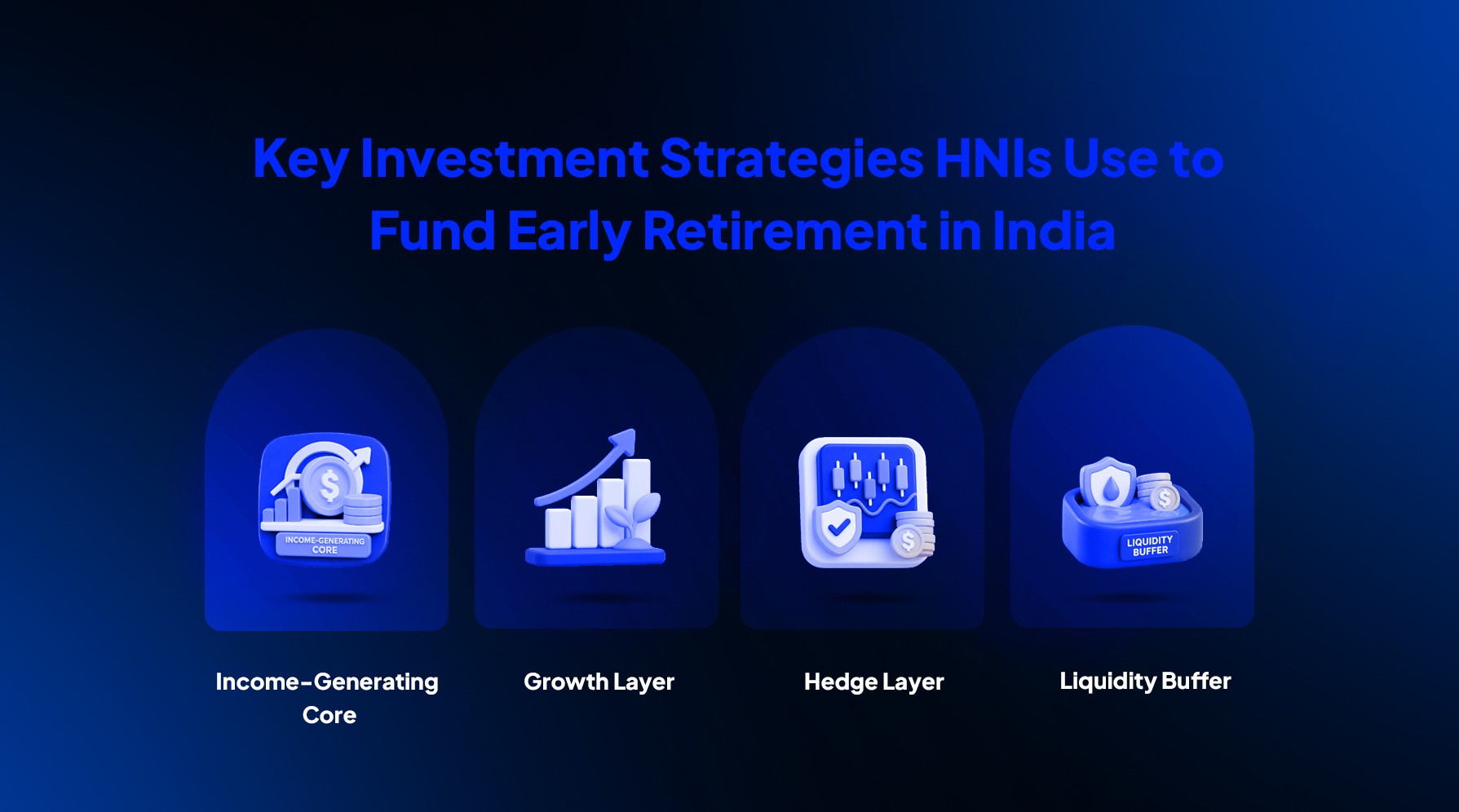
Step 1: Income-Generating Core
Commercial real estate: Commercial properties in strong business locations can generate stable rental income and long-term appreciation.
Portfolio Management Services (PMS): PMS offers professionally managed equity portfolios designed for HNIs seeking active wealth creation and structured portfolio management.
Dividend-focused equity portfolios: These portfolios focus on companies with regular dividend payouts, helping create recurring passive income.
Step 2: Growth Layer
Alternative Investment Funds (AIFs): AIFs provide access to investment opportunities beyond traditional mutual funds, including private equity and structured strategies.
Private market exposure: Investments in unlisted or privately held businesses can offer higher long-term growth potential for affluent investors.
Equity growth portfolios: These portfolios focus on long-term capital appreciation through growth-oriented companies and sectors.
📊 HNI investments in AIFs reached ₹5.38 lakh crore by March 2025, growing over 30% year-on-year: Family offices and HNIs now account for 80–90% of total AIF inflows in India.
Source: IBEF citing SEBI, March 2025
Step 3: Hedge Layer
Global ETFs: Global ETFs provide exposure to international markets and reduce overdependence on Indian equities alone.
US equities: Investing in US-listed companies allows HNIs to participate in global technology and innovation-driven growth.
Dollar-denominated assets: These assets help protect purchasing power against long-term INR depreciation and currency risk.
Step 4: Liquidity Buffer
Emergency corpus: A liquid emergency fund helps manage unexpected expenses without disrupting long-term investments.
Short-term debt instruments: These investments offer relatively stable returns with lower volatility and easier access to capital.
Liquid funds: Liquid funds maintain quick access to cash while earning better returns than idle savings balances.
📊 A layered FIRE portfolio requires ongoing allocation decisions across PMS, AIFs, commercial real estate, and global assets. Review your current allocation structure with a Ckredence wealth advisor.
What Has Changed in HNI FIRE Planning in 2026?
The FIRE conversation for Indian HNIs looks very different today compared to five years ago. Earlier, financial independence was mostly discussed in online communities focused on aggressive savings and early retirement.
Today, affluent Indian investors are approaching FIRE as a structured wealth-planning strategy built around flexibility, passive income, and long-term lifestyle security.
1. The HNI Population Boom
India’s affluent investor base is growing rapidly, with more professionals, business owners, and entrepreneurs entering the HNI category every year.
FIRE planning is now part of mainstream wealth management discussions rather than a niche internet concept.
More HNIs are asking how their portfolios can support financial independence without depending entirely on active income.
2. SEBI’s AIF Expansion
Alternative investments are becoming more accessible to affluent investors through evolving regulatory structures and wider participation. Our SEBI-registered PMS framework helps HNIs navigate AIF participation with full regulatory oversight.
📊 Category II AIFs crossed ₹10 lakh crore in total commitments for the first time in December 2024: Private equity and real estate funds drove the majority of this growth.
Source: IBEF citing SEBI, March 2025
3. Global Diversification Has Become Important
INR depreciation and global economic uncertainty have increased the importance of international diversification within HNI portfolios. Many affluent investors no longer want their long-term wealth tied entirely to one economy or currency.
Global ETFs, US equities, and dollar-denominated assets are increasingly being used to create stability and reduce domestic market concentration risk over long investment horizons.
4. Post-COVID Wealth Priorities Have Shifted
The pandemic changed how many HNIs think about work, time, and financial security. Business owners and senior professionals now place greater value on flexibility, lifestyle control, and passive income generation.
Instead of targeting a traditional retirement age, many affluent investors are now focusing on building optionality: the ability to step back from active income whenever they choose, without affecting lifestyle quality.
Key Challenges That Stop HNIs from Achieving FIRE in India
High income does not automatically create financial independence. Many affluent investors still struggle to convert earnings into structured long-term wealth.
Our SEBI-registered advisory services are built to address these structural gaps in HNI wealth management.
Challenge | Why It Becomes a Problem for HNIs |
High Taxation | Capital gains taxes, surcharge structures, and inefficient withdrawals can reduce usable retirement income considerably over time. Poor tax planning weakens long-term withdrawal sustainability. |
Lifestyle Inflation | As income rises, spending often rises faster. Luxury housing, travel, healthcare, premium education, and lifestyle maintenance increase FIRE requirements sharply. |
Overdependence on Active Income | Many HNIs continue depending heavily on business profits, consulting income, or professional earnings even after building substantial wealth. |
Insufficient Emergency Liquidity | Several affluent investors remain asset-rich but cash-flow weak during disruptions. A strong liquid emergency corpus remains essential for financial stability. |
How a ₹5 Crore Business Owner Built a FatFIRE Portfolio Over 8 Years
“Someone is sitting in the shade today because someone planted a tree a long time ago.”
Warren Buffett, Chairman & CEO, Berkshire Hathaway
Source: Berkshire Hathaway Annual Letter, 1985
A Gujarat-based business owner in his mid-40s had approximately ₹5 crore in investable surplus but no structured retirement plan.
Most wealth was linked to business income and scattered investments. Passive income generation was weak, and there was no clear long-term FIRE framework.
The Portfolio Structure
40% PMS allocation: A large portion of capital was placed into professionally managed PMS strategies focused on long-term equity growth and active portfolio management.
25% commercial real estate: Commercial property exposure was used to create stable rental income and improve long-term cash-flow visibility.
20% AIF Category II exposure: Alternative Investment Funds were added to access private market opportunities and diversify beyond traditional public market investments.
15% global ETFs: Global ETFs helped create international diversification and reduce overdependence on Indian market performance and INR movements.
The Strategy and Outcome
The focus shifted from aggressive accumulation to sustainable long-term wealth generation with a lower withdrawal framework.
Instead of maximising short-term returns, the portfolio was designed to support long-term financial independence with controlled risk.
Over eight years, the target portfolio moved toward a corpus designed to support lifestyle-led financial independence while reducing business dependency.
🔒 If your investable surplus is between ₹3 crore and ₹10 crore and your income remains primarily business or salary-linked, your FIRE portfolio has not been started yet. Schedule a 20-minute FIRE readiness review with Ckredence Wealth.
Conclusion
FIRE for HNIs in India is not about leaving work early and living minimally. It is about creating financial flexibility while maintaining the lifestyle, security, and optionality affluent families expect.
For Indian HNIs, this requires structured portfolio management, tax-aware withdrawal planning, diversified assets, and long-term discipline built around real lifestyle needs. The difference between wealth and financial independence is structure. If that structure is not yet in place, now is the time to build it.
FAQs
01.
What does working with a SEBI-registered advisor add to HNI FIRE planning in India?
A SEBI-registered advisor must act in the client’s interest, without earning product commissions. Your FIRE strategy is built on your actual goals, not product incentives. Regulatory accountability adds transparency that unregistered advisors cannot provide.
02.
How is FatFIRE different from standard FIRE planning for Indian investors?
FatFIRE preserves lifestyle quality rather than reducing expenses to accelerate retirement. It requires a larger corpus, lower withdrawal rates, and diversified asset allocation. Standard FIRE prioritises aggressive saving and early exit, which rarely suits HNI wealth structures.
03.
Who should consider a structured FIRE portfolio in India?
Business owners, senior professionals, and families with investable surplus above ₹3 crore benefit most. Concentrated business wealth without passive income is the clearest signal to begin FIRE planning. City, lifestyle costs, and family commitments also determine the corpus size required.
04.
How does Ckredence Wealth approach building a FIRE portfolio for an HNI client?
First, the actual FIRE number is mapped across lifestyle, city of residence, and tax exposure. From there, a layered portfolio is built across income-generating, growth, hedge, and liquidity assets. Regular reviews adjust the portfolio as income, expenses, and market conditions shift over time.
India’s HNI population grew 6% in 2024 to 85,698 individuals with assets above $10 million, according to Knight Frank’s Wealth Report 2025. Yet for most of these investors, wealth and financial independence are not the same thing. FIRE for HNIs in India is no longer a niche concept.
High-income professionals and business owners are increasingly planning structured financial independence rather than relying on traditional retirement models.
For Indian HNIs, FIRE is not about expense minimisation. It is about building enough passive and managed income to sustain lifestyle quality without depending on active business or salary income.
HNI investments in AIFs crossed ₹5.38 lakh crore by March 2025, growing over 30% year-on-year, indicating a clear shift toward structured, diversified wealth strategies. PMS-led investing, global diversification, and tax-aware withdrawal planning are now central to how affluent families build long-term financial flexibility.
Key Takeaways
HNI FIRE planning in India focuses on lifestyle flexibility, not expense reduction.
Luxury lifestyle inflation often rises faster than standard retirement formulas assume.
Most affluent investors underestimate post-tax requirements when planning their FIRE corpus.
PMS, AIFs, commercial real estate, and global assets form the core of HNI FIRE portfolios.
The traditional 4% withdrawal rule rarely fits Indian HNIs planning long retirement horizons.
Tax planning matters as much as portfolio returns when structuring FIRE withdrawals.
A realistic FIRE number must account for city, lifestyle, and long-term healthcare costs.
What Is FIRE for High-Net-Worth Individuals in India?
FIRE for HNIs in India refers to building enough wealth to achieve financial independence without depending fully on active business or salary income.
Unlike traditional FIRE models focused on aggressive savings and minimal lifestyles, HNI FIRE follows the FatFIRE approach, where the goal is maintaining lifestyle quality while reducing financial dependence on work.
Our financial independence planning guide explores how HNIs across India are approaching this shift in practice.
For affluent investors, this means building a portfolio capable of supporting luxury housing, healthcare, travel, family commitments, and lifestyle inflation over multiple decades.
FatFIRE vs. Lean FIRE
Standard FIRE focuses heavily on expense reduction and early retirement through aggressive savings. FatFIRE is different.
It assumes higher lifestyle costs and larger wealth requirements while prioritising flexibility and comfort.
The ₹5 Crore Threshold
In the Indian context, HNI FIRE conversations become meaningful once liquid investable assets move beyond ₹5 crore.
At this level, investors shift from accumulation thinking toward passive income structures, capital preservation, and long-term withdrawal planning.
Why FIRE Is Becoming More Relevant for Indian HNIs
India’s HNI population is expanding rapidly. More professionals and business owners are realising that wealth without structure often creates dependency instead of freedom.
“Risk comes from not knowing what you are doing.”
Warren Buffett, Chairman & CEO, Berkshire Hathaway
Source: Berkshire Hathaway Shareholder Meeting
Why the 4% Withdrawal Rule Does Not Work for Indian HNIs
The traditional 4% withdrawal rule was built around Western retirement assumptions. For Indian HNIs, the reality is very different.
Our comparison of PMS, mutual funds, and AIFs in India covers how portfolio structure directly affects withdrawal capacity and post-tax income.
Lifestyle Inflation Is Higher: Luxury lifestyle inflation in India often rises faster than general inflation.
International travel, premium healthcare, high-end schooling, and imported consumption categories may rise at 8–10% annually.
Tax Exposure Changes Real Returns: Capital gains tax, surcharge structures, and withdrawal timing directly affect usable income.
Gross portfolio returns and post-tax retirement income are rarely the same.
India Has No Social Security Cushion: Unlike some Western economies, Indian HNIs cannot rely on large retirement support systems.
FIRE portfolios must independently sustain healthcare, emergencies, and longevity risk.
HNI Portfolios Behave Differently: HNI portfolios often include PMS, AIFs, commercial real estate, and concentrated equity exposure.
These structures require different withdrawal assumptions compared to passive index investing.
The Case for a Lower Withdrawal Rate
Many HNI advisors now prefer a 2.5% to 3% withdrawal framework for affluent Indian investors planning long retirement horizons. This creates greater sustainability during market volatility.
What Is the Right FIRE Number for HNIs in India in 2026?
The biggest mistake affluent investors make is using generic retirement formulas without adjusting for their actual lifestyle. The table below provides a realistic starting framework.
Lifestyle Profile | Estimated FIRE Corpus | Approx. Monthly Passive Income |
Surat / Vadodara HNI Lifestyle | ₹5–8 crore | ₹1.2L–2L |
Tier-1 Metro Lifestyle | ₹10–15 crore | ₹2.5L–4L |
Ultra Luxury FatFIRE | ₹20 crore+ | ₹5L+ |
The 25x Rule Needs Adjustment
The traditional 25x annual expense formula works for basic FIRE calculations. HNIs often need higher multipliers because expenses are not static.
₹12 Crore Corpus Reality
A ₹12 crore portfolio may appear large, but after tax, inflation, and healthcare costs, the real usable passive income may feel lower than expected in Tier-1 cities.
City-Level Lifestyle Matters
A Mumbai lifestyle and a Surat lifestyle require different FIRE numbers. Housing, education, travel, and social spending vary considerably across cities.
💡 Most HNIs in Gujarat and Maharashtra do not have a FIRE number built on their actual lifestyle, city, and tax exposure. Map your personal FIRE corpus with a SEBI-registered Ckredence advisor.
Key Investment Strategies HNIs Use to Fund Early Retirement in India
Most affluent investors do not build FIRE through savings accounts and SIPs alone. The approach is layered across different asset categories. Our portfolio management services are designed for HNIs seeking structured, long-term wealth generation.

Step 1: Income-Generating Core
Commercial real estate: Commercial properties in strong business locations can generate stable rental income and long-term appreciation.
Portfolio Management Services (PMS): PMS offers professionally managed equity portfolios designed for HNIs seeking active wealth creation and structured portfolio management.
Dividend-focused equity portfolios: These portfolios focus on companies with regular dividend payouts, helping create recurring passive income.
Step 2: Growth Layer
Alternative Investment Funds (AIFs): AIFs provide access to investment opportunities beyond traditional mutual funds, including private equity and structured strategies.
Private market exposure: Investments in unlisted or privately held businesses can offer higher long-term growth potential for affluent investors.
Equity growth portfolios: These portfolios focus on long-term capital appreciation through growth-oriented companies and sectors.
📊 HNI investments in AIFs reached ₹5.38 lakh crore by March 2025, growing over 30% year-on-year: Family offices and HNIs now account for 80–90% of total AIF inflows in India.
Source: IBEF citing SEBI, March 2025
Step 3: Hedge Layer
Global ETFs: Global ETFs provide exposure to international markets and reduce overdependence on Indian equities alone.
US equities: Investing in US-listed companies allows HNIs to participate in global technology and innovation-driven growth.
Dollar-denominated assets: These assets help protect purchasing power against long-term INR depreciation and currency risk.
Step 4: Liquidity Buffer
Emergency corpus: A liquid emergency fund helps manage unexpected expenses without disrupting long-term investments.
Short-term debt instruments: These investments offer relatively stable returns with lower volatility and easier access to capital.
Liquid funds: Liquid funds maintain quick access to cash while earning better returns than idle savings balances.
📊 A layered FIRE portfolio requires ongoing allocation decisions across PMS, AIFs, commercial real estate, and global assets. Review your current allocation structure with a Ckredence wealth advisor.
What Has Changed in HNI FIRE Planning in 2026?
The FIRE conversation for Indian HNIs looks very different today compared to five years ago. Earlier, financial independence was mostly discussed in online communities focused on aggressive savings and early retirement.
Today, affluent Indian investors are approaching FIRE as a structured wealth-planning strategy built around flexibility, passive income, and long-term lifestyle security.
1. The HNI Population Boom
India’s affluent investor base is growing rapidly, with more professionals, business owners, and entrepreneurs entering the HNI category every year.
FIRE planning is now part of mainstream wealth management discussions rather than a niche internet concept.
More HNIs are asking how their portfolios can support financial independence without depending entirely on active income.
2. SEBI’s AIF Expansion
Alternative investments are becoming more accessible to affluent investors through evolving regulatory structures and wider participation. Our SEBI-registered PMS framework helps HNIs navigate AIF participation with full regulatory oversight.
📊 Category II AIFs crossed ₹10 lakh crore in total commitments for the first time in December 2024: Private equity and real estate funds drove the majority of this growth.
Source: IBEF citing SEBI, March 2025
3. Global Diversification Has Become Important
INR depreciation and global economic uncertainty have increased the importance of international diversification within HNI portfolios. Many affluent investors no longer want their long-term wealth tied entirely to one economy or currency.
Global ETFs, US equities, and dollar-denominated assets are increasingly being used to create stability and reduce domestic market concentration risk over long investment horizons.
4. Post-COVID Wealth Priorities Have Shifted
The pandemic changed how many HNIs think about work, time, and financial security. Business owners and senior professionals now place greater value on flexibility, lifestyle control, and passive income generation.
Instead of targeting a traditional retirement age, many affluent investors are now focusing on building optionality: the ability to step back from active income whenever they choose, without affecting lifestyle quality.
Key Challenges That Stop HNIs from Achieving FIRE in India
High income does not automatically create financial independence. Many affluent investors still struggle to convert earnings into structured long-term wealth.
Our SEBI-registered advisory services are built to address these structural gaps in HNI wealth management.
Challenge | Why It Becomes a Problem for HNIs |
High Taxation | Capital gains taxes, surcharge structures, and inefficient withdrawals can reduce usable retirement income considerably over time. Poor tax planning weakens long-term withdrawal sustainability. |
Lifestyle Inflation | As income rises, spending often rises faster. Luxury housing, travel, healthcare, premium education, and lifestyle maintenance increase FIRE requirements sharply. |
Overdependence on Active Income | Many HNIs continue depending heavily on business profits, consulting income, or professional earnings even after building substantial wealth. |
Insufficient Emergency Liquidity | Several affluent investors remain asset-rich but cash-flow weak during disruptions. A strong liquid emergency corpus remains essential for financial stability. |
How a ₹5 Crore Business Owner Built a FatFIRE Portfolio Over 8 Years
“Someone is sitting in the shade today because someone planted a tree a long time ago.”
Warren Buffett, Chairman & CEO, Berkshire Hathaway
Source: Berkshire Hathaway Annual Letter, 1985
A Gujarat-based business owner in his mid-40s had approximately ₹5 crore in investable surplus but no structured retirement plan.
Most wealth was linked to business income and scattered investments. Passive income generation was weak, and there was no clear long-term FIRE framework.
The Portfolio Structure
40% PMS allocation: A large portion of capital was placed into professionally managed PMS strategies focused on long-term equity growth and active portfolio management.
25% commercial real estate: Commercial property exposure was used to create stable rental income and improve long-term cash-flow visibility.
20% AIF Category II exposure: Alternative Investment Funds were added to access private market opportunities and diversify beyond traditional public market investments.
15% global ETFs: Global ETFs helped create international diversification and reduce overdependence on Indian market performance and INR movements.
The Strategy and Outcome
The focus shifted from aggressive accumulation to sustainable long-term wealth generation with a lower withdrawal framework.
Instead of maximising short-term returns, the portfolio was designed to support long-term financial independence with controlled risk.
Over eight years, the target portfolio moved toward a corpus designed to support lifestyle-led financial independence while reducing business dependency.
🔒 If your investable surplus is between ₹3 crore and ₹10 crore and your income remains primarily business or salary-linked, your FIRE portfolio has not been started yet. Schedule a 20-minute FIRE readiness review with Ckredence Wealth.
Conclusion
FIRE for HNIs in India is not about leaving work early and living minimally. It is about creating financial flexibility while maintaining the lifestyle, security, and optionality affluent families expect.
For Indian HNIs, this requires structured portfolio management, tax-aware withdrawal planning, diversified assets, and long-term discipline built around real lifestyle needs. The difference between wealth and financial independence is structure. If that structure is not yet in place, now is the time to build it.
FAQs
01.
What does working with a SEBI-registered advisor add to HNI FIRE planning in India?
A SEBI-registered advisor must act in the client’s interest, without earning product commissions. Your FIRE strategy is built on your actual goals, not product incentives. Regulatory accountability adds transparency that unregistered advisors cannot provide.
02.
How is FatFIRE different from standard FIRE planning for Indian investors?
FatFIRE preserves lifestyle quality rather than reducing expenses to accelerate retirement. It requires a larger corpus, lower withdrawal rates, and diversified asset allocation. Standard FIRE prioritises aggressive saving and early exit, which rarely suits HNI wealth structures.
03.
Who should consider a structured FIRE portfolio in India?
Business owners, senior professionals, and families with investable surplus above ₹3 crore benefit most. Concentrated business wealth without passive income is the clearest signal to begin FIRE planning. City, lifestyle costs, and family commitments also determine the corpus size required.
04.
How does Ckredence Wealth approach building a FIRE portfolio for an HNI client?
First, the actual FIRE number is mapped across lifestyle, city of residence, and tax exposure. From there, a layered portfolio is built across income-generating, growth, hedge, and liquidity assets. Regular reviews adjust the portfolio as income, expenses, and market conditions shift over time.