10min Read

10min Read

Equity vs Real Estate Investment in India: Where Your Next Rupee Should Go

Equity vs Real Estate Investment in India: Where Your Next Rupee Should Go

Equity vs Real Estate Investment in India: Where Your Next Rupee Should Go

Compare equity vs real estate investment in India on returns, liquidity, and tax benefits to decide where your next rupee should go.

Compare equity vs real estate investment in India on returns, liquidity, and tax benefits to decide where your next rupee should go.

Compare equity vs real estate investment in India on returns, liquidity, and tax benefits to decide where your next rupee should go.

Ckredence Wealth

Ckredence Wealth

|

Ckredence Wealth banner comparing equity vs real estate investment in India, showing a rupee coin at a split path between a stock market bull with rising charts and residential property buildings.

Most Indian household wealth still sits in bricks, not markets. In 2023-24, households held about Rs.38.4 lakh crore in physical assets like real estate, against roughly Rs.3.4 lakh crore in financial assets such as equities, per RBI data. That gap shapes how most people approach the equity vs real estate investment decision, often without ever comparing the two directly.

Before you put your next rupee toward either one, ask yourself:

  • Are you buying property because it fits your goals, or because it is what your family has always done?

  • Do you know how much of your real estate’s return is actual price growth versus rent that barely covers upkeep?

  • If you needed the money back in six months, could your current portfolio actually deliver it?

We built this guide to compare equity vs real estate investment in India on the numbers that matter, entry cost, liquidity, returns, and tax treatment, so your next rupee goes where it actually fits.

TL;DR

  • Equity generally offers easier entry, faster liquidity, and a higher historical return than real estate in India.

  • Real estate offers a tangible asset, rental income, and tax deductions equity does not, at the cost of illiquidity and active management.

  • Industry-reported figures put equity’s total return near 13.5% annually against real estate’s near 9.5%.

  • Transaction costs on property, often near 5% of value, quietly erode real estate’s apparent advantage.

  • Most Indian portfolios are already overweight real estate by default, not by design.

  • The better question is not equity or real estate, but how much of each fits your horizon and capital.

What Equity Offers in the Equity vs Real Estate Investment Debate

Equity generally wins on liquidity and entry cost. You can start with a SIP for as little as Rs.100 a month and sell your holding within a day, a stark contrast to a property sale that can take months to close.

  • Entry point: SIPs starting from Rs.100 a month, versus lakhs typically required for even a property down payment.

  • Liquidity: shares and mutual fund units settle within a day; a property sale usually takes weeks to months.

  • Historical growth: equity has delivered roughly 12% annual capital appreciation against real estate’s roughly 8%, per industry-reported figures.

Equity’s edge is speed and access, not necessarily comfort. That trade-off is exactly why real estate still holds a place in most Indian portfolios.

GROWTH WITHOUT THE LOCK-IN

Building equity exposure through mutual fund advisory or managed portfolio management gives you the liquidity real estate cannot match.

Schedule a Consultation: ckredencewealth.com/contact-us

What Real Estate Offers in the Equity vs Real Estate Investment Debate

Real estate remains the default for a reason. It is tangible, it can be lived in, and it comes with tax benefits equity does not, including a Section 24(b) deduction on home loan interest and Section 80C benefit on principal repayment.

  • Tax benefits: Section 24(b) on home loan interest and Section 80C on principal repayment, unavailable on equity.

  • Illiquidity: selling a property typically takes weeks to months, compared to same-day settlement for listed equity.

  • Transaction costs: registration and related charges can run close to 5% of property value, a cost equity investors do not pay.

Real estate suits investors who want a tangible, inflation-linked asset and can accept the illiquidity that comes with it. For most portfolios, the real question is not which one to pick, but how much of each.

ALREADY OWN PROPERTY?

Most Indian portfolios are overweight real estate by default. We help balance that concentration through structured asset allocation.

Schedule a Consultation: ckredencewealth.com/contact-us

Equity vs Real Estate Investment in India: Comparing Returns and Risk

A side by side view makes the trade off clear.

Factor

Equity

Real Estate

Typical Entry Point

SIPs from Rs.100 a month

Rs.5 to 10 lakh minimum, or more

Liquidity

Sell within a day

Weeks to months to sell

Capital Appreciation

Roughly 12% annually

Roughly 8% annually

Total Expected Return

Roughly 13.5% annually

Roughly 9.5% annually

Tax Benefits

LTCG exemption; ELSS under 80C

Section 24(b) and 80C on home loans

Transaction Costs

Low

Registration costs near 5% of value

Management Effort

Low, especially via PMS or mutual funds

High, tenant and upkeep management

Table: equity vs real estate investment in India, compared on entry, liquidity, return, and tax treatment.

Returns rarely tell the full story until tax enters the picture. Knowing how mutual fund and PMS taxation works alongside property tax rules helps you compare the two on an actual post-tax basis, not just the headline number.
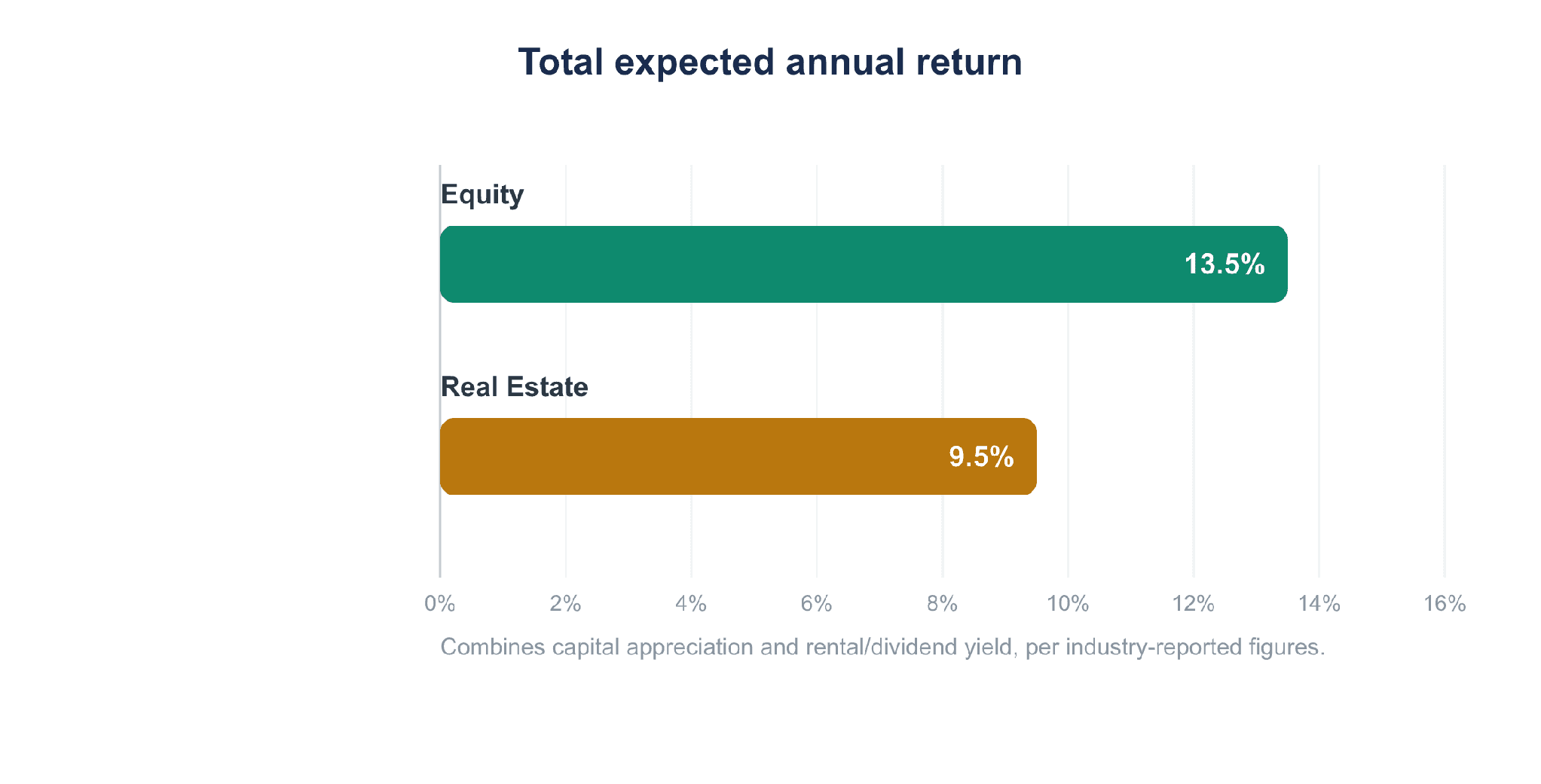

Total expected annual return: equity versus real estate in India

Total expected annual return, combining appreciation and yield.

The right split between the two depends on your own situation, not the average investor’s. Use the map below to see where you fit.
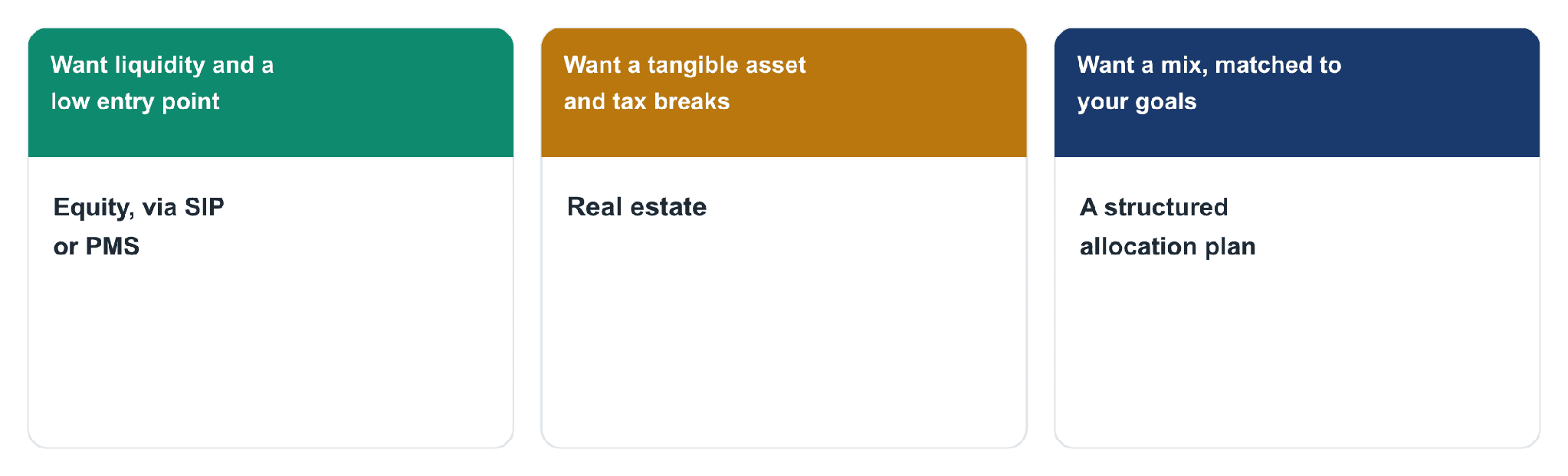

Decision map matching investor goals to equity, real estate, or a blended allocation

Match your goal to equity, real estate, or a blended plan.

How to Decide Between Equity and Real Estate Investment in India

The right mix in the equity vs real estate investment decision comes down to three questions, not a single verdict.

  • Investment horizon: shorter horizons favor equity’s liquidity; multi-decade horizons can absorb real estate’s illiquidity.

  • Starting capital: equity works with small, regular amounts; real estate usually needs a lump sum or a loan.

  • Management style: equity investing through PMS or mutual funds can be entirely passive; a rental property needs ongoing attention.

If your horizon stretches toward long term financial independence, the split between the two matters more than picking a single winner.

A PLAN, NOT A GUESS

Matching your horizon, capital, and management preference to the right mix is what our RIA team does before recommending anything.

Schedule a Consultation: ckredencewealth.com/contact-us

Why Should You Choose Ckredence Wealth?

Many of our clients arrive with a portfolio that is already overweight real estate simply by default. Ckredence Wealth is a SEBI registered investment advisor (INA000020846) and portfolio manager (INP000007164), built on a 37 year legacy since 1987.

Solutions That Matter:

  • Structured equity exposure across our 4 investment approaches, built for liquidity real estate cannot offer.

  • Portfolio management through our PMS services, for investors ready to move beyond mutual funds.

  • Fee only advice on rebalancing an existing, property-heavy portfolio.

Ready to transform your investment approach? Schedule a Consultation!

Conclusion

The equity vs real estate investment debate rarely has a single winner. Equity offers easier entry, faster liquidity, and a higher historical return, while real estate offers a tangible asset, tax deductions, and a hedge that many investors value even at a lower return.

Most Indian portfolios lean toward real estate by habit rather than by comparison. Decide your split based on your own horizon, starting capital, and appetite for active management, not on which asset your family has always trusted. A deliberate mix, reviewed as your goals change, beats a default one every time.

FAQs

01.

Does equity really beat real estate in India?

On average, industry-reported figures show equity outperforming real estate over the long term, roughly 13.5% versus 9.5% annually, though individual properties and stocks vary widely.

02.

Is real estate a better inflation hedge than equity?

Real estate is often seen as a stronger direct inflation hedge since prices and rents tend to track costs, though equity has also outpaced inflation over long periods.

03.

How much money do I need to start investing in each?

Equity SIPs can start from around Rs.100 a month, while real estate typically requires several lakhs for a down payment or full purchase.

04.

Should I choose equity or real estate completely, not both?

Most advisors recommend a blend based on your horizon and liquidity needs, rather than an all-or-nothing choice between the two.

Most Indian household wealth still sits in bricks, not markets. In 2023-24, households held about Rs.38.4 lakh crore in physical assets like real estate, against roughly Rs.3.4 lakh crore in financial assets such as equities, per RBI data. That gap shapes how most people approach the equity vs real estate investment decision, often without ever comparing the two directly.

Before you put your next rupee toward either one, ask yourself:

  • Are you buying property because it fits your goals, or because it is what your family has always done?

  • Do you know how much of your real estate’s return is actual price growth versus rent that barely covers upkeep?

  • If you needed the money back in six months, could your current portfolio actually deliver it?

We built this guide to compare equity vs real estate investment in India on the numbers that matter, entry cost, liquidity, returns, and tax treatment, so your next rupee goes where it actually fits.

TL;DR

  • Equity generally offers easier entry, faster liquidity, and a higher historical return than real estate in India.

  • Real estate offers a tangible asset, rental income, and tax deductions equity does not, at the cost of illiquidity and active management.

  • Industry-reported figures put equity’s total return near 13.5% annually against real estate’s near 9.5%.

  • Transaction costs on property, often near 5% of value, quietly erode real estate’s apparent advantage.

  • Most Indian portfolios are already overweight real estate by default, not by design.

  • The better question is not equity or real estate, but how much of each fits your horizon and capital.

What Equity Offers in the Equity vs Real Estate Investment Debate

Equity generally wins on liquidity and entry cost. You can start with a SIP for as little as Rs.100 a month and sell your holding within a day, a stark contrast to a property sale that can take months to close.

  • Entry point: SIPs starting from Rs.100 a month, versus lakhs typically required for even a property down payment.

  • Liquidity: shares and mutual fund units settle within a day; a property sale usually takes weeks to months.

  • Historical growth: equity has delivered roughly 12% annual capital appreciation against real estate’s roughly 8%, per industry-reported figures.

Equity’s edge is speed and access, not necessarily comfort. That trade-off is exactly why real estate still holds a place in most Indian portfolios.

GROWTH WITHOUT THE LOCK-IN

Building equity exposure through mutual fund advisory or managed portfolio management gives you the liquidity real estate cannot match.

Schedule a Consultation: ckredencewealth.com/contact-us

What Real Estate Offers in the Equity vs Real Estate Investment Debate

Real estate remains the default for a reason. It is tangible, it can be lived in, and it comes with tax benefits equity does not, including a Section 24(b) deduction on home loan interest and Section 80C benefit on principal repayment.

  • Tax benefits: Section 24(b) on home loan interest and Section 80C on principal repayment, unavailable on equity.

  • Illiquidity: selling a property typically takes weeks to months, compared to same-day settlement for listed equity.

  • Transaction costs: registration and related charges can run close to 5% of property value, a cost equity investors do not pay.

Real estate suits investors who want a tangible, inflation-linked asset and can accept the illiquidity that comes with it. For most portfolios, the real question is not which one to pick, but how much of each.

ALREADY OWN PROPERTY?

Most Indian portfolios are overweight real estate by default. We help balance that concentration through structured asset allocation.

Schedule a Consultation: ckredencewealth.com/contact-us

Equity vs Real Estate Investment in India: Comparing Returns and Risk

A side by side view makes the trade off clear.

Factor

Equity

Real Estate

Typical Entry Point

SIPs from Rs.100 a month

Rs.5 to 10 lakh minimum, or more

Liquidity

Sell within a day

Weeks to months to sell

Capital Appreciation

Roughly 12% annually

Roughly 8% annually

Total Expected Return

Roughly 13.5% annually

Roughly 9.5% annually

Tax Benefits

LTCG exemption; ELSS under 80C

Section 24(b) and 80C on home loans

Transaction Costs

Low

Registration costs near 5% of value

Management Effort

Low, especially via PMS or mutual funds

High, tenant and upkeep management

Table: equity vs real estate investment in India, compared on entry, liquidity, return, and tax treatment.

Returns rarely tell the full story until tax enters the picture. Knowing how mutual fund and PMS taxation works alongside property tax rules helps you compare the two on an actual post-tax basis, not just the headline number.


Total expected annual return: equity versus real estate in India

Total expected annual return, combining appreciation and yield.

The right split between the two depends on your own situation, not the average investor’s. Use the map below to see where you fit.


Decision map matching investor goals to equity, real estate, or a blended allocation

Match your goal to equity, real estate, or a blended plan.

How to Decide Between Equity and Real Estate Investment in India

The right mix in the equity vs real estate investment decision comes down to three questions, not a single verdict.

  • Investment horizon: shorter horizons favor equity’s liquidity; multi-decade horizons can absorb real estate’s illiquidity.

  • Starting capital: equity works with small, regular amounts; real estate usually needs a lump sum or a loan.

  • Management style: equity investing through PMS or mutual funds can be entirely passive; a rental property needs ongoing attention.

If your horizon stretches toward long term financial independence, the split between the two matters more than picking a single winner.

A PLAN, NOT A GUESS

Matching your horizon, capital, and management preference to the right mix is what our RIA team does before recommending anything.

Schedule a Consultation: ckredencewealth.com/contact-us

Why Should You Choose Ckredence Wealth?

Many of our clients arrive with a portfolio that is already overweight real estate simply by default. Ckredence Wealth is a SEBI registered investment advisor (INA000020846) and portfolio manager (INP000007164), built on a 37 year legacy since 1987.

Solutions That Matter:

  • Structured equity exposure across our 4 investment approaches, built for liquidity real estate cannot offer.

  • Portfolio management through our PMS services, for investors ready to move beyond mutual funds.

  • Fee only advice on rebalancing an existing, property-heavy portfolio.

Ready to transform your investment approach? Schedule a Consultation!

Conclusion

The equity vs real estate investment debate rarely has a single winner. Equity offers easier entry, faster liquidity, and a higher historical return, while real estate offers a tangible asset, tax deductions, and a hedge that many investors value even at a lower return.

Most Indian portfolios lean toward real estate by habit rather than by comparison. Decide your split based on your own horizon, starting capital, and appetite for active management, not on which asset your family has always trusted. A deliberate mix, reviewed as your goals change, beats a default one every time.

FAQs

01.

Does equity really beat real estate in India?

On average, industry-reported figures show equity outperforming real estate over the long term, roughly 13.5% versus 9.5% annually, though individual properties and stocks vary widely.

02.

Is real estate a better inflation hedge than equity?

Real estate is often seen as a stronger direct inflation hedge since prices and rents tend to track costs, though equity has also outpaced inflation over long periods.

03.

How much money do I need to start investing in each?

Equity SIPs can start from around Rs.100 a month, while real estate typically requires several lakhs for a down payment or full purchase.

04.

Should I choose equity or real estate completely, not both?

Most advisors recommend a blend based on your horizon and liquidity needs, rather than an all-or-nothing choice between the two.