
All Weather Portfolio Management Service: What 5 Years and 7 Market Disruptions Reveal About Multi-Asset PMS in India
An all weather PMS spans equity, gold, and offshore ETFs. See how this approach holds up across bear markets and corrections in India.

Ckredence Wealth |June 21, 2026

The BSE 500 TRI generated -4.09% in the 12 months ending June 10, 2026. In that same period, the all weather portfolio management service built on a multi-asset structure returned +10.49%. That gap tells you something important about how portfolio construction shapes outcomes during flat and falling markets.
Most HNI investors who moved into a PMS after 2020 have lived through exactly this environment. Markets stayed largely flat for 21 months after the September 2024 peak. Pure equity portfolios absorbed the full impact. If your portfolio is built on a single asset class, it moves with that class and there is no cushion.
This blog covers what an all weather PMS actually is, how the asset allocation works across different market conditions, and what five years of verified performance data in India tells us about this approach.
| BSE 500 TRI vs All Weather PMS: Same Period, Different OutcomeBSE 500 TRI: -4.09% in 1 yearAll Weather PMS: +10.49% in the same periodThat 14.58 percentage point gap was not a market move. It was a portfolio construction decision.+10.49% when the market fell. See the full 1 year breakdown → |
TL;DR
An all weather PMS holds domestic equity, overseas ETFs, and gold ETFs simultaneously so the portfolio earns across every market condition, not just bull runs. Here is what five years of verified data shows:
- The BSE 500 TRI fell 4.09% in 1 year. The All Weather Fund returned 10.49% in the same period.
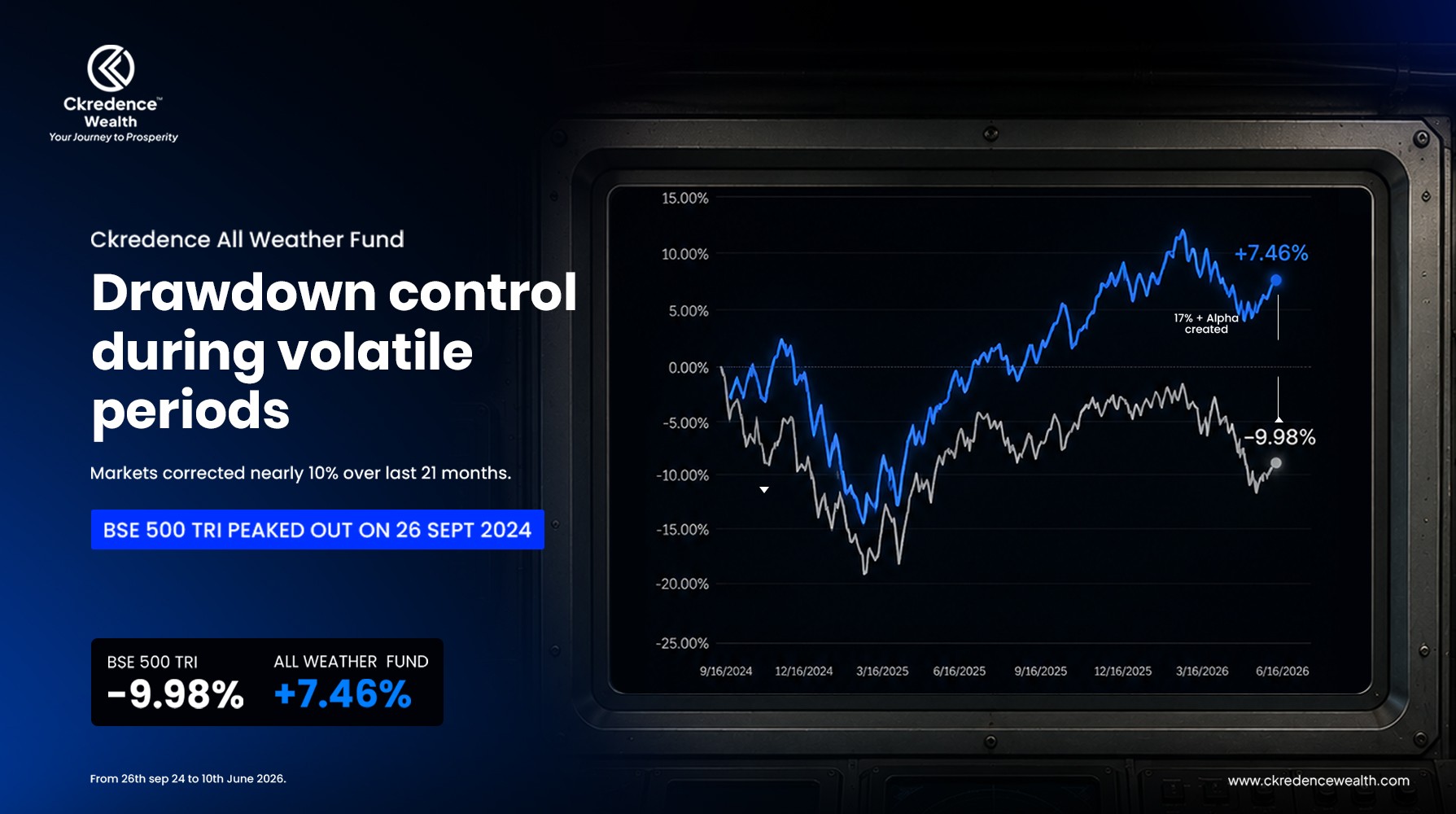
- Over 21 months of flat market (Sep 2024 to Jun 2026), the benchmark fell 9.98%. The fund returned +7.46%.
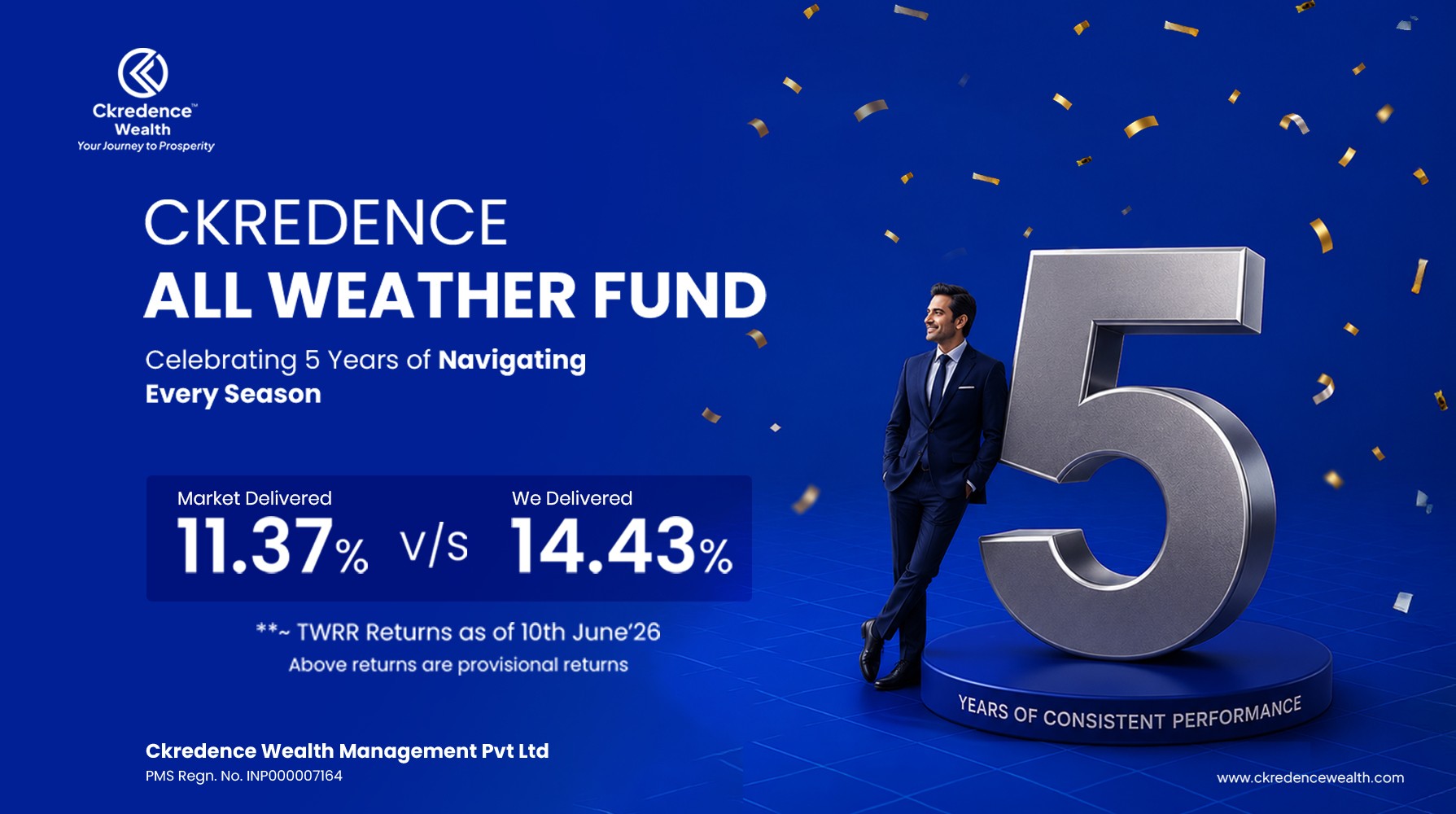
- 5-year TWRR: 14.43% vs 11.37% for BSE 500 TRI, built from a high-base market launch with no post Covid recovery advantage.
- The fund navigated 7 market disruptions across 2 complete bear cycles without switching strategy.
- Fee structure: 0.25% AMC plus 25% profit sharing above a 7% hurdle. No performance fee below 7%.
- Minimum investment: Rs. 50 Lakhs. Portfolio holds 25 to 35 high conviction stocks plus tactical gold and overseas ETF positions.
- SEBI registration: INP000007164. AUM: Rs. 773.83 Crores. Active PMS clients: 497.
If you are evaluating the best PMS in India for flat market protection and benchmark-beating returns over multiple cycles, the all weather structure is built for exactly that environment.
What Is an All Weather Portfolio Management Service?
An all weather portfolio management service is a SEBI-regulated discretionary PMS that invests across multiple non-correlated asset classes simultaneously. The goal is to generate returns regardless of whether markets are rising, falling, or trading sideways for extended periods.
Unlike a pure equity PMS, this structure holds domestic equity stocks alongside overseas equity ETFs and gold ETFs. Each asset class responds differently to market conditions, which is what gives the portfolio its stability across cycles.
SEBI mandates a minimum investment of Rs. 50 Lakhs for all PMS accounts in India. Within that structure, an all weather approach typically holds between 25 and 35 high conviction stocks alongside tactical ETF positions for gold and global exposure.
How an All Weather PMS Differs from a Standard Equity PMS
A standard equity PMS holds only Indian listed stocks. Its returns are almost entirely tied to the direction of domestic markets. An all weather PMS holds domestic equity at 60 to 100%, overseas equity ETFs at 0 to 20%, and gold ETFs at 0 to 20%, and it is that non-equity portion that absorbs shocks when Indian markets fall.
| We don’t manage a portfolio to beat the market only when it is rising. We manage it to hold ground when others are falling. That is what multi-asset construction does.Kartik Mehta, CIO, Ckredence Wealth |
How All Weather PMS Asset Allocation Works Across Market Conditions
The allocation across three asset classes is not fixed. It shifts tactically depending on where we are in the market cycle. That active adjustment is what separates an all weather approach from a static diversified fund.
In a bull market, domestic equity carries the highest allocation. Indian equities generate the bulk of returns during growth phases, and the portfolio stays heavily weighted toward stocks. In a bear market or correction, gold ETF allocation rises and overseas ETF exposure helps offset India-specific drawdowns, because global markets do not always fall in sync with Indian indices.
The sideways market is where pure equity PMS strategies quietly underperform. When markets trade in a range for 12 to 21 months, equity only portfolios earn near zero returns. A multi-asset structure continues to generate returns from non-correlated assets even when the headline index is flat.
5 Years of Verified Performance: All Weather PMS vs BSE 500 TRI
| Period | All Weather (TWRR) | BSE 500 TRI (TWRR) | Outperformance |
| 1 Year | 10.49% | -4.09% | +14.58 pts |
| 2 Year | 8.56% | 1.48% | +7.08 pts |
| 3 Year | 17.45% | 12.49% | +4.96 pts |
| 5 Year | 14.43% | 11.37% | +3.06 pts |
Source: Ckredence Wealth 5Y Fund Report, as of June 10, 2026. TWRR annualised.
These returns were built from a high base. We launched the All Weather Fund in June 2021, after markets had already recovered 108% (Nifty 50) and 183% (Nifty Smallcap 250) from their Covid lows.
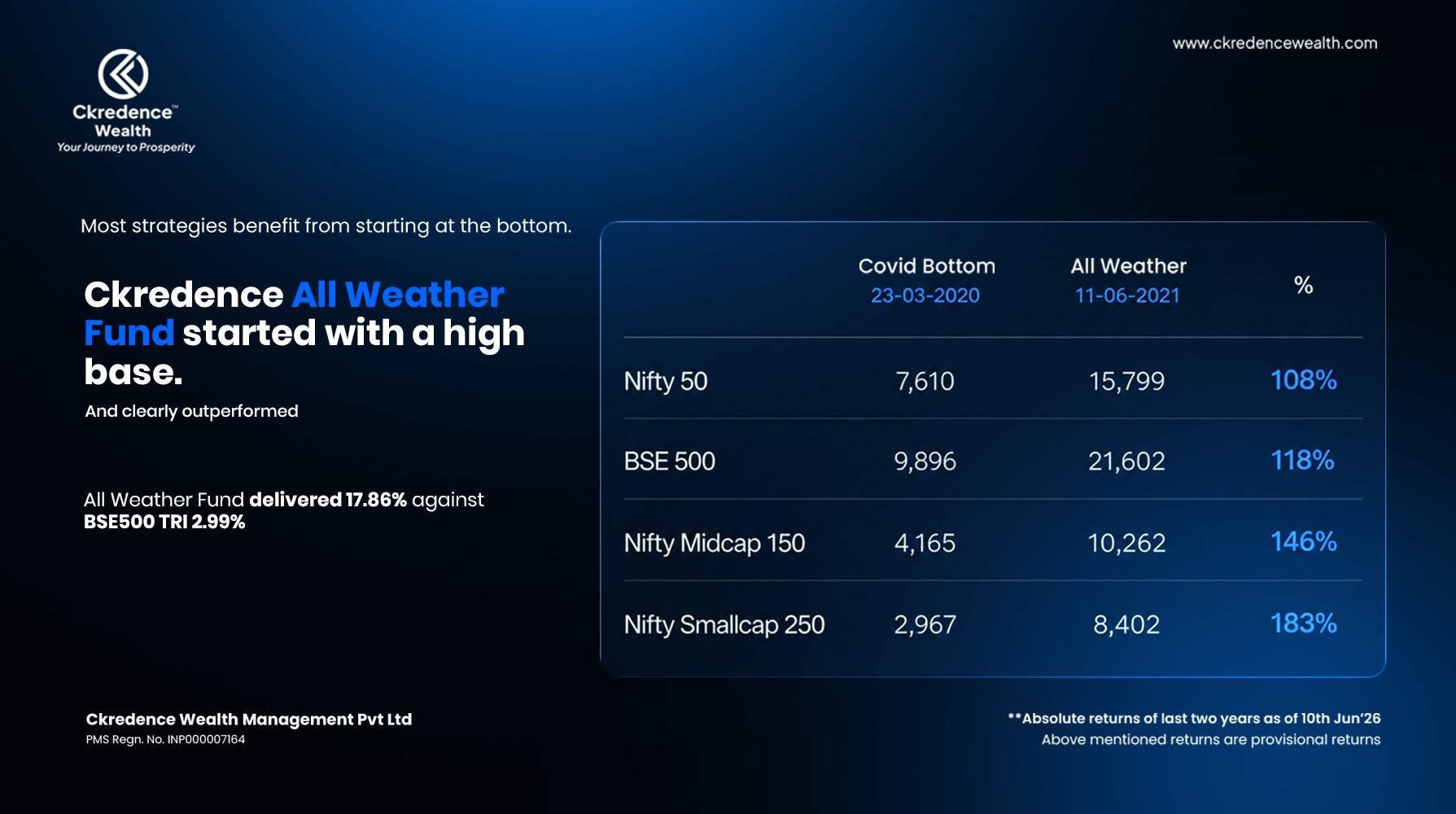
We did not benefit from the post Covid recovery rally. Every percentage point of outperformance was earned in real market conditions, from a high starting point.
Over the 2-year period ending June 10, 2026, the BSE 500 TRI delivered 2.99% in absolute terms. The All Weather Fund delivered 17.86% in absolute terms during the same period. That is a gap of nearly 15 percentage points during one of the most difficult stretches for Indian equity markets in recent years.
Drawdown Control: The Flat Market Test
When the BSE 500 TRI peaked on September 26, 2024, markets entered a prolonged flat and downward phase. By June 10, 2026, the benchmark had fallen 9.98% from that peak.
During that same 21-month stretch, the All Weather Fund returned +7.46%. That 17.44 percentage point gap did not come from markets recovering.
It came from the portfolio holding assets that behaved differently from the broader equity market. We cover the market story behind this period in our analysis on turning market volatility into returns.
| 21 Months. Flat Market. Two Different Outcomes.BSE 500 TRI: -9.98%All Weather Fund: +7.46%Same period. Two different portfolios. One difference in construction.17.44 points of protection over 21 months. See how the portfolio was built to hold ground → |
| When the benchmark was down 9.98% over 21 months, we returned +7.46%. That gap was not luck. It was asset allocation working exactly as designed.Kartik Mehta, CIO, Ckredence Wealth | Source: Ckredence Wealth 5Y Fund Report, June 2026 |
7 Market Disruptions in 5 Years: What the Portfolio Faced
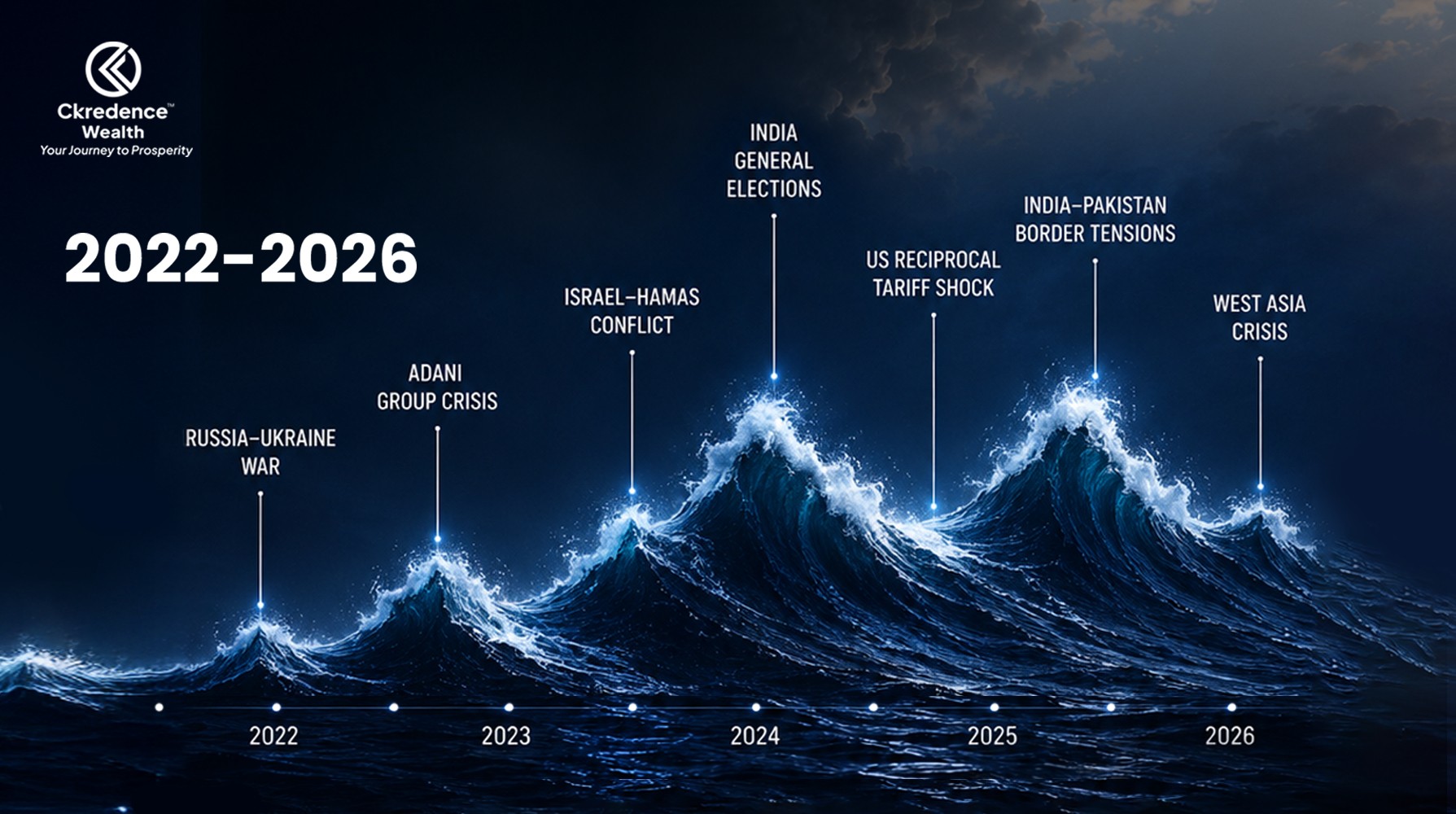
The fund launched in June 2021, before any of the following events occurred. Each one tested the portfolio’s multi-asset construction in real conditions, not simulations or backtests.
- Russia Ukraine war (2022): Global commodity shock, energy price spike, and broad risk off sentiment across markets
- Adani Group crisis (2023): India-specific conglomerate short-sell and banking sector stress
- Israel Hamas conflict (late 2023 to 2024): Middle East geopolitical risk and oil price volatility
- India General Elections (2024): Political uncertainty and sector rotation around election outcomes
- India Pakistan border tensions (2025): Regional geopolitical stress and sharp defence sector moves
- US reciprocal tariff shock (2025 to 2026): Export sector pressure and global trade uncertainty
- West Asia Crisis (2026): Energy price volatility and a broad shift in global risk sentiment
The portfolio operated through two complete market cycles across these events. The first cycle saw Nifty 50 peak in October 2021, bottom in June 2022, and then trade flat for nearly two years. The second cycle began with a fresh peak in September 2024, followed by a correction that had not recovered as of June 2026.
| Seven global events. Two bear cycles. Five years. The same multi-asset structure ran through all of it without switching strategy or benchmark.Kartik Mehta, CIO, Ckredence Wealth | Source: Ckredence Wealth 5Y Fund Report, June 2026 |
How to Evaluate an All Weather Portfolio Management Service Before Investing
Not all all weather PMS strategies in India are built the same way. Here is what to verify before committing Rs. 50 Lakhs or more. You can compare all four approaches we manage on our investment approaches page to understand how each strategy differs in construction and objective.
- Check when the fund launched and from what market level. A fund that started in March 2020 shows extraordinary returns from the Covid bottom recovery. That number does not tell you how the strategy holds up under normal or difficult conditions.
- Confirm the benchmark. The correct benchmark for a multi-asset PMS is the BSE 500 TRI, not the Nifty 50. A narrower or lower benchmark makes outperformance appear easier than it is.
- Review performance across multiple timeframes. A single strong year can result from a temporary tailwind. Look for consistent outperformance across 3-year and 5-year periods alongside the 1-year number.
- Understand the fee structure. A fixed 2.5% fee means you pay the fund manager whether your portfolio goes up or down. A fee model with a hurdle rate means the manager earns performance fees only after your returns cross a defined threshold such as 7%.
- Look at portfolio concentration. A 30 stock portfolio reflects high conviction selection. A 60 to 80 stock portfolio tends to replicate index returns without adding meaningful alpha.
- Ask specifically about the September 2024 to June 2026 period. This 21-month window separated pure equity PMS from multi-asset PMS in a clearly measurable way. Ask your fund manager what their portfolio returned during this window and which assets protected capital.
Fundamental vs Quantitative All Weather PMS: What Is the Difference?
| Provider | Approach | Asset Focus | Track Record |
| Ckredence Wealth | Fundamental | Equity, Gold, Overseas ETFs | 5 years |
| Qode Advisors | Quantitative | ETFs only | ~1.5 years |
| Torus Oro | Algorithmic | Momentum, BSE 200 | Newer |
Ckredence uses bottom up fundamental research to select individual stocks and supplements with tactical positions in overseas ETFs and gold ETFs based on the market cycle. If you are comparing this with our Diversified Investment Approach, the core difference is in scope: Diversified stays within Indian equities across sectors, while All Weather adds overseas and gold exposure for a cycle neutral structure.
Why Choose Ckredence Wealth for All Weather Portfolio Management?
We launched the All Weather Fund in June 2021 into a fully priced market, with Nifty 50 already 108% above its March 2020 lows, so every return in this five-year track record was earned without a recovery tailwind. CIO Kartik Mehta brings 20+ years of institutional experience from IDFC Asset Management and Canara Robeco, and the portfolio runs on fundamental research, not screens or algorithms.
We charge 0.25% AMC plus 25% profit sharing above a 7% hurdle, which means we earn a performance fee only after your portfolio crosses 7% first. At 25 to 35 stocks, every position is a conviction call with no room to hide.
What we bring to your Rs. 50 Lakh+ investment:
- 14.43% TWRR over 5 years vs 11.37% for BSE 500 TRI, earned from a high-base market launch in June 2021
- +7.46% during the September 2024 to June 2026 correction while the benchmark fell 9.98%
- 17.86% absolute return over 2 years compared to 2.99% for the BSE 500 TRI in the same period
- Rs. 773.83 Crores AUM across 497 active PMS clients (Source: PMSBazaar, May 2026)
- 0.25% AMC + 7% hurdle + 25% profit sharing above the hurdle, no fixed 2.5% regardless of performance
- SEBI registration INP000007164, custodian Orbis Financial Corporation, assets held separately from ours
- 20+ years institutional investment experience in the fund management team across two of India’s largest AMCs
- 7 market disruption events navigated across 5 years without switching strategy or benchmark
Since inception, the All Weather Fund has delivered 14.43% annualised TWRR while the benchmark earned 11.37%. That 3.06 percentage point annual gap compounds into a meaningful difference over a 10-year wealth horizon. If you are evaluating a PMS investment of Rs. 50 Lakhs or more, our team will walk you through the full 5-year drawdown data, fee calculations, and portfolio positioning in one focused conversation.
Rs. 773 Crore portfolio. 497 clients. 7% hurdle before we earn a single rupee in performance fee. In 30 minutes, we will show you exactly what this means for your Rs. 50 Lakh capital. Start the portfolio review →
| Ckredence All Weather Fund at a Glance5Y TWRR: 14.43% vs Benchmark 11.37%2Y Absolute Return: 17.86% vs Benchmark 2.99%Drawdown Period: +7.46% vs Benchmark -9.98%AUM: Rs. 773.83 Cr | Clients: 497 | Hurdle Rate: 7%Rs. 773 Crore managed. 7% hurdle before we earn a performance fee. Get the full numbers in 30 minutes → |
Conclusion
An all weather portfolio management service is a specific construction choice: hold multiple non-correlated assets so the portfolio can generate returns even when one asset class underperforms for 21 months or more. Over five years, across two flat market cycles and seven disruption events, the Ckredence All Weather Fund delivered 14.43% TWRR against 11.37% for the BSE 500 TRI, built entirely from a high-base market entry with no post Covid recovery tailwind behind it.
The 21 months from September 2024 to June 2026 showed what the all weather structure was built for. While the BSE 500 TRI fell 9.98% from its peak, the All Weather Fund returned +7.46%. If you are evaluating the best PMS in India for an HNI investment of Rs. 50 Lakhs or more, that 17 point gap during a flat market tells you more than any bull market number ever could.
FAQs
01.
What is an all weather portfolio management service in India?
An all weather portfolio management service is a SEBI-regulated PMS that holds domestic equity, overseas equity ETFs, and gold ETFs simultaneously. The minimum investment required is Rs. 50 Lakhs. The goal is to deliver positive returns across rising, falling, and flat market conditions.
02.
How does an all weather PMS perform during a market correction?
An all weather PMS holds non-correlated assets that can rise or stay stable when Indian equities fall. During the September 2024 to June 2026 correction, the BSE 500 TRI fell 9.98%. The Ckredence All Weather Fund returned +7.46% in the same period, a 17.44 percentage point difference in outcomes.
03.
What is the minimum investment for an all weather portfolio management service?
The minimum investment for any PMS in India is Rs. 50 Lakhs, as per SEBI regulations. This applies to all PMS strategies including all weather multi-asset approaches. Ckredence Wealth also offers a minimum SIP of Rs. 2 Lakhs for existing clients who want to add to their portfolio over time.
04.
How is an all weather PMS different from a diversified mutual fund?
A PMS holds stocks directly in your demat account under your name, not in a pooled fund. You can see every individual holding in your portfolio at any time. A diversified mutual fund pools your money with thousands of other investors and does not allow the same level of personalisation or direct ownership.