13min Read
13min Read
Where to Invest Money for Good Returns in India: A Guide by Risk and Goal
Compare high-growth, balanced, and safe investment options in India by risk and goal to find where your money can earn genuinely good returns.

Ckredence Wealth
Ckredence Wealth
|

“Where should I invest money for good returns?” is one of the most searched questions in Indian personal finance, and most answers read the same: FD, PPF, mutual funds, gold, real estate, listed in no particular order, with no regard for your actual risk appetite or how soon you need the money back.
That gap has a real cost. A fixed deposit earning 6.5% looks safe until tax and inflation enter the picture: for an investor in the 30% bracket, the after-tax yield falls to roughly 4.55%, and against inflation near 6%, the real return turns negative, near -1.45% a year.
Before adding another instrument to your portfolio, ask yourself:
Do you actually know how many years you have before you need this money back?
Is your money spread across FD, a stock tip, and an insurance-linked plan, with no plan tying them together?
Would you recognize a “safe” option that is quietly losing to inflation?
This guide sorts real investment options in India by risk and horizon, not by which name is most familiar, so your next rupee actually earns something.
TL;DR
High-growth options such as equity mutual funds, direct stocks, and PMS suit horizons of 7+ years and have historically returned 12% to 16% annually.
Balanced options such as NPS and REITs suit retirement and mid-term goals, blending market exposure with steadier income near 9% to 12%.
Safe options such as PPF and fixed deposits protect capital but, after tax and inflation, can barely preserve its value.
Good returns come from matching the option to your horizon and risk appetite, not from chasing the highest number on a list.
Most Indian portfolios lean on FDs by default, not because they were compared against the alternatives.
A mix across all three risk buckets, reviewed periodically, beats picking one instrument and hoping.
High-Growth Options for Long-Term Wealth Creation
For goals seven or more years away, retirement, a child’s education, or simply compounding wealth, growth-oriented options have historically outpaced every “safe” alternative by a wide margin.
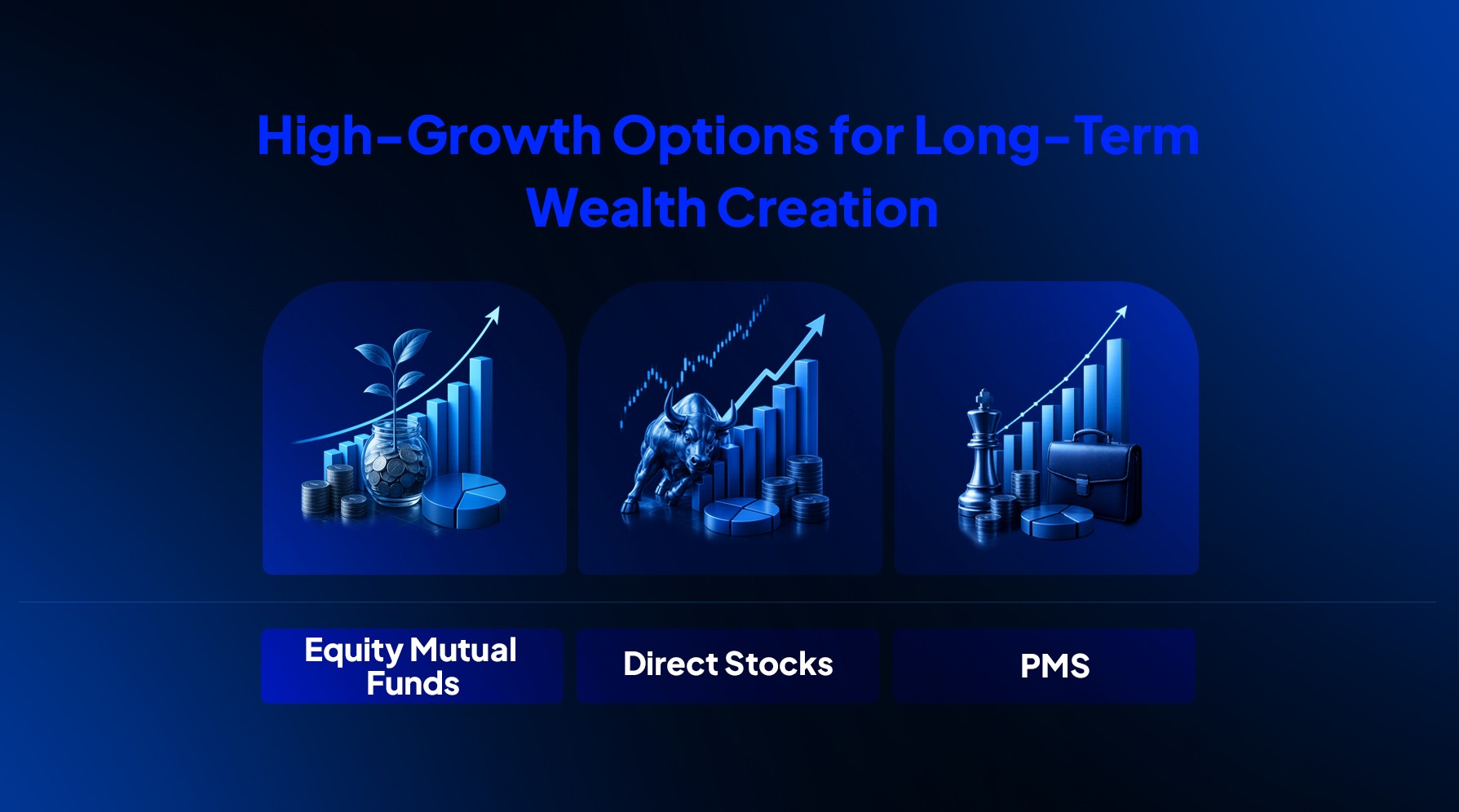
Equity Mutual Funds: roughly 12% to 14% annually over the long term, with SIPs starting from as little as Rs.100 a month.
Direct Stocks: potential for the highest returns, but demands ongoing research and the stomach for volatility.
PMS: structured equity strategies for larger portfolios, historically delivering 14% to 16%+ for investors who can accept higher risk.
The trade-off is volatility, not lack of return. That is exactly why a long horizon matters more here than anywhere else on this list.
GROWTH FOR THE LONG HAUL |
Building equity exposure through mutual fund advisory or managed portfolio management turns “good returns” from a guess into a structured plan. |
Schedule a Consultation: ckredencewealth.com/contact-us |
Balanced Growth Options for Mid-Term and Retirement Goals
Between chasing maximum growth and locking money away completely sits a middle tier, options built for retirement and goals five to fifteen years out.
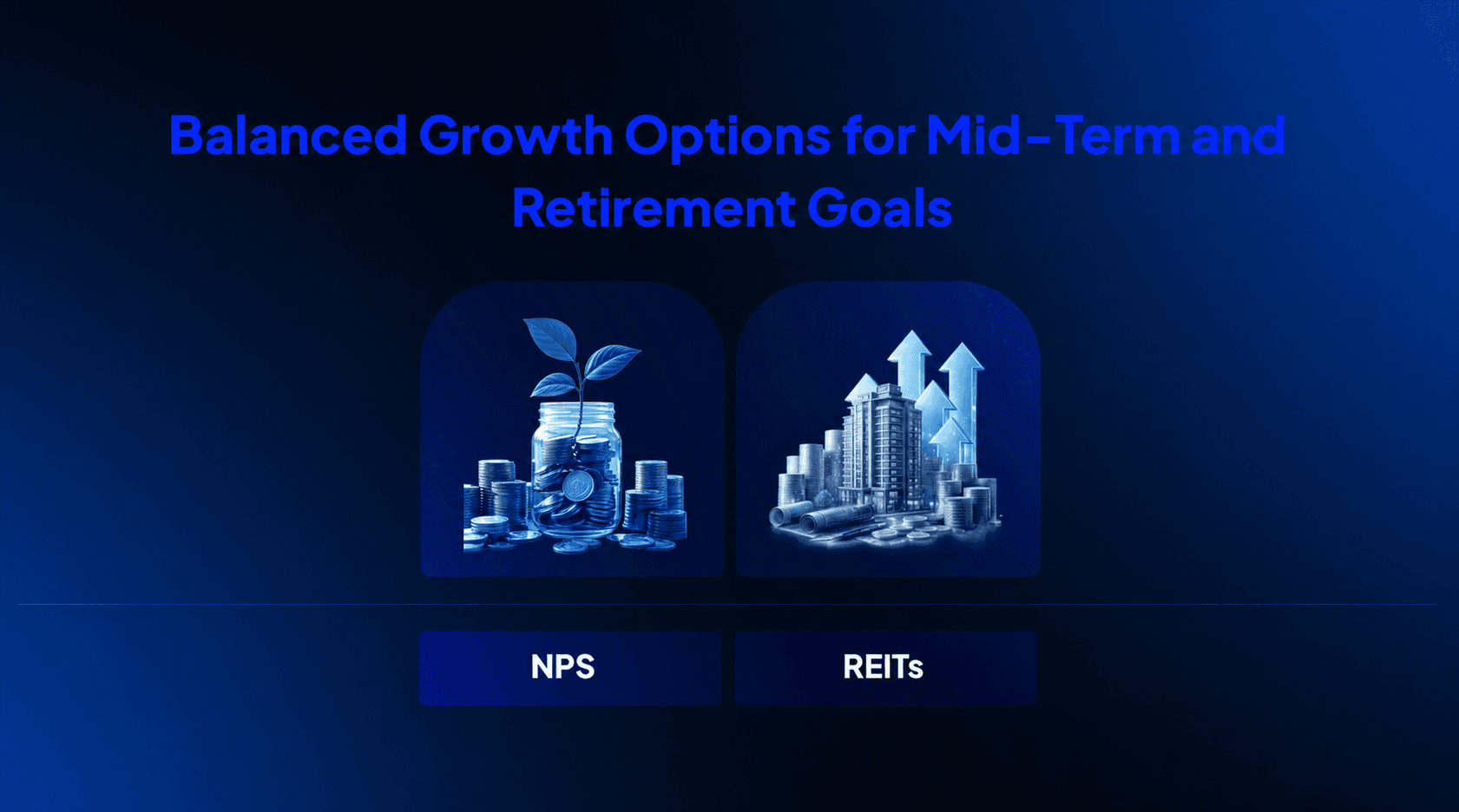
NPS: historically 9% to 12% annually, blending equity, corporate bonds, and government securities, with an extra Rs.50,000 tax deduction under Section 80CCD(1B).
REITs: roughly 8% to 9% from dividend yield and appreciation combined, offering real estate exposure without physical property’s illiquidity.
Both suit investors who want more than a fixed deposit but are not ready for equity’s full volatility.
RETIREMENT, WITHOUT THE GUESSWORK |
Structuring NPS, REITs, and equity together as one asset allocation plan, mapped to your retirement goals, beats picking instruments in isolation. |
Schedule a Consultation: ckredencewealth.com/contact-us |
Safe and Guaranteed Options for Capital Protection
Every portfolio needs a safe layer, money you cannot afford to see shrink before you need it. The mistake is treating this layer as the whole portfolio rather than one part of it.
PPF: 7.1%, tax-free at maturity, with a 15-year lock-in that suits long-term, goal-tagged savings.
Bank FD: 6% to 7%, fully guaranteed, but taxed as income, meaning higher tax brackets can see real, inflation-adjusted returns turn negative.
Safe does not always mean “good returns.” It means capital protection, a different job than growth, and one that should be sized to near-term needs rather than your entire net worth.
SAFE DOES NOT HAVE TO MEAN STAGNANT |
If your FD ladder is quietly losing to inflation, our RIA team can show you alternatives worth comparing, without giving up capital protection. |
Schedule a Consultation: ckredencewealth.com/contact-us |
Comparing Returns Across Investment Options in India
A side-by-side view makes the trade-offs clear.
Option | Typical Return | Risk Level | Liquidity / Lock-in |
Bank FD | 6% to 7% | Low | No lock-in, breakable anytime with a penalty |
PPF | 7.1%, tax-free | Low | 15-year lock-in, partial withdrawals allowed |
REITs | 8% to 9% | Medium | Listed; sells like a stock within a day |
NPS | 9% to 12% | Low to Medium | Locked till retirement; partial exit rules apply |
Equity Mutual Funds | 12% to 14% | Medium to High | Open-ended, redeemable in one to three days |
PMS / Direct Equity | 14% to 16%+ | High | Directly held; exit anytime, values fluctuate |
Table: investment options in India compared on typical return, risk, and liquidity.
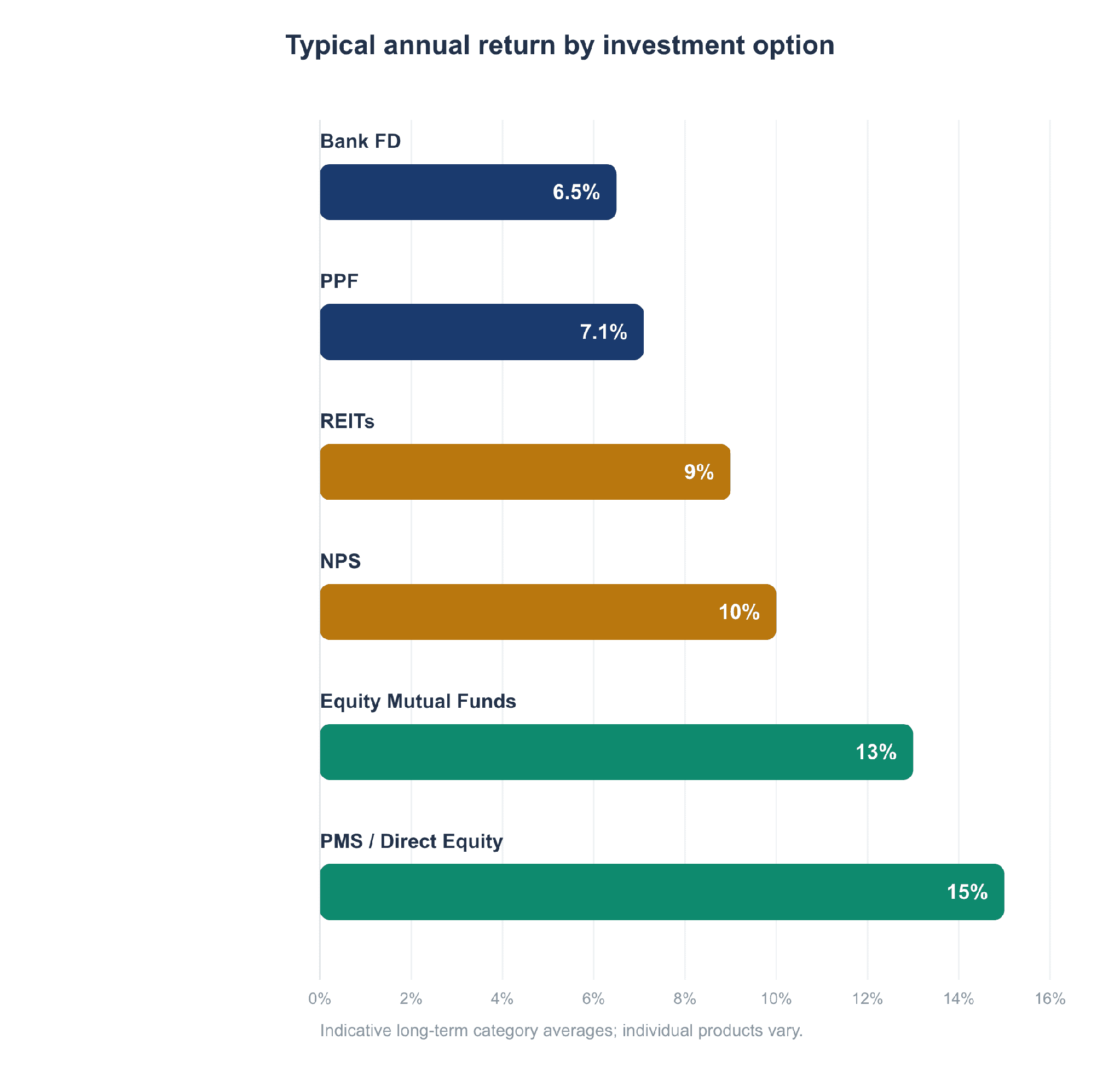
Typical annual return by investment option, indicative long-term averages.
The right entry point depends on which bucket matches your own goal, not the average investor’s.
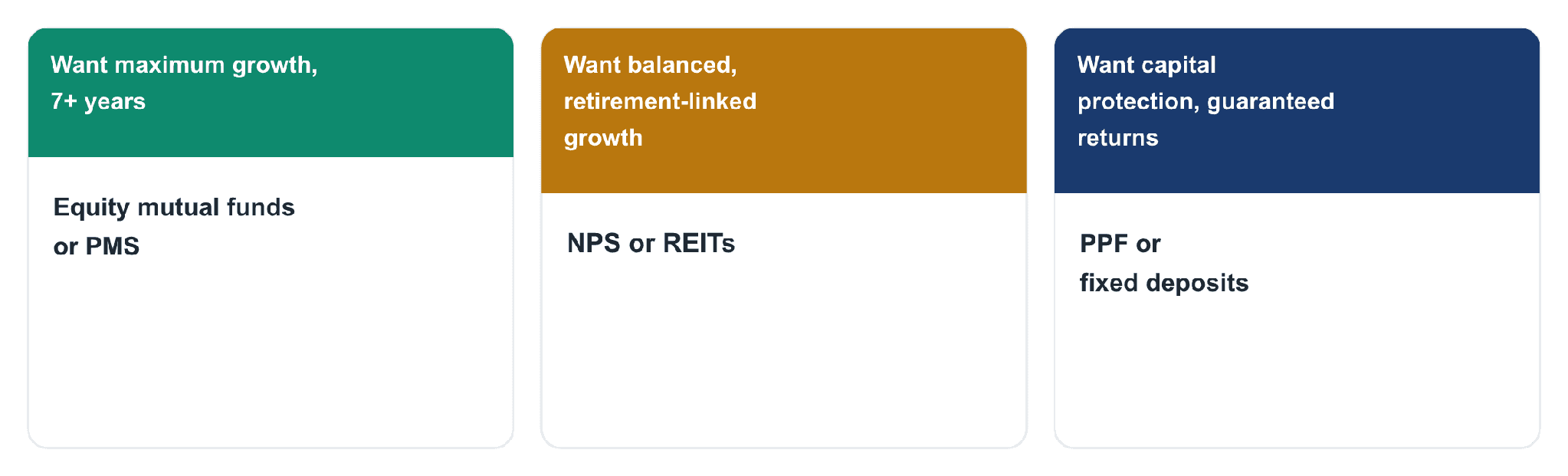
Match your goal to a high-growth, balanced, or safe option.
How to Choose the Right Investment Option for You
Three questions decide where your money actually belongs, more than any ranked list can.
Investment horizon: money you need within two to three years belongs in safe options, not equity.
Risk appetite: can you watch a growth investment fall 20% without selling out of panic?
Existing concentration: most portfolios are already overweight FDs or property; the next rupee should correct that, not add to it.
If you are optimizing for long-term financial independence rather than a single year’s return, comparing PMS, mutual funds, and AIFs side by side matters more than picking the single highest number.
Why Should You Choose Ckredence Wealth?
Many investors who ask “where should I invest for good returns” already hold a portfolio, just not one that was ever compared against the alternatives. Ckredence Wealth is a SEBI registered investment advisor (INA000020846) and portfolio manager (INP000007164), built on a 37 year legacy since 1987.
Solutions That Matter:
Structured allocation across our 4 investment approaches, matched to your horizon and risk appetite.
Portfolio management through our PMS services, for investors ready to move beyond a scattered mix of instruments.
Fee-only advice on rebalancing a portfolio that has drifted toward FDs or a single asset class by default.
Ready to put a plan behind your next rupee? Schedule a Consultation!
Conclusion
“Where to invest money for good returns in India” does not have one universal answer. It depends on whether you have six months or sixteen years, and whether you can accept volatility or need your capital untouched. Equity and PMS suit long horizons and higher risk tolerance; NPS and REITs suit retirement-linked, mid-term goals; PPF and FDs suit near-term safety, though rarely genuinely “good” returns once tax and inflation are counted.
The mistake most investors make is not choosing the wrong instrument, it is choosing without a plan for how much goes where. A deliberate mix across all three risk buckets, reviewed as your goals and income change, will outperform any single “best investment” pulled from a list. Start with your horizon, not the headline return.
FAQs
01.
What is the best investment option in India for good returns?
There is no single best option, it depends on your horizon and risk appetite. Equity mutual funds and PMS have historically delivered 12% to 16% over 7+ years, while NPS and REITs offer steadier, more moderate returns near 9% to 12%.
02.
Are fixed deposits still worth it for good returns?
FDs still suit near-term safety and emergency funds, but after tax and inflation, real returns can turn negative for higher tax brackets, so they should not be the largest holding in a growth-focused portfolio.
03.
How much of my money should go into safe versus high-growth investments?
That depends on your time horizon and goals. A common approach limits safe instruments like PPF and FD to near-term needs, while directing longer-horizon money toward equity, NPS, or PMS.
04.
Is NPS a good investment for high returns?
NPS suits retirement-linked goals rather than pure high-return chasing, historically returning near 9% to 12% annually with additional tax benefits under Section 80CCD(1B).
“Where should I invest money for good returns?” is one of the most searched questions in Indian personal finance, and most answers read the same: FD, PPF, mutual funds, gold, real estate, listed in no particular order, with no regard for your actual risk appetite or how soon you need the money back.
That gap has a real cost. A fixed deposit earning 6.5% looks safe until tax and inflation enter the picture: for an investor in the 30% bracket, the after-tax yield falls to roughly 4.55%, and against inflation near 6%, the real return turns negative, near -1.45% a year.
Before adding another instrument to your portfolio, ask yourself:
Do you actually know how many years you have before you need this money back?
Is your money spread across FD, a stock tip, and an insurance-linked plan, with no plan tying them together?
Would you recognize a “safe” option that is quietly losing to inflation?
This guide sorts real investment options in India by risk and horizon, not by which name is most familiar, so your next rupee actually earns something.
TL;DR
High-growth options such as equity mutual funds, direct stocks, and PMS suit horizons of 7+ years and have historically returned 12% to 16% annually.
Balanced options such as NPS and REITs suit retirement and mid-term goals, blending market exposure with steadier income near 9% to 12%.
Safe options such as PPF and fixed deposits protect capital but, after tax and inflation, can barely preserve its value.
Good returns come from matching the option to your horizon and risk appetite, not from chasing the highest number on a list.
Most Indian portfolios lean on FDs by default, not because they were compared against the alternatives.
A mix across all three risk buckets, reviewed periodically, beats picking one instrument and hoping.
High-Growth Options for Long-Term Wealth Creation
For goals seven or more years away, retirement, a child’s education, or simply compounding wealth, growth-oriented options have historically outpaced every “safe” alternative by a wide margin.

Equity Mutual Funds: roughly 12% to 14% annually over the long term, with SIPs starting from as little as Rs.100 a month.
Direct Stocks: potential for the highest returns, but demands ongoing research and the stomach for volatility.
PMS: structured equity strategies for larger portfolios, historically delivering 14% to 16%+ for investors who can accept higher risk.
The trade-off is volatility, not lack of return. That is exactly why a long horizon matters more here than anywhere else on this list.
GROWTH FOR THE LONG HAUL |
Building equity exposure through mutual fund advisory or managed portfolio management turns “good returns” from a guess into a structured plan. |
Schedule a Consultation: ckredencewealth.com/contact-us |
Balanced Growth Options for Mid-Term and Retirement Goals
Between chasing maximum growth and locking money away completely sits a middle tier, options built for retirement and goals five to fifteen years out.

NPS: historically 9% to 12% annually, blending equity, corporate bonds, and government securities, with an extra Rs.50,000 tax deduction under Section 80CCD(1B).
REITs: roughly 8% to 9% from dividend yield and appreciation combined, offering real estate exposure without physical property’s illiquidity.
Both suit investors who want more than a fixed deposit but are not ready for equity’s full volatility.
RETIREMENT, WITHOUT THE GUESSWORK |
Structuring NPS, REITs, and equity together as one asset allocation plan, mapped to your retirement goals, beats picking instruments in isolation. |
Schedule a Consultation: ckredencewealth.com/contact-us |
Safe and Guaranteed Options for Capital Protection
Every portfolio needs a safe layer, money you cannot afford to see shrink before you need it. The mistake is treating this layer as the whole portfolio rather than one part of it.
PPF: 7.1%, tax-free at maturity, with a 15-year lock-in that suits long-term, goal-tagged savings.
Bank FD: 6% to 7%, fully guaranteed, but taxed as income, meaning higher tax brackets can see real, inflation-adjusted returns turn negative.
Safe does not always mean “good returns.” It means capital protection, a different job than growth, and one that should be sized to near-term needs rather than your entire net worth.
SAFE DOES NOT HAVE TO MEAN STAGNANT |
If your FD ladder is quietly losing to inflation, our RIA team can show you alternatives worth comparing, without giving up capital protection. |
Schedule a Consultation: ckredencewealth.com/contact-us |
Comparing Returns Across Investment Options in India
A side-by-side view makes the trade-offs clear.
Option | Typical Return | Risk Level | Liquidity / Lock-in |
Bank FD | 6% to 7% | Low | No lock-in, breakable anytime with a penalty |
PPF | 7.1%, tax-free | Low | 15-year lock-in, partial withdrawals allowed |
REITs | 8% to 9% | Medium | Listed; sells like a stock within a day |
NPS | 9% to 12% | Low to Medium | Locked till retirement; partial exit rules apply |
Equity Mutual Funds | 12% to 14% | Medium to High | Open-ended, redeemable in one to three days |
PMS / Direct Equity | 14% to 16%+ | High | Directly held; exit anytime, values fluctuate |
Table: investment options in India compared on typical return, risk, and liquidity.

Typical annual return by investment option, indicative long-term averages.
The right entry point depends on which bucket matches your own goal, not the average investor’s.

Match your goal to a high-growth, balanced, or safe option.
How to Choose the Right Investment Option for You
Three questions decide where your money actually belongs, more than any ranked list can.
Investment horizon: money you need within two to three years belongs in safe options, not equity.
Risk appetite: can you watch a growth investment fall 20% without selling out of panic?
Existing concentration: most portfolios are already overweight FDs or property; the next rupee should correct that, not add to it.
If you are optimizing for long-term financial independence rather than a single year’s return, comparing PMS, mutual funds, and AIFs side by side matters more than picking the single highest number.
Why Should You Choose Ckredence Wealth?
Many investors who ask “where should I invest for good returns” already hold a portfolio, just not one that was ever compared against the alternatives. Ckredence Wealth is a SEBI registered investment advisor (INA000020846) and portfolio manager (INP000007164), built on a 37 year legacy since 1987.
Solutions That Matter:
Structured allocation across our 4 investment approaches, matched to your horizon and risk appetite.
Portfolio management through our PMS services, for investors ready to move beyond a scattered mix of instruments.
Fee-only advice on rebalancing a portfolio that has drifted toward FDs or a single asset class by default.
Ready to put a plan behind your next rupee? Schedule a Consultation!
Conclusion
“Where to invest money for good returns in India” does not have one universal answer. It depends on whether you have six months or sixteen years, and whether you can accept volatility or need your capital untouched. Equity and PMS suit long horizons and higher risk tolerance; NPS and REITs suit retirement-linked, mid-term goals; PPF and FDs suit near-term safety, though rarely genuinely “good” returns once tax and inflation are counted.
The mistake most investors make is not choosing the wrong instrument, it is choosing without a plan for how much goes where. A deliberate mix across all three risk buckets, reviewed as your goals and income change, will outperform any single “best investment” pulled from a list. Start with your horizon, not the headline return.
FAQs
01.
What is the best investment option in India for good returns?
There is no single best option, it depends on your horizon and risk appetite. Equity mutual funds and PMS have historically delivered 12% to 16% over 7+ years, while NPS and REITs offer steadier, more moderate returns near 9% to 12%.
02.
Are fixed deposits still worth it for good returns?
FDs still suit near-term safety and emergency funds, but after tax and inflation, real returns can turn negative for higher tax brackets, so they should not be the largest holding in a growth-focused portfolio.
03.
How much of my money should go into safe versus high-growth investments?
That depends on your time horizon and goals. A common approach limits safe instruments like PPF and FD to near-term needs, while directing longer-horizon money toward equity, NPS, or PMS.
04.
Is NPS a good investment for high returns?
NPS suits retirement-linked goals rather than pure high-return chasing, historically returning near 9% to 12% annually with additional tax benefits under Section 80CCD(1B).