
What Is GMP in an IPO, and Why Shouldn't You Trust It Alone?
What is GMP in an IPO? What grey market premium actually measures, why it missed on a recent mega-listing, and a five-point check before you apply.

Ckredence Wealth |September 17, 2026

When the National Stock Exchange opened its own ₹22,562 crore IPO for subscription on 17 September 2026, with a price band of ₹1,700 to ₹1,785, one number dominated every WhatsApp forward and business news ticker: the grey market premium, or GMP. GMP is the price at which an IPO's shares change hands in an unofficial, unregulated market before they list on an exchange, and it is widely read as a preview of the listing-day gain. A promoter checking his phone between meetings sees "NSE IPO GMP up 8%" and treats it as a verdict. It is not one, and this piece explains why, using the NSE IPO as the current example rather than the subject.
What Is GMP in an IPO, and What Was the NSE IPO's GMP Actually Showing?
| Grey Market Premium (GMP)GMP is the difference between an IPO's official issue price and the price at which its shares trade in an informal, unregulated "grey market" before listing. A GMP of ₹85 on a ₹1,785 issue price implies the market expects the stock to list around ₹1,870, but the trade itself carries no exchange guarantee, no SEBI oversight, and no settlement mechanism if either party walks away. |
TL; DR
- GMP is an unofficial, unregulated number, not a SEBI-tracked metric or a guaranteed listing indicator
2. It reflects short-term sentiment among a small set of grey-market participants, not the company's underlying financials
3. GMP has reversed sharply in the final days before listing on several large 2025-26 IPOs, including a premium mega-IPO that still listed at a discount
4. Average returns across India's listed IPOs turned negative in FY26 even as fundraising hit a record, per SEBI-registered PRIME Database
5. A five-point checklist of what is actually verifiable about an IPO is more useful than tracking GMP day to day
6. What you do with a listing-day gain matters more to long-term wealth than whether you got the allotment
7. GMP-chasing is a pattern, not a strategy, and it is worth recognising before the next mega IPO, not during it
| If IPO applications have become a habit rather than a plan, a structured review is a reasonable place to start.GET A SECOND OPINION ON YOUR CURRENT PORTFOLIO |
Chittorgarh and brokerage desks tracking the NSE IPO reported a GMP in the high single digits as a percentage of the issue price through its subscription window, alongside heavy retail interest given the exchange's own brand recognition. That number changed by the day. It said nothing about NSE's five-year earnings trajectory, its regulatory relationship with SEBI as the entity it also lists on, or the price at which the offer was actually valued against comparable exchange businesses. A promoter who applies to every headline IPO on the strength of the GMP number alone is trading on a rumour, however widely reported that rumour is, a pattern this page returns to when weighing where IPO exposure fits against other HNI options.
Why Doesn't a High GMP Guarantee Listing Gains?
The clearest recent illustration is not the NSE IPO but Lenskart Solutions, which listed on 10 November 2025.
| What GMP implied | What actually happened | |
| Grey market signal | A double-digit percentage premium over the ₹402 issue price through most of the subscription window | Reported to have narrowed sharply in the final sessions before listing |
| Listing outcome | Widely expected to open well above issue price | Opened at ₹395 on the NSE, a 1.7% discount to the issue price, as Business Standard reported at the time (10 November 2025) |
| ⚠️ Risk to understandGrey market trades are not settled through an exchange clearing house. There is no mechanism forcing either side to honour the agreed price if sentiment turns before listing, which is exactly what several large 2025-26 IPOs experienced. A GMP quoted on a Tuesday can be meaningless by Friday, and investors who allocate capital based on it are pricing a rumour, not a security. |
This is not confined to one stock. According to PRIME Database figures reported by The Tribune (as of 1 April 2026), India's mainboard IPOs raised a record Rs 1,78,963 crore across 112 issues in FY26, yet the average listing gain fell to 8% from 30% the year before, and the average return of listed IPOs turned negative at -7% amid broader market corrections. Record fundraising and weakening actual returns happened in the same year. GMP does not capture that gap, because it is measuring enthusiasm three days out, not value five years out.
How Should You Actually Evaluate an IPO Before Applying?
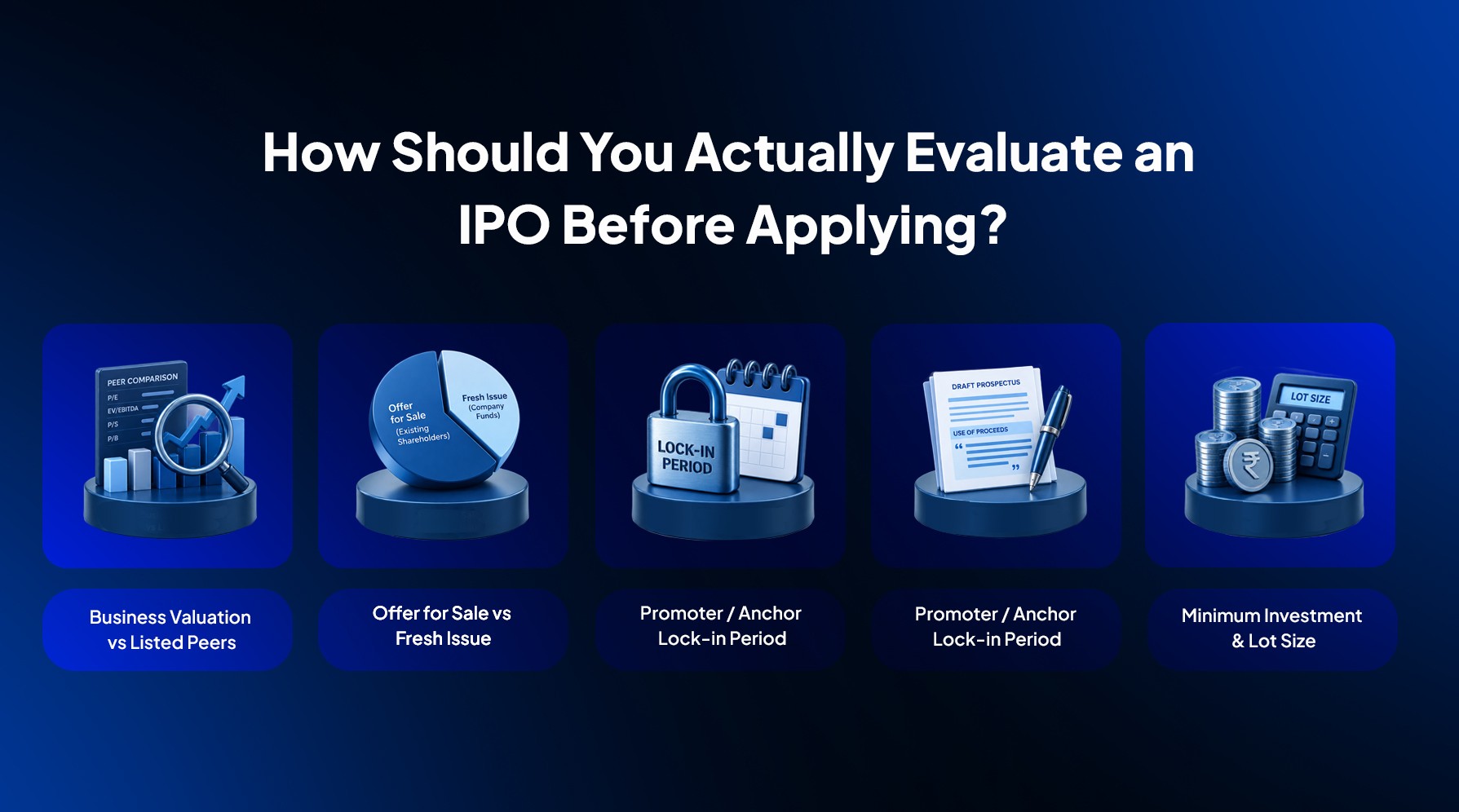
Move the question from "what is the GMP today" to a shorter, more answerable list:
- What is the business actually valued at, relative to listed peers on standard multiples, not relative to its own hype
- What share of the issue is an Offer for Sale, where existing shareholders are exiting, versus a fresh issue funding the business itself
- What is the promoter or anchor lock-in period, and does it end soon after listing
- What does the draft prospectus say about use of proceeds, in the company's own words, not a summary
- Does the minimum investment and lot size fit inside your existing asset allocation, or would an allotment concentrate your portfolio in one untested stock
None of these five require access to a grey-market quote. All five are answerable from public documents before the issue even opens.
Can You Tell Which Parts of an IPO Story Are Verifiable? A Five-Point Check
| What you're told | Verifiable before applying? | Where to check |
| "GMP is trading at a strong premium" | No | Unregulated, no official record, changes daily |
| "The issue is oversubscribed 15 times" | Yes | NSE/BSE bidding data, updated live during the window |
| "Promoters are locked in for six months" | Yes | The draft red herring prospectus (DRHP), a public document |
| "This is a fresh issue funding growth" | Yes | Objects of the issue section of the DRHP |
| "Anchor investors bought in at this price" | Yes | Anchor allocation disclosure, published before the issue opens |
| "This will double on listing" | No | No document, official or unofficial, can verify a forward price |
The pattern is not subtle once it is laid out this way. The number everyone quotes on WhatsApp is the one that cannot be verified, and the ones that can be checked in ten minutes are rarely mentioned at all.
| Whether it is the NSE IPO or the next one, a listing-day gain is a portfolio decision, not just a trading one.START A STRUCTURED PORTFOLIO REVIEW |
What Should You Do With IPO Listing Gains?
A single stock, however it was acquired, is concentration risk the moment it lands in a demat account. The more useful conversation for an HNI is not "should I have applied," but what role that position should play alongside the rest of the portfolio. A gain that came from one allotment lottery is not a strategy repeated, and treating it as one is how a portfolio drifts into being a collection of past IPO bets rather than a plan.
This is where portfolio management services and SEBI-registered advisory earn their place. Not in helping anyone apply for an IPO, which sits with a broker, but in deciding what a resulting position should be sized at, held for, or exited into, once it exists.
Who Should Not Be Applying for IPOs Based on GMP Alone?
- An investor who cannot name the company's revenue or profit trend without checking, because the application was decided from the GMP headline alone
- Anyone treating every mega IPO as a must-apply event, rather than evaluating each on its own listed peers and valuation
- An investor whose existing portfolio is already concentrated in one sector or one recent listing, where another allotment would add to the same risk rather than diversify it
- Anyone relying on GMP trackers to decide position size, since none of them carry any liability if the number proves wrong
Saying no to a mega IPO because the checklist does not hold up is a harder discipline than applying, and it is the one most retail investors skip.
The Question That Actually Matters
The NSE IPO will have listed, allotted, and moved on to being just another stock long before most readers finish researching the next mega IPO. GMP will be back in the headlines for that one too. The checklist above does not change with the news cycle, which is the point. It is the same five questions whether the issue size is Rs 500 crore or Rs 22,562 crore.
| Whether it is evaluating the next mega IPO or deciding what to do with the last one, a second opinion costs nothing to ask for.TALK TO OUR SEBI-REGISTERED ADVISORY TEAM |
FAQs
01 Number
Is GMP always accurate?
No. GMP reflects sentiment among a small, unregulated set of grey-market participants and has diverged sharply from actual listing prices on several large recent IPOs. It should be read as one data point on demand, not as a forecast.
02 Number
What if GMP is negative?
A negative GMP means grey-market participants expect the stock to list below its issue price, usually reflecting weak subscription or broader market weakness. It is still an unregulated signal and can reverse before listing, in either direction.
03 Number
How is GMP calculated?
GMP is simply the grey-market trading price minus the official issue price, quoted informally between grey-market participants. There is no exchange, regulator, or clearing house involved in setting or verifying the number.
04 Number
Is GMP a good indicator to invest?
GMP tells you what a small group of traders think will happen in the next few days, not what an investor should decide for the next five years. The more useful question is the one this article's checklist answers: is the business fairly valued, and does an allotment fit your existing portfolio, regardless of what GMP says today.