9min read

9min read

Best Wealth Management for Family Offices in India (2026): A Guide for UHNW Families

Best Wealth Management for Family Offices in India (2026): A Guide for UHNW Families

Best Wealth Management for Family Offices in India (2026): A Guide for UHNW Families

Fragmented wealth across banks and advisors is not the same as a managed family office. Compare the best wealth management firms for family offices in India by governance, fee structure, and SEBI registration.

Fragmented wealth across banks and advisors is not the same as a managed family office. Compare the best wealth management firms for family offices in India by governance, fee structure, and SEBI registration.

Fragmented wealth across banks and advisors is not the same as a managed family office. Compare the best wealth management firms for family offices in India by governance, fee structure, and SEBI registration.

Ckredence

Ckredence

|

May 19, 2026

May 19, 2026

Family office wealth management India workflow with onboarding, IPS, allocation, tax planning and reporting

"The individual investor should act consistently as an investor and not as a speculator." 

Family office wealth management in India has changed significantly over the last five years. Most affluent Indian families earlier depended on private banks, relationship managers, or disconnected investment advisors across multiple institutions. 

Today, promoter families, second-generation business owners, and HNIs are increasingly looking for consolidated structures that combine investment management, succession planning, governance, tax coordination, and reporting under one framework. 

According to PwC, the number of family offices in India rose from 45 in 2018 to nearly 300 by 2024, managing an estimated $30 billion in assets.The best wealth management for family offices in India is no longer just about returns. 

According to Knight Frank's Wealth Report 2025, the number of UHNWIs in India is expected to grow by 50% between 2024 and 2029, reaching approximately 19,000

That growth is being met by an advisory market still fragmented across institutions. The families navigating this environment need governance, advisory independence, succession continuity, and a structure that can manage wealth across

generations instead of across isolated products.

Key Takeaways

  • Family offices operate under structured mandates, not product distribution relationships.

  • Advisory independence matters more than brand size for UHNW families.

  • A SEBI-registered RIA operates under fiduciary obligations, not commission incentives.

  • Investment Policy Statements separate family office mandates from distributor relationships.

  • Governance and succession planning are now central to family office mandates in India.

  • Tier-II business families in Gujarat and Maharashtra are actively entering family office structures.

  • Consolidated reporting is the strongest operational indicator of a genuine family office mandate.

What Is Wealth Management for Family Offices in India?

Family office wealth management is a structured advisory framework designed to manage investments, governance, succession, reporting, taxation, and long-term wealth continuity for affluent families. 

Unlike traditional wealth management relationships that focus primarily on products, family offices operate as long-term strategic advisory structures.

India's family office ecosystem has expanded rapidly. The shift reflects a broader move from product-led investing to governance-led wealth management among business families managing multi-generational assets.

Structure

Primary Focus

How It Operates

Private Bank

Product distribution and portfolio services

Relationship-led investment management

Multi-Family Office (MFO)

Shared advisory platform for multiple families

Consolidated advisory and governance support

Single-Family Office (SFO)

Dedicated structure for one family

Fully customised long-term wealth oversight

Single-Family Office vs Multi-Family Office: Which Model Fits Indian HNI Families?

Single-family offices are designed for ultra-large promoter families with complex structures, operating businesses, global assets, and succession requirements. They require internal staff, legal counsel, and independent governance infrastructure.

Multi-family offices allow affluent families to access sophisticated advisory structures without building a full internal office setup. For most Indian HNI and UHNW families with investable assets between ₹10 crore and ₹100 crore, a multi-family office mandate is the more practical starting point.

What Services Does a Family Office Provide That a Private Bank Does Not?

A family office typically combines:

  • Investment oversight: Continuous monitoring across equity, debt, PMS, AIFs, real estate, and global assets.

  • Governance structures: Frameworks defining how financial decisions are made within the family across generations.

  • Succession planning: Planning for smooth wealth transfer, business continuity, and ownership transition.

  • Tax coordination: Structuring investments for long-term tax efficiency and compliance.

  • Consolidated reporting: One unified view of the family's wealth across banks, products, and geographies.

  • Philanthropy planning: Structuring charitable giving and social impact initiatives systematically.

  • Legacy structuring: Long-term wealth preservation frameworks aligned with family values.

Who Qualifies for Family Office Wealth Management in India?

Most family office mandates begin once investable surplus crosses ₹10 to ₹25 crore. Many affluent business families begin consolidation discussions earlier when wealth becomes fragmented across multiple advisors, PMS structures, banks, and real estate holdings.

Our guide to our Portfolio Management Services covers how HNI families structure equity and multi-asset allocations before building a broader family office mandate.

"Rule No. 1: Never lose money. Rule No. 2: Never forget Rule No. 1." Warren Buffett, Chairman and CEO, Berkshire Hathaway
Source: Berkshire Hathaway Annual Shareholder Letters

Why Most Indian Family Office Advisors Have a Conflict of Interest You Are Not Told About

Most affluent families assume their advisor is working in their best interest. In reality, many Indian wealth management relationships still operate on a distributor-led structure where revenue is linked to product commissions. 

This creates a structural conflict between what the advisor recommends and what best serves the family's long-term wealth structure.

Distributor Model

Independent Fiduciary Model

Revenue linked to product commissions

Revenue linked to advisory relationship

Incentive to increase product movement

Incentive to improve long-term outcomes

Focus on proprietary or commission-paying products

Focus on suitability and governance

Portfolio fragmentation often ignored

Consolidated oversight prioritised

SEBI's 2020 RIA framework exists because advisory conflicts in wealth management are not theoretical. They are structurally recognised by regulation itself.

What Is a SEBI-Registered RIA and Why It Changes the Advisory Relationship

A SEBI-registered RIA operates under fiduciary obligations, meaning advisory responsibility is tied to the client's interests rather than product distribution incentives. 

Our SEBI-registered advisory services detail how this structure differs from distributor-led wealth management relationships.

📊 India's family office AUM is projected to grow from $30 billion in 2024 to $45 billion by 2027: This reflects a decisive shift from product accumulation to structured, governance-led family wealth management across the country. Source: Sundaram Alternate Assets, as cited by IBEF, 2024

The Distributor Commission Model: What It Costs HNI Families Over a 10-Year Horizon

Even a 1 to 2% trail commission difference across long investment horizons can materially affect long-term family wealth accumulation. More critically, distributor structures encourage fragmented product accumulation instead of integrated family wealth planning. 

The real question is not whether your portfolio generated returns last year. The question is whether your advisor benefits more from product movement than from preserving your family's long-term wealth structure.

How to Verify Advisory Independence Before Signing a Mandate

Before selecting a family office advisor, affluent families should verify:

  1. SEBI registration status: Verifies whether the advisor operates under recognised regulatory standards.

  2. Fee structure transparency: Clarifies how the advisor earns revenue and whether hidden commissions exist.

  3. Product neutrality: Confirms recommendations are based on suitability, not product pushing.

  4. Reporting independence: Allows families to receive unbiased consolidated reporting across institutions.

  5. Governance framework: Defines how investment decisions and succession planning will be managed.

💼 If your current wealth relationship cannot tell you clearly how it earns revenue, you do not yet have a fiduciary advisory structure. Book a 20-minute advisory review with Ckredence Wealth to understand what a SEBI-registered, fee-transparent family office mandate looks like for your family.

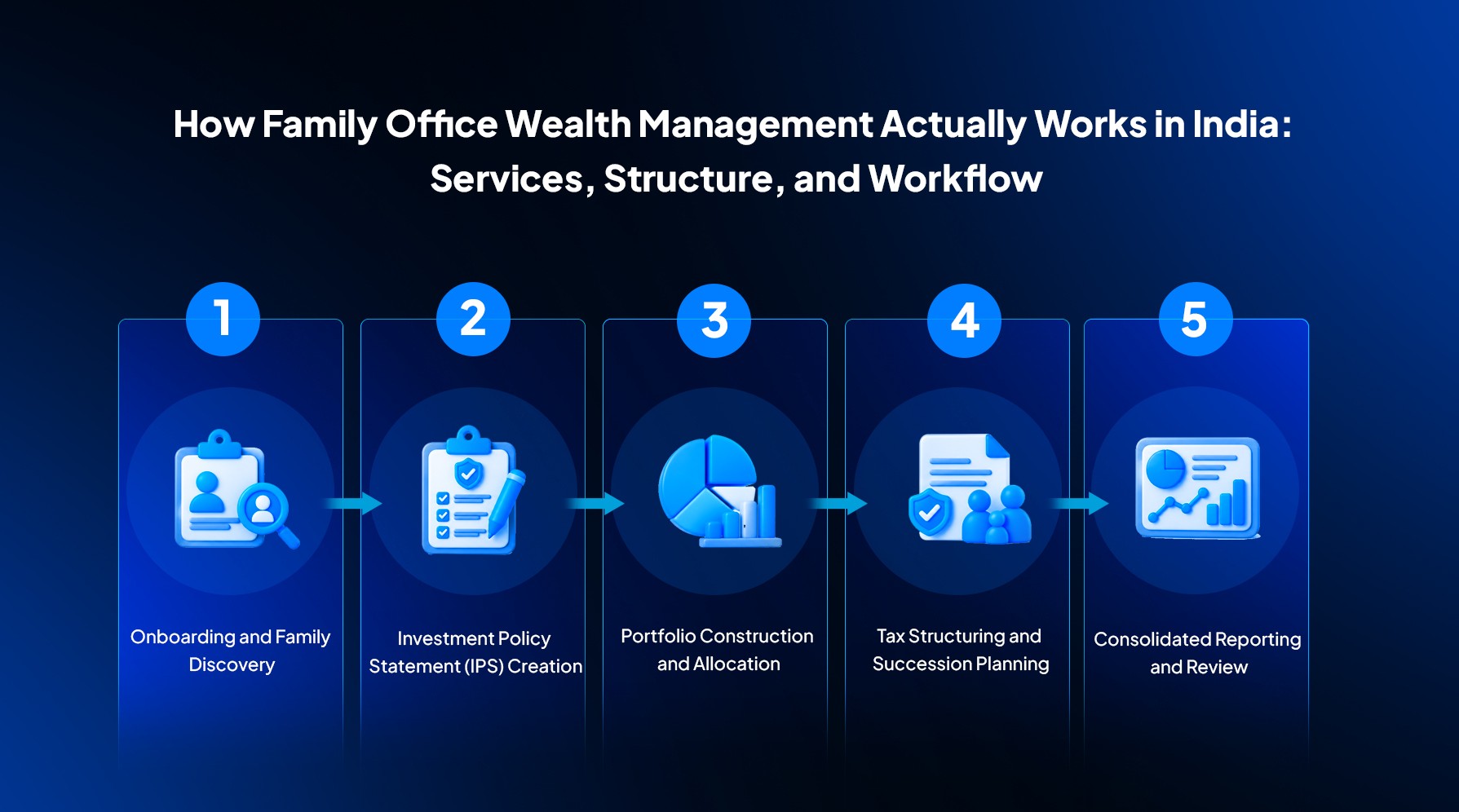
How Family Office Wealth Management Actually Works in India: Services, Structure, and Workflow

Family office mandates operate through a structured advisory process instead of isolated investment recommendations. The goal is one integrated framework for investments, governance, taxation, reporting, and succession planning.
Best wealth management for family offices in India with UHNW family advisory and portfolio review

Typical Family Office Workflow

1. Onboarding and Family Discovery

The process begins with understanding the complete financial and family structure before any investment recommendations are made. 

This covers family member structure, ownership responsibilities, business holdings, asset distribution across banks and PMS, liabilities, and long-term succession priorities.

2. Investment Policy Statement (IPS) Creation

The IPS defines risk tolerance, liquidity expectations, return objectives, governance rules, and allocation principles across equity, debt, real estate, PMS, and alternative investments. This is the biggest structural difference between a genuine family office mandate and a distributor relationship. 

Our guide to how to invest in Portfolio Management Services covers how HNI families approach IPS-based allocation decisions.

3. Portfolio Construction and Allocation

The portfolio is structured across multiple asset classes: equity, debt, PMS, AIFs, global investments, real estate, and liquidity reserves. Concentration in any one asset class is reviewed against the IPS allocation framework.

4. Tax Structuring and Succession Planning

Family office mandates coordinate with legal and tax professionals for long-term wealth continuity. This includes inheritance planning, trust structures, estate efficiency, and family governance frameworks for future decision-making.

5. Consolidated Reporting and Review

The family receives one consolidated view across institutions, products, and geographies. Regular strategic reviews replace transaction-level reporting. Risk visibility across concentration, liquidity, and sector exposure is provided systematically.

If your current wealth manager cannot produce a consolidated view of all your assets across instruments, banks, and geographies in a single dashboard, you do not have a family office relationship. You have a distributor relationship packaged to look like one.

🔍 If your family's wealth is visible only in fragments, across separate bank statements, PMS reports, and fixed deposit certificates, you are managing products, not managing wealth. Schedule a consolidation review with Ckredence Wealth to see what a unified family office dashboard looks like for your asset mix.

What Has Changed in Family Office Wealth Management in India in 2026?

Family office conversations in India today are very different from what they were five years ago. The shift is not cosmetic. Return-focused mandates have given way to governance and legacy-focused structures. 

Consolidated reporting has replaced fragmented statements. IPS-led advisory frameworks have replaced product-led conversations.

Pre-2024 Standard

2026 Family Office Standard

Return-focused mandates

Governance and legacy-focused mandates

Fragmented reporting

Consolidated reporting dashboards

Domestic-only allocation

Global diversification structures

Product-led conversations

IPS-led advisory frameworks

Informal succession planning

Structured governance and estate planning

Why Tier-II HNI Families Are Entering Family Office Structures

Business families in Surat, Ahmedabad, Rajkot, Indore, and Vadodara are increasingly adopting family office mandates as wealth structures become more complex across generations. 

Gujarat business families in particular are moving from informal multi-advisor arrangements toward regulated, consolidated structures.

📊 India's HNWI population rose 6% in 2024 to 85,698, with numbers expected to reach 93,753 by 2028: This expansion is being driven by entrepreneurial wealth creation, global integration, and growing demand for structured family wealth advisory in Tier-II cities.
Source: Knight Frank, The Wealth Report 2025

AIF and PMS Regulatory Evolution

Changes in PMS and AIF participation have increased institutionalisation in HNI investing. Governance over allocation decisions has become more important than simple product access. 

Our guide to types of Portfolio Management Services in India covers how these changes affect family office allocation frameworks.

Offshore Structuring and Global Diversification

Global asset allocation has become more relevant because affluent families increasingly seek currency diversification, geographic diversification, offshore exposure to global businesses, and succession flexibility through international wealth structures.

Family office wealth management in India is no longer only about portfolio performance. It is increasingly a governance, continuity, and long-term wealth preservation conversation.

How to Choose the Best Wealth Management Firm for Your Family Office: 5 Criteria Most Families Never Ask

Most affluent families compare advisors using brand reputation and recent returns. That is rarely enough.

Criterion

What Good Looks Like

Red Flag

Question to Ask

SEBI Registration

Transparent regulatory structure

Unclear advisory status

Are you SEBI-registered?

Fee Transparency

Clear advisory fee structure

Hidden commissions

How are you compensated?

Consolidated Reporting

Unified family visibility

Fragmented statements

Can all assets be viewed together?

Governance Framework

IPS and succession structure

Product-only focus

Do you create an IPS?

Advisory Independence

Product-neutral allocation

Product pushing

Are recommendations commission-linked?

SEBI Registration Check Is Non-Negotiable

Before signing any family office or wealth management mandate, families should verify the advisor's registration status, regulatory standing, fee disclosures, and compliance framework. 

These checks establish whether the relationship operates under recognised fiduciary standards or functions primarily as a distributor-led structure. 

Our minimum PMS investment guide covers what SEBI registration means in practice for HNI investors.

Why Fee Structure Transparency Matters

A lower visible fee may still hide distributor compensation through product commissions, trail structures, and embedded incentives. 

Families should clearly understand how the advisor earns revenue because compensation structures directly influence product recommendations and portfolio decisions over long investment horizons.

What a Strong Family Investment Policy Statement Should Include

A strong IPS clearly defines allocation rules, liquidity expectations, governance structures, succession principles, and portfolio review discipline. 

The IPS acts as a long-term decision-making framework that keeps wealth management aligned across generations instead of depending on informal discussions or product-level decisions.

Most affluent families spend more time reviewing business contracts than reviewing wealth advisory mandates. That imbalance creates long-term structural risk.

"Know what you own, and know why you own it." Peter Lynch, Former Fund Manager, Fidelity Magellan Fund
Source: Fidelity Investments, Investor Resources

Before and After: How a Gujarat-Based Business Family Consolidated ₹15 Crore Across 6 Instruments into One Managed Structure

Many affluent families operate with wealth spread across multiple banks, PMS providers, fixed deposits, and direct equity holdings without one consolidated advisory structure. 

Over time, investments grow, but reporting, governance, and succession planning often remain fragmented.

Use Case: Consolidating a Fragmented Family Wealth Structure

A Gujarat-based business family with nearly ₹15 crore in investable assets operated through three banking relationships, multiple PMS allocations, insurance-linked products, and untracked tax exposure. 

No single advisor had complete visibility into the family's overall financial structure.

After moving toward a structured advisory mandate, the family introduced consolidated reporting, IPS-based allocation oversight, improved tax visibility, and succession planning discussions within one framework.

This transition created better visibility, stronger governance, and a more coordinated long-term wealth structure instead of disconnected investment decisions.

(Source: Ckredence Wealth client engagement. Detailed structure available on request.)

If your family's wealth is spread across multiple banks, PMS providers, and fixed deposit accounts that no single advisor has ever mapped together, you do not yet have a consolidated wealth structure. That consolidation is where a family office mandate begins.

💡 If no single advisor has ever mapped your full asset picture, including banks, PMS, real estate, and fixed income, you are running a fragmented structure, not a family office. Schedule a 20-minute consolidation review with Ckredence Wealth to see where the gaps are and what a structured mandate looks like.

Why Ckredence Wealth for Family Office Wealth Management in India

Ckredence Wealth approaches family office advisory as a governance and fiduciary responsibility instead of a product distribution exercise. The focus remains on building structured long-term wealth frameworks aligned with family objectives, continuity, and risk management.

  • SEBI Registered PMS: INP000007164

  • ₹805+ Crore Assets Under Management

  • 376 Active HNI Clients

  • 37-Year Legacy Since 1987

  • Offices in Surat, Mumbai, and Vadodara

  • IPS-based advisory framework aligning investments with family objectives, not product quotas.

  • Consolidated reporting across all assets, institutions, and geographies in one view.

  • Succession-oriented structuring that addresses intergenerational wealth transfer planning.

  • Advisory-first approach with transparent fee structures and no hidden commission dependency.

SEBI registration INP000007164 means the advisory relationship operates under regulated standards instead of informal distributor-led wealth management practices. 

If your investable surplus is above ₹50 lakh and you want an IPS-backed, SEBI-registered advisory structure aligned with your family's long-term objectives, the next step is a focused conversation with Ckredence Wealth.

Book a 20-minute family office advisory review with Ckredence Wealth.

Conclusion

The best wealth management for family offices in India is no longer defined by product access alone. Affluent families today require governance, consolidated reporting, succession planning, and advisory independence alongside investment management. 

For promoter families and UHNW investors, the real value of a family office structure lies in clarity: clarity across assets, decision-making, legacy planning, and long-term family wealth continuity.

FAQs

01.

What is the difference between a SEBI-registered RIA and a wealth distributor for family office mandates?

A SEBI-registered RIA operates under fiduciary obligations and earns through advisory fees, not product commissions. A distributor model earns through commissions tied to product sales. This difference directly affects what the advisor recommends and how your wealth is structured over time.

02.

How much wealth is typically needed to engage a family office wealth management firm in India?

Most family office mandates begin once investable surplus crosses ₹10 to ₹25 crore. Many affluent families begin consolidation discussions earlier when wealth becomes fragmented across banks, PMS, and real estate. SEBI-registered advisory is available from ₹50 lakh investable surplus.

03.

What should a family include in its Investment Policy Statement before selecting a wealth manager?

An IPS should define risk tolerance, liquidity requirements, allocation rules, and governance principles. It should also address succession considerations and long-term financial objectives. An IPS separates a structured family office mandate from an informal product-level relationship.

04.

How does a family office differ from a private bank relationship in India?

A private bank usually focuses on investment products and portfolio services for individual accounts. A family office provides broader advisory support covering governance, succession, reporting, taxation, and long-term wealth structuring. The advisory model, fee structure, and fiduciary responsibility are structurally different.


"The individual investor should act consistently as an investor and not as a speculator." 

Family office wealth management in India has changed significantly over the last five years. Most affluent Indian families earlier depended on private banks, relationship managers, or disconnected investment advisors across multiple institutions. 

Today, promoter families, second-generation business owners, and HNIs are increasingly looking for consolidated structures that combine investment management, succession planning, governance, tax coordination, and reporting under one framework. 

According to PwC, the number of family offices in India rose from 45 in 2018 to nearly 300 by 2024, managing an estimated $30 billion in assets.The best wealth management for family offices in India is no longer just about returns. 

According to Knight Frank's Wealth Report 2025, the number of UHNWIs in India is expected to grow by 50% between 2024 and 2029, reaching approximately 19,000

That growth is being met by an advisory market still fragmented across institutions. The families navigating this environment need governance, advisory independence, succession continuity, and a structure that can manage wealth across

generations instead of across isolated products.

Key Takeaways

  • Family offices operate under structured mandates, not product distribution relationships.

  • Advisory independence matters more than brand size for UHNW families.

  • A SEBI-registered RIA operates under fiduciary obligations, not commission incentives.

  • Investment Policy Statements separate family office mandates from distributor relationships.

  • Governance and succession planning are now central to family office mandates in India.

  • Tier-II business families in Gujarat and Maharashtra are actively entering family office structures.

  • Consolidated reporting is the strongest operational indicator of a genuine family office mandate.

What Is Wealth Management for Family Offices in India?

Family office wealth management is a structured advisory framework designed to manage investments, governance, succession, reporting, taxation, and long-term wealth continuity for affluent families. 

Unlike traditional wealth management relationships that focus primarily on products, family offices operate as long-term strategic advisory structures.

India's family office ecosystem has expanded rapidly. The shift reflects a broader move from product-led investing to governance-led wealth management among business families managing multi-generational assets.

Structure

Primary Focus

How It Operates

Private Bank

Product distribution and portfolio services

Relationship-led investment management

Multi-Family Office (MFO)

Shared advisory platform for multiple families

Consolidated advisory and governance support

Single-Family Office (SFO)

Dedicated structure for one family

Fully customised long-term wealth oversight

Single-Family Office vs Multi-Family Office: Which Model Fits Indian HNI Families?

Single-family offices are designed for ultra-large promoter families with complex structures, operating businesses, global assets, and succession requirements. They require internal staff, legal counsel, and independent governance infrastructure.

Multi-family offices allow affluent families to access sophisticated advisory structures without building a full internal office setup. For most Indian HNI and UHNW families with investable assets between ₹10 crore and ₹100 crore, a multi-family office mandate is the more practical starting point.

What Services Does a Family Office Provide That a Private Bank Does Not?

A family office typically combines:

  • Investment oversight: Continuous monitoring across equity, debt, PMS, AIFs, real estate, and global assets.

  • Governance structures: Frameworks defining how financial decisions are made within the family across generations.

  • Succession planning: Planning for smooth wealth transfer, business continuity, and ownership transition.

  • Tax coordination: Structuring investments for long-term tax efficiency and compliance.

  • Consolidated reporting: One unified view of the family's wealth across banks, products, and geographies.

  • Philanthropy planning: Structuring charitable giving and social impact initiatives systematically.

  • Legacy structuring: Long-term wealth preservation frameworks aligned with family values.

Who Qualifies for Family Office Wealth Management in India?

Most family office mandates begin once investable surplus crosses ₹10 to ₹25 crore. Many affluent business families begin consolidation discussions earlier when wealth becomes fragmented across multiple advisors, PMS structures, banks, and real estate holdings.

Our guide to our Portfolio Management Services covers how HNI families structure equity and multi-asset allocations before building a broader family office mandate.

"Rule No. 1: Never lose money. Rule No. 2: Never forget Rule No. 1." Warren Buffett, Chairman and CEO, Berkshire Hathaway
Source: Berkshire Hathaway Annual Shareholder Letters

Why Most Indian Family Office Advisors Have a Conflict of Interest You Are Not Told About

Most affluent families assume their advisor is working in their best interest. In reality, many Indian wealth management relationships still operate on a distributor-led structure where revenue is linked to product commissions. 

This creates a structural conflict between what the advisor recommends and what best serves the family's long-term wealth structure.

Distributor Model

Independent Fiduciary Model

Revenue linked to product commissions

Revenue linked to advisory relationship

Incentive to increase product movement

Incentive to improve long-term outcomes

Focus on proprietary or commission-paying products

Focus on suitability and governance

Portfolio fragmentation often ignored

Consolidated oversight prioritised

SEBI's 2020 RIA framework exists because advisory conflicts in wealth management are not theoretical. They are structurally recognised by regulation itself.

What Is a SEBI-Registered RIA and Why It Changes the Advisory Relationship

A SEBI-registered RIA operates under fiduciary obligations, meaning advisory responsibility is tied to the client's interests rather than product distribution incentives. 

Our SEBI-registered advisory services detail how this structure differs from distributor-led wealth management relationships.

📊 India's family office AUM is projected to grow from $30 billion in 2024 to $45 billion by 2027: This reflects a decisive shift from product accumulation to structured, governance-led family wealth management across the country. Source: Sundaram Alternate Assets, as cited by IBEF, 2024

The Distributor Commission Model: What It Costs HNI Families Over a 10-Year Horizon

Even a 1 to 2% trail commission difference across long investment horizons can materially affect long-term family wealth accumulation. More critically, distributor structures encourage fragmented product accumulation instead of integrated family wealth planning. 

The real question is not whether your portfolio generated returns last year. The question is whether your advisor benefits more from product movement than from preserving your family's long-term wealth structure.

How to Verify Advisory Independence Before Signing a Mandate

Before selecting a family office advisor, affluent families should verify:

  1. SEBI registration status: Verifies whether the advisor operates under recognised regulatory standards.

  2. Fee structure transparency: Clarifies how the advisor earns revenue and whether hidden commissions exist.

  3. Product neutrality: Confirms recommendations are based on suitability, not product pushing.

  4. Reporting independence: Allows families to receive unbiased consolidated reporting across institutions.

  5. Governance framework: Defines how investment decisions and succession planning will be managed.

💼 If your current wealth relationship cannot tell you clearly how it earns revenue, you do not yet have a fiduciary advisory structure. Book a 20-minute advisory review with Ckredence Wealth to understand what a SEBI-registered, fee-transparent family office mandate looks like for your family.

How Family Office Wealth Management Actually Works in India: Services, Structure, and Workflow

Family office mandates operate through a structured advisory process instead of isolated investment recommendations. The goal is one integrated framework for investments, governance, taxation, reporting, and succession planning.

Best wealth management for family offices in India with UHNW family advisory and portfolio review

Typical Family Office Workflow

1. Onboarding and Family Discovery

The process begins with understanding the complete financial and family structure before any investment recommendations are made. 

This covers family member structure, ownership responsibilities, business holdings, asset distribution across banks and PMS, liabilities, and long-term succession priorities.

2. Investment Policy Statement (IPS) Creation

The IPS defines risk tolerance, liquidity expectations, return objectives, governance rules, and allocation principles across equity, debt, real estate, PMS, and alternative investments. This is the biggest structural difference between a genuine family office mandate and a distributor relationship. 

Our guide to how to invest in Portfolio Management Services covers how HNI families approach IPS-based allocation decisions.

3. Portfolio Construction and Allocation

The portfolio is structured across multiple asset classes: equity, debt, PMS, AIFs, global investments, real estate, and liquidity reserves. Concentration in any one asset class is reviewed against the IPS allocation framework.

4. Tax Structuring and Succession Planning

Family office mandates coordinate with legal and tax professionals for long-term wealth continuity. This includes inheritance planning, trust structures, estate efficiency, and family governance frameworks for future decision-making.

5. Consolidated Reporting and Review

The family receives one consolidated view across institutions, products, and geographies. Regular strategic reviews replace transaction-level reporting. Risk visibility across concentration, liquidity, and sector exposure is provided systematically.

If your current wealth manager cannot produce a consolidated view of all your assets across instruments, banks, and geographies in a single dashboard, you do not have a family office relationship. You have a distributor relationship packaged to look like one.

🔍 If your family's wealth is visible only in fragments, across separate bank statements, PMS reports, and fixed deposit certificates, you are managing products, not managing wealth. Schedule a consolidation review with Ckredence Wealth to see what a unified family office dashboard looks like for your asset mix.

What Has Changed in Family Office Wealth Management in India in 2026?

Family office conversations in India today are very different from what they were five years ago. The shift is not cosmetic. Return-focused mandates have given way to governance and legacy-focused structures. 

Consolidated reporting has replaced fragmented statements. IPS-led advisory frameworks have replaced product-led conversations.

Pre-2024 Standard

2026 Family Office Standard

Return-focused mandates

Governance and legacy-focused mandates

Fragmented reporting

Consolidated reporting dashboards

Domestic-only allocation

Global diversification structures

Product-led conversations

IPS-led advisory frameworks

Informal succession planning

Structured governance and estate planning

Why Tier-II HNI Families Are Entering Family Office Structures

Business families in Surat, Ahmedabad, Rajkot, Indore, and Vadodara are increasingly adopting family office mandates as wealth structures become more complex across generations. 

Gujarat business families in particular are moving from informal multi-advisor arrangements toward regulated, consolidated structures.

📊 India's HNWI population rose 6% in 2024 to 85,698, with numbers expected to reach 93,753 by 2028: This expansion is being driven by entrepreneurial wealth creation, global integration, and growing demand for structured family wealth advisory in Tier-II cities.
Source: Knight Frank, The Wealth Report 2025

AIF and PMS Regulatory Evolution

Changes in PMS and AIF participation have increased institutionalisation in HNI investing. Governance over allocation decisions has become more important than simple product access. 

Our guide to types of Portfolio Management Services in India covers how these changes affect family office allocation frameworks.

Offshore Structuring and Global Diversification

Global asset allocation has become more relevant because affluent families increasingly seek currency diversification, geographic diversification, offshore exposure to global businesses, and succession flexibility through international wealth structures.

Family office wealth management in India is no longer only about portfolio performance. It is increasingly a governance, continuity, and long-term wealth preservation conversation.

How to Choose the Best Wealth Management Firm for Your Family Office: 5 Criteria Most Families Never Ask

Most affluent families compare advisors using brand reputation and recent returns. That is rarely enough.

Criterion

What Good Looks Like

Red Flag

Question to Ask

SEBI Registration

Transparent regulatory structure

Unclear advisory status

Are you SEBI-registered?

Fee Transparency

Clear advisory fee structure

Hidden commissions

How are you compensated?

Consolidated Reporting

Unified family visibility

Fragmented statements

Can all assets be viewed together?

Governance Framework

IPS and succession structure

Product-only focus

Do you create an IPS?

Advisory Independence

Product-neutral allocation

Product pushing

Are recommendations commission-linked?

SEBI Registration Check Is Non-Negotiable

Before signing any family office or wealth management mandate, families should verify the advisor's registration status, regulatory standing, fee disclosures, and compliance framework. 

These checks establish whether the relationship operates under recognised fiduciary standards or functions primarily as a distributor-led structure. 

Our minimum PMS investment guide covers what SEBI registration means in practice for HNI investors.

Why Fee Structure Transparency Matters

A lower visible fee may still hide distributor compensation through product commissions, trail structures, and embedded incentives. 

Families should clearly understand how the advisor earns revenue because compensation structures directly influence product recommendations and portfolio decisions over long investment horizons.

What a Strong Family Investment Policy Statement Should Include

A strong IPS clearly defines allocation rules, liquidity expectations, governance structures, succession principles, and portfolio review discipline. 

The IPS acts as a long-term decision-making framework that keeps wealth management aligned across generations instead of depending on informal discussions or product-level decisions.

Most affluent families spend more time reviewing business contracts than reviewing wealth advisory mandates. That imbalance creates long-term structural risk.

"Know what you own, and know why you own it." Peter Lynch, Former Fund Manager, Fidelity Magellan Fund
Source: Fidelity Investments, Investor Resources

Before and After: How a Gujarat-Based Business Family Consolidated ₹15 Crore Across 6 Instruments into One Managed Structure

Many affluent families operate with wealth spread across multiple banks, PMS providers, fixed deposits, and direct equity holdings without one consolidated advisory structure. 

Over time, investments grow, but reporting, governance, and succession planning often remain fragmented.

Use Case: Consolidating a Fragmented Family Wealth Structure

A Gujarat-based business family with nearly ₹15 crore in investable assets operated through three banking relationships, multiple PMS allocations, insurance-linked products, and untracked tax exposure. 

No single advisor had complete visibility into the family's overall financial structure.

After moving toward a structured advisory mandate, the family introduced consolidated reporting, IPS-based allocation oversight, improved tax visibility, and succession planning discussions within one framework.

This transition created better visibility, stronger governance, and a more coordinated long-term wealth structure instead of disconnected investment decisions.

(Source: Ckredence Wealth client engagement. Detailed structure available on request.)

If your family's wealth is spread across multiple banks, PMS providers, and fixed deposit accounts that no single advisor has ever mapped together, you do not yet have a consolidated wealth structure. That consolidation is where a family office mandate begins.

💡 If no single advisor has ever mapped your full asset picture, including banks, PMS, real estate, and fixed income, you are running a fragmented structure, not a family office. Schedule a 20-minute consolidation review with Ckredence Wealth to see where the gaps are and what a structured mandate looks like.

Why Ckredence Wealth for Family Office Wealth Management in India

Ckredence Wealth approaches family office advisory as a governance and fiduciary responsibility instead of a product distribution exercise. The focus remains on building structured long-term wealth frameworks aligned with family objectives, continuity, and risk management.

  • SEBI Registered PMS: INP000007164

  • ₹805+ Crore Assets Under Management

  • 376 Active HNI Clients

  • 37-Year Legacy Since 1987

  • Offices in Surat, Mumbai, and Vadodara

  • IPS-based advisory framework aligning investments with family objectives, not product quotas.

  • Consolidated reporting across all assets, institutions, and geographies in one view.

  • Succession-oriented structuring that addresses intergenerational wealth transfer planning.

  • Advisory-first approach with transparent fee structures and no hidden commission dependency.

SEBI registration INP000007164 means the advisory relationship operates under regulated standards instead of informal distributor-led wealth management practices. 

If your investable surplus is above ₹50 lakh and you want an IPS-backed, SEBI-registered advisory structure aligned with your family's long-term objectives, the next step is a focused conversation with Ckredence Wealth.

Book a 20-minute family office advisory review with Ckredence Wealth.

Conclusion

The best wealth management for family offices in India is no longer defined by product access alone. Affluent families today require governance, consolidated reporting, succession planning, and advisory independence alongside investment management. 

For promoter families and UHNW investors, the real value of a family office structure lies in clarity: clarity across assets, decision-making, legacy planning, and long-term family wealth continuity.

FAQs

01.

What is the difference between a SEBI-registered RIA and a wealth distributor for family office mandates?

A SEBI-registered RIA operates under fiduciary obligations and earns through advisory fees, not product commissions. A distributor model earns through commissions tied to product sales. This difference directly affects what the advisor recommends and how your wealth is structured over time.

02.

How much wealth is typically needed to engage a family office wealth management firm in India?

Most family office mandates begin once investable surplus crosses ₹10 to ₹25 crore. Many affluent families begin consolidation discussions earlier when wealth becomes fragmented across banks, PMS, and real estate. SEBI-registered advisory is available from ₹50 lakh investable surplus.

03.

What should a family include in its Investment Policy Statement before selecting a wealth manager?

An IPS should define risk tolerance, liquidity requirements, allocation rules, and governance principles. It should also address succession considerations and long-term financial objectives. An IPS separates a structured family office mandate from an informal product-level relationship.

04.

How does a family office differ from a private bank relationship in India?

A private bank usually focuses on investment products and portfolio services for individual accounts. A family office provides broader advisory support covering governance, succession, reporting, taxation, and long-term wealth structuring. The advisory model, fee structure, and fiduciary responsibility are structurally different.