12min Read
12min Read
PMS vs Direct Stock Portfolio: Which Is Actually Better for You?
Compare PMS and a self-managed direct stock portfolio on cost, control, risk discipline, and tax reporting to see which actually fits you.

Ckredence Wealth
Ckredence Wealth
|

Neither option is universally better. The right choice depends on your capital, your time, and your own market expertise, not on which one sounds more sophisticated.
India's PMS industry has grown from roughly Rs.18.1 lakh crore in AUM in 2020 to Rs.42.4 lakh crore by April 2026, which tells you plenty of investors are choosing to pay for professional management rather than pick stocks themselves. It does not tell you which choice is right for you specifically.
Before you decide, ask yourself:
Do you have Rs.50 lakh in investable capital, the SEBI minimum for PMS, or does direct equity’s lack of a floor fit you better?
How many hours a week can you realistically give to research and monitoring positions?
Are you confident you can hold through a drawdown without panic-selling, or does a systematic process protect you from yourself?
This guide compares the two directly on cost, control, risk discipline, and tax, so the decision comes down to fit, not sophistication.
TL;DR
PMS requires a SEBI-mandated Rs.50 lakh minimum; direct equity has no floor, you can start with the price of a single share.
PMS charges management fees, up to 2.5% annually, plus a possible performance fee; direct equity’s only costs are brokerage, STT, and exchange charges.
PMS gives up control to a professional manager within an agreed mandate; direct equity gives you 100% control over every decision.
PMS applies systematic position sizing and rebalancing; direct equity’s risk discipline depends entirely on your own behavior.
Both are taxed under the same capital gains rules, but PMS’s higher trade frequency usually makes tax reporting more complex.
Many PMS structures charge a declining exit load if you withdraw early, often highest in year one and tapering by year three.
Minimum Investment and Cost
The entry point alone rules PMS out for most investors, and that is by design. Our guide to PMS charges and fee structure covers the fee side in more depth, but the core numbers are worth seeing directly.
Factor | Direct Stock Portfolio | PMS |
Minimum investment | None, start with one share | Rs.50 lakh, SEBI-mandated |
Costs | Brokerage, STT, exchange charges only | Up to 2.5% management, plus performance fee |
Control | 100%, every decision is yours | Manager-led, within an agreed mandate |
Risk discipline | Depends on your own behavior | Systematic position sizing and rebalancing |
Tax reporting | Simpler, fewer transactions | More complex, frequent trades inside the account |
Table: PMS versus a self-managed direct stock portfolio, compared factor by factor.
SEBI also caps a PMS’s operating expenses at 0.50% annually, excluding brokerage, which limits how much a provider can pad costs beyond the disclosed management and performance fees.
Control, Risk Discipline, and Behavior
This is where the real trade-off sits, and it is less about skill than most people assume
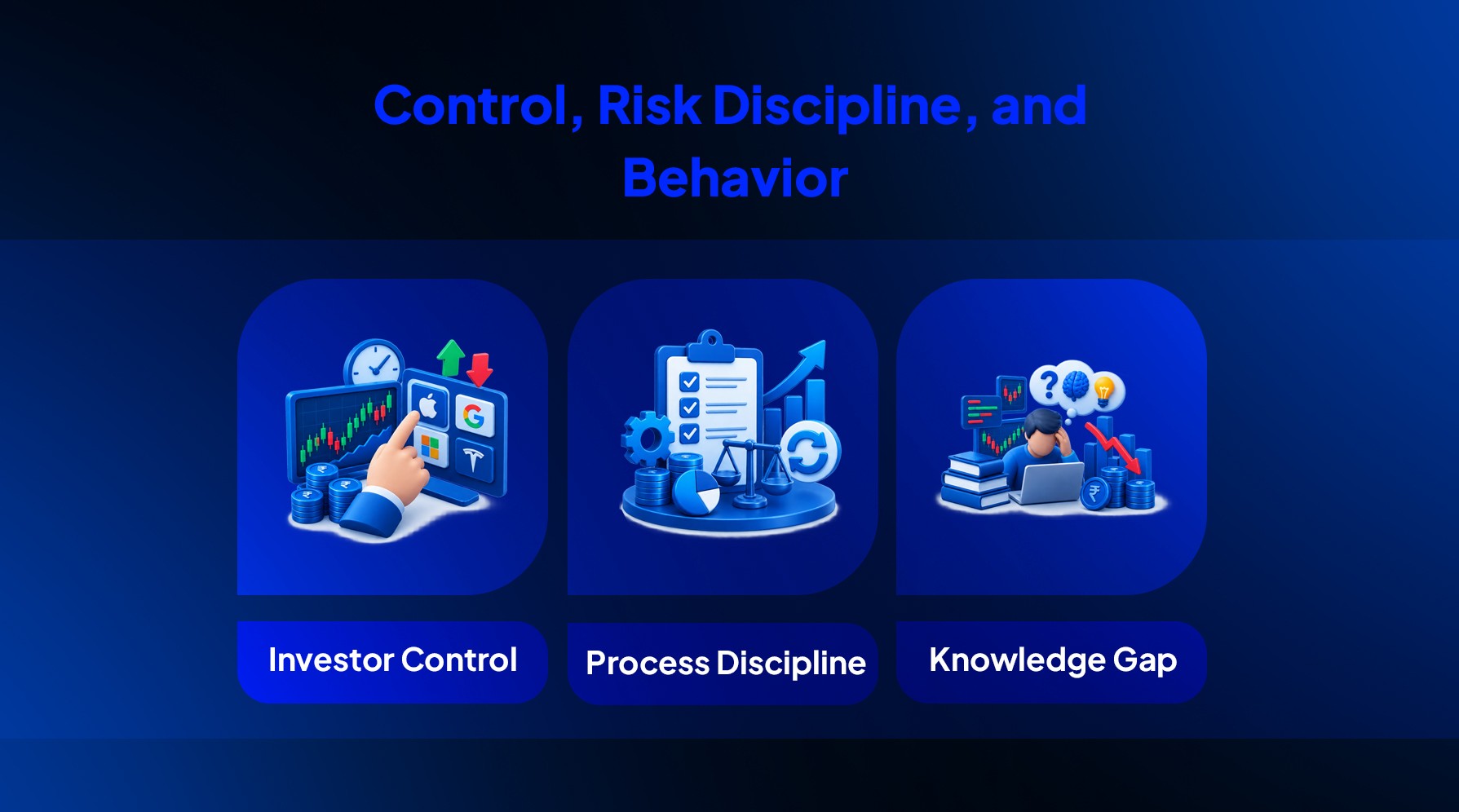
Direct equity gives you complete control over stock selection, timing, and allocation, for better or worse.
PMS applies a systematic process, position sizing and rebalancing rules that do not bend to emotion in a falling market.
A significant share of active retail investors have limited market knowledge relative to how actively they trade, which is exactly the gap a systematic process is built to close.
THE BIGGEST RISK IS OFTEN BEHAVIORAL, NOT MARKET RISK |
A good process protects you from your own worst decisions in a bad quarter. That is worth pricing in, not just the fee. |
Exit Terms and Taxation
Liquidity looks different on paper than it does in practice once exit loads enter the picture.
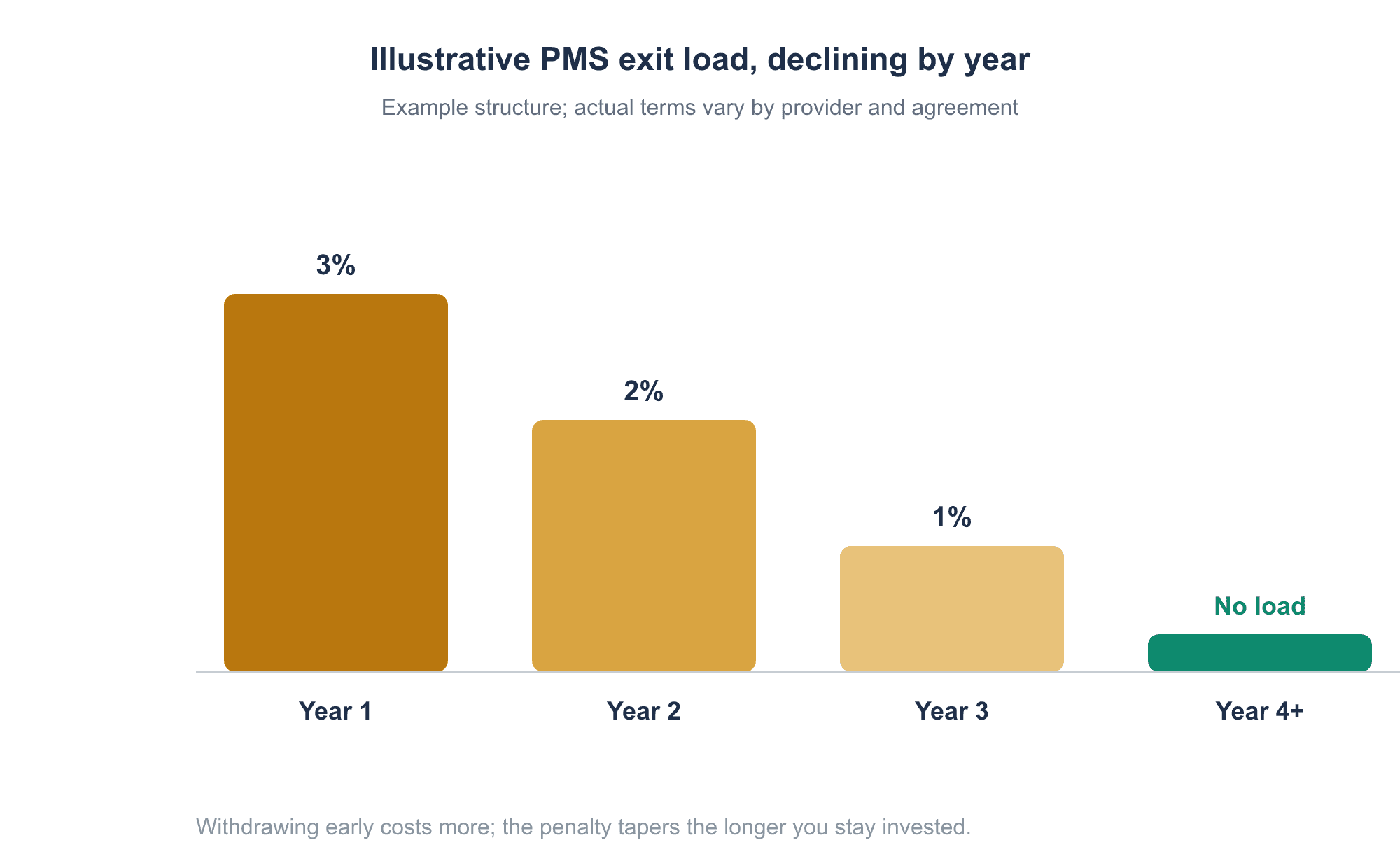
Example PMS exit load structure, declining the longer you stay invested.
Direct equity can be sold on any trading day with no such penalty. Both are taxed under the same STCG and LTCG rules, but PMS’s higher transaction volume inside your account typically makes the filing more involved. Our guide to mutual fund and PMS taxation covers the mechanics.
How to Decide
Two questions matter more than any feature comparison: do you meet the Rs.50 lakh PMS minimum, and how many hours a week can you genuinely dedicate to research and monitoring? If you are still weighing PMS against pooled mutual funds specifically, our PMS versus mutual funds guide covers that comparison directly, and if you already hold mutual funds and are considering a move, see our guide on switching from mutual funds to PMS.
Why Should You Choose Ckredence Wealth?
Many investors who come to us have been managing direct portfolios themselves and want to know, honestly, whether the fee is worth it for their situation. Ckredence Wealth is a SEBI registered investment advisor (INA000020846) and portfolio manager (INP000007164), and we will tell you if it is not.
Solutions That Matter:
Transparent fee structures through PMS, explained against what a comparable direct portfolio would cost you in time.
Fee-only guidance through RIA advisory if a lighter-touch relationship fits better than full discretionary management.
An honest read on whether your existing direct portfolio needs a manager, or just better discipline.
Not sure which side of this you actually fall on? Schedule a Consultation!
Conclusion
PMS versus a direct stock portfolio is not a question of which is objectively better, it is a question of fit. PMS suits investors with Rs.50 lakh or more, limited time for research, and a preference for systematic, professional oversight. Direct equity suits investors with genuine market expertise, the time to monitor positions, and a preference for full control without management fees.
The honest test is not your capital alone, it is whether your current process, self-directed or otherwise, is actually working. If it is, the fee may not be worth it. If it is not, the fee may be the cheapest insurance against your own behavior that you can buy.
FAQs
01.
Can I start a direct stock portfolio with less money than PMS?
Yes. Direct equity has no minimum investment, you can start with the price of a single share, while PMS requires a SEBI-mandated minimum of Rs.50 lakh.
02.
Is PMS worth the fee compared to managing my own stocks?
It depends on your time, expertise, and behavioral discipline. If you lack the time to research and monitor positions, or tend to make emotional decisions in volatile markets, the systematic process a PMS provides can be worth the cost.
03.
Are PMS and direct equity taxed differently?
Both fall under the same STCG and LTCG rules for equity. The practical difference is reporting complexity, a PMS’s more frequent internal trading usually generates more taxable events to track than a self-managed portfolio with fewer transactions.
04.
What happens if I want to exit a PMS early?
Many PMS providers charge a declining exit load, for example around 3% in the first year, tapering to 1% by the third, though exact terms vary by provider and should be checked in the agreement before investing.
Neither option is universally better. The right choice depends on your capital, your time, and your own market expertise, not on which one sounds more sophisticated.
India's PMS industry has grown from roughly Rs.18.1 lakh crore in AUM in 2020 to Rs.42.4 lakh crore by April 2026, which tells you plenty of investors are choosing to pay for professional management rather than pick stocks themselves. It does not tell you which choice is right for you specifically.
Before you decide, ask yourself:
Do you have Rs.50 lakh in investable capital, the SEBI minimum for PMS, or does direct equity’s lack of a floor fit you better?
How many hours a week can you realistically give to research and monitoring positions?
Are you confident you can hold through a drawdown without panic-selling, or does a systematic process protect you from yourself?
This guide compares the two directly on cost, control, risk discipline, and tax, so the decision comes down to fit, not sophistication.
TL;DR
PMS requires a SEBI-mandated Rs.50 lakh minimum; direct equity has no floor, you can start with the price of a single share.
PMS charges management fees, up to 2.5% annually, plus a possible performance fee; direct equity’s only costs are brokerage, STT, and exchange charges.
PMS gives up control to a professional manager within an agreed mandate; direct equity gives you 100% control over every decision.
PMS applies systematic position sizing and rebalancing; direct equity’s risk discipline depends entirely on your own behavior.
Both are taxed under the same capital gains rules, but PMS’s higher trade frequency usually makes tax reporting more complex.
Many PMS structures charge a declining exit load if you withdraw early, often highest in year one and tapering by year three.
Minimum Investment and Cost
The entry point alone rules PMS out for most investors, and that is by design. Our guide to PMS charges and fee structure covers the fee side in more depth, but the core numbers are worth seeing directly.
Factor | Direct Stock Portfolio | PMS |
Minimum investment | None, start with one share | Rs.50 lakh, SEBI-mandated |
Costs | Brokerage, STT, exchange charges only | Up to 2.5% management, plus performance fee |
Control | 100%, every decision is yours | Manager-led, within an agreed mandate |
Risk discipline | Depends on your own behavior | Systematic position sizing and rebalancing |
Tax reporting | Simpler, fewer transactions | More complex, frequent trades inside the account |
Table: PMS versus a self-managed direct stock portfolio, compared factor by factor.
SEBI also caps a PMS’s operating expenses at 0.50% annually, excluding brokerage, which limits how much a provider can pad costs beyond the disclosed management and performance fees.
Control, Risk Discipline, and Behavior
This is where the real trade-off sits, and it is less about skill than most people assume

Direct equity gives you complete control over stock selection, timing, and allocation, for better or worse.
PMS applies a systematic process, position sizing and rebalancing rules that do not bend to emotion in a falling market.
A significant share of active retail investors have limited market knowledge relative to how actively they trade, which is exactly the gap a systematic process is built to close.
THE BIGGEST RISK IS OFTEN BEHAVIORAL, NOT MARKET RISK |
A good process protects you from your own worst decisions in a bad quarter. That is worth pricing in, not just the fee. |
Exit Terms and Taxation
Liquidity looks different on paper than it does in practice once exit loads enter the picture.

Example PMS exit load structure, declining the longer you stay invested.
Direct equity can be sold on any trading day with no such penalty. Both are taxed under the same STCG and LTCG rules, but PMS’s higher transaction volume inside your account typically makes the filing more involved. Our guide to mutual fund and PMS taxation covers the mechanics.
How to Decide
Two questions matter more than any feature comparison: do you meet the Rs.50 lakh PMS minimum, and how many hours a week can you genuinely dedicate to research and monitoring? If you are still weighing PMS against pooled mutual funds specifically, our PMS versus mutual funds guide covers that comparison directly, and if you already hold mutual funds and are considering a move, see our guide on switching from mutual funds to PMS.
Why Should You Choose Ckredence Wealth?
Many investors who come to us have been managing direct portfolios themselves and want to know, honestly, whether the fee is worth it for their situation. Ckredence Wealth is a SEBI registered investment advisor (INA000020846) and portfolio manager (INP000007164), and we will tell you if it is not.
Solutions That Matter:
Transparent fee structures through PMS, explained against what a comparable direct portfolio would cost you in time.
Fee-only guidance through RIA advisory if a lighter-touch relationship fits better than full discretionary management.
An honest read on whether your existing direct portfolio needs a manager, or just better discipline.
Not sure which side of this you actually fall on? Schedule a Consultation!
Conclusion
PMS versus a direct stock portfolio is not a question of which is objectively better, it is a question of fit. PMS suits investors with Rs.50 lakh or more, limited time for research, and a preference for systematic, professional oversight. Direct equity suits investors with genuine market expertise, the time to monitor positions, and a preference for full control without management fees.
The honest test is not your capital alone, it is whether your current process, self-directed or otherwise, is actually working. If it is, the fee may not be worth it. If it is not, the fee may be the cheapest insurance against your own behavior that you can buy.
FAQs
01.
Can I start a direct stock portfolio with less money than PMS?
Yes. Direct equity has no minimum investment, you can start with the price of a single share, while PMS requires a SEBI-mandated minimum of Rs.50 lakh.
02.
Is PMS worth the fee compared to managing my own stocks?
It depends on your time, expertise, and behavioral discipline. If you lack the time to research and monitor positions, or tend to make emotional decisions in volatile markets, the systematic process a PMS provides can be worth the cost.
03.
Are PMS and direct equity taxed differently?
Both fall under the same STCG and LTCG rules for equity. The practical difference is reporting complexity, a PMS’s more frequent internal trading usually generates more taxable events to track than a self-managed portfolio with fewer transactions.
04.
What happens if I want to exit a PMS early?
Many PMS providers charge a declining exit load, for example around 3% in the first year, tapering to 1% by the third, though exact terms vary by provider and should be checked in the agreement before investing.