
Is PMS a Safe Investment in India? Regulatory Safety vs Market Risk
Is PMS a safe investment in India? See what SEBI regulation actually protects you from, and what market risk it does not cover.

Ckredence Wealth |September 22, 2026
Portfolio Management Services in India are not a "safe" or guaranteed investment, though they are a legitimate, SEBI-regulated financial product. Those two facts sound contradictory until you separate what "safe" actually means, and most confusion about PMS comes from conflating the two.
SEBI requires PMS providers to hold client funds and securities through an independent custodian, which limits the risk of a provider mismanaging or absconding with your money. That is regulatory safety. It has nothing to do with whether the underlying stocks go up or down, which is market risk, and SEBI is explicit that this is not covered.
Before you invest, ask yourself:
- Are you asking whether your money is protected from fraud, or whether your capital is protected from loss? These are different questions.
- Have you checked who holds custody of your securities, or are you only looking at past returns?
- Do you know which specific risks, entry cost, fees, taxes, liquidity, apply to you, versus which are generic warnings?
This guide separates the two kinds of safety clearly, and covers the specific risks worth weighing before you commit Rs.50 lakh to a single strategy.
TL;DR
- PMS is regulated by SEBI, which protects against fraud and custody risk, but does not protect against market losses.
- An independent custodian holds your funds and securities, reducing the risk of a provider absconding with your money.
- PMS concentrates your capital in a single strategy, typically 15 to 30 stocks, which raises risk compared to a diversified mutual fund.
- Fees are higher and more complex than mutual funds, management plus performance fees, custody, and brokerage.
- Every trade your manager makes is a taxable event for you, adding real tax-reporting complexity.
- The risks you can actually reduce are fee comparison, track record review, and diversification across providers, not market risk itself.
How Safe Is PMS? Two Different Questions
Regulatory safety and market risk answer entirely different questions, and a PMS provider can score well on one while offering no protection on the other.
- Regulatory safety: PMS providers are strictly regulated by SEBI. Your funds and securities are held in your own demat account or via an independent custodian, which keeps counterparty and default risk low.
- Market risk: PMS investments, mostly equities or debt, are exposed to full market volatility and concentration risk from holding fewer stocks. You can lose a significant portion of your capital.
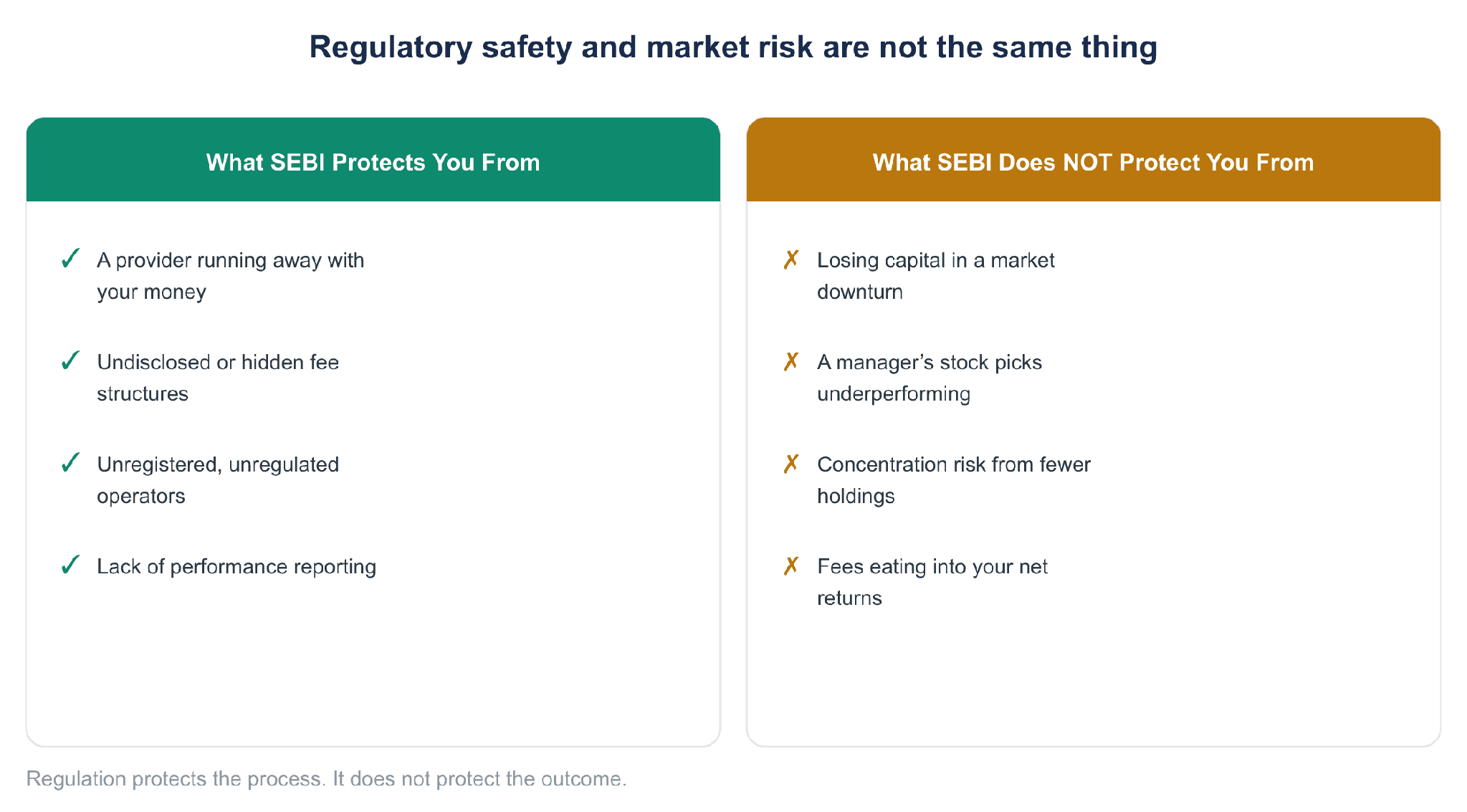
Regulatory safety and market risk are not the same thing.
| REGULATION PROTECTS THE PROCESS, NOT THE OUTCOME |
| SEBI oversight tells you the provider is legitimate. It does not tell you whether the strategy will make you money. |
| Schedule a Consultation: ckredencewealth.com/contact-us |
Key Risks and Drawbacks to Know Before Investing
Beyond market risk itself, several specific, practical risks are worth weighing before committing capital. Our guide to PMS charges and fee structure and mutual fund and PMS taxation guide cover two of these in depth.
| Risk | What It Means | Can You Reduce It? |
| High entry barrier | Rs.50 lakh concentrated in one strategy, one manager | Only by diversifying across providers |
| No guaranteed returns | Performance depends entirely on manager skill | Check track record across cycles |
| High, complex fees | Management fee plus performance fee, custody, brokerage | Compare fee structures before signing |
| Tax inefficiency | Each manager trade is a taxable event for you | Ask about the strategy’s typical churn |
| Lower liquidity | Exit takes time; shares must be sold in the market | Check exit load terms upfront |
Table: the practical risks and drawbacks of PMS, and which ones you can actually manage.
None of these risks are unique to any one provider, they are structural to how PMS works. A strategy with a strong recent quarter can still carry every risk in this table.
| A STRONG QUARTER DOES NOT ERASE THESE RISKS |
| Recent performance is the easiest thing to check and the least reliable thing to rely on. The risks in this table do not go away because of it. |
| Schedule a Consultation |
How to Reduce the Risks You Can Control
You cannot eliminate market risk, but several of the practical risks above are genuinely within your control.
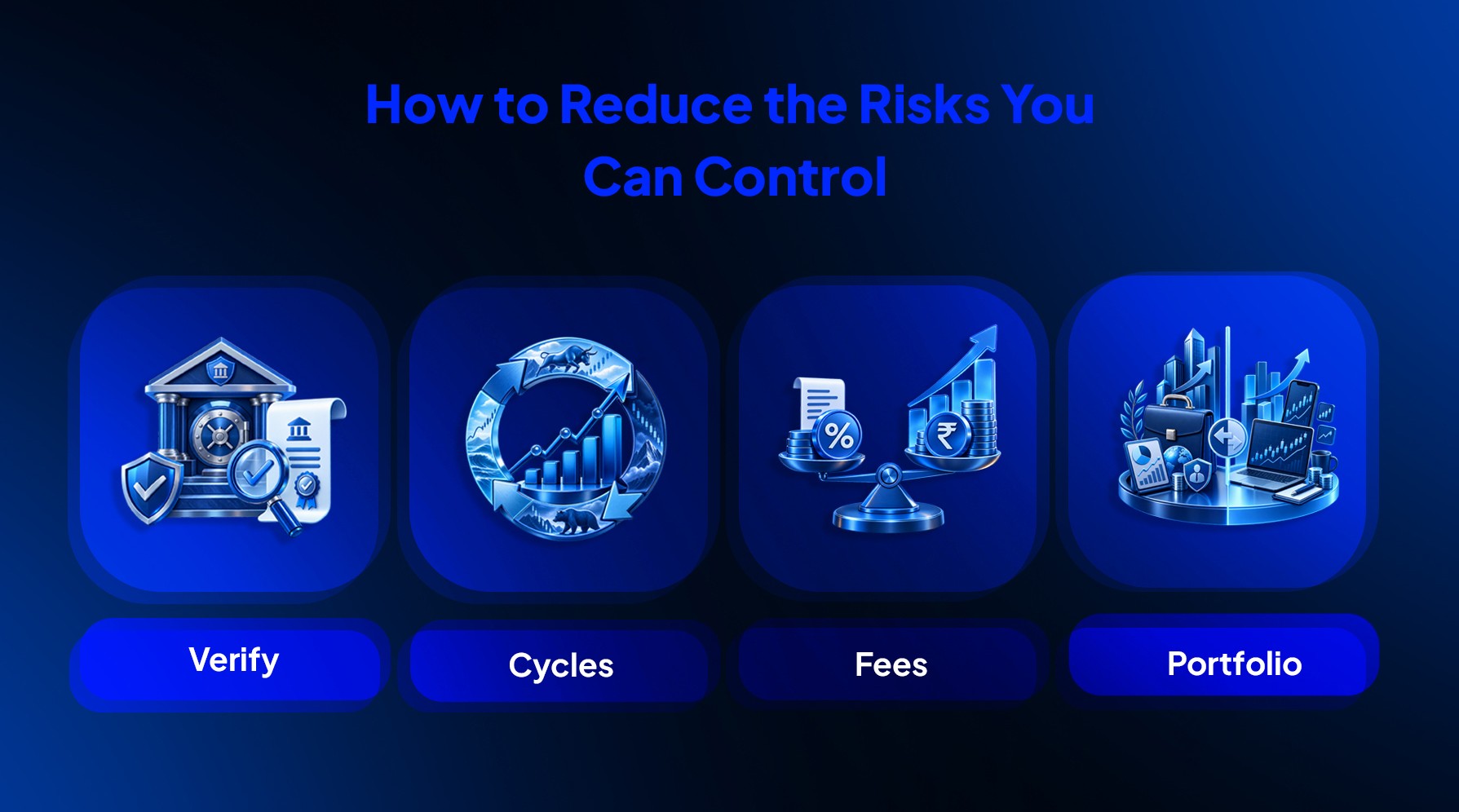
- Verify the custodian arrangement and the provider’s SEBI registration directly, not just what is claimed on their website.
- Review the track record across full market cycles, not just a recent strong quarter.
- Compare the fee structure against what the strategy has actually delivered net of fees, not gross returns.
- If you are unsure PMS is the right structure at all, our comparison of PMS against a self-managed direct stock portfolio may be the more useful starting point.
Why Should You Choose Ckredence Wealth?
We would rather an investor understand these risks clearly before committing capital than discover them afterward. Ckredence Wealth is a SEBI registered investment advisor (INA000020846) and portfolio manager (INP000007164), with funds and securities held through an independent custodian as required.
Solutions That Matter:
- Transparent fee disclosure before you invest, through our PMS strategies.
- Fee-only guidance through RIA advisory if you want a second opinion before committing to any PMS, including ours.
- A straightforward answer on whether your risk tolerance actually fits PMS, not just your capital.
Want a clear-eyed read on your own risk fit? Schedule a Consultation!
Conclusion
Is PMS a safe investment in India? Regulated, yes. Guaranteed, no. SEBI oversight and independent custody genuinely protect you from fraud and mismanagement, which is real and worth valuing. They do nothing to protect your capital from market losses, concentration risk, or a strategy that simply underperforms.
The risks worth focusing on are the ones you can actually influence: verifying registration and custody, reviewing track record across full cycles, and understanding fees before you commit. Market risk is the price of the potential upside PMS offers, not something any provider can regulate away.
FAQs
01 Number
Can I lose money in a PMS?
Yes. PMS investments are subject to market risk like any equity or debt investment, and concentrated portfolios can experience significant losses. SEBI regulation does not guarantee returns or protect against market losses.
02 Number
Is my money safe with a SEBI-registered PMS provider?
Your funds and securities are held through an independent custodian or in your own demat account, which protects against a provider absconding with your money. This is separate from, and does not eliminate, market risk on the investments themselves.
03 Number
Why does PMS carry more risk than a mutual fund?
PMS typically holds a more concentrated portfolio, often 15 to 30 stocks, compared to a diversified mutual fund holding 40 to 80 or more. Fewer holdings mean each stock has a larger impact on your overall returns, in either direction.
04 Number
What should I check before investing in a PMS to reduce risk?
Verify SEBI registration and the custodian arrangement directly, review the track record across full market cycles rather than a recent strong quarter, and compare the fee structure against net, not gross, historical returns.