11min Read

11min Read

Surplus Business Money Should Not Sit Idle, But It Should Not Be Rushed Either

Surplus Business Money Should Not Sit Idle, But It Should Not Be Rushed Either

Surplus Business Money Should Not Sit Idle, But It Should Not Be Rushed Either

Learn how to invest surplus money from your business across liquid, short-term, and long-term options, matched to your cash-flow timeline.

Learn how to invest surplus money from your business across liquid, short-term, and long-term options, matched to your cash-flow timeline.

Learn how to invest surplus money from your business across liquid, short-term, and long-term options, matched to your cash-flow timeline.

Ckredence Wealth

Ckredence Wealth

|

Ckredence Wealth banner showing surplus business money should not sit idle, with an hourglass filled with coins, rising growth chart, coin stacks, and tree representing timed cash allocation and wealth growth.

Surplus cash sitting in a business current account earns close to nothing. Most current accounts in India pay no interest at all, while liquid mutual funds have delivered roughly 6.25% to 6.9% over the past one to three years, and corporate FDs have offered around 7.75% to 8.4% over a three-year tenure. That gap is a real cost, not a rounding error, especially once inflation is factored in.

Yet most business owners leave surplus parked exactly there, not because it is the right call, but because there is no clear framework for what to do instead.

Before you decide, ask yourself:

  • How much of this surplus do you actually need for day-to-day operations versus how much is genuinely spare?

  • Is reinvesting in the business itself a better return than any market instrument right now?

  • Does your business structure, sole proprietorship, partnership, or private limited, change how this money should be held?

This guide breaks business surplus into a practical framework: how much to protect, how much to reinvest, and how much to deploy into low-risk or growth-oriented instruments, matched to when you might need it back.

TL;DR

  • A common framework splits business surplus into three layers: 3 to 6 months of operating expenses in a liquid reserve, near-term funds for debt paydown or reinvestment, and a long-term growth allocation.

  • Liquid and arbitrage mutual funds are common low-risk parking spots, typically earning far more than a zero-interest current account.

  • Paying down high-interest business debt often delivers a better guaranteed return than any market instrument available.

  • Corporate FDs and short-term debt instruments suit money you will not need for 1 to 3 years.

  • Surplus not needed for 3 or more years can go into government or corporate bonds, or growth-oriented options.

  • The right split depends on your surplus amount, how soon you might need the cash, and your business structure.

Reinvesting in the Business First

Before any surplus leaves the business, it is worth asking whether reinvesting it internally beats any external return available.

  • Upgrade equipment or software: capital spending that boosts daily output often pays for itself faster than a market instrument would.

  • Expand the team: hiring skilled staff or funding training can compound the same way a growth investment does, just inside the business.

  • Pay off high-interest debt: clearing a business loan at 12-14% interest is a guaranteed return no market instrument can promise.

Beyond the business itself, this is also where a personal investment plan built for HNI business owners starts to matter, since not all surplus should stay tied to one company.

Low-Risk, Liquid Options for Near-Term Surplus

For surplus you might need within the next few months, safety and speed of access matter more than the last percentage point of return.

  • Liquid mutual funds: park short-term cash for meaningfully better yields than a current account while keeping high liquidity, typically redeemable within a day.

  • Arbitrage funds: exploit price gaps between cash and futures markets for low-volatility returns, with the added benefit of equity-like tax treatment.

  • Corporate FDs and short-term debt: lock funds into secure, short-tenure fixed income instruments for a modest step up in yield.

Structuring these three instruments together, rather than picking one in isolation, is what a proper asset allocation plan actually does.

PARKED CASH SHOULD STILL EARN SOMETHING

Liquid funds, arbitrage funds, and corporate FDs work best as one coordinated plan, not three separate decisions.

Schedule a Consultation

Business Surplus Cash Allocation Framework
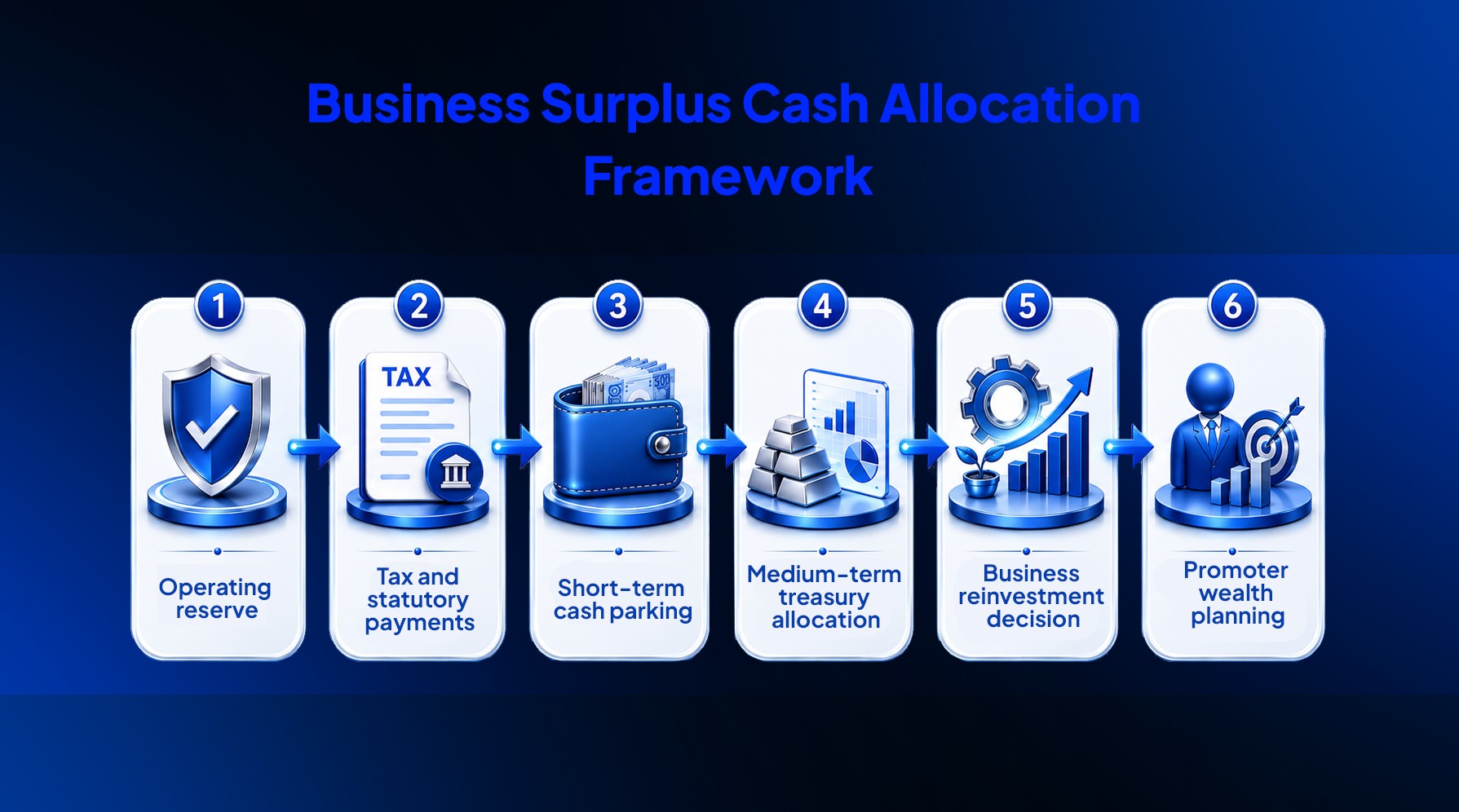
Business surplus cash allocation framework showing six steps: operating reserve, tax and statutory payments, short-term cash parking, medium-term treasury allocation, business reinvestment decision, and promoter wealth planning.

Comparing the Options

A side-by-side view makes the trade-off clear, and mirrors the same logic used when comparing PMS, mutual funds, and AIFs for personal wealth.

Option

Typical Return

Risk

Liquidity

Liquid Mutual Funds

~6.5%

Low

Redeemable in 1 day

Arbitrage Funds

~6-7%

Low

Redeemable in 1-3 days

Corporate FD / Short-Term Debt

~7.75%

Low to Medium

1 to 3 year tenure

Government / Corporate Bonds

~8.5%

Medium

Longer tenure, some tradable

Table: common surplus-deployment options compared on return, risk, and liquidity.
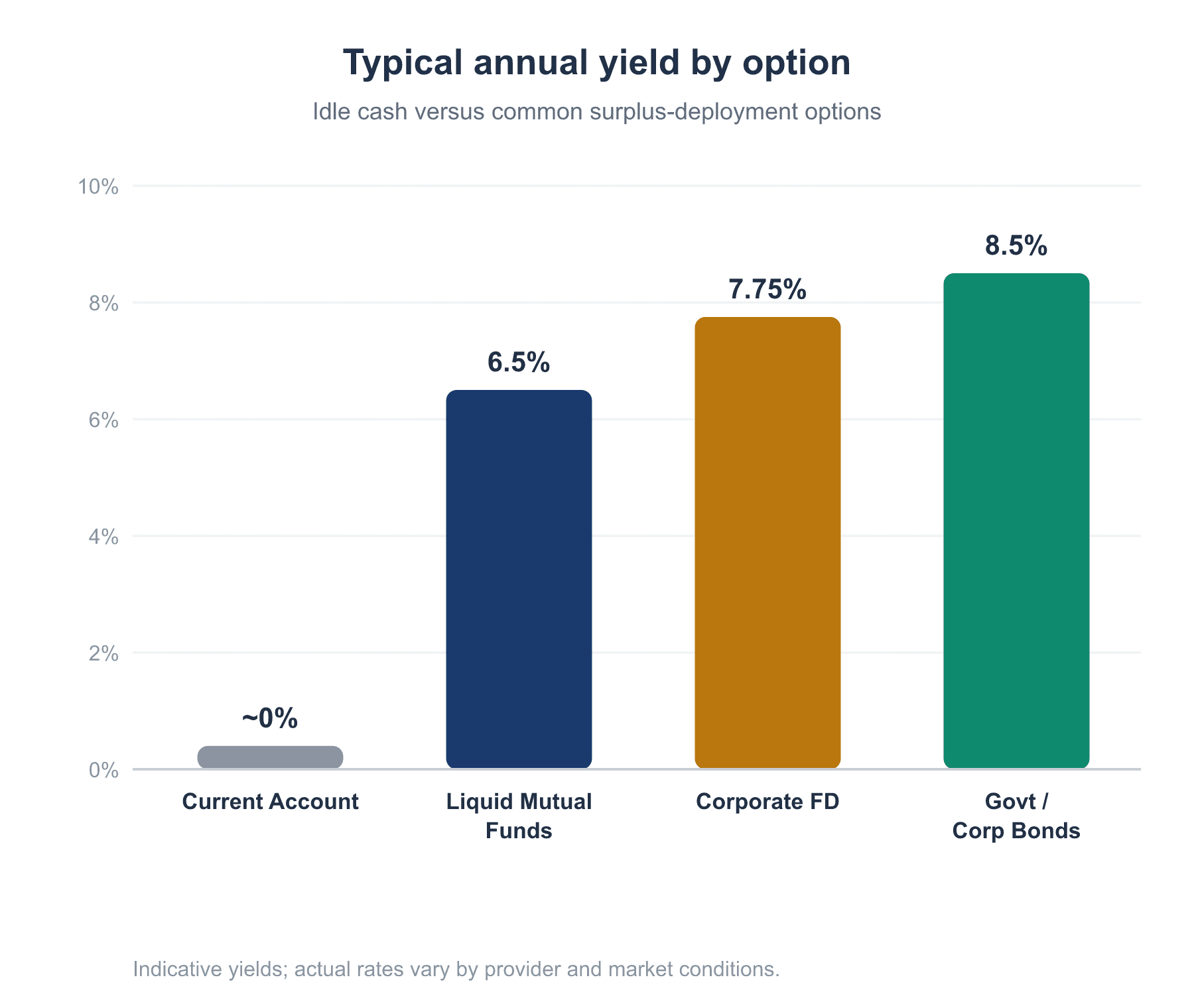
Typical annual yield by option, idle cash versus surplus deployment options

Typical annual yield, idle cash versus common surplus-deployment options.

For surplus with a longer runway, government or corporate bonds and other growth-oriented options extend the same logic further out. For business owners who already qualify as HNIs, it is worth comparing these against the fuller set of best investment options for HNIs in India.

  • Government or corporate bonds: steady, predictable interest over extended periods, for money not needed for 3 or more years.

  • Strategic reinvestment: acquiring a smaller competitor or investing in a synergistic venture can outperform financial markets, if the opportunity is genuinely sound.
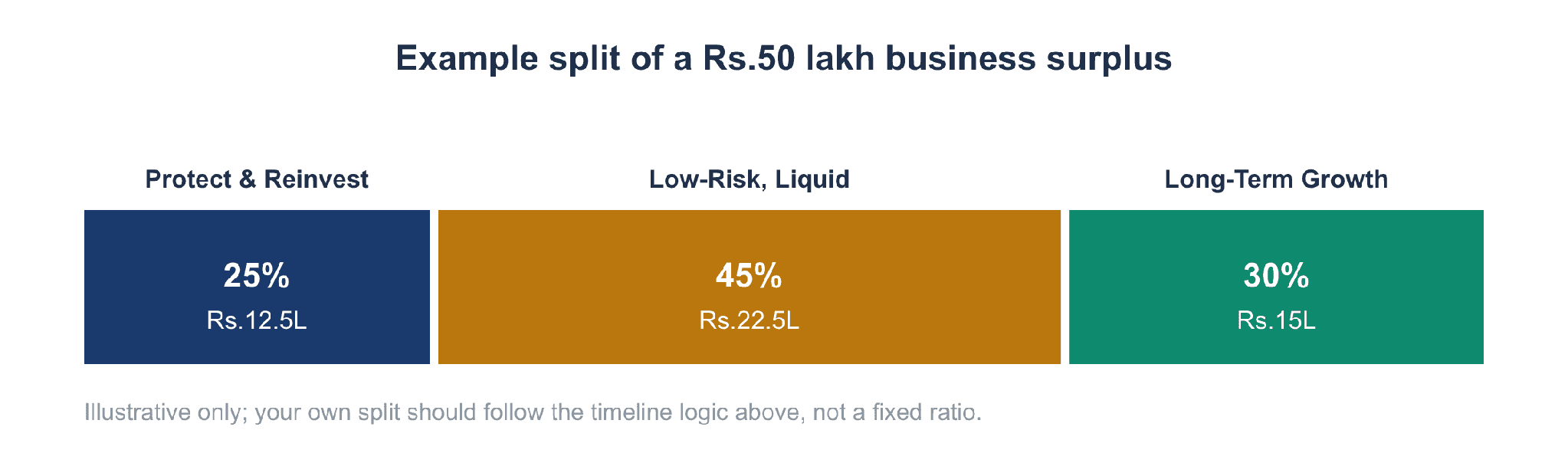

Example split of a Rs.50 lakh business surplus across protect, liquid, and growth buckets

An illustrative split; your own ratio should follow the timeline logic above.

What This Means for You Personally

Surplus that stays inside the business is only part of the picture. Profits eventually get drawn out, as dividends, salary, or through a business sale, and how your business is structured changes how that money is taxed on the way out, worth checking against our guide to mutual fund and PMS taxation and with your CA.

Once that money moves from the business into your own hands, it belongs in portfolio management or structured, RIA-guided advice, not back into a current account.

ONCE SURPLUS BECOMES PERSONAL WEALTH

Profits drawn out of the business deserve the same structured planning as the surplus still sitting inside it.

Why Should You Choose Ckredence Wealth?

Business owners make up a large share of the HNI investors we work with, and surplus cash decisions rarely stop at the business. Ckredence Wealth works with business owners through both financial advisory services and portfolio management, and is a SEBI registered investment advisor (INA000020846) and portfolio manager (INP000007164), built on a 37 year legacy since 1987.

Solutions That Matter:

  • Personal wealth planning separate from your company balance sheet.

  • Portfolio management for profits drawn out of the business and ready to grow independently.

  • Fee-only advice on sequencing reinvestment, debt paydown, and personal wealth building.

Ready to plan beyond the current account? Schedule a Consultation!

Conclusion

Investing surplus money from a business is not one decision, it is three: how much to reinvest internally, how much to keep liquid and low-risk for the near term, and how much to deploy for longer-term growth. Paying down high-interest debt and upgrading the business itself often beat any market return available, but past that point, a current account earning nothing is rarely the right home for the rest.

The size of your surplus, how soon you might need it, and your business structure should decide the split, not habit. And once profits leave the business as personal income, that money deserves the same structured planning as the surplus still sitting on the balance sheet.

FAQs

01.

Where should a small business park surplus cash?

For cash needed within a few months, liquid or arbitrage mutual funds are common choices, offering better yields than a current account while keeping the money easily accessible.

02.

Should I pay off business debt or invest the surplus?

Paying off high-interest debt, often 12% or more, is generally a better guaranteed return than most market instruments, and is usually worth prioritizing before investing surplus elsewhere.

03.

Does my business structure affect how I should invest surplus?

Yes. A sole proprietorship, partnership, and private limited company are taxed differently when profits are drawn out, so it is worth checking with a CA before deciding how much surplus to keep in the business versus draw as personal income.

04.

What should I do with surplus I will not need for years?

Longer-term surplus can move into government or corporate bonds, or growth-oriented options, and once it becomes personal wealth rather than working capital, it can be planned alongside your broader portfolio.

Surplus cash sitting in a business current account earns close to nothing. Most current accounts in India pay no interest at all, while liquid mutual funds have delivered roughly 6.25% to 6.9% over the past one to three years, and corporate FDs have offered around 7.75% to 8.4% over a three-year tenure. That gap is a real cost, not a rounding error, especially once inflation is factored in.

Yet most business owners leave surplus parked exactly there, not because it is the right call, but because there is no clear framework for what to do instead.

Before you decide, ask yourself:

  • How much of this surplus do you actually need for day-to-day operations versus how much is genuinely spare?

  • Is reinvesting in the business itself a better return than any market instrument right now?

  • Does your business structure, sole proprietorship, partnership, or private limited, change how this money should be held?

This guide breaks business surplus into a practical framework: how much to protect, how much to reinvest, and how much to deploy into low-risk or growth-oriented instruments, matched to when you might need it back.

TL;DR

  • A common framework splits business surplus into three layers: 3 to 6 months of operating expenses in a liquid reserve, near-term funds for debt paydown or reinvestment, and a long-term growth allocation.

  • Liquid and arbitrage mutual funds are common low-risk parking spots, typically earning far more than a zero-interest current account.

  • Paying down high-interest business debt often delivers a better guaranteed return than any market instrument available.

  • Corporate FDs and short-term debt instruments suit money you will not need for 1 to 3 years.

  • Surplus not needed for 3 or more years can go into government or corporate bonds, or growth-oriented options.

  • The right split depends on your surplus amount, how soon you might need the cash, and your business structure.

Reinvesting in the Business First

Before any surplus leaves the business, it is worth asking whether reinvesting it internally beats any external return available.

  • Upgrade equipment or software: capital spending that boosts daily output often pays for itself faster than a market instrument would.

  • Expand the team: hiring skilled staff or funding training can compound the same way a growth investment does, just inside the business.

  • Pay off high-interest debt: clearing a business loan at 12-14% interest is a guaranteed return no market instrument can promise.

Beyond the business itself, this is also where a personal investment plan built for HNI business owners starts to matter, since not all surplus should stay tied to one company.

Low-Risk, Liquid Options for Near-Term Surplus

For surplus you might need within the next few months, safety and speed of access matter more than the last percentage point of return.

  • Liquid mutual funds: park short-term cash for meaningfully better yields than a current account while keeping high liquidity, typically redeemable within a day.

  • Arbitrage funds: exploit price gaps between cash and futures markets for low-volatility returns, with the added benefit of equity-like tax treatment.

  • Corporate FDs and short-term debt: lock funds into secure, short-tenure fixed income instruments for a modest step up in yield.

Structuring these three instruments together, rather than picking one in isolation, is what a proper asset allocation plan actually does.

PARKED CASH SHOULD STILL EARN SOMETHING

Liquid funds, arbitrage funds, and corporate FDs work best as one coordinated plan, not three separate decisions.

Schedule a Consultation

Business Surplus Cash Allocation Framework

Business surplus cash allocation framework showing six steps: operating reserve, tax and statutory payments, short-term cash parking, medium-term treasury allocation, business reinvestment decision, and promoter wealth planning.

Comparing the Options

A side-by-side view makes the trade-off clear, and mirrors the same logic used when comparing PMS, mutual funds, and AIFs for personal wealth.

Option

Typical Return

Risk

Liquidity

Liquid Mutual Funds

~6.5%

Low

Redeemable in 1 day

Arbitrage Funds

~6-7%

Low

Redeemable in 1-3 days

Corporate FD / Short-Term Debt

~7.75%

Low to Medium

1 to 3 year tenure

Government / Corporate Bonds

~8.5%

Medium

Longer tenure, some tradable

Table: common surplus-deployment options compared on return, risk, and liquidity.

Typical annual yield by option, idle cash versus surplus deployment options

Typical annual yield, idle cash versus common surplus-deployment options.

For surplus with a longer runway, government or corporate bonds and other growth-oriented options extend the same logic further out. For business owners who already qualify as HNIs, it is worth comparing these against the fuller set of best investment options for HNIs in India.

  • Government or corporate bonds: steady, predictable interest over extended periods, for money not needed for 3 or more years.

  • Strategic reinvestment: acquiring a smaller competitor or investing in a synergistic venture can outperform financial markets, if the opportunity is genuinely sound.


Example split of a Rs.50 lakh business surplus across protect, liquid, and growth buckets

An illustrative split; your own ratio should follow the timeline logic above.

What This Means for You Personally

Surplus that stays inside the business is only part of the picture. Profits eventually get drawn out, as dividends, salary, or through a business sale, and how your business is structured changes how that money is taxed on the way out, worth checking against our guide to mutual fund and PMS taxation and with your CA.

Once that money moves from the business into your own hands, it belongs in portfolio management or structured, RIA-guided advice, not back into a current account.

ONCE SURPLUS BECOMES PERSONAL WEALTH

Profits drawn out of the business deserve the same structured planning as the surplus still sitting inside it.

Why Should You Choose Ckredence Wealth?

Business owners make up a large share of the HNI investors we work with, and surplus cash decisions rarely stop at the business. Ckredence Wealth works with business owners through both financial advisory services and portfolio management, and is a SEBI registered investment advisor (INA000020846) and portfolio manager (INP000007164), built on a 37 year legacy since 1987.

Solutions That Matter:

  • Personal wealth planning separate from your company balance sheet.

  • Portfolio management for profits drawn out of the business and ready to grow independently.

  • Fee-only advice on sequencing reinvestment, debt paydown, and personal wealth building.

Ready to plan beyond the current account? Schedule a Consultation!

Conclusion

Investing surplus money from a business is not one decision, it is three: how much to reinvest internally, how much to keep liquid and low-risk for the near term, and how much to deploy for longer-term growth. Paying down high-interest debt and upgrading the business itself often beat any market return available, but past that point, a current account earning nothing is rarely the right home for the rest.

The size of your surplus, how soon you might need it, and your business structure should decide the split, not habit. And once profits leave the business as personal income, that money deserves the same structured planning as the surplus still sitting on the balance sheet.

FAQs

01.

Where should a small business park surplus cash?

For cash needed within a few months, liquid or arbitrage mutual funds are common choices, offering better yields than a current account while keeping the money easily accessible.

02.

Should I pay off business debt or invest the surplus?

Paying off high-interest debt, often 12% or more, is generally a better guaranteed return than most market instruments, and is usually worth prioritizing before investing surplus elsewhere.

03.

Does my business structure affect how I should invest surplus?

Yes. A sole proprietorship, partnership, and private limited company are taxed differently when profits are drawn out, so it is worth checking with a CA before deciding how much surplus to keep in the business versus draw as personal income.

04.

What should I do with surplus I will not need for years?

Longer-term surplus can move into government or corporate bonds, or growth-oriented options, and once it becomes personal wealth rather than working capital, it can be planned alongside your broader portfolio.