12min Read

12min Read

How to Make 50 Lakhs in 5 Years: The SIP Math That Actually Works

How to Make 50 Lakhs in 5 Years: The SIP Math That Actually Works

How to Make 50 Lakhs in 5 Years: The SIP Math That Actually Works

See the real SIP math behind making Rs.50 lakh in 5 years, the asset mix that supports it, and what to do once you cross that threshold.

See the real SIP math behind making Rs.50 lakh in 5 years, the asset mix that supports it, and what to do once you cross that threshold.

See the real SIP math behind making Rs.50 lakh in 5 years, the asset mix that supports it, and what to do once you cross that threshold.

Ckredence Wealth

Ckredence Wealth

|

Ckredence Wealth banner showing how to make ₹50 lakhs in 5 years, with a growing money jar, SIP calculator, coin stacks, calendar, and rising chart representing disciplined monthly investing.

Most "how to make 50 lakhs in 5 years" videos and articles give an inspiring number and skip two things: which return assumption that number is actually built on, and what to do once you have the money. Both matter more than the headline figure.

Using the standard compound SIP formula, reaching Rs.50 lakh in 60 months at a 12% assumed annual return needs a fixed monthly investment of roughly Rs.60,500, not the Rs.65,000 to Rs.70,000 figure that some popular calculators and videos cite. The gap usually comes down to compounding assumptions, not a different goal.

Before you commit to a monthly number, ask yourself:

  • Do you know which return assumption your "50 lakh in 5 years" number is actually built on?

  • Have you planned what to do with the money once you reach it, or only how to get there?

  • Is your asset mix built for a 5-year horizon, or copied from a longer-term plan?

This guide redoes the math properly, lays out the asset mix that supports it, and covers the one thing most competing guides skip entirely: what comes next once you cross Rs.50 lakh.

TL;DR

  • Reaching Rs.50 lakh in 5 years via a fixed SIP needs roughly Rs.55,800 to Rs.67,500 a month, depending on the return assumed, 15% down to 8%.

  • A lower starting SIP, around Rs.35,000 to Rs.40,000 a month, with a 15-20% annual step-up, can reach a similar target as income grows.

  • Asset mix matters as much as the SIP amount: a higher equity share lowers the monthly amount needed but raises volatility along the way.

  • Rs.50 lakh is not just a round number, it is the SEBI minimum ticket size for Portfolio Management Services (PMS).

  • Few people reach this purely on salary savings; a side income or step-up in contributions is usually part of the plan.

  • Staying invested through market corrections matters more than optimizing the exact return assumption.

The Math: How Much You Need to Invest Each Month

The monthly SIP required to hit Rs.50 lakh in 60 months depends heavily on the return you assume, and small differences in that assumption change the number more than most people expect.

  • At an assumed 12% annual return, the fixed monthly SIP needed is roughly Rs.60,500, using the standard compound SIP formula.

  • At a more conservative 8% return, typical of a debt-heavy mix, the monthly SIP needed rises to roughly Rs.67,500.

  • At a more aggressive 15% return, typical of a higher equity concentration, the monthly SIP needed falls to roughly Rs.55,800.

  • A step-up SIP starting lower, around Rs.35,000 to Rs.40,000 a month, with a 15-20% increase each year as income grows, can reach a similar target without needing the full amount from month one.

THE RIGHT NUMBER DEPENDS ON THE RIGHT ASSUMPTION

A fixed SIP calculator gives you one number. A plan that accounts for your actual income growth and risk tolerance, built with our RIA team, gives you the real one.

Schedule a Consultation

Where That Monthly Investment Should Go

The SIP amount only tells half the story. The asset mix behind it determines whether the number is realistic or just optimistic.
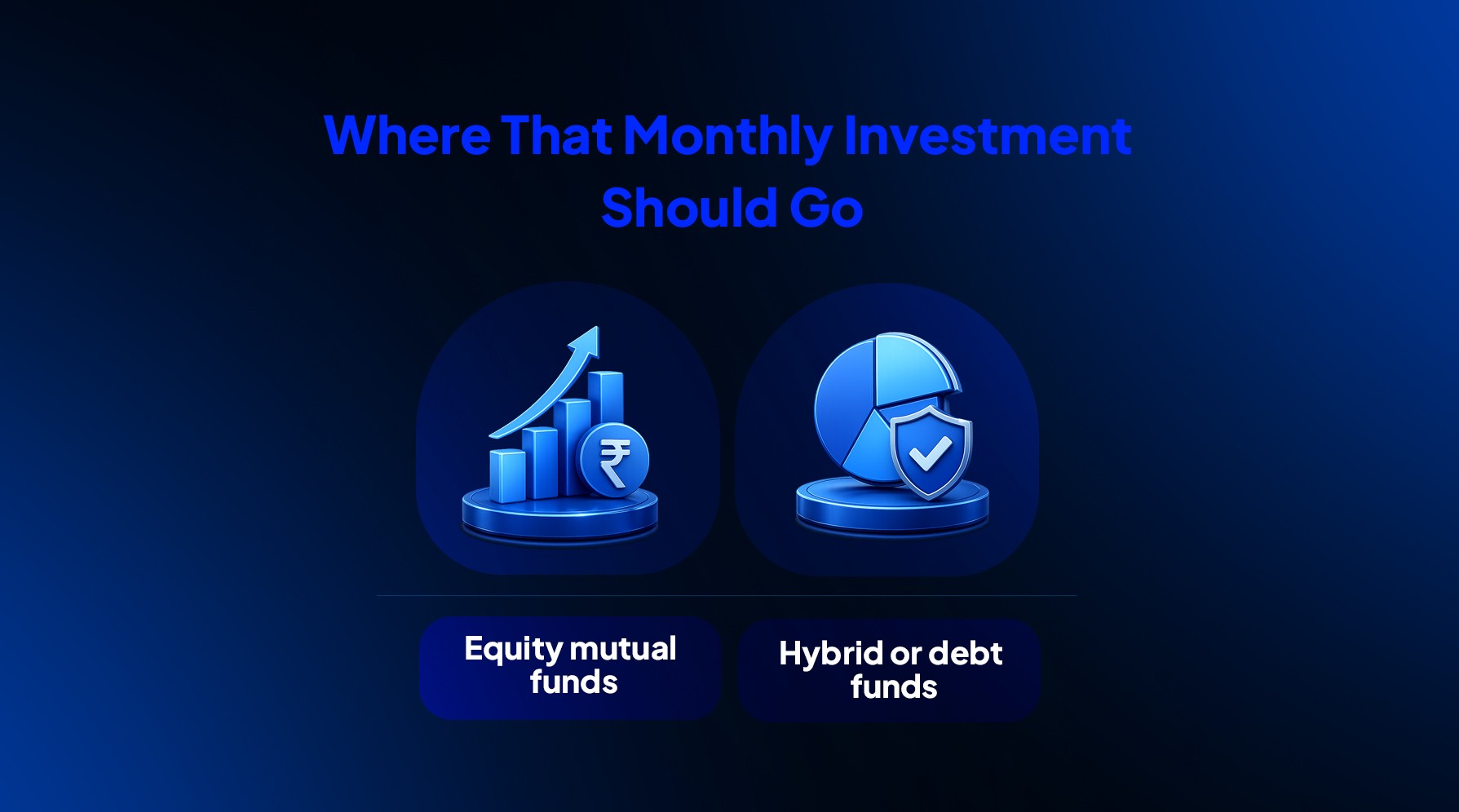
Where monthly investment should go visual showing equity mutual funds and hybrid or debt funds as the two main allocation buckets for a 5-year ₹50 lakh SIP goal.

Equity mutual funds: roughly 70-80% of the monthly amount, split across large-cap, flexi-cap, or index funds, for the growth this horizon needs.

  • Hybrid or debt funds: the remaining 20-30%, to cushion the portfolio against a sharp correction close to your 5-year deadline.

  • This split is a starting point, not a fixed rule; your own risk tolerance should adjust it in either direction.

Comparing the Numbers

A side-by-side view makes the trade-off between return assumption and monthly commitment clear.

Assumed Return

Monthly SIP Needed

Typical Asset Mix

8% (debt-heavy)

Rs.67,500

20-30% equity, 70-80% debt

10% (moderate)

Rs.64,000

40-50% equity, rest hybrid/debt

12% (balanced)

Rs.60,500

60-70% equity, rest hybrid/debt

15% (equity-heavy)

Rs.55,800

80%+ equity, small buffer

Table: monthly SIP needed for Rs.50 lakh in 5 years, by assumed return and typical asset mix.
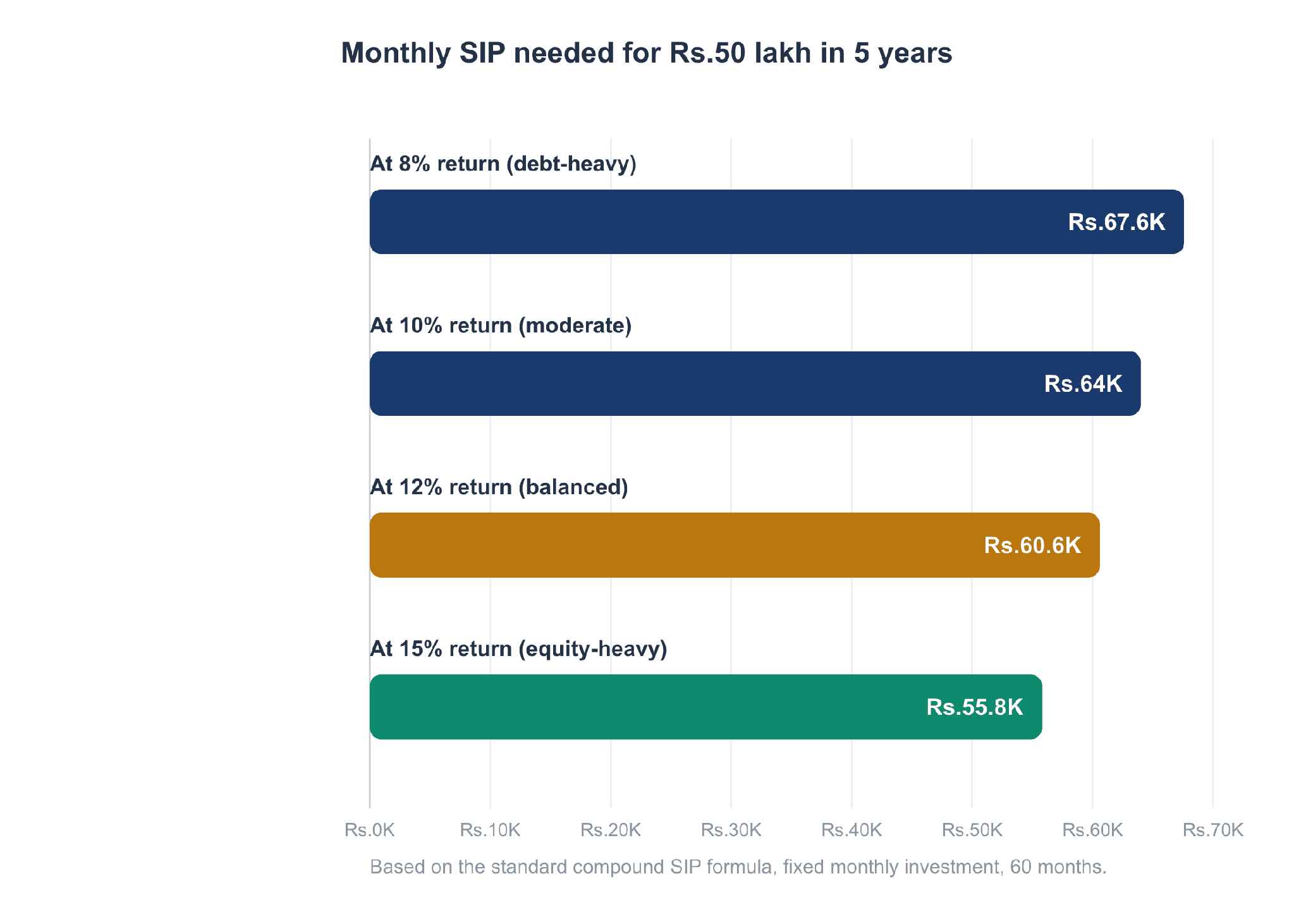

Monthly SIP needed to reach Rs.50 lakh in 5 years, by assumed return

Monthly SIP needed for Rs.50 lakh in 5 years, using the standard compound SIP formula.

Beyond the SIP itself, most people who actually hit this target combine disciplined investing with a second lever: growing the amount they can invest in the first place.

  • Boost your investable income: a primary job alone rarely funds a Rs.60,000-plus monthly SIP; side consulting, freelance work, or a side business often make up the difference.

  • Automate the SIP: set the debit for the day you receive income, so the investment happens before spending decisions do.

  • Do not pause during corrections: a step-up SIP that stops during a downturn defeats the rupee-cost averaging it depends on.

What Happens Once You Reach Rs.50 Lakh

This is the part most "50 lakh in 5 years" guides skip entirely. Rs.50 lakh is not an arbitrary target, it is also the SEBI minimum investment for Portfolio Management Services (PMS). Reaching it through disciplined SIP investing means you arrive at that threshold with a process already in place, not a lump sum with no plan behind it.
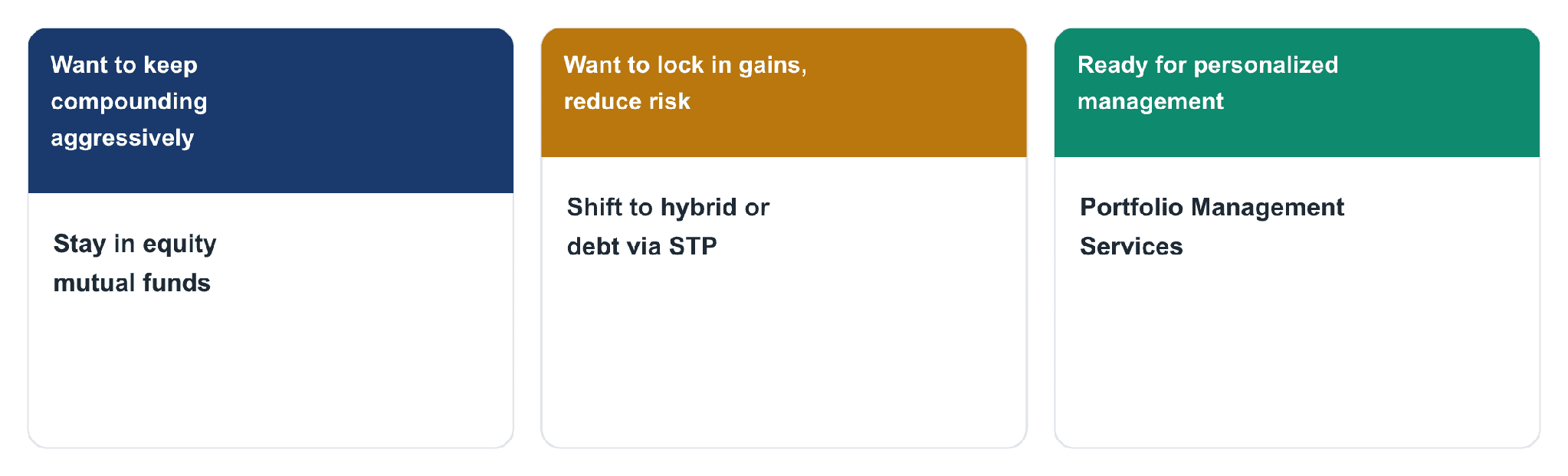

Decision map for what to do once you reach Rs.50 lakh

Match your next step once you cross the Rs.50 lakh mark.

Why Should You Choose Ckredence Wealth?

Many investors chasing a Rs.50 lakh target focus entirely on the monthly SIP number and never plan the step after. Ckredence Wealth is a SEBI registered investment advisor (INA000020846) and portfolio manager (INP000007164), built on a 37 year legacy since 1987.

Solutions That Matter:

  • Goal-based planning through our mutual fund advisory, built around your actual 5-year horizon.

  • A clear path into portfolio management once your corpus crosses the SEBI minimum.

  • Fee-only advice on the asset mix and step-up structure that fits your income growth, not a generic calculator output.

Ready to build a real plan behind the number? Schedule a Consultation!

Conclusion

How to make 50 lakhs in 5 years comes down to a monthly SIP of roughly Rs.55,800 to Rs.67,500, depending on the return you assume, backed by an asset mix weighted toward equity but not entirely dependent on it. A step-up SIP and a boost to your investable income are usually part of the plan for anyone getting there without a windfall.

The number itself is only half the plan. Rs.50 lakh is also the point where Portfolio Management Services becomes available to you, and deciding what to do with the corpus deserves the same attention as the SIP that built it. Plan both together, not one after the other.

FAQs

01.

How much SIP is needed to reach Rs.50 lakh in 5 years?

Roughly Rs.55,800 to Rs.67,500 a month, depending on the assumed annual return, 15% down to 8%, using the standard compound SIP formula for a 60-month fixed investment.

02.

Can a step-up SIP reach Rs.50 lakh with a lower starting amount?

Yes. Starting around Rs.35,000 to Rs.40,000 a month and increasing the SIP by 15-20% each year as income grows can reach a similar target without the full amount needed from month one.

03.

What asset mix works best for a 5-year, Rs.50 lakh goal?

A common starting point is 70-80% in equity mutual funds for growth and 20-30% in hybrid or debt funds to cushion against a correction close to the deadline, adjusted for your own risk tolerance.

04.

What should I do once I reach Rs.50 lakh?

Rs.50 lakh is also the SEBI minimum for Portfolio Management Services, so beyond continuing to invest, it is worth deciding whether to stay in mutual funds, shift toward debt, or move to a more personalized, actively managed portfolio.

Most "how to make 50 lakhs in 5 years" videos and articles give an inspiring number and skip two things: which return assumption that number is actually built on, and what to do once you have the money. Both matter more than the headline figure.

Using the standard compound SIP formula, reaching Rs.50 lakh in 60 months at a 12% assumed annual return needs a fixed monthly investment of roughly Rs.60,500, not the Rs.65,000 to Rs.70,000 figure that some popular calculators and videos cite. The gap usually comes down to compounding assumptions, not a different goal.

Before you commit to a monthly number, ask yourself:

  • Do you know which return assumption your "50 lakh in 5 years" number is actually built on?

  • Have you planned what to do with the money once you reach it, or only how to get there?

  • Is your asset mix built for a 5-year horizon, or copied from a longer-term plan?

This guide redoes the math properly, lays out the asset mix that supports it, and covers the one thing most competing guides skip entirely: what comes next once you cross Rs.50 lakh.

TL;DR

  • Reaching Rs.50 lakh in 5 years via a fixed SIP needs roughly Rs.55,800 to Rs.67,500 a month, depending on the return assumed, 15% down to 8%.

  • A lower starting SIP, around Rs.35,000 to Rs.40,000 a month, with a 15-20% annual step-up, can reach a similar target as income grows.

  • Asset mix matters as much as the SIP amount: a higher equity share lowers the monthly amount needed but raises volatility along the way.

  • Rs.50 lakh is not just a round number, it is the SEBI minimum ticket size for Portfolio Management Services (PMS).

  • Few people reach this purely on salary savings; a side income or step-up in contributions is usually part of the plan.

  • Staying invested through market corrections matters more than optimizing the exact return assumption.

The Math: How Much You Need to Invest Each Month

The monthly SIP required to hit Rs.50 lakh in 60 months depends heavily on the return you assume, and small differences in that assumption change the number more than most people expect.

  • At an assumed 12% annual return, the fixed monthly SIP needed is roughly Rs.60,500, using the standard compound SIP formula.

  • At a more conservative 8% return, typical of a debt-heavy mix, the monthly SIP needed rises to roughly Rs.67,500.

  • At a more aggressive 15% return, typical of a higher equity concentration, the monthly SIP needed falls to roughly Rs.55,800.

  • A step-up SIP starting lower, around Rs.35,000 to Rs.40,000 a month, with a 15-20% increase each year as income grows, can reach a similar target without needing the full amount from month one.

THE RIGHT NUMBER DEPENDS ON THE RIGHT ASSUMPTION

A fixed SIP calculator gives you one number. A plan that accounts for your actual income growth and risk tolerance, built with our RIA team, gives you the real one.

Schedule a Consultation

Where That Monthly Investment Should Go

The SIP amount only tells half the story. The asset mix behind it determines whether the number is realistic or just optimistic.

Where monthly investment should go visual showing equity mutual funds and hybrid or debt funds as the two main allocation buckets for a 5-year ₹50 lakh SIP goal.

Equity mutual funds: roughly 70-80% of the monthly amount, split across large-cap, flexi-cap, or index funds, for the growth this horizon needs.

  • Hybrid or debt funds: the remaining 20-30%, to cushion the portfolio against a sharp correction close to your 5-year deadline.

  • This split is a starting point, not a fixed rule; your own risk tolerance should adjust it in either direction.

Comparing the Numbers

A side-by-side view makes the trade-off between return assumption and monthly commitment clear.

Assumed Return

Monthly SIP Needed

Typical Asset Mix

8% (debt-heavy)

Rs.67,500

20-30% equity, 70-80% debt

10% (moderate)

Rs.64,000

40-50% equity, rest hybrid/debt

12% (balanced)

Rs.60,500

60-70% equity, rest hybrid/debt

15% (equity-heavy)

Rs.55,800

80%+ equity, small buffer

Table: monthly SIP needed for Rs.50 lakh in 5 years, by assumed return and typical asset mix.


Monthly SIP needed to reach Rs.50 lakh in 5 years, by assumed return

Monthly SIP needed for Rs.50 lakh in 5 years, using the standard compound SIP formula.

Beyond the SIP itself, most people who actually hit this target combine disciplined investing with a second lever: growing the amount they can invest in the first place.

  • Boost your investable income: a primary job alone rarely funds a Rs.60,000-plus monthly SIP; side consulting, freelance work, or a side business often make up the difference.

  • Automate the SIP: set the debit for the day you receive income, so the investment happens before spending decisions do.

  • Do not pause during corrections: a step-up SIP that stops during a downturn defeats the rupee-cost averaging it depends on.

What Happens Once You Reach Rs.50 Lakh

This is the part most "50 lakh in 5 years" guides skip entirely. Rs.50 lakh is not an arbitrary target, it is also the SEBI minimum investment for Portfolio Management Services (PMS). Reaching it through disciplined SIP investing means you arrive at that threshold with a process already in place, not a lump sum with no plan behind it.


Decision map for what to do once you reach Rs.50 lakh

Match your next step once you cross the Rs.50 lakh mark.

Why Should You Choose Ckredence Wealth?

Many investors chasing a Rs.50 lakh target focus entirely on the monthly SIP number and never plan the step after. Ckredence Wealth is a SEBI registered investment advisor (INA000020846) and portfolio manager (INP000007164), built on a 37 year legacy since 1987.

Solutions That Matter:

  • Goal-based planning through our mutual fund advisory, built around your actual 5-year horizon.

  • A clear path into portfolio management once your corpus crosses the SEBI minimum.

  • Fee-only advice on the asset mix and step-up structure that fits your income growth, not a generic calculator output.

Ready to build a real plan behind the number? Schedule a Consultation!

Conclusion

How to make 50 lakhs in 5 years comes down to a monthly SIP of roughly Rs.55,800 to Rs.67,500, depending on the return you assume, backed by an asset mix weighted toward equity but not entirely dependent on it. A step-up SIP and a boost to your investable income are usually part of the plan for anyone getting there without a windfall.

The number itself is only half the plan. Rs.50 lakh is also the point where Portfolio Management Services becomes available to you, and deciding what to do with the corpus deserves the same attention as the SIP that built it. Plan both together, not one after the other.

FAQs

01.

How much SIP is needed to reach Rs.50 lakh in 5 years?

Roughly Rs.55,800 to Rs.67,500 a month, depending on the assumed annual return, 15% down to 8%, using the standard compound SIP formula for a 60-month fixed investment.

02.

Can a step-up SIP reach Rs.50 lakh with a lower starting amount?

Yes. Starting around Rs.35,000 to Rs.40,000 a month and increasing the SIP by 15-20% each year as income grows can reach a similar target without the full amount needed from month one.

03.

What asset mix works best for a 5-year, Rs.50 lakh goal?

A common starting point is 70-80% in equity mutual funds for growth and 20-30% in hybrid or debt funds to cushion against a correction close to the deadline, adjusted for your own risk tolerance.

04.

What should I do once I reach Rs.50 lakh?

Rs.50 lakh is also the SEBI minimum for Portfolio Management Services, so beyond continuing to invest, it is worth deciding whether to stay in mutual funds, shift toward debt, or move to a more personalized, actively managed portfolio.