10min Read

10min Read

How to Invest 50 Lakhs: Where Your Lump Sum Should Go

How to Invest 50 Lakhs: Where Your Lump Sum Should Go

How to Invest 50 Lakhs: Where Your Lump Sum Should Go

See how to invest Rs.50 lakh across protection, income, and growth, and what the SEBI PMS threshold means once you have this lump sum in hand.

See how to invest Rs.50 lakh across protection, income, and growth, and what the SEBI PMS threshold means once you have this lump sum in hand.

See how to invest Rs.50 lakh across protection, income, and growth, and what the SEBI PMS threshold means once you have this lump sum in hand.

Ckredence Wealth

Ckredence Wealth

|

Ckredence Wealth banner showing how to invest ₹50 lakhs, with a ₹50 lakh briefcase, bank building, growth chart, house, report, coins, and plant representing lump sum allocation across safety, income, and growth.

A bonus, a property sale, an inheritance, or a maturing FD can put Rs.50 lakh in your account overnight. What to do with it is a different problem than how you got there, and it deserves more thought than "just fix it in an FD."

Rs.50 lakh is not only a large number, it is also the SEBI minimum investment for Portfolio Management Services (PMS). Most guidance on investing a lump sum this size treats it like a bigger FD decision and misses that it also opens a category of investing retail mutual funds cannot offer.

Before you deploy it, ask yourself:

  • Do you need part of this money for monthly income, or is it purely for long-term growth?

  • Is your emergency reserve separate from this Rs.50 lakh, or would investing it all leave you exposed?

  • Have you checked whether this ticket size qualifies you for options beyond mutual funds?

This guide breaks Rs.50 lakh into a protect, deploy, and grow framework, so the money has a plan rather than a parking spot.

TL;DR

  • A common lump sum framework splits Rs.50 lakh into three parts: protect (emergency reserve), deploy with purpose (short to mid-term needs), and grow (long-term equity).

  • Rs.5 to 8 lakh in liquid funds covers roughly 6 months of expenses before anything else is invested.

  • Equity allocation should go in through an STP over 6 to 12 months, not as a single lump sum, to manage timing risk.

  • Rs.50 lakh is also the SEBI minimum for Portfolio Management Services, opening an option beyond retail mutual funds.

  • The right split depends on your goal timeline and whether you need monthly income now or are purely growing wealth.

  • If you are still building toward Rs.50 lakh rather than deploying it, that is a different exercise, see our guide on how to make 50 lakhs in 5 years.

Step 1: Protect Your Emergency Reserve

Before any of this Rs.50 lakh goes toward growth, a portion needs to stay completely liquid and untouched by market movement.

  • Allocation: roughly Rs.5 to 8 lakh in a liquid mutual fund.

  • Goal: cover around 6 months of living expenses without ever touching your main investments.

  • Why it comes first: an emergency reserve invested alongside your growth money gets treated as growth money, and gets touched at the worst possible time.

PROTECTION IS NOT THE SAME AS PARKING

An emergency reserve should be liquid, not just "safe." Our RIA team can help you size it correctly against your actual monthly expenses, not a rule of thumb.

Step 2: Build Safe, Short to Mid-Term Income

The next portion bridges the gap between your emergency fund and your long-term growth money, built for needs one to three years out, or for monthly income today.

  • Allocation: roughly Rs.15 to 20 lakh in short-duration debt funds, bank FDs, or corporate deposits.

  • Goal: steady, low-volatility value for near-term goals, or a Systematic Withdrawal Plan (SWP) if you need monthly income now.

  • This bucket is where "how to invest 50 lakhs for monthly income" plans usually get built, using SWP from debt funds rather than FD interest alone.

INCOME NOW, WITHOUT GIVING UP GROWTH LATER

Structuring this bucket as an SWP alongside a broader asset allocation plan keeps monthly income from eating into your long-term growth allocation.

Step 3: Grow Wealth for the Long Term

The remaining portion is where Rs.50 lakh actually compounds, and where the ticket size itself starts to matter.

  • Allocation: roughly Rs.25 to 30 lakh (or whatever remains) in flexi-cap or index equity mutual funds, for goals 5 or more years away.

  • How: move this money in through a Systematic Transfer Plan (STP) over 6 to 12 months from a liquid fund, rather than investing it all on one day.

  • At this size, Portfolio Management Services also becomes an option, offering direct stock ownership and active management mutual funds do not.

RS.50 LAKH QUALIFIES FOR MORE THAN A MUTUAL FUND

At this ticket size, portfolio management gives you active, personalized allocation across market cycles that a retail mutual fund cannot.

Schedule a Consultation

Suggested Allocation by Investor Profile

The three-part split above is a starting point. How far you lean toward growth depends on your own risk appetite.

Profile

Liquid / Emergency

Debt / FD

Equity / PMS

Conservative

15% (Rs.7.5L)

60% (Rs.30L)

25% (Rs.12.5L)

Moderate

15% (Rs.7.5L)

35% (Rs.17.5L)

50% (Rs.25L)

Aggressive

10% (Rs.5L)

20% (Rs.10L)

70% (Rs.35L)

Table: suggested allocation of Rs.50 lakh by investor profile, across liquid, debt, and equity or PMS.
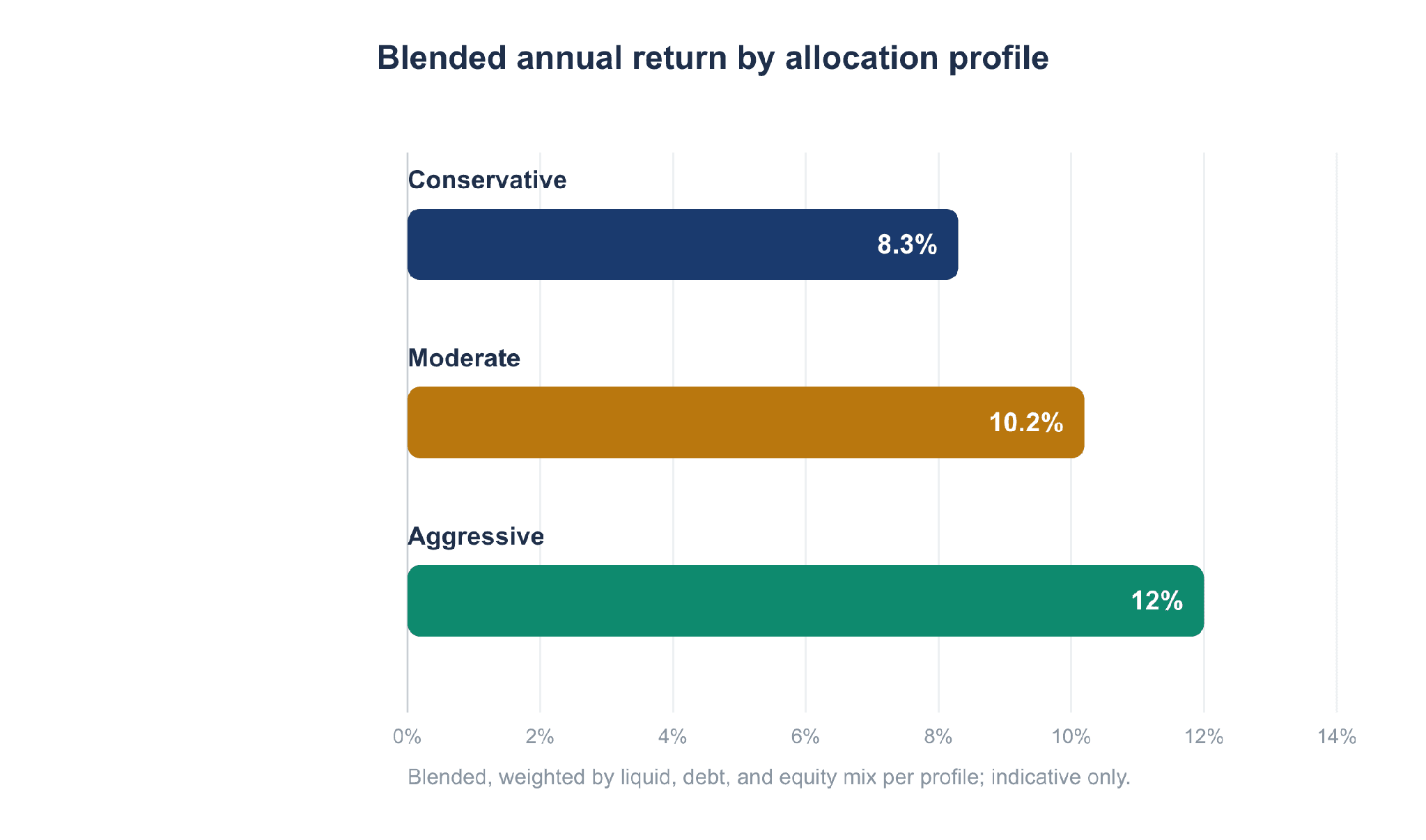

Blended annual return by allocation profile for Rs.50 lakh

Blended annual return by allocation profile, indicative only.

What Rs.50 Lakh Also Means for You

Most guides stop at "diversify and do not invest it all at once." What they skip is that Rs.50 lakh is the exact SEBI minimum for Portfolio Management Services, a threshold, not just a number in a spreadsheet.

Once your growth allocation alone crosses this PMS minimum investment, the question is no longer just which mutual fund to pick, it is whether a more actively managed, personalized portfolio fits your goals better.

Why Should You Choose Ckredence Wealth?

Investors who receive Rs.50 lakh as a lump sum often make one of two mistakes: parking it all in FDs out of caution, or deploying it all into equity out of excitement. Ckredence Wealth is a SEBI registered investment advisor (INA000020846) and portfolio manager (INP000007164), built on a 37 year legacy since 1987.

Solutions That Matter:

  • Goal-based deployment through our mutual fund advisory, structured around your actual timeline, not a generic split.

  • A direct path into portfolio management for the portion of your lump sum built for long-term growth.

  • Fee-only advice on how much to protect, deploy, and grow, reviewed as your goals change.

Ready to put a plan behind your Rs.50 lakh? Schedule a Consultation!

Conclusion

How to invest 50 lakhs comes down to three buckets, not one decision: an emergency reserve that stays untouched, a short to mid-term layer for income or near-term goals, and a long-term growth allocation moved in gradually through an STP. A conservative investor might lean 60% toward the safety layer, while someone with a longer horizon can push more toward growth, but the framework holds either way.

The costliest mistake with a Rs.50 lakh lump sum is not picking the wrong fund, it is treating the whole amount as one decision instead of three. Decide your split based on your own income needs and horizon, and remember that this ticket size qualifies you for more than a retail mutual fund if you choose to use it.

FAQs

01.

How should I invest 50 lakhs for monthly income?

A common approach places 15 to 20 lakh in short-duration debt funds structured as a Systematic Withdrawal Plan, which is generally more tax-aware than FD interest, since only the gain portion of each withdrawal is taxed.

02.

Should I invest 50 lakhs all at once or gradually?

The equity portion is usually better invested gradually, through an STP over 6 to 12 months, rather than as a single lump sum, to reduce the risk of investing everything right before a downturn.

03.

Is 50 lakhs enough to qualify for PMS?

Yes. Rs.50 lakh is the SEBI-mandated minimum investment for Portfolio Management Services, though most advisors recommend keeping a separate emergency reserve outside that amount.

04.

How much of 50 lakhs should go into equity?

It depends on your risk profile and timeline. A common range is 25% for conservative investors up to 70% for aggressive, long-horizon investors, with the rest split between liquid and debt allocations.

A bonus, a property sale, an inheritance, or a maturing FD can put Rs.50 lakh in your account overnight. What to do with it is a different problem than how you got there, and it deserves more thought than "just fix it in an FD."

Rs.50 lakh is not only a large number, it is also the SEBI minimum investment for Portfolio Management Services (PMS). Most guidance on investing a lump sum this size treats it like a bigger FD decision and misses that it also opens a category of investing retail mutual funds cannot offer.

Before you deploy it, ask yourself:

  • Do you need part of this money for monthly income, or is it purely for long-term growth?

  • Is your emergency reserve separate from this Rs.50 lakh, or would investing it all leave you exposed?

  • Have you checked whether this ticket size qualifies you for options beyond mutual funds?

This guide breaks Rs.50 lakh into a protect, deploy, and grow framework, so the money has a plan rather than a parking spot.

TL;DR

  • A common lump sum framework splits Rs.50 lakh into three parts: protect (emergency reserve), deploy with purpose (short to mid-term needs), and grow (long-term equity).

  • Rs.5 to 8 lakh in liquid funds covers roughly 6 months of expenses before anything else is invested.

  • Equity allocation should go in through an STP over 6 to 12 months, not as a single lump sum, to manage timing risk.

  • Rs.50 lakh is also the SEBI minimum for Portfolio Management Services, opening an option beyond retail mutual funds.

  • The right split depends on your goal timeline and whether you need monthly income now or are purely growing wealth.

  • If you are still building toward Rs.50 lakh rather than deploying it, that is a different exercise, see our guide on how to make 50 lakhs in 5 years.

Step 1: Protect Your Emergency Reserve

Before any of this Rs.50 lakh goes toward growth, a portion needs to stay completely liquid and untouched by market movement.

  • Allocation: roughly Rs.5 to 8 lakh in a liquid mutual fund.

  • Goal: cover around 6 months of living expenses without ever touching your main investments.

  • Why it comes first: an emergency reserve invested alongside your growth money gets treated as growth money, and gets touched at the worst possible time.

PROTECTION IS NOT THE SAME AS PARKING

An emergency reserve should be liquid, not just "safe." Our RIA team can help you size it correctly against your actual monthly expenses, not a rule of thumb.

Step 2: Build Safe, Short to Mid-Term Income

The next portion bridges the gap between your emergency fund and your long-term growth money, built for needs one to three years out, or for monthly income today.

  • Allocation: roughly Rs.15 to 20 lakh in short-duration debt funds, bank FDs, or corporate deposits.

  • Goal: steady, low-volatility value for near-term goals, or a Systematic Withdrawal Plan (SWP) if you need monthly income now.

  • This bucket is where "how to invest 50 lakhs for monthly income" plans usually get built, using SWP from debt funds rather than FD interest alone.

INCOME NOW, WITHOUT GIVING UP GROWTH LATER

Structuring this bucket as an SWP alongside a broader asset allocation plan keeps monthly income from eating into your long-term growth allocation.

Step 3: Grow Wealth for the Long Term

The remaining portion is where Rs.50 lakh actually compounds, and where the ticket size itself starts to matter.

  • Allocation: roughly Rs.25 to 30 lakh (or whatever remains) in flexi-cap or index equity mutual funds, for goals 5 or more years away.

  • How: move this money in through a Systematic Transfer Plan (STP) over 6 to 12 months from a liquid fund, rather than investing it all on one day.

  • At this size, Portfolio Management Services also becomes an option, offering direct stock ownership and active management mutual funds do not.

RS.50 LAKH QUALIFIES FOR MORE THAN A MUTUAL FUND

At this ticket size, portfolio management gives you active, personalized allocation across market cycles that a retail mutual fund cannot.

Schedule a Consultation

Suggested Allocation by Investor Profile

The three-part split above is a starting point. How far you lean toward growth depends on your own risk appetite.

Profile

Liquid / Emergency

Debt / FD

Equity / PMS

Conservative

15% (Rs.7.5L)

60% (Rs.30L)

25% (Rs.12.5L)

Moderate

15% (Rs.7.5L)

35% (Rs.17.5L)

50% (Rs.25L)

Aggressive

10% (Rs.5L)

20% (Rs.10L)

70% (Rs.35L)

Table: suggested allocation of Rs.50 lakh by investor profile, across liquid, debt, and equity or PMS.


Blended annual return by allocation profile for Rs.50 lakh

Blended annual return by allocation profile, indicative only.

What Rs.50 Lakh Also Means for You

Most guides stop at "diversify and do not invest it all at once." What they skip is that Rs.50 lakh is the exact SEBI minimum for Portfolio Management Services, a threshold, not just a number in a spreadsheet.

Once your growth allocation alone crosses this PMS minimum investment, the question is no longer just which mutual fund to pick, it is whether a more actively managed, personalized portfolio fits your goals better.

Why Should You Choose Ckredence Wealth?

Investors who receive Rs.50 lakh as a lump sum often make one of two mistakes: parking it all in FDs out of caution, or deploying it all into equity out of excitement. Ckredence Wealth is a SEBI registered investment advisor (INA000020846) and portfolio manager (INP000007164), built on a 37 year legacy since 1987.

Solutions That Matter:

  • Goal-based deployment through our mutual fund advisory, structured around your actual timeline, not a generic split.

  • A direct path into portfolio management for the portion of your lump sum built for long-term growth.

  • Fee-only advice on how much to protect, deploy, and grow, reviewed as your goals change.

Ready to put a plan behind your Rs.50 lakh? Schedule a Consultation!

Conclusion

How to invest 50 lakhs comes down to three buckets, not one decision: an emergency reserve that stays untouched, a short to mid-term layer for income or near-term goals, and a long-term growth allocation moved in gradually through an STP. A conservative investor might lean 60% toward the safety layer, while someone with a longer horizon can push more toward growth, but the framework holds either way.

The costliest mistake with a Rs.50 lakh lump sum is not picking the wrong fund, it is treating the whole amount as one decision instead of three. Decide your split based on your own income needs and horizon, and remember that this ticket size qualifies you for more than a retail mutual fund if you choose to use it.

FAQs

01.

How should I invest 50 lakhs for monthly income?

A common approach places 15 to 20 lakh in short-duration debt funds structured as a Systematic Withdrawal Plan, which is generally more tax-aware than FD interest, since only the gain portion of each withdrawal is taxed.

02.

Should I invest 50 lakhs all at once or gradually?

The equity portion is usually better invested gradually, through an STP over 6 to 12 months, rather than as a single lump sum, to reduce the risk of investing everything right before a downturn.

03.

Is 50 lakhs enough to qualify for PMS?

Yes. Rs.50 lakh is the SEBI-mandated minimum investment for Portfolio Management Services, though most advisors recommend keeping a separate emergency reserve outside that amount.

04.

How much of 50 lakhs should go into equity?

It depends on your risk profile and timeline. A common range is 25% for conservative investors up to 70% for aggressive, long-horizon investors, with the rest split between liquid and debt allocations.