13min Read

13min Read

How to Invest 1 Crore in India: Where Your Lump Sum Should Go

How to Invest 1 Crore in India: Where Your Lump Sum Should Go

How to Invest 1 Crore in India: Where Your Lump Sum Should Go

Learn how to invest 1 crore in India across FD, debt funds, and equity or PMS, with allocation plans by risk profile and monthly income options.

Learn how to invest 1 crore in India across FD, debt funds, and equity or PMS, with allocation plans by risk profile and monthly income options.

Learn how to invest 1 crore in India across FD, debt funds, and equity or PMS, with allocation plans by risk profile and monthly income options.

Ckredence Wealth

Ckredence Wealth

|

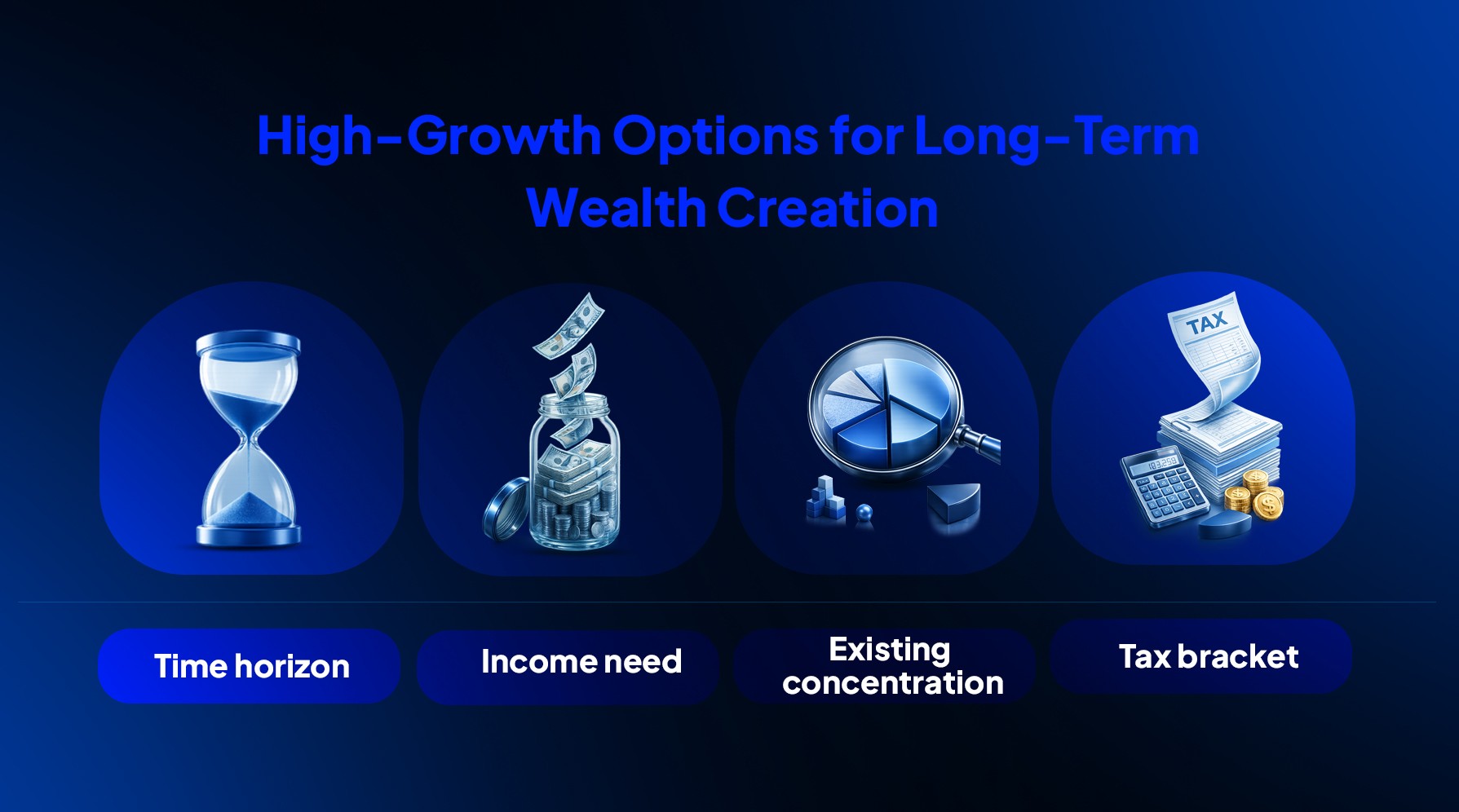
High-growth investment options visual showing key factors for long-term wealth creation, including time horizon, income need, existing concentration, and tax bracket.

Getting Rs.1 crore in hand, from a retirement payout, a property sale, an ESOP encashment, or a business exit, is one problem. Deploying it well is another, and most people default to a single instrument rather than a plan.

That default has a cost. A Rs.1 crore fixed deposit at 6.3% pays about Rs.52,500 a month before tax, a number that drops further once taxed as income, with inflation quietly eating the rest.

Before your Rs.1 crore lands in one place by default, ask yourself:

  • Do you need monthly income now, or are you building for a goal ten or more years away?

  • Is your corpus about to sit entirely in one instrument, by habit rather than by plan?

  • Have you compared returns after tax, not just the headline rate advertised?

This guide breaks down how to invest 1 crore in India, bucket by bucket and by risk profile, so your lump sum has a plan behind it.

TL;DR

  • A common, risk-balanced approach splits Rs.1 crore roughly 30-40% into FD or bonds for safety, 20-30% into debt mutual funds via SWP for income, and 30-40% into equity or PMS for growth.

  • An FD alone yields about Rs.52,500 a month pre-tax on Rs.1 crore at 6.3%, taxed further as income each year.

  • Debt mutual fund SWPs can be more tax-efficient for steady income, since only the gain portion of each withdrawal is taxed.

  • Your ideal split depends on your risk profile, conservative, moderate, or aggressive, not one fixed formula.

  • Equity or PMS exposure is usually staggered in through an STP over 12 to 24 months, not deployed as a single lump sum.

  • The biggest risk to a Rs.1 crore corpus is not market volatility, it is leaving it undeployed or parked entirely in one instrument.

Fixed Deposits and Corporate Bonds: Your Capital Safety Layer

Every Rs.1 crore plan needs a layer that cannot fall in value, money for near-term needs or simple peace of mind.

  • Allocation: roughly 30% to 40% (Rs.30 to 40 lakh).

  • Goal: capital safety and a guaranteed, predictable income.

  • How: split across scheduled bank FDs and top-rated NBFC or corporate deposits, laddering maturities so the whole sum is not locked at one rate.

SAFETY WITHOUT THE INFLATION DRAG

Before locking 30 to 40% of your corpus into FD, it is worth comparing alternatives that protect capital without losing as much to tax and inflation.

Schedule a Consultation: ckredencewealth.com/contact-us

Debt Mutual Funds via SWP: Steady, Tax-Aware Income

A Systematic Withdrawal Plan lets you draw a fixed sum from a debt mutual fund at regular intervals, instead of relying on FD interest alone.

  • Allocation: roughly 20% to 30% (Rs.20 to 30 lakh).

  • Goal: steady monthly income, structured more tax-aware than FD interest.

  • How: each SWP withdrawal is part principal, part gain, so only the gain portion is taxed at your slab rate, unlike FD interest, which is fully taxed every year whether you use it or not.

INCOME, STRUCTURED PROPERLY

Choosing between debt mutual funds, PMS, and AIFs for your income layer depends on ticket size and tax bracket, not just the SWP rate advertised.

Schedule a Consultation: ckredencewealth.com/contact-us

Equity Mutual Funds and PMS: The Growth Engine

The remaining allocation should target long-term growth, the layer that keeps your Rs.1 crore from merely standing still against inflation.

  • Allocation: roughly 30% to 40% (Rs.30 to 40 lakh), or higher for longer horizons.

  • Goal: wealth creation over 7 or more years, ahead of inflation.

  • How: stagger this portion in through an STP over 12 to 24 months rather than investing it all at once, and consider PMS once the ticket crosses roughly Rs.50 lakh for actively managed, less commoditized exposure.

RS.1 CRORE DESERVES A MANAGED STRATEGY

At this ticket size, portfolio management gives you active allocation across market cycles that a self-directed SIP or STP alone cannot.

Schedule a Consultation: ckredencewealth.com/contact-us

Suggested Allocation by Risk Profile

There is no single correct split, only the one that matches how much risk you can actually sit with.

Risk Profile

FD / Bonds

Debt MF (SWP)

Equity MF / PMS

Conservative

60% (Rs.60L)

25% (Rs.25L)

15% (Rs.15L)

Moderate

40% (Rs.40L)

30% (Rs.30L)

30% (Rs.30L)

Aggressive

20% (Rs.20L)

20% (Rs.20L)

60% (Rs.60L)

Table: suggested allocation of Rs.1 crore by risk profile, across FD, debt MF, and equity or PMS.
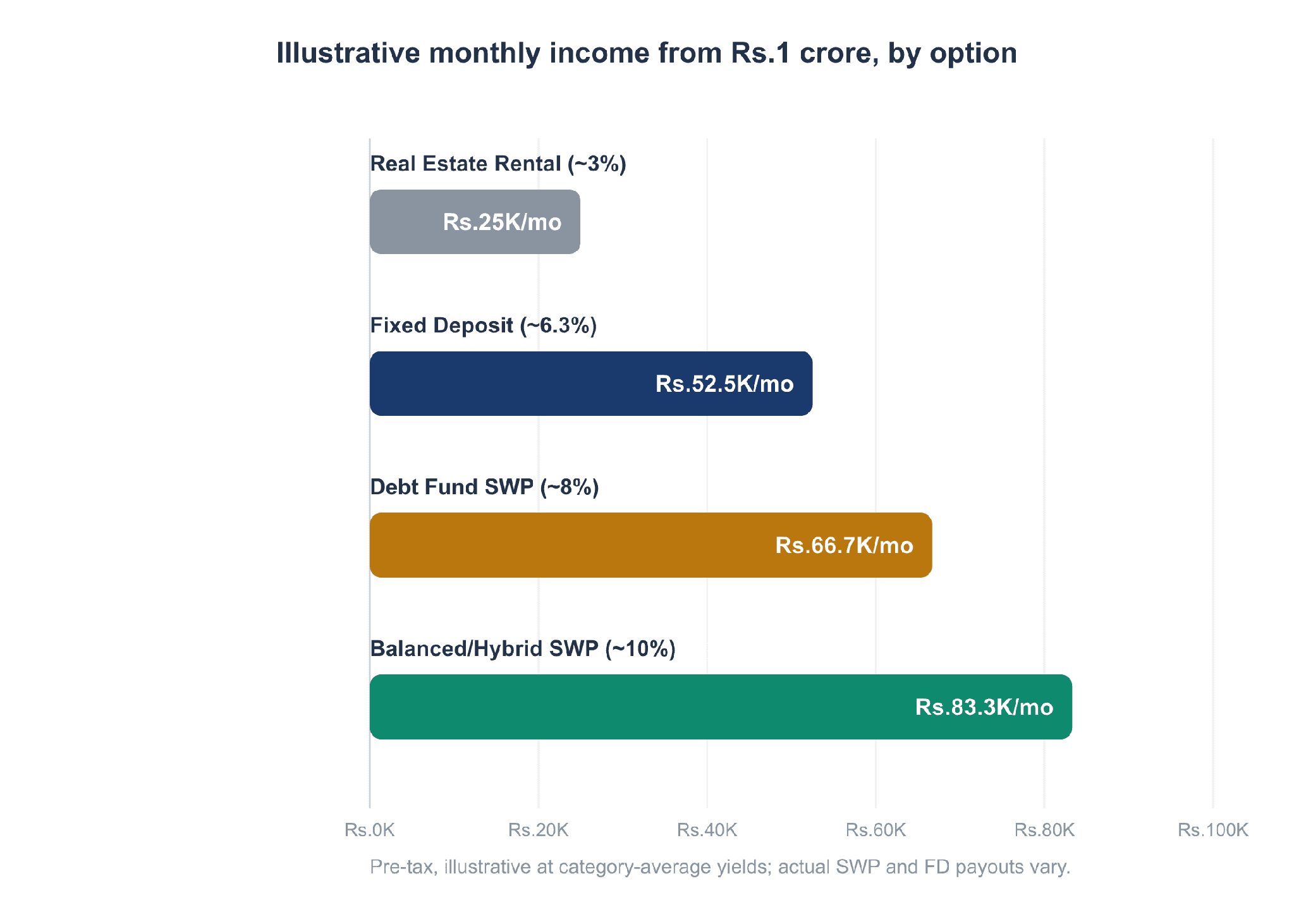

Illustrative monthly income from Rs.1 crore by investment option

Illustrative monthly income from Rs.1 crore, by option.

Matching your own comfort with risk to one of these three profiles is a faster starting point than researching every instrument individually.
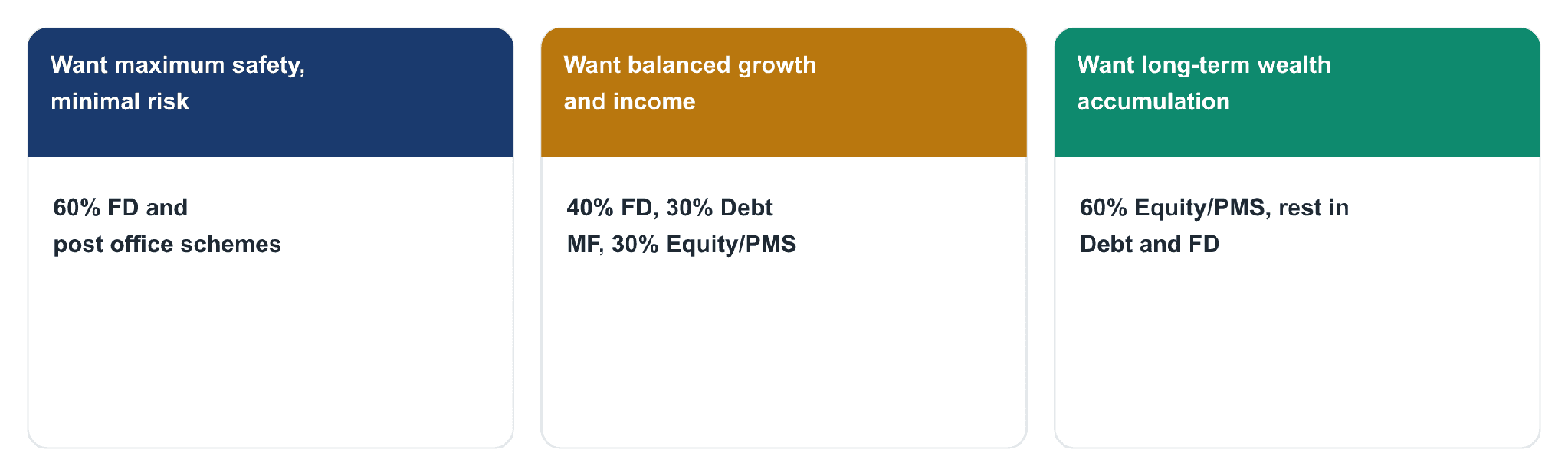

Decision map matching investor risk profile to a Rs.1 crore allocation plan

Match your risk profile to a starting allocation.

How to Decide Your Own Split

Four questions matter more than any fixed percentage.
Ckredence Wealth banner showing how to invest ₹1 crore in India, with coins, piggy bank, house, gold, safe, financial reports, and a rising growth chart.
  • Time horizon: money needed within two to three years belongs in the safety layer, not equity.

  • Income need: if you need monthly cash flow now, weight more toward FD and debt MF SWP.

  • Existing concentration: if you already hold property or company stock, your Rs.1 crore may need to diversify away from it, not add to it.

  • Tax bracket: higher brackets should weigh SWP-based income more heavily than FD interest.

If this Rs.1 crore is meant to fund long-term financial independence or a defined retirement corpus, the split matters more than the individual fund you pick within each bucket.

Why Should You Choose Ckredence Wealth?

Rs.1 crore is exactly the ticket size where a self-directed FD-and-SIP mix starts to leave real money on the table. Ckredence Wealth is a SEBI registered investment advisor (INA000020846) and portfolio manager (INP000007164), built on a 37 year legacy since 1987.

Solutions That Matter:

  • Structured allocation planning across our investment planning services for HNI investors, built for exactly this ticket size.

  • Portfolio management through our PMS services, for the growth layer of your corpus.

  • Fee-only advice on splitting a lump sum across safety, income, and growth, reviewed as your needs change.

Ready to put a plan behind your Rs.1 crore? Schedule a Consultation!

Conclusion

How to invest 1 crore in India comes down to three buckets, not one instrument: a safety layer in FD or bonds, an income layer through debt mutual fund SWPs, and a growth layer in equity or PMS. A conservative investor might lean 60% toward safety, while someone with a longer horizon can push more toward growth, but the three-bucket framework holds either way.

The costliest mistake with a Rs.1 crore corpus is not picking the wrong fund, it is leaving the money undeployed or parked entirely in one instrument out of habit. Decide your split based on your own income needs and horizon, revisit it as your goals change, and treat Rs.1 crore as a portfolio to manage, not a number to protect.

FAQs

01.

How much monthly income can I get from 1 crore?

It depends on the instrument. An FD at around 6.3% pays roughly Rs.52,500 a month pre-tax, while a debt mutual fund SWP at 8% can pay closer to Rs.66,700, though actual returns vary and are never guaranteed.

02.

it better to invest 1 crore in mutual funds or FD?

FDs offer guaranteed but fully taxable interest, while mutual funds, especially through SWP, can be more tax-aware since only the gain portion of each withdrawal is taxed. Most balanced plans use both rather than choosing one.

03.

Should I invest 1 crore as a lump sum in equity?

Most advisors recommend staggering equity or PMS exposure through an STP over 12 to 24 months rather than deploying the entire allocation at once, to reduce timing risk.

04.

What is the safest way to invest 1 crore in India?

FD, corporate bonds, and post office schemes offer the most safety, though a portfolio limited only to these will likely lose value to tax and inflation over time. Most advisors recommend combining safety with some income and growth allocation.

Getting Rs.1 crore in hand, from a retirement payout, a property sale, an ESOP encashment, or a business exit, is one problem. Deploying it well is another, and most people default to a single instrument rather than a plan.

That default has a cost. A Rs.1 crore fixed deposit at 6.3% pays about Rs.52,500 a month before tax, a number that drops further once taxed as income, with inflation quietly eating the rest.

Before your Rs.1 crore lands in one place by default, ask yourself:

  • Do you need monthly income now, or are you building for a goal ten or more years away?

  • Is your corpus about to sit entirely in one instrument, by habit rather than by plan?

  • Have you compared returns after tax, not just the headline rate advertised?

This guide breaks down how to invest 1 crore in India, bucket by bucket and by risk profile, so your lump sum has a plan behind it.

TL;DR

  • A common, risk-balanced approach splits Rs.1 crore roughly 30-40% into FD or bonds for safety, 20-30% into debt mutual funds via SWP for income, and 30-40% into equity or PMS for growth.

  • An FD alone yields about Rs.52,500 a month pre-tax on Rs.1 crore at 6.3%, taxed further as income each year.

  • Debt mutual fund SWPs can be more tax-efficient for steady income, since only the gain portion of each withdrawal is taxed.

  • Your ideal split depends on your risk profile, conservative, moderate, or aggressive, not one fixed formula.

  • Equity or PMS exposure is usually staggered in through an STP over 12 to 24 months, not deployed as a single lump sum.

  • The biggest risk to a Rs.1 crore corpus is not market volatility, it is leaving it undeployed or parked entirely in one instrument.

Fixed Deposits and Corporate Bonds: Your Capital Safety Layer

Every Rs.1 crore plan needs a layer that cannot fall in value, money for near-term needs or simple peace of mind.

  • Allocation: roughly 30% to 40% (Rs.30 to 40 lakh).

  • Goal: capital safety and a guaranteed, predictable income.

  • How: split across scheduled bank FDs and top-rated NBFC or corporate deposits, laddering maturities so the whole sum is not locked at one rate.

SAFETY WITHOUT THE INFLATION DRAG

Before locking 30 to 40% of your corpus into FD, it is worth comparing alternatives that protect capital without losing as much to tax and inflation.

Schedule a Consultation: ckredencewealth.com/contact-us

Debt Mutual Funds via SWP: Steady, Tax-Aware Income

A Systematic Withdrawal Plan lets you draw a fixed sum from a debt mutual fund at regular intervals, instead of relying on FD interest alone.

  • Allocation: roughly 20% to 30% (Rs.20 to 30 lakh).

  • Goal: steady monthly income, structured more tax-aware than FD interest.

  • How: each SWP withdrawal is part principal, part gain, so only the gain portion is taxed at your slab rate, unlike FD interest, which is fully taxed every year whether you use it or not.

INCOME, STRUCTURED PROPERLY

Choosing between debt mutual funds, PMS, and AIFs for your income layer depends on ticket size and tax bracket, not just the SWP rate advertised.

Schedule a Consultation: ckredencewealth.com/contact-us

Equity Mutual Funds and PMS: The Growth Engine

The remaining allocation should target long-term growth, the layer that keeps your Rs.1 crore from merely standing still against inflation.

  • Allocation: roughly 30% to 40% (Rs.30 to 40 lakh), or higher for longer horizons.

  • Goal: wealth creation over 7 or more years, ahead of inflation.

  • How: stagger this portion in through an STP over 12 to 24 months rather than investing it all at once, and consider PMS once the ticket crosses roughly Rs.50 lakh for actively managed, less commoditized exposure.

RS.1 CRORE DESERVES A MANAGED STRATEGY

At this ticket size, portfolio management gives you active allocation across market cycles that a self-directed SIP or STP alone cannot.

Schedule a Consultation: ckredencewealth.com/contact-us

Suggested Allocation by Risk Profile

There is no single correct split, only the one that matches how much risk you can actually sit with.

Risk Profile

FD / Bonds

Debt MF (SWP)

Equity MF / PMS

Conservative

60% (Rs.60L)

25% (Rs.25L)

15% (Rs.15L)

Moderate

40% (Rs.40L)

30% (Rs.30L)

30% (Rs.30L)

Aggressive

20% (Rs.20L)

20% (Rs.20L)

60% (Rs.60L)

Table: suggested allocation of Rs.1 crore by risk profile, across FD, debt MF, and equity or PMS.


Illustrative monthly income from Rs.1 crore by investment option

Illustrative monthly income from Rs.1 crore, by option.

Matching your own comfort with risk to one of these three profiles is a faster starting point than researching every instrument individually.


Decision map matching investor risk profile to a Rs.1 crore allocation plan

Match your risk profile to a starting allocation.

How to Decide Your Own Split

Four questions matter more than any fixed percentage.

Ckredence Wealth banner showing how to invest ₹1 crore in India, with coins, piggy bank, house, gold, safe, financial reports, and a rising growth chart.
  • Time horizon: money needed within two to three years belongs in the safety layer, not equity.

  • Income need: if you need monthly cash flow now, weight more toward FD and debt MF SWP.

  • Existing concentration: if you already hold property or company stock, your Rs.1 crore may need to diversify away from it, not add to it.

  • Tax bracket: higher brackets should weigh SWP-based income more heavily than FD interest.

If this Rs.1 crore is meant to fund long-term financial independence or a defined retirement corpus, the split matters more than the individual fund you pick within each bucket.

Why Should You Choose Ckredence Wealth?

Rs.1 crore is exactly the ticket size where a self-directed FD-and-SIP mix starts to leave real money on the table. Ckredence Wealth is a SEBI registered investment advisor (INA000020846) and portfolio manager (INP000007164), built on a 37 year legacy since 1987.

Solutions That Matter:

  • Structured allocation planning across our investment planning services for HNI investors, built for exactly this ticket size.

  • Portfolio management through our PMS services, for the growth layer of your corpus.

  • Fee-only advice on splitting a lump sum across safety, income, and growth, reviewed as your needs change.

Ready to put a plan behind your Rs.1 crore? Schedule a Consultation!

Conclusion

How to invest 1 crore in India comes down to three buckets, not one instrument: a safety layer in FD or bonds, an income layer through debt mutual fund SWPs, and a growth layer in equity or PMS. A conservative investor might lean 60% toward safety, while someone with a longer horizon can push more toward growth, but the three-bucket framework holds either way.

The costliest mistake with a Rs.1 crore corpus is not picking the wrong fund, it is leaving the money undeployed or parked entirely in one instrument out of habit. Decide your split based on your own income needs and horizon, revisit it as your goals change, and treat Rs.1 crore as a portfolio to manage, not a number to protect.

FAQs

01.

How much monthly income can I get from 1 crore?

It depends on the instrument. An FD at around 6.3% pays roughly Rs.52,500 a month pre-tax, while a debt mutual fund SWP at 8% can pay closer to Rs.66,700, though actual returns vary and are never guaranteed.

02.

it better to invest 1 crore in mutual funds or FD?

FDs offer guaranteed but fully taxable interest, while mutual funds, especially through SWP, can be more tax-aware since only the gain portion of each withdrawal is taxed. Most balanced plans use both rather than choosing one.

03.

Should I invest 1 crore as a lump sum in equity?

Most advisors recommend staggering equity or PMS exposure through an STP over 12 to 24 months rather than deploying the entire allocation at once, to reduce timing risk.

04.

What is the safest way to invest 1 crore in India?

FD, corporate bonds, and post office schemes offer the most safety, though a portfolio limited only to these will likely lose value to tax and inflation over time. Most advisors recommend combining safety with some income and growth allocation.