6 min read time
6 min read time
Financial Advisor vs Portfolio Manager: Key Differences Every Indian Investor Must Know
Understand the real difference between a financial advisor and a portfolio manager in India. Know who to hire for your financial goals.

Ckredence Wealth
Ckredence Wealth
|
March 21, 2026
March 21, 2026

As of August 2024, India had only 973 SEBI-registered Investment Advisors (RIAs) and 1,330 registered research analysts, according to SEBI data cited by Trade Brains - a number that has barely grown despite unique stock market investors rising from 3 crore to over 10 crore in just four years.
At the same time, India's wealth management AUM is projected to nearly double from USD 1.1 trillion in FY2024 to USD 2.3 trillion by FY2029, per a Deloitte India report from January 2025.
The gap between growing investor wealth and qualified advisory professionals has never been wider.
Are you paying for financial advice but unsure if your advisor is actually managing your investments or just recommending them?
Do you know the difference between someone who tells you where to invest and someone who actively buys and sells on your behalf?
If your money is sitting with a professional, do you know their exact legal duty toward you?
These questions matter more than most investors realise. A financial advisor and a portfolio manager are two very different professionals.
Mixing them up can lead to the wrong service, misaligned expectations, and gaps in your financial plan.
This blog breaks down both roles clearly, compares them across every important parameter, and helps you decide exactly who you need at your current stage of investing.
Key Takeaways
A financial advisor builds your financial roadmap; a portfolio manager executes the investment strategy
Portfolio managers operate under SEBI (Portfolio Managers) Regulations, 2020; financial advisors under SEBI (Investment Advisers) Regulations, 2013
Portfolio managers hold discretionary authority to buy and sell on your behalf without prior approval
SEBI-registered RIAs are bound by fiduciary duty; not all financial advisors in India hold this status
PMS in India requires a minimum investment of ₹50 lakhs per client
Your choice depends on whether you need a financial plan, active investment management, or both
What Is a Financial Advisor?
A financial advisor helps you plan your complete financial life. They start by understanding your income, goals, risk tolerance, liabilities, and life stage.
Based on this, they build a financial roadmap that covers where to invest, how much, in which instruments, and for how long.
Their role is to advise, plan, and guide. They do not necessarily execute trades on your behalf. That distinction matters.
In India, the regulated version of a financial advisor is a SEBI-Registered Investment Advisor (RIA), governed under the SEBI (Investment Advisers) Regulations, 2013.
To become an RIA, a professional must hold a relevant graduate degree, clear the NISM certification examinations, and maintain full fiduciary responsibility toward their clients. T
his means they are legally required to act in your best interest at all times. Their advice cannot be influenced by commissions or product incentives.
What Does a Financial Advisor Actually Do?
A financial advisor's work goes well beyond stock recommendations. Their scope covers every layer of your financial life, from goal planning to tax strategy to protection planning.
Goal-Based Financial Planning: Mapping investments to specific goals such as retirement, children's education, or business expansion
Tax-Efficient Investment Strategy: Recommending instruments that align with your tax bracket and LTCG planning
Asset Allocation Guidance: Deciding the right split between equity, debt, gold, and real estate based on your risk profile
Insurance and Protection Planning: Identifying coverage gaps and recommending appropriate life and health cover
Periodic Review and Rebalancing: Reviewing your plan as your income, goals, or market conditions change
Key Action of a Financial Advisor
A financial advisor helps you decide where to invest. They may or may not execute the trades themselves.
In many cases, especially with SEBI RIAs operating under a fee-only model, the advisor recommends and you or your broker executes. Their value is in the quality of the plan, not the speed of execution.
Unlike mutual fund distributors who earn commissions on product sales, SEBI-registered RIAs charge fees directly to clients and provide unbiased recommendations free from product-driven conflicts of interest.
To understand how Ckredence Wealth structures its SEBI-registered advisory services, visit our RIA service page.
What Is a Portfolio Manager?
A portfolio manager directly manages your investment portfolio. They do not just advise. They buy, sell, and rebalance your holdings based on market conditions, research, and your agreed investment strategy.
Their mandate is focused and specific: maximise returns within your defined risk parameters.
In India, portfolio managers operate under the SEBI (Portfolio Managers) Regulations, 2020 and primarily offer services through Portfolio Management Services (PMS), which require a minimum client investment of ₹50 lakhs.
The portfolio manager builds and runs a direct equity portfolio on your behalf, customised to your risk profile and return expectations.
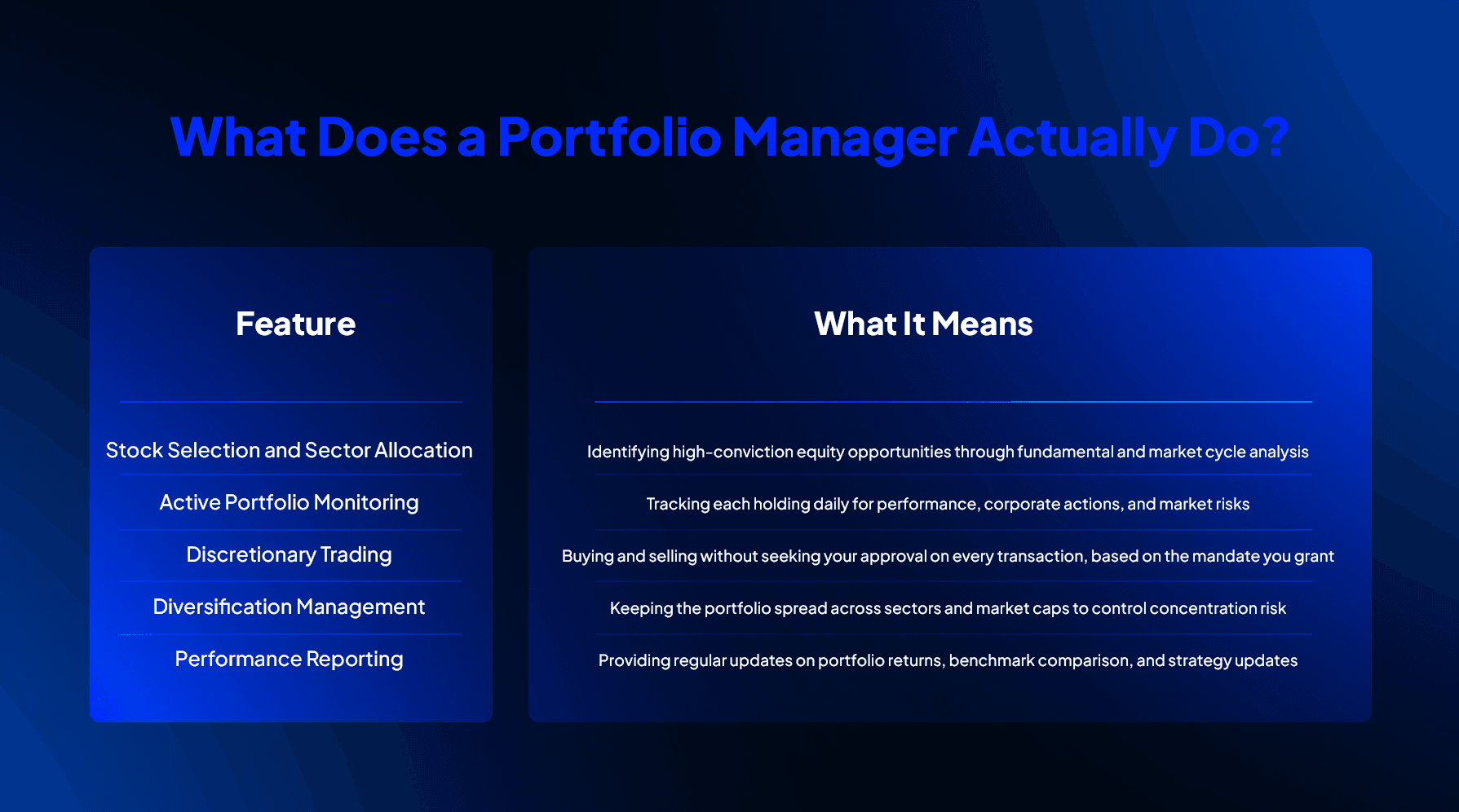
What Does a Portfolio Manager Actually Do?
A portfolio manager's scope stays fully within the investment space. Every action they take is directed at growing and protecting your portfolio.
Key Action of a Portfolio Manager
A portfolio manager manages how your money is invested. They execute the investment strategy.
Portfolio managers are bound by fiduciary responsibility and are legally and ethically required to put your best interests first. Their decisions are backed by research reports, proprietary models, and deep market expertise.
To see how Ckredence Wealth's portfolio managers build and manage investment strategies, explore our investment approaches.
Financial Advisor vs Portfolio Manager: Key Differences
The financial advisor vs portfolio manager debate comes down to one core distinction: advising versus executing. A financial advisor tells you the plan.
A portfolio manager runs the plan. Here is how they differ across every important parameter:
1. Focus: A financial advisor covers your broad financial life, including retirement planning, tax strategy, insurance, and estate goals.
A portfolio manager focuses only on your investment portfolio and its performance.
2. Role: A financial advisor creates a financial roadmap and guides decisions. A portfolio manager is an execution specialist who actively manages your holdings on an ongoing basis.
3. Method: Financial advisors recommend. They provide written advice, reports, and strategies. Portfolio managers act.
Most operate on a discretionary basis, meaning they can make investment decisions without your prior consent on each trade.
4. Best For: A financial advisor is best for individuals who need a comprehensive financial plan, budgeting guidance, tax-efficient investing, or goal-based strategy.
A portfolio manager is best for investors with significant assets who want active, professional management of their equity portfolio.
5. Compensation: Financial advisors may charge flat fees, hourly fees, or a percentage of assets. Portfolio managers in India typically charge a percentage of AUM or a performance-based fee.
For a detailed breakdown of how PMS fees work in India, refer to our guide on PMS charges and fee structures.
6. Regulation in India: Financial advisors are regulated under SEBI (Investment Advisers) Regulations, 2013.
Portfolio managers are regulated under SEBI (Portfolio Managers) Regulations, 2020. Both require SEBI registration to legally operate.
7. Fiduciary Duty: SEBI-registered RIAs are legally bound to act in your best interest. Portfolio managers operating under SEBI-registered PMS structures also hold fiduciary responsibilities.
However, not all professionals who call themselves financial advisors in India are registered or bound by fiduciary standards, making SEBI registration a critical verification step for any investor.
Comparison Table: Financial Advisor vs Portfolio Manager
Parameter | Financial Advisor (RIA) | Portfolio Manager (PMS) |
Focus | Full financial life | Investment portfolio only |
Role | Planning and guidance | Active execution and management |
Method | Recommends, client executes | Discretionary, acts on your behalf |
Best For | Comprehensive financial planning | Active equity portfolio management |
Minimum Investment | No fixed threshold | ₹50 lakhs (SEBI PMS requirement) |
Regulation | SEBI IA Regulations, 2013 | SEBI PM Regulations, 2020 |
Fee Model | Flat fee, hourly, or AUM-based | AUM-based or performance-linked |
Fiduciary Duty | Yes (for SEBI RIAs) | Yes (for SEBI-registered PMS) |
Discretionary Authority | Usually No | Usually Yes |
When to Hire a Financial Advisor vs a Portfolio Manager
This is where most investors get stuck. The answer is not simply about your net worth. It is about what your financial life actually needs right now.
Hire a Financial Advisor When:
You need a structured financial plan but do not yet have a large corpus to deploy. You want guidance on tax planning, retirement goals, insurance gaps, or debt management.
You are at an early stage of wealth building and want someone to map out a clear, goal-based financial strategy before choosing specific investments.
A SEBI-registered RIA gives you unbiased, fee-only advice aligned entirely with your interests.
You can verify any RIA's credentials directly on the SEBI website before engaging them. This step protects you from unregistered advisors operating without regulatory accountability.
To understand how Ckredence Wealth structures its advisory services, visit our RIA service page.
Hire a Portfolio Manager When:
You have ₹50 lakhs or more in investable surplus and want a professional to actively manage your equity portfolio with a defined strategy.
You do not have the time or expertise to monitor the market daily.
You want direct equity exposure managed by a qualified fund manager under a SEBI-regulated structure with clear performance reporting and transparent fees.
Learn more about the minimum investment required for Portfolio Management Services before making a decision.
To understand what professionally managed portfolios look like in practice, read our resource on what is Portfolio Management Services in India.
Can You Need Both?
Yes. Many HNIs in India work with both. A financial advisor builds the overall financial plan and ensures taxes, estate, and insurance are in order.
A portfolio manager then executes the equity investment portion of that plan with full-time attention and research support.
To see how Ckredence Wealth combines both under one roof, explore our investment approaches. The two roles are complementary, not competing.
Conclusion
A financial advisor helps you build the plan. A portfolio manager puts that plan to work in the markets. Both serve different functions and the right choice depends entirely on where you are in your financial journey. If you need a roadmap, start with a financial advisor. If you need active equity management with ₹50 lakhs or more to deploy, a portfolio manager under a SEBI-regulated PMS structure is the right fit.
For serious investors in India, working with a SEBI-registered professional, whether an RIA or a portfolio manager, is not optional. It is the baseline for credible, legally accountable financial guidance. The right advisor does not just manage your money. They protect it.
FAQs
1.
What is the main difference between a financial advisor and a portfolio manager in India?
A financial advisor creates your financial plan and recommends investments. A portfolio manager actively manages your equity portfolio and can make trades on your behalf.
2.
Is a portfolio manager the same as a financial advisor?
No. A portfolio manager focuses only on managing investments with discretionary authority. A financial advisor covers your complete financial life including tax, retirement, and insurance planning.
3.
Do I need a SEBI-registered advisor to manage my investments in India?
Yes. Anyone providing investment advice or portfolio management services for a fee in India must be registered with SEBI under the relevant regulations to be legally accountable.
4.
What is the minimum investment required to hire a portfolio manager in India?
SEBI requires a minimum investment of ₹50 lakhs per client for Portfolio Management Services in India under the PMS Regulations, 2020.
As of August 2024, India had only 973 SEBI-registered Investment Advisors (RIAs) and 1,330 registered research analysts, according to SEBI data cited by Trade Brains - a number that has barely grown despite unique stock market investors rising from 3 crore to over 10 crore in just four years.
At the same time, India's wealth management AUM is projected to nearly double from USD 1.1 trillion in FY2024 to USD 2.3 trillion by FY2029, per a Deloitte India report from January 2025.
The gap between growing investor wealth and qualified advisory professionals has never been wider.
Are you paying for financial advice but unsure if your advisor is actually managing your investments or just recommending them?
Do you know the difference between someone who tells you where to invest and someone who actively buys and sells on your behalf?
If your money is sitting with a professional, do you know their exact legal duty toward you?
These questions matter more than most investors realise. A financial advisor and a portfolio manager are two very different professionals.
Mixing them up can lead to the wrong service, misaligned expectations, and gaps in your financial plan.
This blog breaks down both roles clearly, compares them across every important parameter, and helps you decide exactly who you need at your current stage of investing.
Key Takeaways
A financial advisor builds your financial roadmap; a portfolio manager executes the investment strategy
Portfolio managers operate under SEBI (Portfolio Managers) Regulations, 2020; financial advisors under SEBI (Investment Advisers) Regulations, 2013
Portfolio managers hold discretionary authority to buy and sell on your behalf without prior approval
SEBI-registered RIAs are bound by fiduciary duty; not all financial advisors in India hold this status
PMS in India requires a minimum investment of ₹50 lakhs per client
Your choice depends on whether you need a financial plan, active investment management, or both
What Is a Financial Advisor?
A financial advisor helps you plan your complete financial life. They start by understanding your income, goals, risk tolerance, liabilities, and life stage.
Based on this, they build a financial roadmap that covers where to invest, how much, in which instruments, and for how long.
Their role is to advise, plan, and guide. They do not necessarily execute trades on your behalf. That distinction matters.
In India, the regulated version of a financial advisor is a SEBI-Registered Investment Advisor (RIA), governed under the SEBI (Investment Advisers) Regulations, 2013.
To become an RIA, a professional must hold a relevant graduate degree, clear the NISM certification examinations, and maintain full fiduciary responsibility toward their clients. T
his means they are legally required to act in your best interest at all times. Their advice cannot be influenced by commissions or product incentives.
What Does a Financial Advisor Actually Do?
A financial advisor's work goes well beyond stock recommendations. Their scope covers every layer of your financial life, from goal planning to tax strategy to protection planning.
Goal-Based Financial Planning: Mapping investments to specific goals such as retirement, children's education, or business expansion
Tax-Efficient Investment Strategy: Recommending instruments that align with your tax bracket and LTCG planning
Asset Allocation Guidance: Deciding the right split between equity, debt, gold, and real estate based on your risk profile
Insurance and Protection Planning: Identifying coverage gaps and recommending appropriate life and health cover
Periodic Review and Rebalancing: Reviewing your plan as your income, goals, or market conditions change
Key Action of a Financial Advisor
A financial advisor helps you decide where to invest. They may or may not execute the trades themselves.
In many cases, especially with SEBI RIAs operating under a fee-only model, the advisor recommends and you or your broker executes. Their value is in the quality of the plan, not the speed of execution.
Unlike mutual fund distributors who earn commissions on product sales, SEBI-registered RIAs charge fees directly to clients and provide unbiased recommendations free from product-driven conflicts of interest.
To understand how Ckredence Wealth structures its SEBI-registered advisory services, visit our RIA service page.
What Is a Portfolio Manager?
A portfolio manager directly manages your investment portfolio. They do not just advise. They buy, sell, and rebalance your holdings based on market conditions, research, and your agreed investment strategy.
Their mandate is focused and specific: maximise returns within your defined risk parameters.
In India, portfolio managers operate under the SEBI (Portfolio Managers) Regulations, 2020 and primarily offer services through Portfolio Management Services (PMS), which require a minimum client investment of ₹50 lakhs.
The portfolio manager builds and runs a direct equity portfolio on your behalf, customised to your risk profile and return expectations.
What Does a Portfolio Manager Actually Do?
A portfolio manager's scope stays fully within the investment space. Every action they take is directed at growing and protecting your portfolio.

Key Action of a Portfolio Manager
A portfolio manager manages how your money is invested. They execute the investment strategy.
Portfolio managers are bound by fiduciary responsibility and are legally and ethically required to put your best interests first. Their decisions are backed by research reports, proprietary models, and deep market expertise.
To see how Ckredence Wealth's portfolio managers build and manage investment strategies, explore our investment approaches.
Financial Advisor vs Portfolio Manager: Key Differences
The financial advisor vs portfolio manager debate comes down to one core distinction: advising versus executing. A financial advisor tells you the plan.
A portfolio manager runs the plan. Here is how they differ across every important parameter:
1. Focus: A financial advisor covers your broad financial life, including retirement planning, tax strategy, insurance, and estate goals.
A portfolio manager focuses only on your investment portfolio and its performance.
2. Role: A financial advisor creates a financial roadmap and guides decisions. A portfolio manager is an execution specialist who actively manages your holdings on an ongoing basis.
3. Method: Financial advisors recommend. They provide written advice, reports, and strategies. Portfolio managers act.
Most operate on a discretionary basis, meaning they can make investment decisions without your prior consent on each trade.
4. Best For: A financial advisor is best for individuals who need a comprehensive financial plan, budgeting guidance, tax-efficient investing, or goal-based strategy.
A portfolio manager is best for investors with significant assets who want active, professional management of their equity portfolio.
5. Compensation: Financial advisors may charge flat fees, hourly fees, or a percentage of assets. Portfolio managers in India typically charge a percentage of AUM or a performance-based fee.
For a detailed breakdown of how PMS fees work in India, refer to our guide on PMS charges and fee structures.
6. Regulation in India: Financial advisors are regulated under SEBI (Investment Advisers) Regulations, 2013.
Portfolio managers are regulated under SEBI (Portfolio Managers) Regulations, 2020. Both require SEBI registration to legally operate.
7. Fiduciary Duty: SEBI-registered RIAs are legally bound to act in your best interest. Portfolio managers operating under SEBI-registered PMS structures also hold fiduciary responsibilities.
However, not all professionals who call themselves financial advisors in India are registered or bound by fiduciary standards, making SEBI registration a critical verification step for any investor.
Comparison Table: Financial Advisor vs Portfolio Manager
Parameter | Financial Advisor (RIA) | Portfolio Manager (PMS) |
Focus | Full financial life | Investment portfolio only |
Role | Planning and guidance | Active execution and management |
Method | Recommends, client executes | Discretionary, acts on your behalf |
Best For | Comprehensive financial planning | Active equity portfolio management |
Minimum Investment | No fixed threshold | ₹50 lakhs (SEBI PMS requirement) |
Regulation | SEBI IA Regulations, 2013 | SEBI PM Regulations, 2020 |
Fee Model | Flat fee, hourly, or AUM-based | AUM-based or performance-linked |
Fiduciary Duty | Yes (for SEBI RIAs) | Yes (for SEBI-registered PMS) |
Discretionary Authority | Usually No | Usually Yes |
When to Hire a Financial Advisor vs a Portfolio Manager
This is where most investors get stuck. The answer is not simply about your net worth. It is about what your financial life actually needs right now.
Hire a Financial Advisor When:
You need a structured financial plan but do not yet have a large corpus to deploy. You want guidance on tax planning, retirement goals, insurance gaps, or debt management.
You are at an early stage of wealth building and want someone to map out a clear, goal-based financial strategy before choosing specific investments.
A SEBI-registered RIA gives you unbiased, fee-only advice aligned entirely with your interests.
You can verify any RIA's credentials directly on the SEBI website before engaging them. This step protects you from unregistered advisors operating without regulatory accountability.
To understand how Ckredence Wealth structures its advisory services, visit our RIA service page.
Hire a Portfolio Manager When:
You have ₹50 lakhs or more in investable surplus and want a professional to actively manage your equity portfolio with a defined strategy.
You do not have the time or expertise to monitor the market daily.
You want direct equity exposure managed by a qualified fund manager under a SEBI-regulated structure with clear performance reporting and transparent fees.
Learn more about the minimum investment required for Portfolio Management Services before making a decision.
To understand what professionally managed portfolios look like in practice, read our resource on what is Portfolio Management Services in India.
Can You Need Both?
Yes. Many HNIs in India work with both. A financial advisor builds the overall financial plan and ensures taxes, estate, and insurance are in order.
A portfolio manager then executes the equity investment portion of that plan with full-time attention and research support.
To see how Ckredence Wealth combines both under one roof, explore our investment approaches. The two roles are complementary, not competing.
Conclusion
A financial advisor helps you build the plan. A portfolio manager puts that plan to work in the markets. Both serve different functions and the right choice depends entirely on where you are in your financial journey. If you need a roadmap, start with a financial advisor. If you need active equity management with ₹50 lakhs or more to deploy, a portfolio manager under a SEBI-regulated PMS structure is the right fit.
For serious investors in India, working with a SEBI-registered professional, whether an RIA or a portfolio manager, is not optional. It is the baseline for credible, legally accountable financial guidance. The right advisor does not just manage your money. They protect it.
FAQs
1.
What is the main difference between a financial advisor and a portfolio manager in India?
A financial advisor creates your financial plan and recommends investments. A portfolio manager actively manages your equity portfolio and can make trades on your behalf.
2.
Is a portfolio manager the same as a financial advisor?
No. A portfolio manager focuses only on managing investments with discretionary authority. A financial advisor covers your complete financial life including tax, retirement, and insurance planning.
3.
Do I need a SEBI-registered advisor to manage my investments in India?
Yes. Anyone providing investment advice or portfolio management services for a fee in India must be registered with SEBI under the relevant regulations to be legally accountable.
4.
What is the minimum investment required to hire a portfolio manager in India?
SEBI requires a minimum investment of ₹50 lakhs per client for Portfolio Management Services in India under the PMS Regulations, 2020.