
Documents Required for PMS Investment in India: Full Checklist
A complete, category-wise checklist of documents required for PMS investment in India, covering individuals, NRIs, HUFs, companies and trusts.

Ckredence Wealth |September 24, 2026

Documents required for PMS investment in India depend on who is actually opening the account, not only on the Rs. 50 lakh minimum. A resident individual, an NRI, and a family investing through an HUF or a private trust each submit a materially different paperwork set, and using the wrong list is a common reason onboarding stalls.
A Surat textile promoter investing personally needs one set of documents. The same promoter investing through his family's HUF needs another set entirely. This guide assumes you have already decided PMS is right for you, our guide on how to invest in portfolio management services covers that groundwork, and breaks the requirement down by investor category.
TL; DR
- Documents differ by investor category, not only by resident or NRI status.
- SEBI's PMS framework covers six practical investor categories, each with a different KYC set.
- Resident individuals need PAN, address proof, photograph, signature, bank proof and FATCA.
- NRIs need all of the above plus passport, visa/OCI and overseas address proof, and more time.
- HUF, corporate, partnership and trust investors need entity documents: a deed, incorporation certificate or UBO declaration.
- CDSL's KRA has processed over 10 crore KYC records (January 2026). An already-validated KYC is still your biggest time lever.
- Confirm your investor category before collecting paperwork. It is the step most checklists skip.
Confirm your eligibility and document checklist before you begin.
| → Start a Structured Portfolio Review |
Why Does Your Investor Category Decide Your PMS Document List?
Most guides to PMS documentation quietly assume the investor is a resident individual. The common assumption is that a single checklist works for every PMS investor. The reality is that SEBI's Portfolio Managers Regulations recognise several distinct client types, an HUF is not a company and a private trust is not a partnership, and KYC obligations change with each one.
Treating a non-individual investment like an individual one is the most avoidable cause of onboarding delay for business families who invest through more than one entity at once.
Which of SEBI's Six PMS Investor Categories Do You Fall Into?
Identify your category first. Every document in this guide is organised around these six categories, so use the table below to find yours before reading further.
| Investor Category | Typical Situation | Core Extra Document |
| Resident Individual | An HNI investing in a personal capacity | PAN and address proof only |
| NRI | An NRI in the UAE, UK or elsewhere investing from abroad | Passport, visa or OCI, overseas address proof |
| HUF | A family business run through a Hindu Undivided Family | HUF deed naming the Karta and coparceners |
| Private Company | A promoter investing surplus through his operating company | Certificate of Incorporation, board resolution |
| Partnership or LLP | A professional partnership investing jointly | Partnership deed or LLP agreement |
| Trust | A family trust set up during succession planning | Trust deed and list of trustees |
Table: the six SEBI-recognised PMS investor categories and the core document each adds on top of standard KYC.
What Documents Does a Resident Individual Need for PMS Investment?
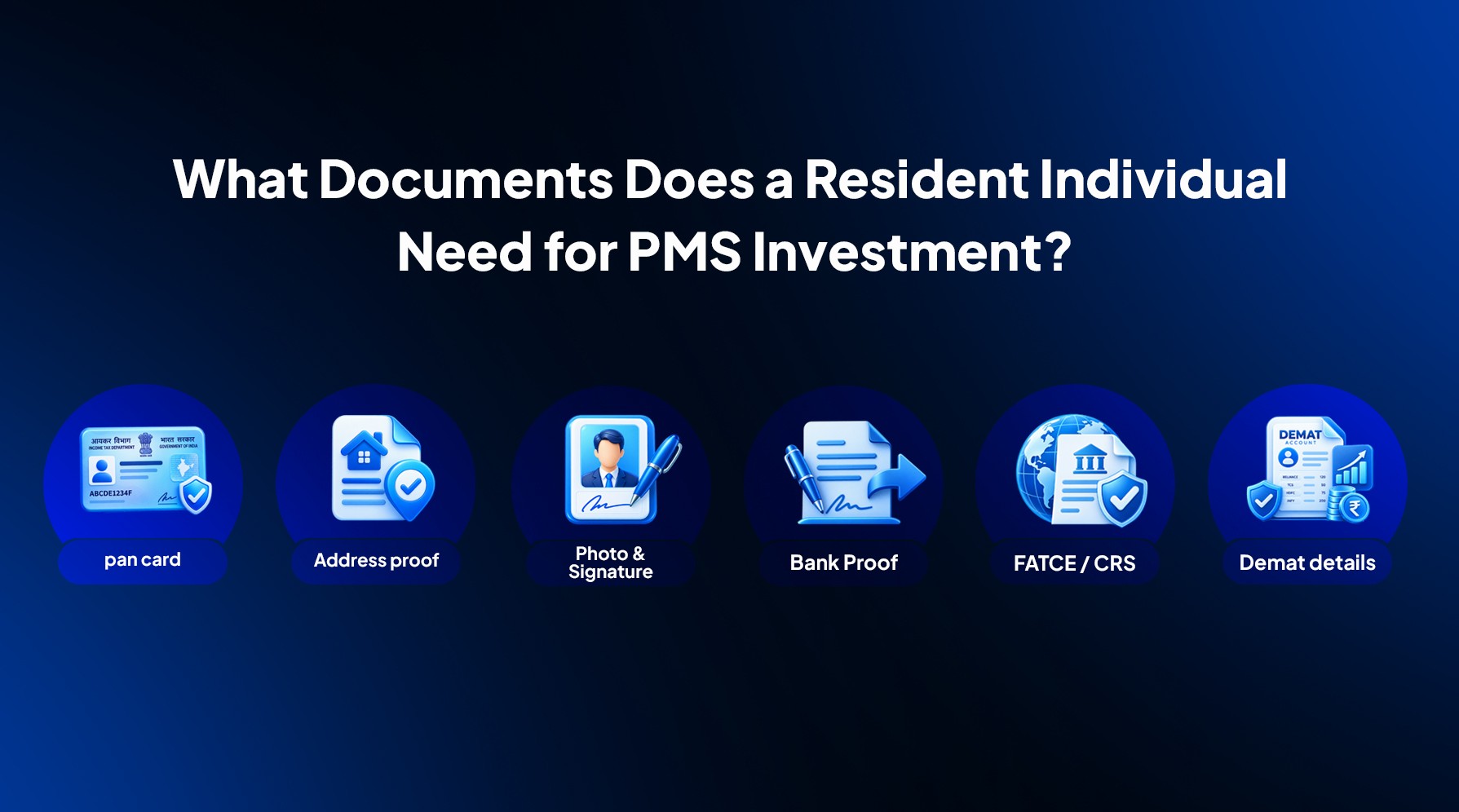
A resident individual is the simplest category, and the baseline every other category builds on. These documents cover the standard case:
- PAN card, the mandatory identifier for every securities market participant
- Aadhaar card or another SEBI-recognised proof of address
- A recent passport-size photograph and signature proof
- Bank proof: a cancelled cheque or a recent bank statement in your own name
- A FATCA and CRS self-declaration
- Demat account details, since PMS holdings sit in your own demat, not a pooled account
If your KYC is already validated from an earlier mutual fund or demat account, most of this step is a formality. Our guide to the PMS onboarding timeline covers how much time an unvalidated KYC typically adds.
| 💡 Does Your PMS Structure Change This List?Barely. A non-discretionary mandate adds a trade-approval clause to the agreement, not a new document. See our guide on discretionary vs non-discretionary PMS if you have not chosen a structure. Investors moving up from mutual funds often assume otherwise. |
What Additional Documents Does an NRI Need for PMS Investment in India?
NRI investors submit everything a resident individual does, plus documents that establish overseas status. NRI onboarding almost always takes longer, mainly because of these additions:
- Passport, the primary identity document for an NRI investor
- Visa, OCI card or PIO card, proving overseas residency status
- Overseas address proof: a utility bill or bank statement from the country of residence
- NRE or NRO bank account details, since a resident savings account cannot be linked to an NRI mandate
- A Portfolio Investment Scheme (PIS) permission letter, where the route requires one
- FATCA and CRS declarations, weighted more heavily given cross-border tax reporting
Documents signed outside India, such as a Power of Attorney, typically need notarisation or apostille first. See our guide to NRI repatriable accounts and our PMS for NRI guide for the fuller picture.
Investing From Outside India? NRI documentation involves FEMA, PIS and apostille requirements that vary by country of residence.
| → Speak to the NRI Desk |
What Documents Do HUF, Corporate, Partnership, and Trust Investors Need?
Non-individual investors submit entity documents in addition to the authorised signatory's own KYC. The entity's identity has to be established independently of the person signing for it.
| Category | Entity Document | Signatory Requirement |
| HUF | HUF deed listing the Karta and coparceners | Karta's full individual KYC |
| Private Company | Certificate of Incorporation, MOA/AOA, board resolution | Signatory's KYC, list of directors |
| Partnership / LLP | Partnership deed or LLP agreement, registration certificate | Authorised partners' KYC |
| Trust | Trust deed, list of trustees, authorising resolution | Authorised trustee's KYC |
All four categories also submit a Beneficial Owner (UBO) declaration, an anti-money-laundering requirement with no equivalent on the individual checklist. You can independently verify any portfolio manager's SEBI registration before submitting entity documents.
| The Situation We See Most Often With Entity InvestorsA business family with surplus sitting inside their operating company, alongside investments already held personally. The company's own KYC had never been completed even though the family's personal KYC was years old.Situation described is illustrative of a client engagement pattern and does not indicate results for any other investor. |
What Commonly Delays or Rejects a PMS KYC Application?
Most delays are not about missing documents. They are about documents that do not match each other.
| ⚠️ Risk to UnderstandAddress proof that does not exactly match the name and spelling on your PAN is the most common rejection reason across every category. A cancelled cheque with a different signature variant than your application form is the second most common. |
The pattern we see across business families is rarely a missing document. It is usually an old KYC record never updated after a name change, an address move, or a company restructuring.
Who Should Wait Before Starting the PMS Documentation Process?
Not everyone benefits from gathering these documents today. Three situations are worth resolving first.
- Your investable capital has not yet crossed the Rs. 50 lakh regulatory minimum. Our guide to the PMS minimum investment explains how that threshold is calculated.
- Your existing KYC is inactive, on hold, or was never linked to your current PAN.
- You have not yet decided which entity, personal, HUF, or company, should hold the investment.
There is no cost to waiting a few weeks. There is a real cost to submitting documents against the wrong entity and starting over.
What Sources and Methodology Back This Checklist?
This checklist reflects SEBI's Portfolio Managers Regulations and standard KYC Registration Agency practice, cross-checked against document requirements published by SEBI-registered intermediaries. See our guide on what portfolio management services means in India for the underlying definitions.
| 📊 10 Crore+ KYC RecordsCDSL Ventures Limited, India's largest KRA, crossed 10 crore processed KYC records as of January 2026, why an already-validated KYC is the fastest path through this checklist.Source: Business Upturn, as of January 2026 |
According to data reported by India Corporate Law, Cyril Amarchand Mangaldas (as of 31 May 2026), India's PMS industry serves 2.19 lakh clients across 515 registered portfolio managers. SEBI's 23 July 2026 consultation paper on overhauling the PMS framework proposes calendar-day compliance timelines that could speed up this stage further.
Source: India Corporate Law, Cyril Amarchand Mangaldas, as of 31 May 2026
Conclusion
Documents required for PMS investment in India are not one fixed list. They depend on which of the six investor categories your money is coming from, and confirming that is the one step worth doing first.
Our guide to PMS charges and fee structure is a natural next read once your documentation is in motion.
Not sure which category or documents apply to your situation? Talk it through before you submit anything.
| → Get a Second Opinion on Your Documents |
FAQs
01 Number
How do I open a PMS account in India?
Select a SEBI-registered portfolio manager, complete KYC for your investor category, sign the agreement, link a bank and demat account, and transfer the minimum investment. This typically takes 5 to 10 business days once documents are ready.
02 Number
What is the minimum investment required for a PMS portfolio?
SEBI mandates a minimum of Rs. 50 lakh, in cash, existing securities, or a combination, uniformly across resident individual, NRI, and entity investors.
03 Number
Is the PMS document list the same across every provider in India?
The core documents are standardised because they come from SEBI's KYC regulations, not any single provider's preference. Minor differences exist in signature and verification steps.
04 Number
Can I use my mutual fund KYC documents for a PMS account?
Often yes, if your KYC is already validated and your PAN is correctly linked, since validated KYC status carries across mutual funds, PMS, and other securities investments.