8 Min Read

8 Min Read

Specialized Investment Funds (SIF): Understanding SEBI's New Investment Option for High-Net-Worth Investors

Specialized Investment Funds (SIF): Understanding SEBI's New Investment Option for High-Net-Worth Investors

Specialized Investment Funds (SIF): Understanding SEBI's New Investment Option for High-Net-Worth Investors

Learn about Specialized Investment Funds (SIF) introduced by SEBI. Understand investment strategies, ₹10 lakh minimum requirement & benefits for HNIs.

Learn about Specialized Investment Funds (SIF) introduced by SEBI. Understand investment strategies, ₹10 lakh minimum requirement & benefits for HNIs.

Learn about Specialized Investment Funds (SIF) introduced by SEBI. Understand investment strategies, ₹10 lakh minimum requirement & benefits for HNIs.

Ckredence Wealth

Ckredence Wealth

|

December 16, 2025

December 16, 2025

India's mutual fund industry managed assets worth ₹81.32 trillion as of November 2025, reflecting growing investor confidence in professionally managed investment products (Source: AMFI). Yet, a significant gap existed between traditional mutual funds and high-ticket portfolio management services. 

High-net-worth investors seeking sophisticated strategies often found mutual funds too restrictive, while PMS required commitments of ₹50 lakh or more.

This positioning challenge prompted SEBI to introduce a new category. Investment choices now expand beyond conventional options.

  • Are you looking for investment flexibility that mutual funds don't provide, but cannot commit ₹50 lakh to PMS?

  • Do current market-linked products fail to match your risk appetite and return expectations as an experienced investor?

  • Can specialized investment strategies bridge the gap between traditional mutual funds and portfolio management services effectively?

The Securities and Exchange Board of India addressed these concerns by launching Specialized Investment Funds on April 1, 2025. These SEBI-regulated investment vehicles offer strategy-driven approaches, including long-short positions, sector rotation, and tactical asset allocation. 

With a ₹10 lakh minimum investment threshold, SIFs cater to investors seeking advanced portfolio management within a structured regulatory framework. Understanding this new investment category helps high-net-worth individuals make informed capital allocation decisions.

Key Takeaways

  • Specialized Investment Funds bridge traditional mutual funds and portfolio management services with flexible strategy-driven approaches

  • Minimum investment starts at ₹10 lakh per investor, calculated at the  PAN level across all SIF strategies withina  single AMC

  • Fund managers can take long-short positions up to 25% through unhedged derivatives, unlike traditional mutual funds

  • Investment strategies span equity-oriented, debt-oriented, and hybrid approaches with varying liquidity terms

  • Redemption frequency varies from daily to quarterl,y with potential notice periods up to 15 working days

  • SIFs suit experienced investors comfortable with higher volatility and lower liquidity compared to regular mutual funds

  • Accredited investors qualify for exemption fromthe  minimum investment threshold under SEBI regulations

What is a Specialized Investment Fund (SIF)?

A Specialized Investment Fund refers to a SEBI-regulated investment category launched under mutual fund regulations effective April 1, 2025. These funds allow asset management companies to offer strategy-focused schemes with greater portfolio flexibility than traditional mutual funds.

SIFs serve investors seeking advanced asset allocation methods within a regulated framework. Fund managers can employ complex investment strategies, including long-short equity, sector-based positioning, and active asset allocation. These schemes permit unhedged short positions up to 25% of portfolio value using derivatives.

The ₹10 lakh minimum investment requirement applies per investor at the PAN level across all SIF strategies under a single AMC. This threshold ensures investors possess the financial capacity to engage with sophisticated products that may have lower liquidity. Accredited investors receive an exemption from this minimum threshold under SEBI guidelines.

Regulatory Framework

SEBI governs Specialized Investment Funds under the Mutual Fund Regulations of 1996. AMCs must maintain strict disclosure norms and risk labeling ranging from bands 1 to 5. Listed interval or closed-end SIFs require compliance with additional listing requirements.

These regulatory safeguards provide investor protection while allowing fund managers operational flexibility. The framework balances innovation with oversight to maintain market integrity.

Key Features of Specialized Investment Funds

Specialized Investment Funds distinguish themselves through several defining characteristics that differentiate them from conventional mutual fund offerings.

Targeted Investor Base

SIFs design their investment approach for individuals with substantial capital and better market understanding. The minimum investment threshold stands at ₹10 lakh aggregated across all SIF strategies within a single AMC at PAN level.

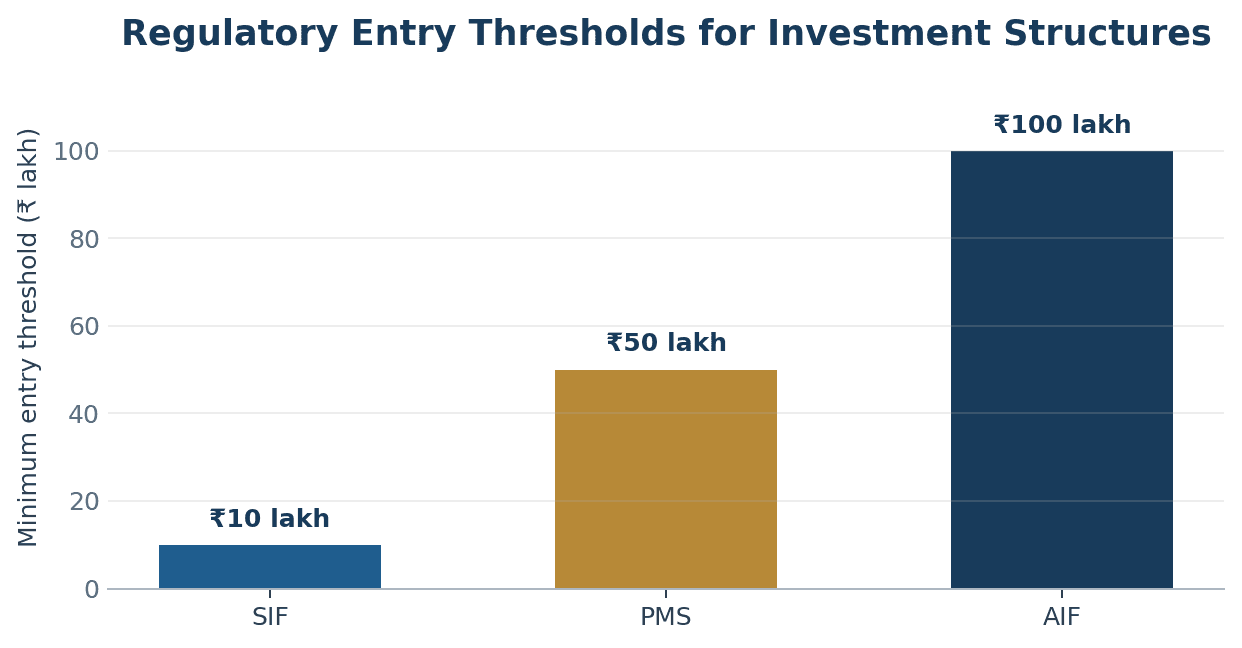
This requirement stays lower than ₹50 lakh needed for portfolio management services or ₹1 crore for alternative investment funds. The structure makes sophisticated strategies accessible to a broader investor segment while maintaining quality standards.

Strategy Flexibility

Traditional mutual funds typically follow long-only approaches. They profit when prices rise. Specialized Investment Funds employ advanced strategies that capture opportunities in various market conditions.

  • Long-Short Positions: Fund managers take both long positions buying assets expecting price increases and short positions through derivatives expecting price decreases. Short exposure remains capped at 25% of portfolio net assets.

  • Sector Rotation: These funds dynamically shift investments between different sectors based on market trends and economic cycles. Managers can position across a maximum of four sectors with tactical allocation adjustments.

  • Tactical Asset Allocation: SIFs rebalance portfolios across equity, debt, and alternative assets, responding to changing market conditions rather than maintaining static allocations.

Structural Options

Asset management companies can structure Specialized Investment Funds as open-ended or interval funds, depending on strategy type. Open-ended funds allow more frequent redemptions while interval funds specify periodic redemption windows.

The flexibility in structure enables AMCs to match fund design with underlying strategy requirements. Complex strategies requiring longer holding periods opt for interval structures with quarterly or less frequent redemption options.

Each specialized investment fund publishes detailed investment strategy documents outlining its approach, risk parameters, and liquidity terms. Investors should review these disclosures carefully before committing capital.

SEBI Regulations and Minimum Investment Requirements

The Securities and Exchange Board of India established specific guidelines governing Specialized Investment Funds to protect investor interests while enabling innovative strategies.

Minimum Investment Threshold

Regulation 49X of SEBI's Mutual Fund Regulations mandates ₹10 lakh minimum investment per investor. This requirement applies at the PAN level across all SIF strategies offered by a single asset management company. The threshold represents total commitment across multiple SIF schemes and does not include investments in regular mutual fund schemes.

Calculation occurs across all holdings rather than per scheme. If an investor holds three different SIF strategies under one AMC, the combined value must meet or exceed ₹10 lakh.

Accredited Investor Exemption

Individuals or entities qualifying as accredited investors under SEBI rules receive exemption from the ₹10 lakh minimum requirement. This provision acknowledges that certain sophisticated investors possess adequate financial knowledge and capacity regardless of investment amount.

Accredited investor criteria include specific net worth thresholds and professional qualifications. Investors should verify their eligibility status with the AMC before investing.

Systematic Plans Allowed

Asset management companies can offer systematic investment plans, systematic withdrawal plans, and systematic transfer plans under SIFs. The cumulative commitment through these systematic modes must satisfy the ₹10 lakh threshold unless the investor qualifies as accredited.

This flexibility enables investors to build positions gradually while meeting regulatory requirements. SIP facilities make Specialized Investment Funds more accessible despite higher minimum thresholds compared to traditional mutual funds.

Ongoing Compliance Monitoring

AMCs conduct daily monitoring to track continued compliance with minimum investment rules. Market fluctuations causing passive value decline below ₹10 lakh do not constitute violations. Active redemptions or transfers bringing holdings below threshold may require investor exit from the specialized investment fund.

Fund houses communicate compliance requirements clearly through investor documentation. Understanding these rules helps avoid unintended violations and associated consequences.

Investment Strategies Allowed Under SIFs

SEBI approved specific strategy categories for Specialized Investment Funds, each with defined exposure limits and asset allocation mandates.

Equity-Oriented Investment Strategies

These approaches primarily invest in listed equities with option to take short positions through derivatives.

1. Equity Long-Short Fund

Minimum 80% allocation goes to equities and equity-related instruments. Fund managers can take short exposure up to 25% through unhedged equity derivatives. The strategy captures both upward and downward price movements across the equity market.

These funds are structured as open-ended or interval funds with redemption frequency decided by the AMC. Daily liquidity may be available depending on fund design.

2. Equity Ex Top 100 Long-Short Fund

At least 65% investment targets stocks outside the top 100 companies by market capitalization. Short exposure up to 25% applies to mid and small-cap equities through derivatives. The approach exploits pricing inefficiencies in broader market segments beyond large-cap stocks.

Fund structure allows open-ended or interval design with AMC-determined redemption frequency. This specialized investment fund focuses on opportunities in mid and small-cap space while managing risk through short positions.

3. Sector Rotation Long-Short Fund

Minimum 80% allocation spreads across maximum four sectors with ability to rotate between them tactically. Short exposure reaches 25% at sector level through equity derivatives. Managers adjust sector weightings based on economic cycles and market trends.

The strategy generates returns through correct sector positioning rather than individual stock selection alone. Open-ended or interval structure supports this approach with flexible redemption terms.

Debt-Oriented Investment Strategies

Debt-focused Specialized Investment Funds provide exposure to fixed income instruments while permitting controlled short positions.

1. Debt Long-Short Fund

Core allocation spans fixed income instruments of various durations including government securities, corporate bonds, and money market instruments. Short exposure occurs via exchange-traded debt derivatives. The interval fund structure typically offers weekly redemption frequency or as decided by the AMC.

Interest rate and duration-based positioning drives returns in debt markets. Managers profit from correct predictions about interest rate movements and yield curve changes.

2. Sectoral Debt Long-Short Fund

Investment spreads across at least two sectors in debt markets with maximum 75% concentration in any single sector. Short exposure reaches 25% through unhedged derivative positions within specific sectors. Interval fund structure provides weekly or more frequent redemptions as specified by AMC.

The strategy generates returns through relative value analysis between different debt market sectors. Financial sector debt versus infrastructure debt positioning exemplifies this approach.

Hybrid Investment Strategies

Multi-asset approaches blend equity, debt, and alternatives with active allocation and shorting capabilities.

1. Active Asset Allocator Long-Short Fund

Investment spans equity, debt, equity and debt derivatives, REITs, InvITs, and commodity derivatives. Maximum 25% short exposure applies across equity and debt instruments via derivatives. The interval fund structure offers redemptions twice weekly or more frequent as per AMC discretion.

Dynamic portfolio rebalancing across asset classes responds to changing market conditions. Managers shift allocations between assets based on valuation metrics and economic outlook.

2. Hybrid Long-Short Fund

Minimum 25% allocation each to equity and debt instruments with balanced risk approach. Short exposure reaches 25% via unhedged derivative positions across both asset types. Interval fund structure provides twice weekly or more frequent redemptions.

This specialized investment fund maintains consistent exposure to both major asset classes while allowing tactical positioning through short positions. The balanced approach suits investors seeking equity growth potential with debt stability.

Each investment strategy comes with specific risk-return characteristics that investors should evaluate against their financial objectives and risk tolerance before committing capital.

How Do Specialized Investment Funds Work?

Specialized Investment Funds operate under SEBI mutual fund regulations as a distinct category offering strategy-specific schemes with enhanced flexibility.

Strategy Implementation Process

Asset management companies design each SIF around a specific investment thesis or market opportunity. Fund managers research sectors, securities, and market conditions to identify positions. Long positions involve buying securities expecting price appreciation. Short positions through derivatives anticipate price declines or hedge portfolio risk.

The investment process combines fundamental analysis, technical indicators, and macroeconomic assessment. Managers adjust positions as market conditions evolve while staying within prescribed exposure limits.

Portfolio Construction Approach

Fund managers build portfolios across various asset classes. Equity-oriented funds select stocks based on growth potential, valuation metrics, and sector trends. Debt-oriented strategies analyze credit quality, interest rate sensitivity, and duration characteristics.

  • Asset Class Diversification: SIFs can invest in listed equities, debt instruments, commodity derivatives, REITs, and InvITs depending on strategy mandate. This flexibility enables broader diversification than traditional mutual funds typically achieve.

  • Risk Management: Exposure limits prevent excessive concentration in any single security or sector. The 25% cap on unhedged short positions controls downside risk while allowing tactical positioning.

Operational Structure

Investors commit capital by purchasing units at prevailing net asset value. Fund size grows as more investors participate. AMCs calculate NAV daily or at specified intervals depending on fund structure.

Management fees and performance fees compensate the AMC and fund managers. Fee structures vary by strategy with some SIFs charging fixed fees while others combine fixed and performance-based components.

Liquidity Management

Open-ended SIFs provide more frequent redemption opportunities similar to regular mutual funds. Interval funds specify periodic redemption windows ranging from weekly to quarterly or longer. Notice periods up to 15 working days may apply before redemption requests process.

This structure allows fund managers to invest in less liquid securities without facing daily redemption pressure. Investors should align their liquidity needs with fund redemption terms before investing in any specialized investment fund.

Fund operations maintain transparency through regular disclosures including portfolio holdings, performance reports, and risk metrics. SEBI regulations mandate detailed investor communications to support informed decision-making.

Benefits of Investing in SIFs

Specialized Investment Funds offer several advantages for investors seeking differentiated exposure within a regulated framework.

1. Access to Sophisticated Strategies

Traditional mutual funds typically follow long-only approaches with limited flexibility. SIFs provide access to advanced techniques like long-short equity, tactical asset allocation, and sector rotation normally available only through portfolio management services or alternative investment funds.

2. Professional Management with Regulatory Oversight

Experienced fund managers handle investment decisions backed by research teams and analytical capabilities. Unlike unregulated investment vehicles, SIFs operate under SEBI mutual fund regulations, providing investor protection and transparency requirements.

3. Broader Asset Class Exposure

These funds invest across equities, debt, derivatives, REITs, InvITs, and commodities. Diversification across multiple asset classes reduces dependence on any single market segment. Portfolio stability improves through uncorrelated return sources.

4. Lower Entry Threshold Than PMS

Portfolio management services typically require ₹50 lakh minimum investment while alternative investment funds need ₹1 crore. The ₹10 lakh threshold for SIFs makes sophisticated strategies accessible to a wider investor base while maintaining quality standards.

5. Potential for Enhanced Returns

Short-selling capabilities, dynamic rebalancing, and flexibility in asset allocation enable fund managers to generate returns even in volatile or declining markets. Active management seeks to outperform benchmark indices through tactical positioning.

6. Customized Risk-Return Profiles

Different specialized investment fund strategies cater to varying risk appetites and return objectives. Equity-focused funds target higher growth while hybrid approaches balance risk. Investors can select strategies matching their financial goals.

7. Systematic Investment Options

SIP facilities allow gradual portfolio building despite higher minimum thresholds. Investors benefit from rupee cost averaging while accessing sophisticated strategies normally requiring large lump sum investments.

These advantages must be weighed against associated risks and investment requirements. Specialized Investment Funds suit specific investor profiles and may not be appropriate for everyone seeking market exposure.

Risks Associated with Specialized Investment Funds

Understanding potential risks helps investors make informed decisions about specialized investment fund allocations.

1. Market and Strategy Risk

SIFs remain subject to equity market volatility, interest rate fluctuations, and credit risks like all market-linked products. Short positions can amplify losses if markets move contrary to manager's expectations. Strategy execution depends heavily on fund manager skill and judgment.

Sector rotation strategies face timing risk. Tactical allocation changes may prove incorrect. Derivatives usage introduces leverage and complexity increasing potential losses.

2. Liquidity Constraints

Redemption windows range from daily to quarterly or longer depending on fund structure. Some SIFs impose notice periods up to 15 working days before processing withdrawals. Exit loads may apply, reducing net returns.

Investors needing quick access to capital may face challenges. Less frequent liquidity makes specialized investment funds unsuitable for short-term goals or emergency fund purposes.

3. Higher Minimum Investment

The ₹10 lakh threshold restricts participation to investors with substantial capital. Concentration risk increases as investors commit larger amounts to single fund strategies. Diversification across multiple investments becomes more difficult with higher minimums.

4. Complexity and Understanding Requirements

Advanced strategies involving derivatives, short positions, and multi-asset allocation require a sophisticated understanding. Investors must comprehend how these mechanisms work and their risk implications. Lack of knowledge can lead to unsuitable investment decisions.

5. Performance Dependency on Manager Skill

Returns depend significantly on fund manager expertise and decision-making quality. Manager changes can impact strategy execution and performance. Past performance provides no guarantee of future results especially with new fund launches.

6. Regulatory and Operational Risks

Changes in SEBI regulations may affect fund operations and strategy implementation. Tax treatment of SIF returns may differ from traditional mutual funds. Investors should stay informed about regulatory developments.

7. Exit Barriers

During periods of market stress or strategy underperformance, redemption queues may develop. Interval funds with fixed redemption windows provide less flexibility than open-ended structures. These factors can trap capital longer than anticipated.

Careful risk assessment against financial objectives and personal circumstances remains essential before investing in any specialized investment fund. Consulting SEBI-registered financial advisors provides guidance on suitability and portfolio allocation.

Specialized Investment Funds vs Traditional Mutual Funds

Understanding key differences helps investors determine appropriate investment vehicles for their financial goals.

Feature

Specialized Investment Funds

Traditional Mutual Funds

Investor Eligibility

Minimum ₹10 lakh investment at PAN level; targets HNIs and accredited investors

Starts from ₹100-₹500; open to all retail investors

Investment Approach

Long-short equity, tactical allocation, sector rotation with derivatives

Primarily long-only equity, debt, or hybrid strategies

Strategy Flexibility

Fund managers have greater freedom for complex strategies

Limited by predefined investment mandates and SEBI category definitions

Liquidity

Daily to quarterly redemptions with potential notice periods up to 15 days

Typically daily liquidity for open-ended schemes

Short Selling

Permitted up to 25% through unhedged derivatives

Generally not allowed except in specific categories

Asset Class Range

Equity, debt, derivatives, REITs, InvITs, commodities

Primarily stocks and bonds with limited alternatives

Risk Profile

Higher due to leverage, short positions, concentrated strategies

Moderate to high depending on fund category

Regulatory Framework

SEBI Mutual Fund Regulations with special SIF provisions

SEBI Mutual Fund Regulations standard categories

Target Audience

Experienced investors comfortable with volatility and lower liquidity

Suitable for beginners to advanced investors

Return Potential

Aims for higher returns through complex strategies with increased risk

Market-linked returns based on asset class and fund management

The choice between specialized investment funds and traditional mutual funds depends on investor sophistication, capital availability, risk tolerance, and liquidity requirements. Many investors hold both types as part of diversified portfolios.

Traditional mutual funds serve as core holdings providing broad market exposure with daily liquidity. Specialized investment funds can complement core holdings for investors seeking tactical strategies and enhanced return potential within acceptable risk parameters.

Who Should Invest in Specialized Investment Funds?

Specialized Investment Funds suit specific investor profiles with particular characteristics and financial situations.

Suitable Investor Profiles

  1. High-Net-Worth Individuals: Investors with surplus capital of ₹10 lakh or more who can commit funds for longer horizons. These individuals typically have diversified portfolios and seek additional growth opportunities through sophisticated strategies.

  2. Experienced Market Participants: Those with understanding of complex products including derivatives, long-short positions, and asset allocation shifts. Previous investment experience helps evaluate strategy risks and return potential.

  3. Risk-Tolerant Investors: Individuals comfortable with higher volatility, potential capital loss, and market fluctuations. Risk appetite should match the aggressive nature of some SIF strategies particularly those using leverage and short positions.

  4. Investors Seeking Diversification: Those looking to expand beyond traditional mutual fund offerings into strategies not typically available through conventional products. Specialized investment funds add different return sources to existing portfolios.

  5. Long-Term Capital Allocators: Investors who can commit capital for extended periods matching fund redemption terms. Short-term traders and those needing frequent liquidity should avoid SIFs with restricted redemption windows.

Decision Framework

Potential investors should evaluate several factors before committing to specialized investment funds. 

  • Financial goals and investment horizon must align with fund structure and strategy.

  • Risk capacity should match potential volatility and leverage usage.

  • Liquidity needs require assessment against redemption terms and notice periods.

  • Portfolio diversification benefits should justify the concentration risk from larger minimum investments. 

  • Professional financial advice helps determine appropriate allocation percentages within overall investment portfolios.

Understanding one's investor profile helps make suitable choices between traditional mutual funds and specialized investment funds for optimal portfolio construction.

Why Should You Choose Ckredence Wealth for Specialized Investment Advisory?

High-net-worth investors exploring specialized investment opportunities need experienced wealth management partners. Your current investment approach may not address sophisticated strategy requirements. Ckredence Wealth helps you access and evaluate investment options matching your financial goals.

Expertise in Sophisticated Investment Solutions

We understand complex investment products including specialized investment funds, portfolio management services, and alternative strategies. Our team provides guidance on strategy selection, risk assessment, and portfolio allocation across various investment vehicles.

Key Capabilities:

  • SEBI-registered professional advisory with 37 years of wealth management legacy

  • Multiple portfolio management strategies covering diverse market conditions and investor goals

  • Personalized investment approaches aligned with your risk profile and return objectives

Proven Track Record in Wealth Management

Client Assets: ₹805+ Crores managed with focus on capital preservation and growth across market cycles

Investment Expertise: Experience spanning equities, debt, alternative investments, and tactical strategies

Client Base: 376+ active clients trusting our wealth management guidance and execution

Professional Investment Advisory Services

Our SEBI-registered advisors help you understand specialized investment funds and their role in your portfolio. We analyze strategy risks, liquidity terms, and suitability based on your financial situation. Transparent fee structures and performance alignment keep interests matched.

Advisory Benefits:

  • Comprehensive portfolio design based on detailed risk profiling

  • Regular performance reviews and strategy adjustments as markets evolve

  • Dedicated relationship managers providing ongoing support and market insights

Smart investors need informed guidance on emerging investment categories. Ckredence Wealth brings decades of experience helping high-net-worth individuals build wealth through research-backed strategies and professional management.

Whether you're evaluating specialized investment funds or other sophisticated options, our team provides clarity and actionable recommendations aligned with your long-term financial objectives.

Ready to explore specialized investment opportunities? Schedule a Consultation with our wealth advisory team.

Conclusion

Successful SIF investing demands understanding of strategy mechanisms, risk parameters, and personal suitability. These products add value to diversified portfolios when selected appropriately. Professional financial guidance helps determine optimal allocation percentages and strategy selection aligned with individual circumstances and market outlook.

FAQs

What is the minimum investment required for specialized investment funds?

The minimum investment for specialized investment funds is ₹10 lakh per investor. This requirement applies at PAN level across all SIF strategies within a single asset management company. Accredited investors receive exemption from this threshold under SEBI regulations.

How do specialized investment funds differ from traditional mutual funds?

Specialized investment funds allow long-short strategies, sector rotation, and tactical asset allocation unlike traditional mutual funds. SIFs can take unhedged short positions up to 25% through derivatives. They target experienced investors with ₹10 lakh minimum while traditional funds start at ₹100.

Can I invest in SIFs through systematic investment plans?

Yes, asset management companies offer SIP facilities for specialized investment funds. The cumulative commitment through systematic plans must meet the ₹10 lakh minimum threshold. This applies unless the investor qualifies as an accredited investor under SEBI guidelines.

What are the main risks of investing in specialized investment funds?

SIFs carry market risk, liquidity constraints, and strategy execution risk. Short positions and leverage can amplify losses during adverse market movements. Redemption frequency varies from daily to quarterly with potential notice periods up to 15 working days affecting liquidity.


India's mutual fund industry managed assets worth ₹81.32 trillion as of November 2025, reflecting growing investor confidence in professionally managed investment products (Source: AMFI). Yet, a significant gap existed between traditional mutual funds and high-ticket portfolio management services. 

High-net-worth investors seeking sophisticated strategies often found mutual funds too restrictive, while PMS required commitments of ₹50 lakh or more.

This positioning challenge prompted SEBI to introduce a new category. Investment choices now expand beyond conventional options.

  • Are you looking for investment flexibility that mutual funds don't provide, but cannot commit ₹50 lakh to PMS?

  • Do current market-linked products fail to match your risk appetite and return expectations as an experienced investor?

  • Can specialized investment strategies bridge the gap between traditional mutual funds and portfolio management services effectively?

The Securities and Exchange Board of India addressed these concerns by launching Specialized Investment Funds on April 1, 2025. These SEBI-regulated investment vehicles offer strategy-driven approaches, including long-short positions, sector rotation, and tactical asset allocation. 

With a ₹10 lakh minimum investment threshold, SIFs cater to investors seeking advanced portfolio management within a structured regulatory framework. Understanding this new investment category helps high-net-worth individuals make informed capital allocation decisions.

Key Takeaways

  • Specialized Investment Funds bridge traditional mutual funds and portfolio management services with flexible strategy-driven approaches

  • Minimum investment starts at ₹10 lakh per investor, calculated at the  PAN level across all SIF strategies withina  single AMC

  • Fund managers can take long-short positions up to 25% through unhedged derivatives, unlike traditional mutual funds

  • Investment strategies span equity-oriented, debt-oriented, and hybrid approaches with varying liquidity terms

  • Redemption frequency varies from daily to quarterl,y with potential notice periods up to 15 working days

  • SIFs suit experienced investors comfortable with higher volatility and lower liquidity compared to regular mutual funds

  • Accredited investors qualify for exemption fromthe  minimum investment threshold under SEBI regulations

What is a Specialized Investment Fund (SIF)?

A Specialized Investment Fund refers to a SEBI-regulated investment category launched under mutual fund regulations effective April 1, 2025. These funds allow asset management companies to offer strategy-focused schemes with greater portfolio flexibility than traditional mutual funds.

SIFs serve investors seeking advanced asset allocation methods within a regulated framework. Fund managers can employ complex investment strategies, including long-short equity, sector-based positioning, and active asset allocation. These schemes permit unhedged short positions up to 25% of portfolio value using derivatives.

The ₹10 lakh minimum investment requirement applies per investor at the PAN level across all SIF strategies under a single AMC. This threshold ensures investors possess the financial capacity to engage with sophisticated products that may have lower liquidity. Accredited investors receive an exemption from this minimum threshold under SEBI guidelines.

Regulatory Framework

SEBI governs Specialized Investment Funds under the Mutual Fund Regulations of 1996. AMCs must maintain strict disclosure norms and risk labeling ranging from bands 1 to 5. Listed interval or closed-end SIFs require compliance with additional listing requirements.

These regulatory safeguards provide investor protection while allowing fund managers operational flexibility. The framework balances innovation with oversight to maintain market integrity.

Key Features of Specialized Investment Funds

Specialized Investment Funds distinguish themselves through several defining characteristics that differentiate them from conventional mutual fund offerings.

Targeted Investor Base

SIFs design their investment approach for individuals with substantial capital and better market understanding. The minimum investment threshold stands at ₹10 lakh aggregated across all SIF strategies within a single AMC at PAN level.

This requirement stays lower than ₹50 lakh needed for portfolio management services or ₹1 crore for alternative investment funds. The structure makes sophisticated strategies accessible to a broader investor segment while maintaining quality standards.

Strategy Flexibility

Traditional mutual funds typically follow long-only approaches. They profit when prices rise. Specialized Investment Funds employ advanced strategies that capture opportunities in various market conditions.

  • Long-Short Positions: Fund managers take both long positions buying assets expecting price increases and short positions through derivatives expecting price decreases. Short exposure remains capped at 25% of portfolio net assets.

  • Sector Rotation: These funds dynamically shift investments between different sectors based on market trends and economic cycles. Managers can position across a maximum of four sectors with tactical allocation adjustments.

  • Tactical Asset Allocation: SIFs rebalance portfolios across equity, debt, and alternative assets, responding to changing market conditions rather than maintaining static allocations.

Structural Options

Asset management companies can structure Specialized Investment Funds as open-ended or interval funds, depending on strategy type. Open-ended funds allow more frequent redemptions while interval funds specify periodic redemption windows.

The flexibility in structure enables AMCs to match fund design with underlying strategy requirements. Complex strategies requiring longer holding periods opt for interval structures with quarterly or less frequent redemption options.

Each specialized investment fund publishes detailed investment strategy documents outlining its approach, risk parameters, and liquidity terms. Investors should review these disclosures carefully before committing capital.

SEBI Regulations and Minimum Investment Requirements

The Securities and Exchange Board of India established specific guidelines governing Specialized Investment Funds to protect investor interests while enabling innovative strategies.

Minimum Investment Threshold

Regulation 49X of SEBI's Mutual Fund Regulations mandates ₹10 lakh minimum investment per investor. This requirement applies at the PAN level across all SIF strategies offered by a single asset management company. The threshold represents total commitment across multiple SIF schemes and does not include investments in regular mutual fund schemes.

Calculation occurs across all holdings rather than per scheme. If an investor holds three different SIF strategies under one AMC, the combined value must meet or exceed ₹10 lakh.

Accredited Investor Exemption

Individuals or entities qualifying as accredited investors under SEBI rules receive exemption from the ₹10 lakh minimum requirement. This provision acknowledges that certain sophisticated investors possess adequate financial knowledge and capacity regardless of investment amount.

Accredited investor criteria include specific net worth thresholds and professional qualifications. Investors should verify their eligibility status with the AMC before investing.

Systematic Plans Allowed

Asset management companies can offer systematic investment plans, systematic withdrawal plans, and systematic transfer plans under SIFs. The cumulative commitment through these systematic modes must satisfy the ₹10 lakh threshold unless the investor qualifies as accredited.

This flexibility enables investors to build positions gradually while meeting regulatory requirements. SIP facilities make Specialized Investment Funds more accessible despite higher minimum thresholds compared to traditional mutual funds.

Ongoing Compliance Monitoring

AMCs conduct daily monitoring to track continued compliance with minimum investment rules. Market fluctuations causing passive value decline below ₹10 lakh do not constitute violations. Active redemptions or transfers bringing holdings below threshold may require investor exit from the specialized investment fund.

Fund houses communicate compliance requirements clearly through investor documentation. Understanding these rules helps avoid unintended violations and associated consequences.

Investment Strategies Allowed Under SIFs

SEBI approved specific strategy categories for Specialized Investment Funds, each with defined exposure limits and asset allocation mandates.

Equity-Oriented Investment Strategies

These approaches primarily invest in listed equities with option to take short positions through derivatives.

1. Equity Long-Short Fund

Minimum 80% allocation goes to equities and equity-related instruments. Fund managers can take short exposure up to 25% through unhedged equity derivatives. The strategy captures both upward and downward price movements across the equity market.

These funds are structured as open-ended or interval funds with redemption frequency decided by the AMC. Daily liquidity may be available depending on fund design.

2. Equity Ex Top 100 Long-Short Fund

At least 65% investment targets stocks outside the top 100 companies by market capitalization. Short exposure up to 25% applies to mid and small-cap equities through derivatives. The approach exploits pricing inefficiencies in broader market segments beyond large-cap stocks.

Fund structure allows open-ended or interval design with AMC-determined redemption frequency. This specialized investment fund focuses on opportunities in mid and small-cap space while managing risk through short positions.

3. Sector Rotation Long-Short Fund

Minimum 80% allocation spreads across maximum four sectors with ability to rotate between them tactically. Short exposure reaches 25% at sector level through equity derivatives. Managers adjust sector weightings based on economic cycles and market trends.

The strategy generates returns through correct sector positioning rather than individual stock selection alone. Open-ended or interval structure supports this approach with flexible redemption terms.

Debt-Oriented Investment Strategies

Debt-focused Specialized Investment Funds provide exposure to fixed income instruments while permitting controlled short positions.

1. Debt Long-Short Fund

Core allocation spans fixed income instruments of various durations including government securities, corporate bonds, and money market instruments. Short exposure occurs via exchange-traded debt derivatives. The interval fund structure typically offers weekly redemption frequency or as decided by the AMC.

Interest rate and duration-based positioning drives returns in debt markets. Managers profit from correct predictions about interest rate movements and yield curve changes.

2. Sectoral Debt Long-Short Fund

Investment spreads across at least two sectors in debt markets with maximum 75% concentration in any single sector. Short exposure reaches 25% through unhedged derivative positions within specific sectors. Interval fund structure provides weekly or more frequent redemptions as specified by AMC.

The strategy generates returns through relative value analysis between different debt market sectors. Financial sector debt versus infrastructure debt positioning exemplifies this approach.

Hybrid Investment Strategies

Multi-asset approaches blend equity, debt, and alternatives with active allocation and shorting capabilities.

1. Active Asset Allocator Long-Short Fund

Investment spans equity, debt, equity and debt derivatives, REITs, InvITs, and commodity derivatives. Maximum 25% short exposure applies across equity and debt instruments via derivatives. The interval fund structure offers redemptions twice weekly or more frequent as per AMC discretion.

Dynamic portfolio rebalancing across asset classes responds to changing market conditions. Managers shift allocations between assets based on valuation metrics and economic outlook.

2. Hybrid Long-Short Fund

Minimum 25% allocation each to equity and debt instruments with balanced risk approach. Short exposure reaches 25% via unhedged derivative positions across both asset types. Interval fund structure provides twice weekly or more frequent redemptions.

This specialized investment fund maintains consistent exposure to both major asset classes while allowing tactical positioning through short positions. The balanced approach suits investors seeking equity growth potential with debt stability.

Each investment strategy comes with specific risk-return characteristics that investors should evaluate against their financial objectives and risk tolerance before committing capital.

How Do Specialized Investment Funds Work?

Specialized Investment Funds operate under SEBI mutual fund regulations as a distinct category offering strategy-specific schemes with enhanced flexibility.

Strategy Implementation Process

Asset management companies design each SIF around a specific investment thesis or market opportunity. Fund managers research sectors, securities, and market conditions to identify positions. Long positions involve buying securities expecting price appreciation. Short positions through derivatives anticipate price declines or hedge portfolio risk.

The investment process combines fundamental analysis, technical indicators, and macroeconomic assessment. Managers adjust positions as market conditions evolve while staying within prescribed exposure limits.

Portfolio Construction Approach

Fund managers build portfolios across various asset classes. Equity-oriented funds select stocks based on growth potential, valuation metrics, and sector trends. Debt-oriented strategies analyze credit quality, interest rate sensitivity, and duration characteristics.

  • Asset Class Diversification: SIFs can invest in listed equities, debt instruments, commodity derivatives, REITs, and InvITs depending on strategy mandate. This flexibility enables broader diversification than traditional mutual funds typically achieve.

  • Risk Management: Exposure limits prevent excessive concentration in any single security or sector. The 25% cap on unhedged short positions controls downside risk while allowing tactical positioning.

Operational Structure

Investors commit capital by purchasing units at prevailing net asset value. Fund size grows as more investors participate. AMCs calculate NAV daily or at specified intervals depending on fund structure.

Management fees and performance fees compensate the AMC and fund managers. Fee structures vary by strategy with some SIFs charging fixed fees while others combine fixed and performance-based components.

Liquidity Management

Open-ended SIFs provide more frequent redemption opportunities similar to regular mutual funds. Interval funds specify periodic redemption windows ranging from weekly to quarterly or longer. Notice periods up to 15 working days may apply before redemption requests process.

This structure allows fund managers to invest in less liquid securities without facing daily redemption pressure. Investors should align their liquidity needs with fund redemption terms before investing in any specialized investment fund.

Fund operations maintain transparency through regular disclosures including portfolio holdings, performance reports, and risk metrics. SEBI regulations mandate detailed investor communications to support informed decision-making.

Benefits of Investing in SIFs

Specialized Investment Funds offer several advantages for investors seeking differentiated exposure within a regulated framework.

1. Access to Sophisticated Strategies

Traditional mutual funds typically follow long-only approaches with limited flexibility. SIFs provide access to advanced techniques like long-short equity, tactical asset allocation, and sector rotation normally available only through portfolio management services or alternative investment funds.

2. Professional Management with Regulatory Oversight

Experienced fund managers handle investment decisions backed by research teams and analytical capabilities. Unlike unregulated investment vehicles, SIFs operate under SEBI mutual fund regulations, providing investor protection and transparency requirements.

3. Broader Asset Class Exposure

These funds invest across equities, debt, derivatives, REITs, InvITs, and commodities. Diversification across multiple asset classes reduces dependence on any single market segment. Portfolio stability improves through uncorrelated return sources.

4. Lower Entry Threshold Than PMS

Portfolio management services typically require ₹50 lakh minimum investment while alternative investment funds need ₹1 crore. The ₹10 lakh threshold for SIFs makes sophisticated strategies accessible to a wider investor base while maintaining quality standards.

5. Potential for Enhanced Returns

Short-selling capabilities, dynamic rebalancing, and flexibility in asset allocation enable fund managers to generate returns even in volatile or declining markets. Active management seeks to outperform benchmark indices through tactical positioning.

6. Customized Risk-Return Profiles

Different specialized investment fund strategies cater to varying risk appetites and return objectives. Equity-focused funds target higher growth while hybrid approaches balance risk. Investors can select strategies matching their financial goals.

7. Systematic Investment Options

SIP facilities allow gradual portfolio building despite higher minimum thresholds. Investors benefit from rupee cost averaging while accessing sophisticated strategies normally requiring large lump sum investments.

These advantages must be weighed against associated risks and investment requirements. Specialized Investment Funds suit specific investor profiles and may not be appropriate for everyone seeking market exposure.

Risks Associated with Specialized Investment Funds

Understanding potential risks helps investors make informed decisions about specialized investment fund allocations.

1. Market and Strategy Risk

SIFs remain subject to equity market volatility, interest rate fluctuations, and credit risks like all market-linked products. Short positions can amplify losses if markets move contrary to manager's expectations. Strategy execution depends heavily on fund manager skill and judgment.

Sector rotation strategies face timing risk. Tactical allocation changes may prove incorrect. Derivatives usage introduces leverage and complexity increasing potential losses.

2. Liquidity Constraints

Redemption windows range from daily to quarterly or longer depending on fund structure. Some SIFs impose notice periods up to 15 working days before processing withdrawals. Exit loads may apply, reducing net returns.

Investors needing quick access to capital may face challenges. Less frequent liquidity makes specialized investment funds unsuitable for short-term goals or emergency fund purposes.

3. Higher Minimum Investment

The ₹10 lakh threshold restricts participation to investors with substantial capital. Concentration risk increases as investors commit larger amounts to single fund strategies. Diversification across multiple investments becomes more difficult with higher minimums.

4. Complexity and Understanding Requirements

Advanced strategies involving derivatives, short positions, and multi-asset allocation require a sophisticated understanding. Investors must comprehend how these mechanisms work and their risk implications. Lack of knowledge can lead to unsuitable investment decisions.

5. Performance Dependency on Manager Skill

Returns depend significantly on fund manager expertise and decision-making quality. Manager changes can impact strategy execution and performance. Past performance provides no guarantee of future results especially with new fund launches.

6. Regulatory and Operational Risks

Changes in SEBI regulations may affect fund operations and strategy implementation. Tax treatment of SIF returns may differ from traditional mutual funds. Investors should stay informed about regulatory developments.

7. Exit Barriers

During periods of market stress or strategy underperformance, redemption queues may develop. Interval funds with fixed redemption windows provide less flexibility than open-ended structures. These factors can trap capital longer than anticipated.

Careful risk assessment against financial objectives and personal circumstances remains essential before investing in any specialized investment fund. Consulting SEBI-registered financial advisors provides guidance on suitability and portfolio allocation.

Specialized Investment Funds vs Traditional Mutual Funds

Understanding key differences helps investors determine appropriate investment vehicles for their financial goals.

Feature

Specialized Investment Funds

Traditional Mutual Funds

Investor Eligibility

Minimum ₹10 lakh investment at PAN level; targets HNIs and accredited investors

Starts from ₹100-₹500; open to all retail investors

Investment Approach

Long-short equity, tactical allocation, sector rotation with derivatives

Primarily long-only equity, debt, or hybrid strategies

Strategy Flexibility

Fund managers have greater freedom for complex strategies

Limited by predefined investment mandates and SEBI category definitions

Liquidity

Daily to quarterly redemptions with potential notice periods up to 15 days

Typically daily liquidity for open-ended schemes

Short Selling

Permitted up to 25% through unhedged derivatives

Generally not allowed except in specific categories

Asset Class Range

Equity, debt, derivatives, REITs, InvITs, commodities

Primarily stocks and bonds with limited alternatives

Risk Profile

Higher due to leverage, short positions, concentrated strategies

Moderate to high depending on fund category

Regulatory Framework

SEBI Mutual Fund Regulations with special SIF provisions

SEBI Mutual Fund Regulations standard categories

Target Audience

Experienced investors comfortable with volatility and lower liquidity

Suitable for beginners to advanced investors

Return Potential

Aims for higher returns through complex strategies with increased risk

Market-linked returns based on asset class and fund management

The choice between specialized investment funds and traditional mutual funds depends on investor sophistication, capital availability, risk tolerance, and liquidity requirements. Many investors hold both types as part of diversified portfolios.

Traditional mutual funds serve as core holdings providing broad market exposure with daily liquidity. Specialized investment funds can complement core holdings for investors seeking tactical strategies and enhanced return potential within acceptable risk parameters.

Who Should Invest in Specialized Investment Funds?

Specialized Investment Funds suit specific investor profiles with particular characteristics and financial situations.

Suitable Investor Profiles

  1. High-Net-Worth Individuals: Investors with surplus capital of ₹10 lakh or more who can commit funds for longer horizons. These individuals typically have diversified portfolios and seek additional growth opportunities through sophisticated strategies.

  2. Experienced Market Participants: Those with understanding of complex products including derivatives, long-short positions, and asset allocation shifts. Previous investment experience helps evaluate strategy risks and return potential.

  3. Risk-Tolerant Investors: Individuals comfortable with higher volatility, potential capital loss, and market fluctuations. Risk appetite should match the aggressive nature of some SIF strategies particularly those using leverage and short positions.

  4. Investors Seeking Diversification: Those looking to expand beyond traditional mutual fund offerings into strategies not typically available through conventional products. Specialized investment funds add different return sources to existing portfolios.

  5. Long-Term Capital Allocators: Investors who can commit capital for extended periods matching fund redemption terms. Short-term traders and those needing frequent liquidity should avoid SIFs with restricted redemption windows.

Decision Framework

Potential investors should evaluate several factors before committing to specialized investment funds. 

  • Financial goals and investment horizon must align with fund structure and strategy.

  • Risk capacity should match potential volatility and leverage usage.

  • Liquidity needs require assessment against redemption terms and notice periods.

  • Portfolio diversification benefits should justify the concentration risk from larger minimum investments. 

  • Professional financial advice helps determine appropriate allocation percentages within overall investment portfolios.

Understanding one's investor profile helps make suitable choices between traditional mutual funds and specialized investment funds for optimal portfolio construction.

Why Should You Choose Ckredence Wealth for Specialized Investment Advisory?

High-net-worth investors exploring specialized investment opportunities need experienced wealth management partners. Your current investment approach may not address sophisticated strategy requirements. Ckredence Wealth helps you access and evaluate investment options matching your financial goals.

Expertise in Sophisticated Investment Solutions

We understand complex investment products including specialized investment funds, portfolio management services, and alternative strategies. Our team provides guidance on strategy selection, risk assessment, and portfolio allocation across various investment vehicles.

Key Capabilities:

  • SEBI-registered professional advisory with 37 years of wealth management legacy

  • Multiple portfolio management strategies covering diverse market conditions and investor goals

  • Personalized investment approaches aligned with your risk profile and return objectives

Proven Track Record in Wealth Management

Client Assets: ₹805+ Crores managed with focus on capital preservation and growth across market cycles

Investment Expertise: Experience spanning equities, debt, alternative investments, and tactical strategies

Client Base: 376+ active clients trusting our wealth management guidance and execution

Professional Investment Advisory Services

Our SEBI-registered advisors help you understand specialized investment funds and their role in your portfolio. We analyze strategy risks, liquidity terms, and suitability based on your financial situation. Transparent fee structures and performance alignment keep interests matched.

Advisory Benefits:

  • Comprehensive portfolio design based on detailed risk profiling

  • Regular performance reviews and strategy adjustments as markets evolve

  • Dedicated relationship managers providing ongoing support and market insights

Smart investors need informed guidance on emerging investment categories. Ckredence Wealth brings decades of experience helping high-net-worth individuals build wealth through research-backed strategies and professional management.

Whether you're evaluating specialized investment funds or other sophisticated options, our team provides clarity and actionable recommendations aligned with your long-term financial objectives.

Ready to explore specialized investment opportunities? Schedule a Consultation with our wealth advisory team.

Conclusion

Successful SIF investing demands understanding of strategy mechanisms, risk parameters, and personal suitability. These products add value to diversified portfolios when selected appropriately. Professional financial guidance helps determine optimal allocation percentages and strategy selection aligned with individual circumstances and market outlook.

FAQs

What is the minimum investment required for specialized investment funds?

The minimum investment for specialized investment funds is ₹10 lakh per investor. This requirement applies at PAN level across all SIF strategies within a single asset management company. Accredited investors receive exemption from this threshold under SEBI regulations.

How do specialized investment funds differ from traditional mutual funds?

Specialized investment funds allow long-short strategies, sector rotation, and tactical asset allocation unlike traditional mutual funds. SIFs can take unhedged short positions up to 25% through derivatives. They target experienced investors with ₹10 lakh minimum while traditional funds start at ₹100.

Can I invest in SIFs through systematic investment plans?

Yes, asset management companies offer SIP facilities for specialized investment funds. The cumulative commitment through systematic plans must meet the ₹10 lakh minimum threshold. This applies unless the investor qualifies as an accredited investor under SEBI guidelines.

What are the main risks of investing in specialized investment funds?

SIFs carry market risk, liquidity constraints, and strategy execution risk. Short positions and leverage can amplify losses during adverse market movements. Redemption frequency varies from daily to quarterly with potential notice periods up to 15 working days affecting liquidity.