9min Read

9min Read

Multi Family Office India: 2026 Guide for UHNW Families

Multi Family Office India: 2026 Guide for UHNW Families

Multi Family Office India: 2026 Guide for UHNW Families

Most UHNW families outgrow fragmented advisors before they realise it. Learn how multi family offices in India provide governance, succession, and wealth clarity.

Most UHNW families outgrow fragmented advisors before they realise it. Learn how multi family offices in India provide governance, succession, and wealth clarity.

Most UHNW families outgrow fragmented advisors before they realise it. Learn how multi family offices in India provide governance, succession, and wealth clarity.

Ckredence Wealth

Ckredence Wealth

|

May 25, 2026

May 25, 2026

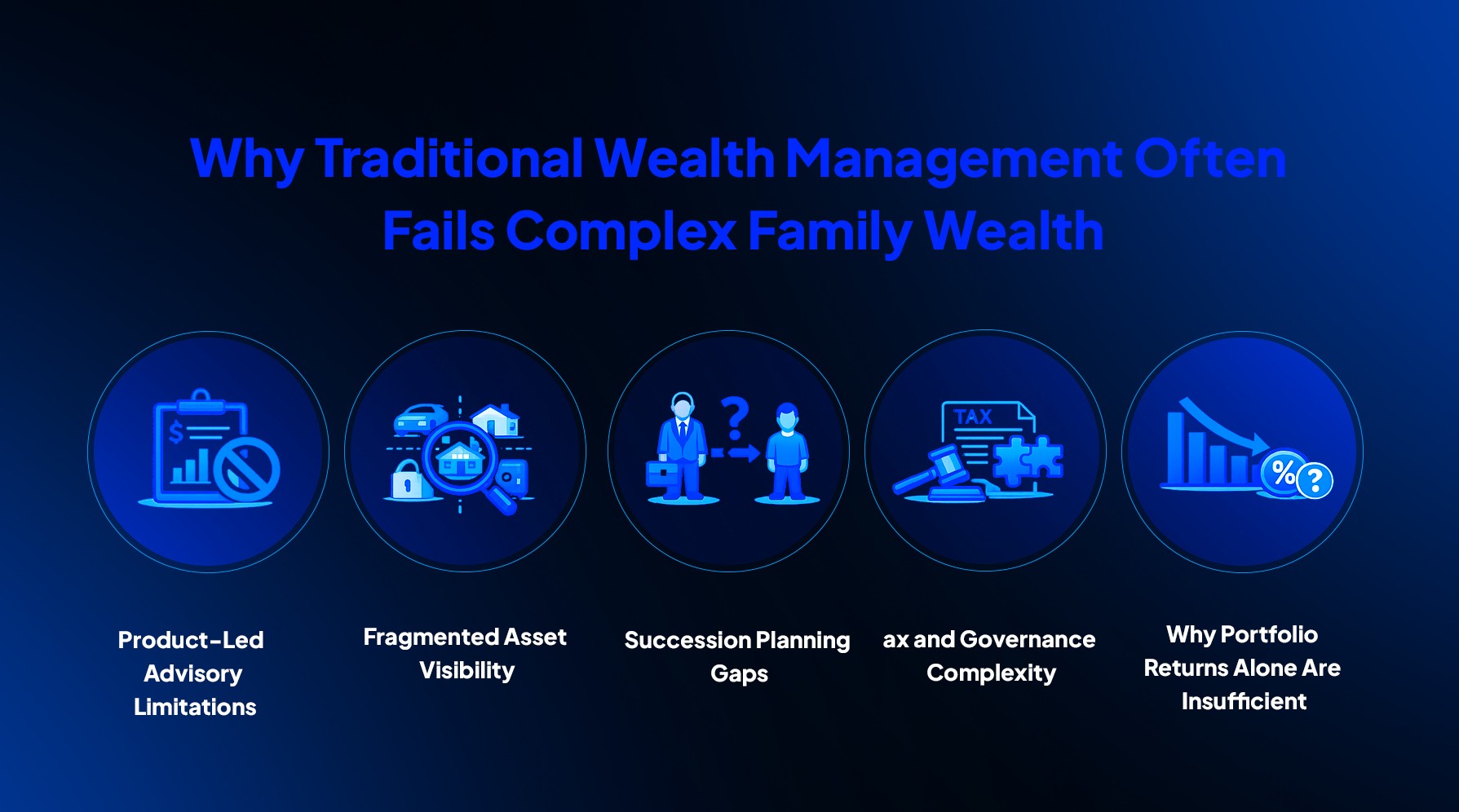
Traditional wealth management challenges infographic showing fragmented asset visibility, succession gaps, tax complexity, and governance risks for family wealth.

India's family office market reached USD 673.3 million in 2024 and is projected to grow to USD 972.6 million by 2033, according to IMARC Group. That growth is being driven by one structural reality: India's UHNW wealth is becoming too complex for traditional wealth management alone.

The number of family offices in India grew from just 45 in 2018 to nearly 300 by 2024, according to a joint study by Julius Baer and EY, with an estimated USD 1.3 trillion in intergenerational wealth transfer expected over the next decade.

For Indian UHNW families managing wealth across businesses, real estate, public equities, private holdings, trusts, and global assets, fragmented advisory structures create governance gaps that compound over time.

The multi family office India model addresses this by bringing investment oversight, succession planning, tax coordination, family governance, and consolidated reporting under one institutional framework. For promoter families, NRIs, and multi-generational wealth holders, that consolidation is no longer optional.

Key Takeaways

  • Multi family offices help UHNW families manage investments, governance, succession, and reporting together.

  • MFOs differ from private banks because they focus on consolidated advisory, not product distribution alone.

  • Family governance is becoming as important as investment management for Indian UHNW families.

  • Succession planning, tax coordination, and asset visibility are core MFO functions.

  • MFO structures are increasingly relevant for business-owner families and NRIs with cross-border exposure.

  • Indian family wealth management is shifting toward governance-led advisory in 2026.

  • The right MFO structure depends on family complexity, not only asset size.

What Is a Multi Family Office (MFO) in India?

A multi family office in India is a professional advisory structure that manages wealth, investments, governance, succession, and reporting for multiple affluent families under one institutional framework. 

Unlike a single family office, which serves one family exclusively, an MFO shares advisory infrastructure across multiple families while still offering customised wealth oversight.

Multi Family Office Meaning Explained

A multi family office provides long-term wealth management support for UHNW families that need more than basic investment advice. It combines investment oversight, tax coordination, succession planning, estate structuring, reporting, and family governance. 

Families seeking this kind of consolidated advisory structure often begin by exploring how a SEBI-registered portfolio management framework fits into broader wealth planning before building toward a full MFO relationship.

Difference Between MFO and Traditional Wealth Management

Traditional wealth management often focuses on investment products, returns, and portfolio recommendations. 

A multi family office goes deeper by connecting investments with family objectives, intergenerational planning, legal structures, and governance systems.

How MFOs Operate

MFOs usually coordinate across investment managers, tax advisors, legal professionals, estate planners, and family stakeholders. 

This creates one central advisory structure instead of fragmented decision-making across multiple institutions.

Why UHNW Families Use MFO Structures

UHNW families use MFOs because wealth complexity increases over time. As assets expand across businesses, real estate, PMS, AIFs, global investments, trusts, and family members, consolidated oversight becomes essential.

📊 India has approximately 13,000 UHNW families today, expected to grow to 19,000 by 2028, with USD 1.3 trillion in intergenerational wealth transfer projected over the next decade: This scale of wealth transition is the primary driver behind India's rapid shift toward structured family office models.
Source: Julius Baer and EY Joint Study, June 2025

Why Traditional Wealth Management Often Fails Complex Family Wealth

Traditional wealth management may work well for simple portfolios, but complex family wealth needs a deeper structure. The challenge is not only choosing investments. It is coordinating decisions across generations, entities, assets, and advisors.

"The old model assumed that if you gave families enough financial planning and investment management, everything else would work out. Wealth 3.0 recognises that the family itself is the most important asset to manage." James Grubman, PhD, Family Wealth Consultant
Source: Trusts & Estates, February 2022
Multi family office India banner showing UHNW family wealth governance, succession planning, legacy structuring, and consolidated advisory management.

1. Product-Led Advisory Limitations

Product-led advisory often focuses on what to invest in next. It may not fully address whether the family's existing wealth structure is aligned with liquidity needs, tax planning, succession goals, and long-term governance.

2. Fragmented Asset Visibility

Many wealthy families hold assets across multiple banks, brokers, advisors, real estate holdings, and business entities. 

Without consolidated reporting, no one has a complete picture of the family's actual financial position.

3. Succession Planning Gaps

Families often delay succession planning because conversations feel sensitive or premature. This creates risk when ownership, decision-making authority, and wealth transfer are not clearly documented before they are needed.

4. Tax and Governance Complexity

As assets grow, taxation and governance become more complex. Poor coordination between investment, legal, and tax advisors can create avoidable inefficiencies across entities, jurisdictions, and generations.

5. Why Portfolio Returns Alone Are Insufficient

A strong return record cannot resolve family disputes, unclear ownership, poor documentation, or unplanned succession. For UHNW families, governance quality is as important as portfolio performance.

NRI families managing cross-border wealth often find that a coordinated advisory structure, beginning with our NRI investment desk, provides the starting point for a more comprehensive governance and reporting framework.

🏛️ Fragmented advisors and unclear succession structures are the most common reasons Indian UHNW families lose wealth across generations. Request a consultation with our SEBI-registered advisory team to assess whether a consolidated multi family office framework suits your family's wealth complexity.

Core Services Offered by Multi Family Offices in India

Multi family offices in India provide a wide range of services designed to protect, grow, and transfer family wealth systematically.

  • Investment Management: MFOs manage or oversee investments across public equities, debt, PMS, AIFs, real estate, global assets, and alternative investments while aligning allocation with family objectives and risk tolerance.

  • Estate and Succession Planning: Succession planning helps families prepare for ownership transfer, inheritance structures, next-generation involvement, and long-term continuity across generations.

  • Tax Structuring and Compliance: MFOs coordinate with tax professionals to improve tax efficiency, reporting accuracy, and compliance discipline across businesses, trusts, investments, and global assets.

  • Family Governance: Family governance defines how decisions are made, who participates in financial discussions, and how responsibilities, conflicts, and long-term structures are managed.

  • Alternative Investment Access: Many MFOs help families evaluate AIFs, private equity, venture capital, structured credit, and other alternative investments based on liquidity, suitability, and risk profile.

  • Philanthropy and Legacy Planning: MFOs also support charitable giving, family foundations, social impact initiatives, and legacy structures aligned with long-term family values.

Multi Family Office vs Private Banking vs Single Family Office

Each structure serves a different level of wealth complexity and family involvement.

Feature

Private Banking

Multi Family Office

Single Family Office

Primary Focus

Banking and investment products

Holistic family wealth advisory

Dedicated full-service family structure

Customisation

Moderate

High

Very high

Cost Structure

Product or relationship-led

Shared institutional cost

Highest setup and operating cost

Governance Support

Limited to moderate

Strong

Fully customised

Best Suited For

Affluent individuals

UHNW families

Very large single-family wealth structures

Private banking may be suitable for investment access and banking convenience. A multi family office is more relevant when the family needs governance, succession, consolidated reporting, and long-term wealth coordination without building a full single-family office.

Families evaluating how registered investment advisory services complement MFO-level coordination often find that SEBI-regulated advisory provides a structured starting point for families approaching MFO-level wealth complexity.

Why Indian UHNW Families Are Increasingly Using Multi Family Offices

Indian UHNW families are adopting MFO structures because wealth is becoming larger, more complex, and more intergenerational.

Factor

Why It Matters

Growing Intergenerational Wealth

Many Indian families are transitioning from founder-led wealth creation to second and third-generation management, creating the need for stronger governance structures.

Global Asset Exposure

Families increasingly hold investments across India and overseas markets, requiring better coordination around taxation, currency management, reporting, and succession planning.

Cross-Border Taxation

NRIs and global families often face tax complexities across multiple jurisdictions, making consolidated advisory and compliance support more important.

Family-Business Complexity

Promoter families usually manage wealth across businesses, real estate, equities, and private holdings, which increases the need for structured oversight and allocation planning.

Institutionalisation of Wealth

Family wealth is increasingly being managed through formal reporting systems, governance frameworks, allocation policies, and documented decision-making structures.

📊 Indian family offices collectively manage approximately USD 30 billion in AUM as of 2024, with AUM projected to grow 50% to USD 45 billion within three years: This rapid growth reflects the accelerating shift from informal wealth management toward structured, institutional-grade family office frameworks among Indian UHNW families.
Source: Sundaram Alternate Assets, cited by IBEF, April 2025

📋 India's UHNW wealth is growing faster than the governance structures most families have in place to protect it. Explore how our investment advisory services can serve as the first layer of structured governance for families approaching multi family office-level complexity.

Common Mistakes UHNW Families Make Without a Family Office Structure

Many wealthy families face avoidable risk because wealth grows faster than governance systems.

  • Fragmented advisors: Multiple advisors may manage separate pieces of wealth without one consolidated view, creating blind spots across asset classes and entities.

  • Lack of consolidated reporting: Families may not know their true exposure across asset classes, geographies, and institutions until a liquidity event or market stress forces the issue.

  • Unstructured succession planning: Unclear transfer rules can create confusion, disputes, and delays during generational transition when decision-making clarity is most needed.

  • Excessive concentration risk: Too much wealth may remain tied to one business, sector, property, or investment theme without the family recognising the structural vulnerability.

  • Informal governance structures: Verbal understanding often fails when family size, wealth, and complexity increase beyond what informal arrangements can manage.

Which Families Usually Need a Multi Family Office Structure?

A multi family office becomes useful when family wealth requires coordination beyond basic portfolio management.

1. Business-Owner Families

Business-owner families often need help separating business wealth, personal wealth, liquidity, succession, and long-term investment planning into clearly documented and independently managed structures.

2. Multi-Generational Wealth Families

Families with multiple generations involved in wealth and business decisions need governance systems for decision-making, reporting, and asset transfer that survive leadership transitions.

3. NRIs and Global Families

NRI families often require cross-border coordination across taxation, investments, repatriation, and global asset exposure. Our NRI investment desk supports the structured advisory layer that NRI families need before formalising a full MFO relationship.

4. Families with Alternative Assets

Families investing in PMS, AIFs, private equity, real estate, or structured products need stronger oversight and reporting beyond what standard portfolio statements provide.

5. Families Preparing Succession Transitions

Families approaching ownership transfer or leadership transition benefit most from documented succession and governance frameworks established before the transition begins, not after.

🎯 The right time to build a family office structure is before complexity forces the issue. Speak with our SEBI-registered advisors to evaluate whether your family's wealth complexity warrants a multi family office advisory framework in 2026.

Conclusion

Multi family offices in India are becoming important because family wealth is now more complex, global, and intergenerational. Investment management alone is no longer enough when families manage businesses, real estate, PMS, AIFs, succession needs, and cross-border tax exposure together.

The right MFO structure creates clarity across investments, governance, taxation, reporting, and legacy planning before problems arise. For UHNW families, this clarity becomes the foundation for long-term continuity across generations.

FAQs

01.

What is a multi family office in India and how does it differ from private banking?

A multi family office is a professional advisory structure managing wealth, governance, succession, and reporting for multiple UHNW families under one institutional framework. Private banking primarily focuses on banking services and investment products. A multi family office provides broader support including family governance, succession planning, consolidated reporting, and tax coordination, structured around family objectives rather than product distribution.

02.

What services do multi family offices typically provide in India?

Multi family offices typically provide investment oversight, estate and succession planning, tax structuring, family governance, consolidated reporting, and alternative investment access. Many also support philanthropy planning and legacy structuring aligned with the family's long-term values. The scope of services scales with the family's asset complexity and generational structure.

03.

Which families benefit most from a multi family office structure?

Business-owner families, multi-generational wealth families, NRIs with cross-border exposure, and families holding complex alternative asset portfolios tend to benefit most. MFO structures become particularly valuable when wealth is spread across businesses, real estate, global assets, PMS, and multiple family entities. The trigger is usually complexity, not a specific asset threshold.

04.

How should an Indian UHNW family get started with family office-level advisory?

The most practical starting point is establishing a SEBI-registered advisory relationship that covers investment allocation, tax coordination, and consolidated reporting. This creates the structured foundation from which a broader governance and succession framework can be built. Families at earlier stages of wealth complexity often begin with portfolio management and investment advisory before formalising a full multi family office relationship.

India's family office market reached USD 673.3 million in 2024 and is projected to grow to USD 972.6 million by 2033, according to IMARC Group. That growth is being driven by one structural reality: India's UHNW wealth is becoming too complex for traditional wealth management alone.

The number of family offices in India grew from just 45 in 2018 to nearly 300 by 2024, according to a joint study by Julius Baer and EY, with an estimated USD 1.3 trillion in intergenerational wealth transfer expected over the next decade.

For Indian UHNW families managing wealth across businesses, real estate, public equities, private holdings, trusts, and global assets, fragmented advisory structures create governance gaps that compound over time.

The multi family office India model addresses this by bringing investment oversight, succession planning, tax coordination, family governance, and consolidated reporting under one institutional framework. For promoter families, NRIs, and multi-generational wealth holders, that consolidation is no longer optional.

Key Takeaways

  • Multi family offices help UHNW families manage investments, governance, succession, and reporting together.

  • MFOs differ from private banks because they focus on consolidated advisory, not product distribution alone.

  • Family governance is becoming as important as investment management for Indian UHNW families.

  • Succession planning, tax coordination, and asset visibility are core MFO functions.

  • MFO structures are increasingly relevant for business-owner families and NRIs with cross-border exposure.

  • Indian family wealth management is shifting toward governance-led advisory in 2026.

  • The right MFO structure depends on family complexity, not only asset size.

What Is a Multi Family Office (MFO) in India?

A multi family office in India is a professional advisory structure that manages wealth, investments, governance, succession, and reporting for multiple affluent families under one institutional framework. 

Unlike a single family office, which serves one family exclusively, an MFO shares advisory infrastructure across multiple families while still offering customised wealth oversight.

Multi Family Office Meaning Explained

A multi family office provides long-term wealth management support for UHNW families that need more than basic investment advice. It combines investment oversight, tax coordination, succession planning, estate structuring, reporting, and family governance. 

Families seeking this kind of consolidated advisory structure often begin by exploring how a SEBI-registered portfolio management framework fits into broader wealth planning before building toward a full MFO relationship.

Difference Between MFO and Traditional Wealth Management

Traditional wealth management often focuses on investment products, returns, and portfolio recommendations. 

A multi family office goes deeper by connecting investments with family objectives, intergenerational planning, legal structures, and governance systems.

How MFOs Operate

MFOs usually coordinate across investment managers, tax advisors, legal professionals, estate planners, and family stakeholders. 

This creates one central advisory structure instead of fragmented decision-making across multiple institutions.

Why UHNW Families Use MFO Structures

UHNW families use MFOs because wealth complexity increases over time. As assets expand across businesses, real estate, PMS, AIFs, global investments, trusts, and family members, consolidated oversight becomes essential.

📊 India has approximately 13,000 UHNW families today, expected to grow to 19,000 by 2028, with USD 1.3 trillion in intergenerational wealth transfer projected over the next decade: This scale of wealth transition is the primary driver behind India's rapid shift toward structured family office models.
Source: Julius Baer and EY Joint Study, June 2025

Why Traditional Wealth Management Often Fails Complex Family Wealth

Traditional wealth management may work well for simple portfolios, but complex family wealth needs a deeper structure. The challenge is not only choosing investments. It is coordinating decisions across generations, entities, assets, and advisors.

"The old model assumed that if you gave families enough financial planning and investment management, everything else would work out. Wealth 3.0 recognises that the family itself is the most important asset to manage." James Grubman, PhD, Family Wealth Consultant
Source: Trusts & Estates, February 2022

Multi family office India banner showing UHNW family wealth governance, succession planning, legacy structuring, and consolidated advisory management.

1. Product-Led Advisory Limitations

Product-led advisory often focuses on what to invest in next. It may not fully address whether the family's existing wealth structure is aligned with liquidity needs, tax planning, succession goals, and long-term governance.

2. Fragmented Asset Visibility

Many wealthy families hold assets across multiple banks, brokers, advisors, real estate holdings, and business entities. 

Without consolidated reporting, no one has a complete picture of the family's actual financial position.

3. Succession Planning Gaps

Families often delay succession planning because conversations feel sensitive or premature. This creates risk when ownership, decision-making authority, and wealth transfer are not clearly documented before they are needed.

4. Tax and Governance Complexity

As assets grow, taxation and governance become more complex. Poor coordination between investment, legal, and tax advisors can create avoidable inefficiencies across entities, jurisdictions, and generations.

5. Why Portfolio Returns Alone Are Insufficient

A strong return record cannot resolve family disputes, unclear ownership, poor documentation, or unplanned succession. For UHNW families, governance quality is as important as portfolio performance.

NRI families managing cross-border wealth often find that a coordinated advisory structure, beginning with our NRI investment desk, provides the starting point for a more comprehensive governance and reporting framework.

🏛️ Fragmented advisors and unclear succession structures are the most common reasons Indian UHNW families lose wealth across generations. Request a consultation with our SEBI-registered advisory team to assess whether a consolidated multi family office framework suits your family's wealth complexity.

Core Services Offered by Multi Family Offices in India

Multi family offices in India provide a wide range of services designed to protect, grow, and transfer family wealth systematically.

  • Investment Management: MFOs manage or oversee investments across public equities, debt, PMS, AIFs, real estate, global assets, and alternative investments while aligning allocation with family objectives and risk tolerance.

  • Estate and Succession Planning: Succession planning helps families prepare for ownership transfer, inheritance structures, next-generation involvement, and long-term continuity across generations.

  • Tax Structuring and Compliance: MFOs coordinate with tax professionals to improve tax efficiency, reporting accuracy, and compliance discipline across businesses, trusts, investments, and global assets.

  • Family Governance: Family governance defines how decisions are made, who participates in financial discussions, and how responsibilities, conflicts, and long-term structures are managed.

  • Alternative Investment Access: Many MFOs help families evaluate AIFs, private equity, venture capital, structured credit, and other alternative investments based on liquidity, suitability, and risk profile.

  • Philanthropy and Legacy Planning: MFOs also support charitable giving, family foundations, social impact initiatives, and legacy structures aligned with long-term family values.

Multi Family Office vs Private Banking vs Single Family Office

Each structure serves a different level of wealth complexity and family involvement.

Feature

Private Banking

Multi Family Office

Single Family Office

Primary Focus

Banking and investment products

Holistic family wealth advisory

Dedicated full-service family structure

Customisation

Moderate

High

Very high

Cost Structure

Product or relationship-led

Shared institutional cost

Highest setup and operating cost

Governance Support

Limited to moderate

Strong

Fully customised

Best Suited For

Affluent individuals

UHNW families

Very large single-family wealth structures

Private banking may be suitable for investment access and banking convenience. A multi family office is more relevant when the family needs governance, succession, consolidated reporting, and long-term wealth coordination without building a full single-family office.

Families evaluating how registered investment advisory services complement MFO-level coordination often find that SEBI-regulated advisory provides a structured starting point for families approaching MFO-level wealth complexity.

Why Indian UHNW Families Are Increasingly Using Multi Family Offices

Indian UHNW families are adopting MFO structures because wealth is becoming larger, more complex, and more intergenerational.

Factor

Why It Matters

Growing Intergenerational Wealth

Many Indian families are transitioning from founder-led wealth creation to second and third-generation management, creating the need for stronger governance structures.

Global Asset Exposure

Families increasingly hold investments across India and overseas markets, requiring better coordination around taxation, currency management, reporting, and succession planning.

Cross-Border Taxation

NRIs and global families often face tax complexities across multiple jurisdictions, making consolidated advisory and compliance support more important.

Family-Business Complexity

Promoter families usually manage wealth across businesses, real estate, equities, and private holdings, which increases the need for structured oversight and allocation planning.

Institutionalisation of Wealth

Family wealth is increasingly being managed through formal reporting systems, governance frameworks, allocation policies, and documented decision-making structures.

📊 Indian family offices collectively manage approximately USD 30 billion in AUM as of 2024, with AUM projected to grow 50% to USD 45 billion within three years: This rapid growth reflects the accelerating shift from informal wealth management toward structured, institutional-grade family office frameworks among Indian UHNW families.
Source: Sundaram Alternate Assets, cited by IBEF, April 2025

📋 India's UHNW wealth is growing faster than the governance structures most families have in place to protect it. Explore how our investment advisory services can serve as the first layer of structured governance for families approaching multi family office-level complexity.

Common Mistakes UHNW Families Make Without a Family Office Structure

Many wealthy families face avoidable risk because wealth grows faster than governance systems.

  • Fragmented advisors: Multiple advisors may manage separate pieces of wealth without one consolidated view, creating blind spots across asset classes and entities.

  • Lack of consolidated reporting: Families may not know their true exposure across asset classes, geographies, and institutions until a liquidity event or market stress forces the issue.

  • Unstructured succession planning: Unclear transfer rules can create confusion, disputes, and delays during generational transition when decision-making clarity is most needed.

  • Excessive concentration risk: Too much wealth may remain tied to one business, sector, property, or investment theme without the family recognising the structural vulnerability.

  • Informal governance structures: Verbal understanding often fails when family size, wealth, and complexity increase beyond what informal arrangements can manage.

Which Families Usually Need a Multi Family Office Structure?

A multi family office becomes useful when family wealth requires coordination beyond basic portfolio management.

1. Business-Owner Families

Business-owner families often need help separating business wealth, personal wealth, liquidity, succession, and long-term investment planning into clearly documented and independently managed structures.

2. Multi-Generational Wealth Families

Families with multiple generations involved in wealth and business decisions need governance systems for decision-making, reporting, and asset transfer that survive leadership transitions.

3. NRIs and Global Families

NRI families often require cross-border coordination across taxation, investments, repatriation, and global asset exposure. Our NRI investment desk supports the structured advisory layer that NRI families need before formalising a full MFO relationship.

4. Families with Alternative Assets

Families investing in PMS, AIFs, private equity, real estate, or structured products need stronger oversight and reporting beyond what standard portfolio statements provide.

5. Families Preparing Succession Transitions

Families approaching ownership transfer or leadership transition benefit most from documented succession and governance frameworks established before the transition begins, not after.

🎯 The right time to build a family office structure is before complexity forces the issue. Speak with our SEBI-registered advisors to evaluate whether your family's wealth complexity warrants a multi family office advisory framework in 2026.

Conclusion

Multi family offices in India are becoming important because family wealth is now more complex, global, and intergenerational. Investment management alone is no longer enough when families manage businesses, real estate, PMS, AIFs, succession needs, and cross-border tax exposure together.

The right MFO structure creates clarity across investments, governance, taxation, reporting, and legacy planning before problems arise. For UHNW families, this clarity becomes the foundation for long-term continuity across generations.

FAQs

01.

What is a multi family office in India and how does it differ from private banking?

A multi family office is a professional advisory structure managing wealth, governance, succession, and reporting for multiple UHNW families under one institutional framework. Private banking primarily focuses on banking services and investment products. A multi family office provides broader support including family governance, succession planning, consolidated reporting, and tax coordination, structured around family objectives rather than product distribution.

02.

What services do multi family offices typically provide in India?

Multi family offices typically provide investment oversight, estate and succession planning, tax structuring, family governance, consolidated reporting, and alternative investment access. Many also support philanthropy planning and legacy structuring aligned with the family's long-term values. The scope of services scales with the family's asset complexity and generational structure.

03.

Which families benefit most from a multi family office structure?

Business-owner families, multi-generational wealth families, NRIs with cross-border exposure, and families holding complex alternative asset portfolios tend to benefit most. MFO structures become particularly valuable when wealth is spread across businesses, real estate, global assets, PMS, and multiple family entities. The trigger is usually complexity, not a specific asset threshold.

04.

How should an Indian UHNW family get started with family office-level advisory?

The most practical starting point is establishing a SEBI-registered advisory relationship that covers investment allocation, tax coordination, and consolidated reporting. This creates the structured foundation from which a broader governance and succession framework can be built. Families at earlier stages of wealth complexity often begin with portfolio management and investment advisory before formalising a full multi family office relationship.