8 min read
8 min read
IPO Minimum Investment in India: Mainboard, SME, and HNI Thresholds Explained (2026)
Know the minimum amount to invest in Mainboard and SME IPOs. Understand lot sizes, RII limits, and SEBI investor categories before applying.

Ckredence Wealth
Ckredence Wealth
|
March 4, 2026
March 4, 2026

Introduction
The minimum investment for an IPO in India is not a single fixed number. It depends on the type of IPO - Mainboard or SME and the investor category you fall under. For a Mainboard IPO, the retail minimum is typically ₹10,000 to ₹15,000 per lot, while an SME IPO can require ₹1 lakh to ₹2 lakhs per lot, making the effective entry point ₹2 lakhs to ₹4 lakhs due to the mandatory 2-lot rule.
Does the number of lots you apply for actually improve your allotment chances in a heavily oversubscribed IPO?
If you stay at the retail minimum of ₹2 lakhs, what changes the moment you cross that threshold by even ₹1?
Why do most retail investors apply for the maximum lots allowed and is that actually the right call?
Getting the minimum investment right is not just about meeting the entry bar. It shapes your allotment outcome, your investor category, and how much capital you are tying up through the ASBA block. This article covers the IPO minimum investment structure across both Mainboard and SME IPOs, the SEBI-defined investor categories with their specific limits, and what your application amount actually means for allotment odds.
Key Takeaways
The minimum investment for a Mainboard IPO starts at ₹10,000-₹15,000; for an SME IPO, the entry point is ₹2 lakhs–₹4 lakhs due to the mandatory 2-lot minimum
Applying above ₹2 lakhs in any IPO automatically classifies you as a Non-Institutional Investor (HNI), with different allotment rules than retail investors
Lot size is not uniform, it varies per IPO based on share price, company structure, and SEBI guidelines
In oversubscribed Mainboard IPOs, retail allotment is done by lottery; more lots do not increase your probability of receiving shares
The cut-off price option is available only to retail investors HNIs and NIIs must bid at a specific price within the band
IPO application funds are blocked via ASBA and released within 6 working days if allotment is unsuccessful plan your liquidity accordingly
SME IPO allotment follows a proportionate system, not a lottery, which means more lots directly increase your allotment share
What Is the Minimum Investment for an IPO in India?
The IPO minimum investment in India is determined by SEBI through the ICDR (Issue of Capital and Disclosure Requirements) Regulations. Every IPO whether Mainboard or SME sets a specific lot size. Your minimum investment equals the lot size multiplied by the upper end of the IPO price band.
For example, if an IPO has a lot size of 30 shares and the price band is ₹400–₹450, the minimum investment is 30 × ₹450 = ₹13,500. This amount is not debited from your account immediately it gets blocked via ASBA (Application Supported by Blocked Amount) until the allotment date, which is why many teams prefer tighter workflows around banking document automation.
Why the Lot Size Varies Per IPO
Lot size is not standard across all IPOs. The issuing company, in consultation with its merchant banker, sets the lot size before filing the DRHP (Draft Red Herring Prospectus), and any large-scale review typically benefits from structured document interpretation workflows.
SEBI requires that one lot for retail investors falls within approximately ₹10,000 to ₹15,000 for Mainboard IPOs this keeps the entry accessible for individual investors while maintaining orderly allocation.
Higher-priced shares tend to have smaller lot sizes to maintain affordability. Lower-priced shares have larger lot quantities per lot but stay within the ₹10,000–₹15,000 range. The lot size is disclosed in the prospectus and listed on NSE and BSE IPO pages before bidding opens.
The ₹2 Lakh Retail Cap and What It Means
SEBI has set a clear investment ceiling for retail participation. Retail Individual Investors (RII) can apply for IPO shares worth a maximum of ₹2 lakhs per application. Any application exceeding ₹2 lakhs shifts you into the Non-Institutional Investor (NII) or HNI category with a different allotment process entirely.
The boundary between ₹1.99 lakhs and ₹2.01 lakhs in an IPO application is not just ₹200 it is a complete category shift with different allotment mechanics and bidding rules.
This is the most frequently missed point in IPO investing. Many investors cross the retail limit without knowing the implications and lose access to the lottery-based retail allotment pool.
Mainboard IPO vs. SME IPO: Minimum Investment Compared
Both IPO types use the lot-based system but differ sharply in entry amounts, listing platforms, and allotment methods. SME IPOs serve smaller companies raising capital on BSE SME or NSE Emerge, and their investment structure is built accordingly.
Understanding this comparison is not just academic. It directly decides how much capital you need ready before an IPO opens and which investor pool you belong to.
Parameter | Mainboard IPO | SME IPO |
Minimum per lot | ₹10,000–₹15,000 | ₹1 lakh–₹2 lakhs |
Minimum lots required | 1 lot | 2 lots (mandatory) |
Effective minimum entry | ||
Maximum retail investment | Varies by issue | |
Listing platform | NSE / BSE | NSE Emerge / BSE SME |
Allotment method | Lottery (if oversubscribed) | Proportionate basis |
SEBI document review | SEBI | Stock Exchange |
The mandatory 2-lot minimum in SME IPOs is a rule set at the exchange level. A retail investor cannot apply for just 1 lot in an SME IPO regardless of the lot cost. This makes the SME IPO minimum investment significantly higher than what the per-lot price alone suggests.
The allotment difference is also worth noting. Mainboard IPOs use a lottery for oversubscribed retail applications, while SME IPOs use proportionate allotment. This changes the value of applying for more lots more on this in the next section.
Investor Categories and Their IPO Investment Limits
SEBI divides all IPO applicants into defined categories. Each has a different reservation quota, allotment method, and investment threshold. Knowing which category you belong to before you apply is not optional it is the basis of your entire bidding strategy, especially if you’re tracking applications using automated data extraction.
The three investor categories under SEBI ICDR Regulations are:
1. Retail Individual Investors (RII) Applications up to ₹2 lakhs fall here. Retail investors receive 35% of shares in a book-built Mainboard IPO. In oversubscribed issues, allotment follows a lottery every retail applicant has an equal chance of receiving exactly 1 lot, regardless of how many lots they applied for.
RIIs also have the exclusive option to bid at the cut-off price, meaning they accept whatever final issue price SEBI approves.
2. Non-Institutional Investors (NII) / HNI Applications above ₹2 lakhs fall here. NIIs are further split: small NIIs apply between ₹2 lakhs and ₹10 lakhs; large NIIs apply above ₹10 lakhs.
NIIs receive 15% of shares in Mainboard IPOs and allotment is proportionate a larger application gets a proportionately higher allotment. NIIs cannot use the cut-off price option and must bid at a specific price within the band.
3. Qualified Institutional Buyers (QIB) This category includes mutual funds, insurance companies, foreign portfolio investors, and banks. QIBs receive up to 75% of shares in book-built issues. They apply through designated channels and are not subject to the ₹2 lakh retail cap.
These categories exist to balance IPO participation across small investors and institutional capital. The split between RII and NII is the one that matters most for individual investors crossing the ₹2 lakh limit changes both your allotment odds and your bidding flexibility in ways that are not always in your favour.
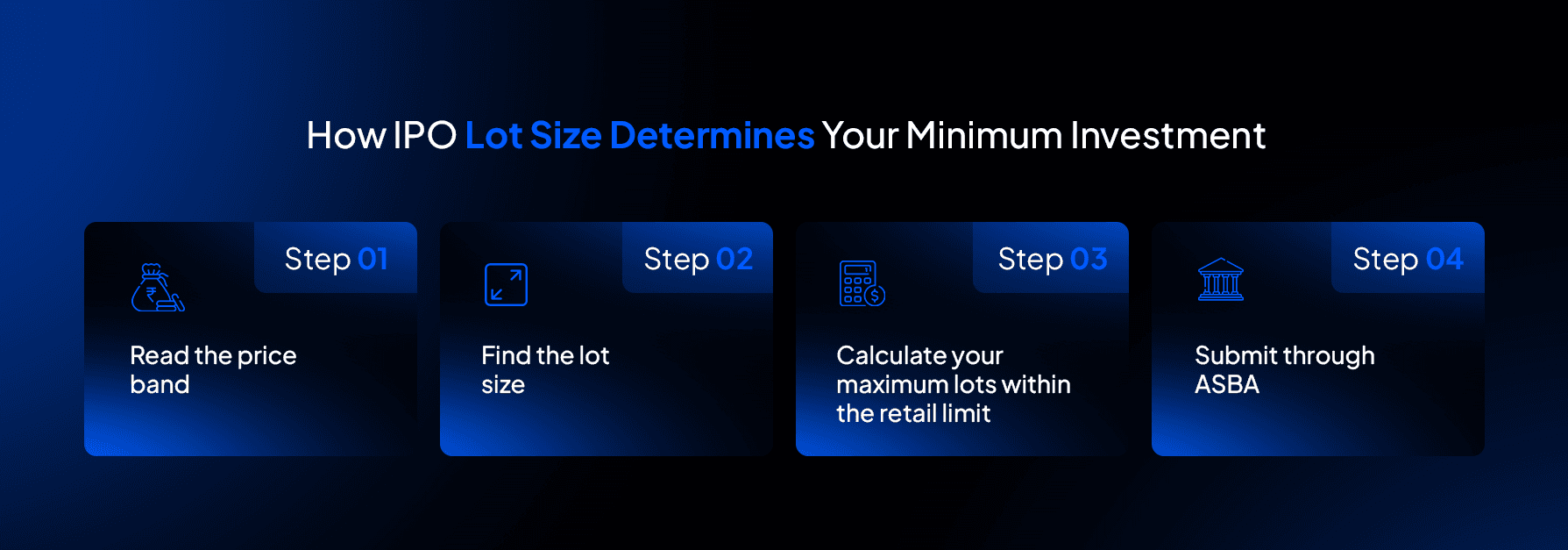
How IPO Lot Size Determines Your Minimum Investment
Lot size calculation follows a clear process. The steps below apply to any Mainboard or SME IPO.
Step 1 - Read the price band Every IPO prospectus states a floor price and a cap price. Retail investors can bid at any price within this band or opt for the cut-off price. For calculation purposes, always use the cap price it reflects the maximum you may pay per share.
Step 2 - Find the lot size The lot size is disclosed in the DRHP and updated Red Herring Prospectus, and if you’re working across multiple filings, automate table extraction helps speed up the review. It is also listed on NSE and BSE IPO pages before the subscription period opens. For instance, a lot size of 56 shares at a cap price of ₹250 means one lot = ₹14,000.
Step 3 - Calculate your maximum lots within the retail limit Divide ₹2,00,000 by the per-lot cost. If one lot is ₹14,000, you can apply for up to 14 lots (₹1,96,000) and remain within the retail category. Applying for 15 lots (₹2,10,000) would move you to the NII category.
Step 4 - Submit through ASBA or UPI The application amount is blocked not debited in your bank account. The debit happens only if shares are allotted. If you do not receive allotment, the funds are unblocked within 6 working days of the allotment date.
This process is consistent across all IPOs. The variable that changes everything is the lot size which is why reading the prospectus before an IPO opens is not optional. Applying without this number is applying without a plan.
What Happens When You Apply at the Minimum?
Most retail investors apply for 1 lot the IPO minimum investment without knowing how allotment actually works. The outcome depends entirely on whether the IPO is oversubscribed and which category it falls into.
In Oversubscribed Mainboard IPOs
When the retail category is oversubscribed, SEBI mandates lottery-based allotment. Every retail applicant - whether they applied for 1 lot or 13 lots has an equal probability of receiving exactly 1 lot. Applying more lots does not increase your chances. In high-demand Mainboard IPOs, applying for 1 lot at the minimum is mathematically the same decision as applying for 14 lots. Both give you one ticket in the same draw.
In Undersubscribed Mainboard IPOs
If the retail portion is not fully subscribed, allotment is proportionate. More lots mean more shares. However, a low subscription level is often a signal worth examining. The demand picture of an IPO is visible through live subscription data published by NSE and BSE throughout the bidding period.
In SME IPOs
SME IPOs use proportionate allotment regardless of subscription level. Applying for the mandatory 2-lot minimum gives you a proportionate share of the available retail allocation. Applying for more lots, within the investment limit, directly increases your allotment share. This makes the minimum-vs-maximum decision more meaningful for SME IPOs than for Mainboard IPOs.
A low minimum does not always mean a smart minimum. Match your application amount to your allotment goal, the IPO type, and your actual liquidity position before the subscription window closes.
Why Should You Choose Ckredence Wealth for IPO Investment Guidance?
IPO participation is one part of a larger wealth-building plan. Your decisions around IPO minimum investment, lot sizing, and investor category need to fit a clear financial strategy not react to each new issue that opens.
What Ckredence Wealth Offers:
SEBI-registered professional guidance (Reg. No. INP000007164) with 37 years of investment management experience
Research-backed IPO evaluation to help you identify quality issues against market noise
Portfolio alignment review ensuring your IPO applications fit your risk profile and long-term goals
Proven Wealth Management Performance:
₹805+ Crores in assets under management across 376+ active clients
Four distinct investment strategies: All Weather, Diversified, Business Cycle, and ICE Growth approaches
Regional presence in Gujarat and Maharashtra with dedicated relationship managers for personalised guidance
IPO investing works best within a planned portfolio approach. Ckredence Wealth helps you connect individual IPO decisions to a broader wealth creation plan—from applying at the right lot size to building a portfolio that grows with discipline and purpose.
Ready to invest with clarity? Schedule a Consultation with Ckredence Wealth today.
Conclusion
The IPO minimum investment in India is not a one-size number. It starts at ₹10,000–₹15,000 for a Mainboard retail lot and goes up to ₹2 lakhs–₹4 lakhs for an SME IPO entry due to the mandatory 2-lot rule. Knowing the lot size before bidding, staying within the ₹2 lakh retail threshold to access lottery-based allotment, and planning your bank liquidity around the ASBA block window are the three decisions that define whether your IPO application is structured or simply reactive.
Beyond the numbers, understanding which investor category your application falls into and how allotment works for each IPO type gives you a clear edge. A Mainboard IPO lottery and an SME proportionate allotment are two very different outcomes from the same act of applying. Getting the IPO minimum investment right is where informed investing in primary markets begins.
FAQs
What is the minimum investment required for a Mainboard IPO in India?
The minimum investment for a Mainboard IPO is typically ₹10,000 to ₹15,000 per lot for retail investors. This equals one lot multiplied by the cap price of the IPO price band. The exact amount varies per IPO based on its lot size and share price.
How is the minimum investment in an SME IPO different from a Mainboard IPO?
SME IPO minimum investment is higher because retail investors must apply for at least 2 lots. One lot in an SME IPO typically costs ₹1 lakh to ₹2 lakhs, making the entry point ₹2 lakhs to ₹4 lakhs. This mandatory 2-lot rule is set by exchange listing norms, not individual company policy.
Does applying for more lots in a Mainboard IPO improve allotment chances?
No, more lots do not improve allotment chances in oversubscribed Mainboard IPOs. SEBI mandates a lottery system where each retail applicant receives a maximum of 1 lot. More lots only matter in undersubscribed issues where allotment is proportionate.
What is the maximum amount a retail investor can apply for in an IPO?
The maximum investment for a retail investor in any IPO is ₹2 lakhs per application. Any amount above ₹2 lakhs classifies you as a Non-Institutional Investor or HNI under SEBI regulations. This limit applies to both Mainboard and SME IPOs.
Introduction
The minimum investment for an IPO in India is not a single fixed number. It depends on the type of IPO - Mainboard or SME and the investor category you fall under. For a Mainboard IPO, the retail minimum is typically ₹10,000 to ₹15,000 per lot, while an SME IPO can require ₹1 lakh to ₹2 lakhs per lot, making the effective entry point ₹2 lakhs to ₹4 lakhs due to the mandatory 2-lot rule.
Does the number of lots you apply for actually improve your allotment chances in a heavily oversubscribed IPO?
If you stay at the retail minimum of ₹2 lakhs, what changes the moment you cross that threshold by even ₹1?
Why do most retail investors apply for the maximum lots allowed and is that actually the right call?
Getting the minimum investment right is not just about meeting the entry bar. It shapes your allotment outcome, your investor category, and how much capital you are tying up through the ASBA block. This article covers the IPO minimum investment structure across both Mainboard and SME IPOs, the SEBI-defined investor categories with their specific limits, and what your application amount actually means for allotment odds.
Key Takeaways
The minimum investment for a Mainboard IPO starts at ₹10,000-₹15,000; for an SME IPO, the entry point is ₹2 lakhs–₹4 lakhs due to the mandatory 2-lot minimum
Applying above ₹2 lakhs in any IPO automatically classifies you as a Non-Institutional Investor (HNI), with different allotment rules than retail investors
Lot size is not uniform, it varies per IPO based on share price, company structure, and SEBI guidelines
In oversubscribed Mainboard IPOs, retail allotment is done by lottery; more lots do not increase your probability of receiving shares
The cut-off price option is available only to retail investors HNIs and NIIs must bid at a specific price within the band
IPO application funds are blocked via ASBA and released within 6 working days if allotment is unsuccessful plan your liquidity accordingly
SME IPO allotment follows a proportionate system, not a lottery, which means more lots directly increase your allotment share
What Is the Minimum Investment for an IPO in India?
The IPO minimum investment in India is determined by SEBI through the ICDR (Issue of Capital and Disclosure Requirements) Regulations. Every IPO whether Mainboard or SME sets a specific lot size. Your minimum investment equals the lot size multiplied by the upper end of the IPO price band.
For example, if an IPO has a lot size of 30 shares and the price band is ₹400–₹450, the minimum investment is 30 × ₹450 = ₹13,500. This amount is not debited from your account immediately it gets blocked via ASBA (Application Supported by Blocked Amount) until the allotment date, which is why many teams prefer tighter workflows around banking document automation.
Why the Lot Size Varies Per IPO

Lot size is not standard across all IPOs. The issuing company, in consultation with its merchant banker, sets the lot size before filing the DRHP (Draft Red Herring Prospectus), and any large-scale review typically benefits from structured document interpretation workflows.
SEBI requires that one lot for retail investors falls within approximately ₹10,000 to ₹15,000 for Mainboard IPOs this keeps the entry accessible for individual investors while maintaining orderly allocation.
Higher-priced shares tend to have smaller lot sizes to maintain affordability. Lower-priced shares have larger lot quantities per lot but stay within the ₹10,000–₹15,000 range. The lot size is disclosed in the prospectus and listed on NSE and BSE IPO pages before bidding opens.
The ₹2 Lakh Retail Cap and What It Means
SEBI has set a clear investment ceiling for retail participation. Retail Individual Investors (RII) can apply for IPO shares worth a maximum of ₹2 lakhs per application. Any application exceeding ₹2 lakhs shifts you into the Non-Institutional Investor (NII) or HNI category with a different allotment process entirely.
The boundary between ₹1.99 lakhs and ₹2.01 lakhs in an IPO application is not just ₹200 it is a complete category shift with different allotment mechanics and bidding rules.
This is the most frequently missed point in IPO investing. Many investors cross the retail limit without knowing the implications and lose access to the lottery-based retail allotment pool.
Mainboard IPO vs. SME IPO: Minimum Investment Compared
Both IPO types use the lot-based system but differ sharply in entry amounts, listing platforms, and allotment methods. SME IPOs serve smaller companies raising capital on BSE SME or NSE Emerge, and their investment structure is built accordingly.
Understanding this comparison is not just academic. It directly decides how much capital you need ready before an IPO opens and which investor pool you belong to.
Parameter | Mainboard IPO | SME IPO |
Minimum per lot | ₹10,000–₹15,000 | ₹1 lakh–₹2 lakhs |
Minimum lots required | 1 lot | 2 lots (mandatory) |
Effective minimum entry | ||
Maximum retail investment | Varies by issue | |
Listing platform | NSE / BSE | NSE Emerge / BSE SME |
Allotment method | Lottery (if oversubscribed) | Proportionate basis |
SEBI document review | SEBI | Stock Exchange |
The mandatory 2-lot minimum in SME IPOs is a rule set at the exchange level. A retail investor cannot apply for just 1 lot in an SME IPO regardless of the lot cost. This makes the SME IPO minimum investment significantly higher than what the per-lot price alone suggests.
The allotment difference is also worth noting. Mainboard IPOs use a lottery for oversubscribed retail applications, while SME IPOs use proportionate allotment. This changes the value of applying for more lots more on this in the next section.
Investor Categories and Their IPO Investment Limits
SEBI divides all IPO applicants into defined categories. Each has a different reservation quota, allotment method, and investment threshold. Knowing which category you belong to before you apply is not optional it is the basis of your entire bidding strategy, especially if you’re tracking applications using automated data extraction.
The three investor categories under SEBI ICDR Regulations are:
1. Retail Individual Investors (RII) Applications up to ₹2 lakhs fall here. Retail investors receive 35% of shares in a book-built Mainboard IPO. In oversubscribed issues, allotment follows a lottery every retail applicant has an equal chance of receiving exactly 1 lot, regardless of how many lots they applied for.
RIIs also have the exclusive option to bid at the cut-off price, meaning they accept whatever final issue price SEBI approves.
2. Non-Institutional Investors (NII) / HNI Applications above ₹2 lakhs fall here. NIIs are further split: small NIIs apply between ₹2 lakhs and ₹10 lakhs; large NIIs apply above ₹10 lakhs.
NIIs receive 15% of shares in Mainboard IPOs and allotment is proportionate a larger application gets a proportionately higher allotment. NIIs cannot use the cut-off price option and must bid at a specific price within the band.
3. Qualified Institutional Buyers (QIB) This category includes mutual funds, insurance companies, foreign portfolio investors, and banks. QIBs receive up to 75% of shares in book-built issues. They apply through designated channels and are not subject to the ₹2 lakh retail cap.
These categories exist to balance IPO participation across small investors and institutional capital. The split between RII and NII is the one that matters most for individual investors crossing the ₹2 lakh limit changes both your allotment odds and your bidding flexibility in ways that are not always in your favour.
How IPO Lot Size Determines Your Minimum Investment
Lot size calculation follows a clear process. The steps below apply to any Mainboard or SME IPO.
Step 1 - Read the price band Every IPO prospectus states a floor price and a cap price. Retail investors can bid at any price within this band or opt for the cut-off price. For calculation purposes, always use the cap price it reflects the maximum you may pay per share.
Step 2 - Find the lot size The lot size is disclosed in the DRHP and updated Red Herring Prospectus, and if you’re working across multiple filings, automate table extraction helps speed up the review. It is also listed on NSE and BSE IPO pages before the subscription period opens. For instance, a lot size of 56 shares at a cap price of ₹250 means one lot = ₹14,000.
Step 3 - Calculate your maximum lots within the retail limit Divide ₹2,00,000 by the per-lot cost. If one lot is ₹14,000, you can apply for up to 14 lots (₹1,96,000) and remain within the retail category. Applying for 15 lots (₹2,10,000) would move you to the NII category.
Step 4 - Submit through ASBA or UPI The application amount is blocked not debited in your bank account. The debit happens only if shares are allotted. If you do not receive allotment, the funds are unblocked within 6 working days of the allotment date.
This process is consistent across all IPOs. The variable that changes everything is the lot size which is why reading the prospectus before an IPO opens is not optional. Applying without this number is applying without a plan.
What Happens When You Apply at the Minimum?
Most retail investors apply for 1 lot the IPO minimum investment without knowing how allotment actually works. The outcome depends entirely on whether the IPO is oversubscribed and which category it falls into.
In Oversubscribed Mainboard IPOs
When the retail category is oversubscribed, SEBI mandates lottery-based allotment. Every retail applicant - whether they applied for 1 lot or 13 lots has an equal probability of receiving exactly 1 lot. Applying more lots does not increase your chances. In high-demand Mainboard IPOs, applying for 1 lot at the minimum is mathematically the same decision as applying for 14 lots. Both give you one ticket in the same draw.
In Undersubscribed Mainboard IPOs
If the retail portion is not fully subscribed, allotment is proportionate. More lots mean more shares. However, a low subscription level is often a signal worth examining. The demand picture of an IPO is visible through live subscription data published by NSE and BSE throughout the bidding period.
In SME IPOs
SME IPOs use proportionate allotment regardless of subscription level. Applying for the mandatory 2-lot minimum gives you a proportionate share of the available retail allocation. Applying for more lots, within the investment limit, directly increases your allotment share. This makes the minimum-vs-maximum decision more meaningful for SME IPOs than for Mainboard IPOs.
A low minimum does not always mean a smart minimum. Match your application amount to your allotment goal, the IPO type, and your actual liquidity position before the subscription window closes.
Why Should You Choose Ckredence Wealth for IPO Investment Guidance?
IPO participation is one part of a larger wealth-building plan. Your decisions around IPO minimum investment, lot sizing, and investor category need to fit a clear financial strategy not react to each new issue that opens.
What Ckredence Wealth Offers:
SEBI-registered professional guidance (Reg. No. INP000007164) with 37 years of investment management experience
Research-backed IPO evaluation to help you identify quality issues against market noise
Portfolio alignment review ensuring your IPO applications fit your risk profile and long-term goals
Proven Wealth Management Performance:
₹805+ Crores in assets under management across 376+ active clients
Four distinct investment strategies: All Weather, Diversified, Business Cycle, and ICE Growth approaches
Regional presence in Gujarat and Maharashtra with dedicated relationship managers for personalised guidance
IPO investing works best within a planned portfolio approach. Ckredence Wealth helps you connect individual IPO decisions to a broader wealth creation plan—from applying at the right lot size to building a portfolio that grows with discipline and purpose.
Ready to invest with clarity? Schedule a Consultation with Ckredence Wealth today.
Conclusion
The IPO minimum investment in India is not a one-size number. It starts at ₹10,000–₹15,000 for a Mainboard retail lot and goes up to ₹2 lakhs–₹4 lakhs for an SME IPO entry due to the mandatory 2-lot rule. Knowing the lot size before bidding, staying within the ₹2 lakh retail threshold to access lottery-based allotment, and planning your bank liquidity around the ASBA block window are the three decisions that define whether your IPO application is structured or simply reactive.
Beyond the numbers, understanding which investor category your application falls into and how allotment works for each IPO type gives you a clear edge. A Mainboard IPO lottery and an SME proportionate allotment are two very different outcomes from the same act of applying. Getting the IPO minimum investment right is where informed investing in primary markets begins.
FAQs
What is the minimum investment required for a Mainboard IPO in India?
The minimum investment for a Mainboard IPO is typically ₹10,000 to ₹15,000 per lot for retail investors. This equals one lot multiplied by the cap price of the IPO price band. The exact amount varies per IPO based on its lot size and share price.
How is the minimum investment in an SME IPO different from a Mainboard IPO?
SME IPO minimum investment is higher because retail investors must apply for at least 2 lots. One lot in an SME IPO typically costs ₹1 lakh to ₹2 lakhs, making the entry point ₹2 lakhs to ₹4 lakhs. This mandatory 2-lot rule is set by exchange listing norms, not individual company policy.
Does applying for more lots in a Mainboard IPO improve allotment chances?
No, more lots do not improve allotment chances in oversubscribed Mainboard IPOs. SEBI mandates a lottery system where each retail applicant receives a maximum of 1 lot. More lots only matter in undersubscribed issues where allotment is proportionate.
What is the maximum amount a retail investor can apply for in an IPO?
The maximum investment for a retail investor in any IPO is ₹2 lakhs per application. Any amount above ₹2 lakhs classifies you as a Non-Institutional Investor or HNI under SEBI regulations. This limit applies to both Mainboard and SME IPOs.