
AIF Taxation in India: Rules, Rates & Investor Guide 2026
Complete guide on AIF taxation in India. Learn Category I, II, III tax rules, rates, TDS, LTCG/STCG treatment, and investor compliance

Ckredence Wealth |January 29, 2026

Alternative Investment Funds represent a ₹15.05 lakh crore opportunity in India as of September 2025, according to SEBI's official data. The AIF industry has witnessed remarkable growth, with total commitments jumping from ₹12.43 lakh crore in September 2024 to ₹15.05 lakh crore in September 2025, representing a year-on-year growth of over 21%. High-net-worth individuals are moving capital into AIFs for better returns and portfolio flexibility. Yet taxation decides your actual gains.
The Income Tax Act treats each AIF category differently. Category I and II investors face pass-through taxation where income lands in their hands. Category III funds pay tax at fund level before distributing returns. This difference changes your post-tax returns by 15-20% annually.
Budget 2024 brought major changes to capital gains. Long-term gains now attract 12.5% tax without indexation. Short-term equity gains jumped to 20% from 15%. These updates affect how AIF income flows to your bank account.
- Are you losing 30-40% of AIF returns to incorrect tax planning?
- Do you know which AIF category saves more tax based on your income slab?
- Can you claim the right deductions and avoid double taxation on distributions?
This guide breaks down AIF taxation rules for 2026. We cover Category-wise treatment, capital gains, TDS implications, and compliance steps. You'll learn how to choose tax-efficient AIFs and maximize your wealth growth through smart structuring.
Key Takeaways
- Category I and II AIFs follow pass-through taxation, meaning income is taxed directly in investor hands at applicable rates while Category III funds pay tax at fund level before distribution.
- Long-term capital gains from AIFs attract 12.5% tax post-July 2024 changes, with no indexation benefit for new investments under revised Budget provisions.
- TDS on AIF distributions is 10% for resident investors and varies for NRIs based on income type and applicable DTAA provisions.
- Business income generated by Category I and II AIFs gets taxed at fund level, not in investor hands, making income classification important for tax planning.
- Investors must report pass-through income in ITR with proper documentation including Form 64C from fund managers to claim TDS credits and avoid compliance penalties.
- NRI investors can reduce tax burden through DTAA benefits by submitting valid Tax Residency Certificate and Form 10F to fund managers before distributions.
- Choosing the right AIF category based on your tax slab and investment goals can improve post-tax returns by 15-20% annually for HNI portfolios.
Understanding AIF Taxation Framework in India
AIFs operate under SEBI regulations but tax treatment depends on fund category. The Income Tax Act divides taxation into two models: pass-through and fund-level.
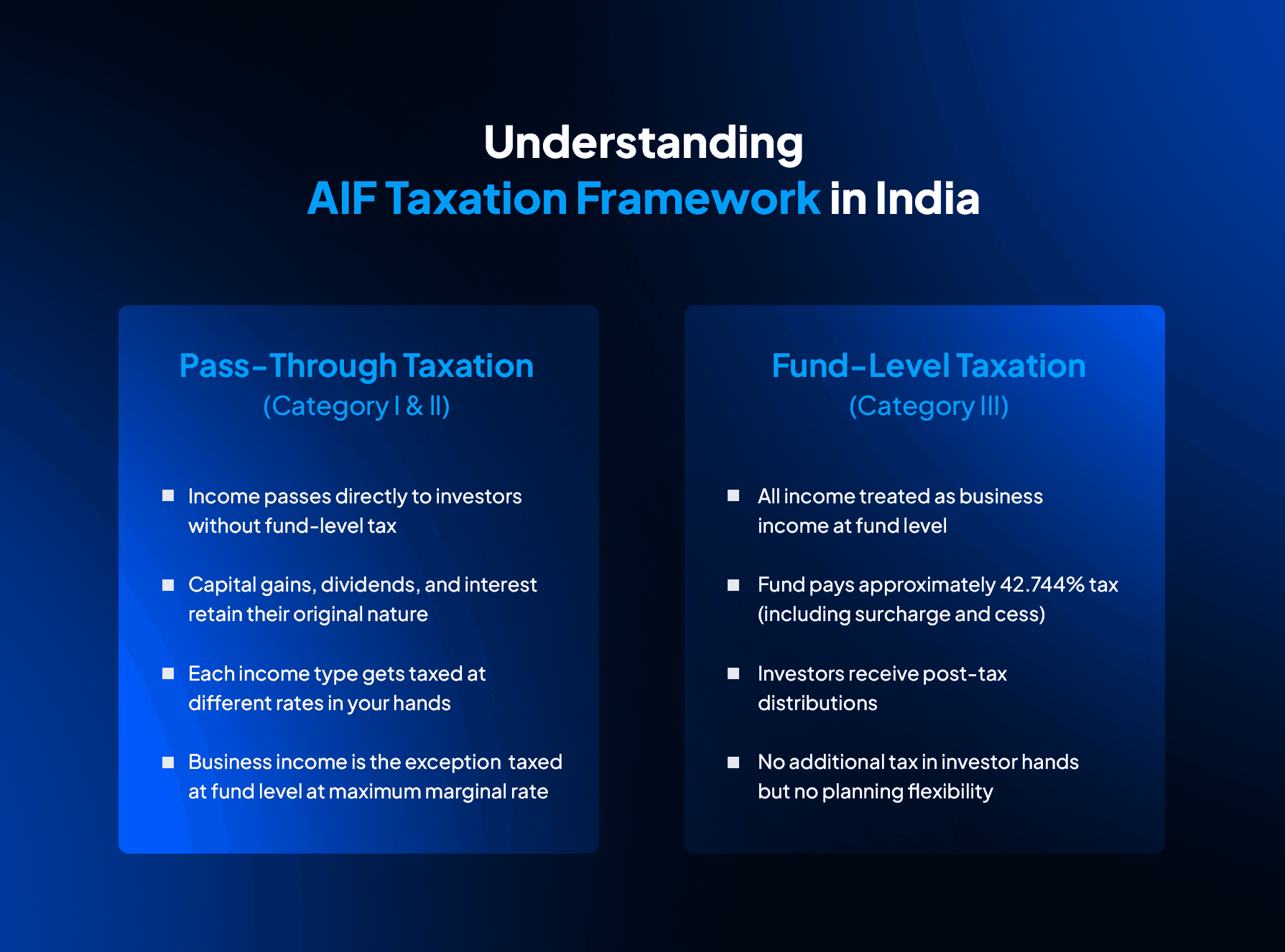
Pass-Through Taxation (Category I & II)
Category I and II AIFs get special treatment under Section 115UB:
- Income passes directly to investors without fund-level tax
- Capital gains, dividends, and interest retain their original nature
- Each income type gets taxed at different rates in your hands
- Business income is the exception - taxed at fund level at maximum marginal rate
Fund-Level Taxation (Category III)
Category III AIFs operate differently:
- All income treated as business income at fund level
- Fund pays approximately 42.744% tax (30% base rate + 37% surcharge + 4% cess on trusts)
- Investors receive post-tax distributions
- No additional tax in investor hands but no planning flexibility
Critical Documentation
Forms You'll Receive:
- Form 64C - Shows income distributed and TDS deducted (for investors)
- Form 64D - Filed by AIF with tax authorities (by June 15 annually)
Missing documentation leads to notices and potential penalties. Keep all forms for ITR filing and TDS credit claims.
Recent Regulatory Updates (2024-2025)
SEBI has introduced several changes to strengthen the AIF ecosystem:
1. Dematerialization Mandate (Effective October 1, 2024):
All AIF investments made after October 1, 2024 must be held in dematerialized form. This:
- Streamlines ownership tracking
- Reduces operational errors
- Enhances regulatory oversight
- Facilitates easier transfers
Exception: AIF schemes with tenure ending on or before January 31, 2025, or those already in extended tenure, are exempted.
2. Mandatory Custodian Requirement:
All new AIF schemes must appoint a custodian before making their first investment, regardless of fund corpus size. Previously, this applied only to:
- Category I & II AIFs with corpus >₹500 crore
- All Category III AIFs
This change improves custodial oversight and investor protection.
AIF Investment Landscape in India
According to SEBI data as of September 2025, AIFs have deployed capital across diverse sectors:
Top 10 Sectors by AIF Investments:
- Real Estate: ₹73,356 crore (17% of total investments)
- Financial Services: ₹51,388 crore
- IT/ITes: ₹35,997 crore
- NBFCs: ₹30,748 crore
- Banks: ₹25,287 crore
- Pharmaceuticals: ₹22,581 crore
- Insurance: ₹15,062 crore
- Health Care Providers & Services: ₹14,228 crore
- Automobiles: ₹12,913 crore
- Others: ₹3,30,379 crore
This sectoral diversification demonstrates AIFs' role in funding critical sectors of the Indian economy, from infrastructure to innovation.
Category I and II AIF Taxation Rules
Category I and II AIFs share the same tax structure using pass-through model. These include venture capital funds, private equity funds, real estate funds, and debt funds.
Capital Gains Taxation (Post-Budget 2024)
Long-Term Capital Gains:
- Assets held over 12 months attract 12.5% tax
- No indexation benefit from July 23, 2024
- Listed equity gets ₹1.25 lakh exemption per year
- Unlisted equity and other assets have no exemption
Short-Term Capital Gains:
- Listed equity with STT: 20% tax under Section 111A
- Other short-term gains: Your applicable slab rate
Transitional Relief (For Properties Purchased Before July 23, 2024):
For immovable property purchased before July 23, 2024 and sold by resident individuals and HUFs, you can choose the lower tax between:
- New rule: 12.5% without indexation
- Old rule: 20% with indexation
Important: Properties purchased after July 23, 2024 are subject to 12.5% LTCG without indexation only.
Source: Budget 2024 Capital Gains Changes
Other Income Types
Dividends and Interest:
- Added to your total income
- Taxed at your slab rate (up to 30% plus surcharge and cess)
Business Income:
- Taxed at fund level at maximum marginal rate (~42.744% for trusts)
- Only net amounts distributed to investors
TDS Rules Under Section 194LBB
For Resident Investors:
- AIF deducts 10% TDS on distributions under Section 194LBB
- Claim credit when filing ITR
- Pay advance tax if total liability exceeds ₹10,000
For Non-Resident Investors:
- TDS at rates prescribed in Income Tax Act
- Lower rates possible through DTAA
- Submit Tax Residency Certificate and Form 10F for reduced TDS
- Must file ITR in India if income exceeds basic exemption
Category III AIF Taxation Explained
Category III AIFs include hedge funds and complex trading strategies. Tax treatment differs completely from Category I and II.
How Fund-Level Taxation Works
Key Features:
- All income classified as business income
- No preferential capital gains treatment
- Fund pays ~42.744% effective rate (30% base + 37% surcharge + 4% cess)
- Investors receive only post-tax distributions
Tax Comparison Example:
Category III AIF earning ₹100 profit:
- Fund pays ₹42.74 tax
- Investors receive ₹57.26
- Effective burden: 42.74%
Category II AIF with same ₹100 (investor in 30% slab):
Fund pays zero tax
Investor pays ₹30 tax
Investor receives ₹70
Effective burden: 30%
The 12.74% difference matters significantly for large investments.
Investor Compliance
What You Need to Do:
Report distributions in ITR under "income from other sources"
Claim exemption by noting tax paid at fund level
Maintain investment documents and annual statements
Simple reporting - no complex income classification needed
Category III makes sense when investment strategy overcomes higher tax drag. The fund manager handles all tax complexity.
Tax Compliance and Filing Requirements for AIF Investors
Proper compliance protects you from penalties and ensures smooth refunds. AIF investments create specific reporting obligations.

Essential Documents to Maintain
Core Records:
- Subscription agreement and capital call notices
- Form 64C (annual income and TDS statement from AIF)
- Distribution statements and bank confirmations
- Investment certificates and unit allotments
- Quarterly portfolio statements
For Category I & II Additional:
- Original investment certificates for capital gains calculation
- Valuation reports for unlisted securities
- Fund expense notices
ITR Filing Steps for Residents
Choosing ITR Form:
ITR-2: For capital gains and investment income
ITR-3: If you have business income
Reporting Pass-Through Income (Category I & II):
- Capital gains → Schedule CG (separate short-term and long-term)
- Interest income → Schedule OS under "interest on securities"
- Dividends → Schedule OS under dividend section
- Business income → Report as per Form 64C
TDS Credit Claims:
- Match Form 64C with Form 26AS
- Verify deductor PAN accuracy
- Enter all TDS in taxes paid section
Advance Tax Payment:
If tax liability after TDS exceeds ₹10,000, pay in four instalments: June 15, September 15, December 15, March 15
NRI Investor Compliance
Filing Requirements:
- File ITR if total income exceeds ₹2.5 lakh
- Use ITR-2 or ITR-3 based on income sources
DTAA Benefit Process:
● Obtain Tax Residency Certificate from resident country
● Submit TRC with Form 10F to AIF before distribution
● Claim refund in ITR if standard TDS was deducted
Repatriation Steps:
Step 1: Use NRE or NRO account per fund structure
Step 2: Submit Form 15CA and 15CB for amounts above ₹5 lakh
Step 3: Obtain CA certification on tax payment
Common Filing Mistakes to Avoid
- Never omit AIF income assuming distributions are tax-free
- Don't mix short-term and long-term capital gains classifications
- Avoid claiming indexation on post-July 23, 2024 investments
- Double-check TDS credit entries against Form 26AS
- Report even Category III distributions for proper disclosure
Tax Planning Strategies for AIF Investors
Smart structuring reduces tax liability without changing investment strategy. High-net-worth individuals can save 15-20% through proper planning.
Choosing the Right Category
For Lower Tax Brackets (20% or below):
● Category I and II work better with pass-through taxation
● You pay at your actual rate instead of fund's 42.744%
● Example: ₹1 crore investment at 15% return
- ○ Category III delivers ₹8.58 lakh post-tax
- ○ Category II delivers ₹12 lakh (20% bracket)
- ○ Difference: ₹3.42 lakh annually
For High-Income Earners (30% plus surcharge):
- Your effective rate reaches ~42.744% (same as Category III)
- Category III offers simpler compliance
- No advance tax calculations or loss tracking needed
Timing Strategies
Exit Planning:
- Time exits during low-income years (like post-retirement)
- Use capital loss set-offs from other investments
- Plan equity sales around AIF distribution cycles
Loss Set-Off Rules:
- Long-term losses offset only long-term gains
- Short-term losses offset both types
- Carry forward unused losses for 8 years
NRI Tax Optimization
DTAA Benefits:
- Check country-specific treaty provisions
- Submit TRC and Form 10F early for lower TDS
- Time residency changes around distribution dates
Family Structuring
Income Splitting:
- Gift capital to family members in lower brackets before investing
- Use proper gift deeds and separate bank accounts
- HUF investments create additional tax layer for planning
Portfolio Mix Strategy
Efficient Allocation:
- Use Category II for long-term equity (12.5% LTCG)
- Use Category III for complex trading strategies
- Balance with direct equity and debt mutual funds
Annual Review:
- Schedule February review with tax advisor
- Calculate projected income including AIF distributions
- Adjust advance tax payments accordingly
- Obtain Form 64C by May for timely ITR filing
Why Should You Choose Ckredence Wealth for AIF Investments?
High-net-worth individuals need partners who understand both investment strategy and tax efficiency. Your AIF selection should consider post-tax returns, not just gross performance.
Ckredence Wealth brings 37 years of experience managing ₹805+ crores for 376+ active clients. Our SEBI-registered expertise helps you choose AIF categories matching your tax profile.
Our Tax-Efficient Approach:
- Pre-investment analysis comparing post-tax returns across categories
- Annual planning reviews considering distributions and portfolio
- Coordination with your CA for optimal ITR filing
- DTAA guidance for NRI investors
Key Capabilities:
- Curated AIF opportunities across all three categories
- Risk-adjusted construction considering tax implications
- Transparent reporting for easy compliance
- Dedicated support across Gujarat and Maharashtra
Smart investors know net returns matter most. We help you build wealth through strategies matching your risk profile and income situation.
Ready to optimize your AIF investments? Schedule a Consultation with our wealth advisors today.
Conclusion
AIF taxation determines your actual investment returns. Category I and II offer pass-through flexibility where income reaches your hands at applicable rates. Category III provides simplicity with fund-level taxation but removes individual tax planning control. Budget 2024 changes brought 12.5% LTCG and 20% STCG rates that affect your net gains.
Choose AIF categories matching your tax profile. Review distributions annually with your advisor. Maintain complete documentation for compliance. Time your entries and exits considering your income pattern. Your wealth grows faster when tax efficiency meets investment strategy.
FAQs
How does AIF taxation differ from mutual fund taxation in India?
AIFs follow pass-through or fund-level taxation based on category. Mutual funds always pass through to investors. AIF Category III pays tax at fund level unlike any mutual fund structure. This creates different post-tax returns for similar gross performance.
What is the minimum investment required for tax-efficient AIF planning?
The minimum investment for most AIFs is ₹1 crore as per SEBI regulations, with exceptions of ₹25 lakh for employees/directors of fund managers or sponsors. Tax efficiency improves with higher amounts due to fixed compliance costs. Investors should evaluate post-tax returns considering their income slab and investment size before committing capital.
Can NRI investors claim DTAA benefits on AIF distributions in India?
Yes, NRI investors can claim DTAA benefits on AIF income. You must submit Tax Residency Certificate and Form 10F to the fund manager before distribution. Treaty provisions override Indian tax rates when beneficial. Proper documentation ensures lower TDS deduction at source.
Are AIF investments eligible for Section 54 capital gains exemption benefits?
Some real estate AIF capital gains may qualify for Section 54 exemption if you invest proceeds in residential property. Category I and II pass-through gains retain their nature making exemptions possible. Check specific fund structure and income classification before claiming benefit in ITR.